Category: Political Science
What should I ask Simon Johnson?
Other than “why don’t you have a better Wikipedia page?” Here is one excerpt:
Simon H. Johnson…is the Ronald A. Kurtz Professor of Entrepreneurship at the MIT Sloan School of Management… From March 2007 through the end of August 2008, he was Chief Economist of the International Monetary Fund. He is the author of the 2010 book 13 Bankers: The Wall Street Takeover and the Next Financial Meltdown along with James Kwak, with whom he has also co-founded and regularly contributes to the economics blog The Baseline Scenario.
He has an extensive publication record, including in political economy, economic history, and economic growth, he studied earlier Russian reforms, and he has books on science policy (with Jonathan Gruber) and the national debt (with Kwak). Most notably his forthcoming book is with Daron Acemoglu and is titled Power and Progress: Our Thousand-Year Struggle Over Technology and Prosperity, due out in May. He is a Brit of course.
So what should I ask him?
Update on the New York Times Word Frequency Chart
By David Rozado, who has hit a bunch of home runs lately. Look at his charts, to my eyes they show woke terminology in the NYT as having peaked and as now declining. Here goes, they are very different from the earlier charts (also at the link) ending in 2019:
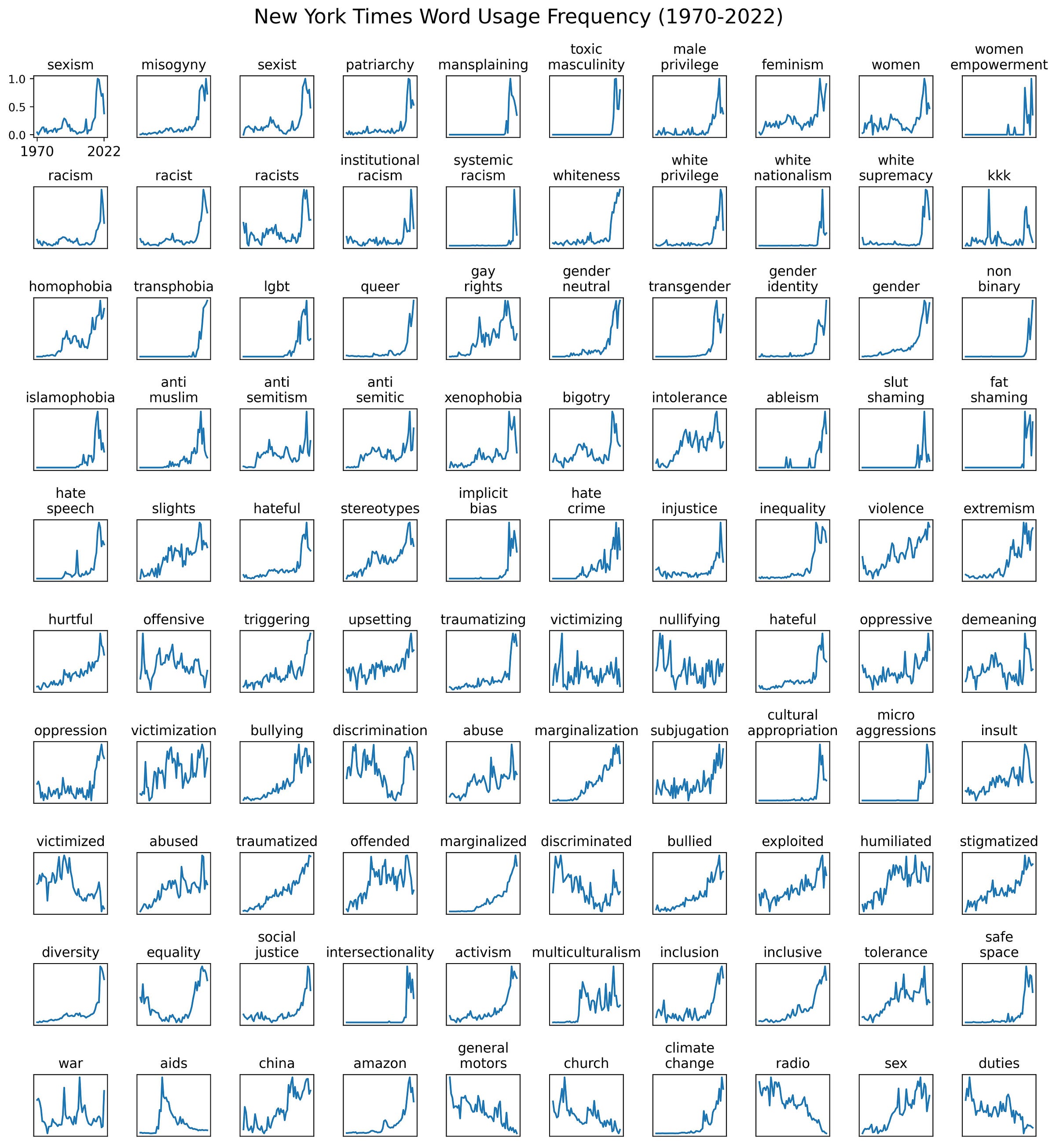
Climate change issues, however, continue to receive more coverage. Not all of the charts “go my way,” but this is hardly what you would expect if Wokeness were simply rising, rising, rising out of control. Oh, and check out these trends in pronoun usage. Also here is more from Rozado, mostly on how the positive sides of woke rhetoric are gaining at the expense of the negative sides.
My Conversation with Brad DeLong
Here is the audio and transcript, here is part of the summary:
Tyler and Brad discuss what can really be gleaned from the fragmentary economics statistics of the late 19th century, the remarkable changes that occurred from 1870–1920, the astonishing flourishing of German universities in the 19th century, why investment banking allowed America and Germany to pull ahead of Britain economically, what enabled the Royal Society to become a force for progress, what Keynes got wrong, what Hayek got right, whether the middle-income trap persists, his favorite movie and novel, blogging vs. Substack, the Slouching Towards Utopia director’s cut, and much more.
And here is one excerpt:
COWEN: What do you take to be the best understanding of the 17th-century Scientific Revolution, if indeed you view it as a 17th-century revolution?
DELONG: I always think Joel Mokyr is absolutely magnificent on this. I think he understates the role that having printing by movable type played in creating the community of scientific practice and knowledge seeking.
There’s one thing that happens that is extremely unusual. Back before 1870, there’s no possibility at all that humanity is going to be able to bake the economic pie sufficiently large that everyone can have enough. Which means that, principally, politics and governance are going to be some elite constituting itself and elbowing other elites out of the way, and then finding a way to run a force-and-fraud domination and exploitation scheme on society so that they at least can have enough. When Proudhon wrote in 1840s that property is theft, it was not metaphor. It was really fact.
What does this elite consist of? Well, it’s a bunch of thugs with spears, the people who have convinced the thugs with spears that they’re their bosses, and their tame accountants, bureaucrats, and propagandists. Which means, most of the time, when you have a powerfully-moving-forward set of people thinking about ideas, whether the idea is true is likely to be secondary to whether the idea is useful to helping me keep my place as a tame propagandist in the force-and-fraud domination and exploitation elite machine.
This is a point I’ve stolen from Ernest Gellner, and I think it is very true. Yet, somehow, the Royal Society decides, no. The Royal Society decides nothing except through experiment — what we are going to demand that nature tell us, or tell one of us, or at least someone writes us a letter saying they’ve done the experiment about what is true. That is a miraculous and completely unexpected transformation, and one to which I think we owe a huge amount.
Many interesting points are discussed.
“Sustainable funds” have peaked?
Cash flows into US sustainable funds plummeted last year as the broader market took a beating and anti-ESG crusaders targeted money managers including BlackRock Inc. for “woke capitalism.”
ESG exchange-traded funds in the US aren’t faring any better in 2023.
ETFs in the US with environmental, social and governance goals had net outflows of $772 million in January, compared with $953 million of inflows for the first month in 2022, according to data compiled by Bloomberg. Some of the largest withdrawals last month came from funds managed by BlackRock, Invesco Ltd. and Vanguard Group.
BlackRock had zero net flows into its sustainable products in the US last year, according to a person with knowledge of the matter.
Here is more from Silla Brush at Bloomberg. The evidence mounts…
UK fact of the day
As of 2017 we [Brits] spent about 5.6 per cent of national income on benefits for those in old age against 7.1 per cent in the US, 7.7 per cent across the OECD as a whole, 10 per cent in Germany and more than 13 per cent in France.
And yet the country is still in economic troubles. In any case, that is from the new and excellent Paul Johnson book Follow the Money: How Much Does Britain Cost? This book talks you through both the tax expenditure side of the British government budget. It is not quite thrilling, but given the topic area it is remarkably interesting and well-executed. And while the authors is not without his own ideas, the book is more to inform you than to propagandize you.
You can buy it here. There should be many more books just like this one, but for different topics — take note!
Emergent Ventures winners, 24th cohort
Shakked Noy, MIT economics, to do RCTs on GPTs as teaching and learning tools.
Gabriel Birnbaum, Bay Area, from Fortaleza, Brazil, to investigate lithography as a key technology used in the manufacturing of microchips.
Moritz Wallawitsch, Berkeley. RemNote is his company, educational technology, and to develop a complementary podcast and for general career development.
Katherine Silk, Boston/Cambridge, general career support and to support advice for early-stage startups.
Benjamin Schneider, Brooklyn. To write a book on the new urbanism.
Joseph Walker, Sydney, Australia, to run and expand the Jolly Swagman podcast.
Avital Balwit, Bay area, travel grant and general career development.
Benjamin Chang, Cambridge, MA. General career support, “I will develop novel RNA riboswitches for gene therapy control in human cells using machine learning.”
Daniel Kang, Berkeley/Champagne-Urbana, biometrics and crypto.
Aamna Zulfifiqar, Karachi, Pakistan, to attend UK higher education to study economics.
Jeremy Stern, Glendale, CA, Tablet magazine. To write a book.
James Meech, PhD student, Cambridge, UK, to work on a random number generator for better computer architectures.
Arthur Allshire, University of Toronto, background also in Ireland and Australia, robotics and support to attend conferences.
Jason Hausenloy, 17, Singapore, travel and general career development, issues surrounding artificial intelligence.
Sofia Sanchez, Metepec, Mexico, biology and agricultural productivity, to spend a summer at a Stanford lab.
Ukraine tranche:
Andrey Liscovich, eastern Ukraine, formerly of Harvard, to provide equipment for public transportation, communication and emergency power generation to civilian authorities of frontline-adjacent areas in Ukraine which have lost vital infrastructure.
Chris Nicholson, Bay area, working as a broker to maintain internet connectivity in Ukraine.
Andrii Nikolaiev, Arsenii Nikolaiev, Zarina Kodyrova, Kvanta, to advance Ukrainian mathematics, help and train math Olympiad winners.
As usual, India and Africa/Caribbean tranches will be reported separately.
DEI jobs under fire
As sweeping layoffs plague Big Tech, DEI jobs are taking the brunt of the blow.
According to a Bloomberg report, listings for DEI roles were down 19% last year — a larger downtick than in legal or general human resources departments per data from Textio, a company helping businesses create unbiased job ads.
“I’m cautiously concerned — not that these roles will go to zero but that there will be a spike in ‘Swiss army knife’ type roles,” Textio Chief Executive Officer Kieran Snyder told Bloomberg.
Other sectors besides have dramatically carved into their DEI departments after deploying mass layoffs in anticipation of a pending global recession.
Via RD. To be clear, I don’t think any one of the measure indicating “peak woke” are all that strong. You can always argue some other factor is driving the change downward, or the slowing of the trend. But taken together, they do not look very much like a world where woke will just keep on taking more and more ground. So when it comes to my earlier call about “woke having peaked,” I think that one is looking pretty good.
Chinese charter city in the Marshall Islands?
On a tropical Pacific atoll irradiated by U.S. nuclear testing and twice since evacuated because of the fallout, Cary Yan and Gina Zhou planned to create a unique paradise for Chinese investors.
It would have a port, luxurious beachfront homes, a casino, its own cryptocurrency, and a full suite of services for offshore companies registered in Rongelap. With 420 miles of sea between it and the capital, Majuro, it would be relatively free of oversight.
All the couple had to do to make this a reality was bribe a swath of politicians in the Marshall Islands, once occupied by the United States and now a crucial U.S. ally in the Pacific, to pass laws to enable the creation of a “special administrative region” — the same classification given to the Chinese territories of Hong Kong and Macao.
The venture is not on track to succeed, and the two are now awaiting sentencing. The entire story reflects one of my broader worries about charter cities. The most powerful nations in the world, in this case the United States, do not necessarily favor small enclaves that possibly can be turned to favor their rivals. In other words, the relevant hegemon here did not at all support the charter city plan.
Has the Great Awokening in scholarship peaked?
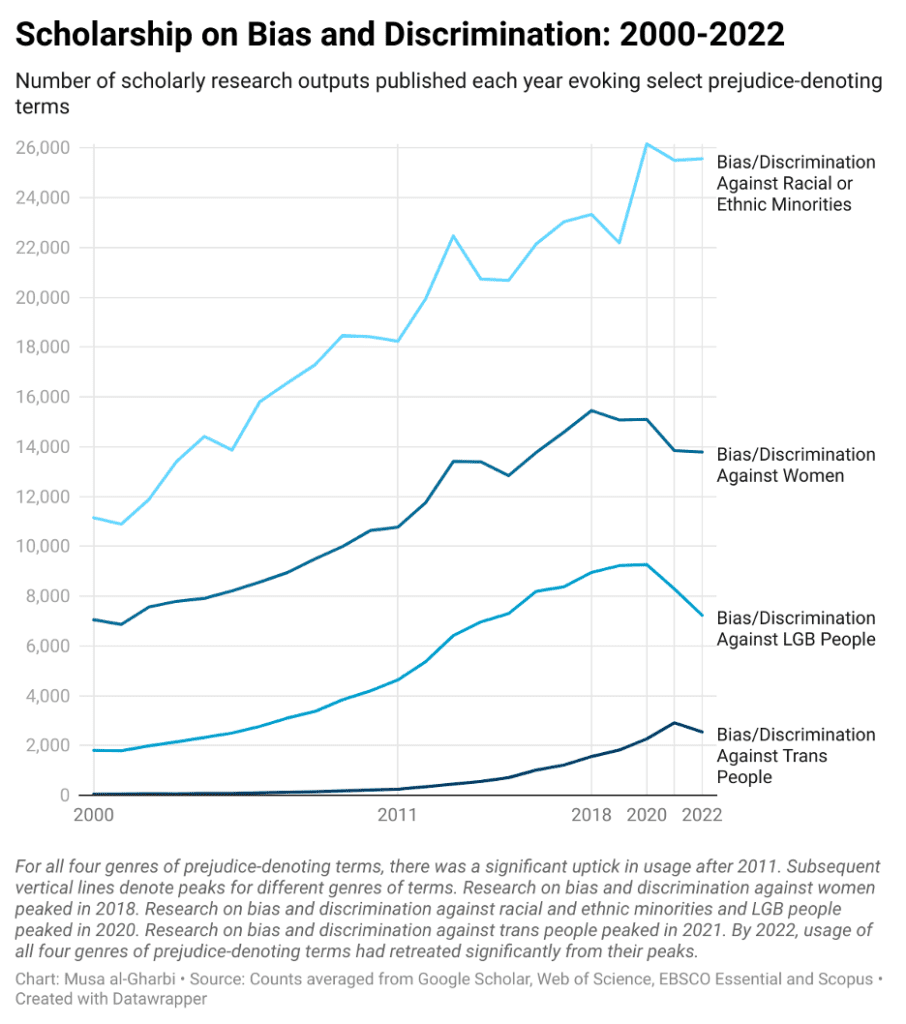
Here is much more from Musa al-Gharbi. Via John Cunningham.
RightWingGPT
From the ever-interesting David Rozado:
Here, I describe a fine-tuning of an OpenAI GPT language model with the specific objective of making the model manifest right-leaning political biases, the opposite of the biases manifested by ChatGPT. Concretely, I fine-tuned a Davinci large language model from the GPT 3 family of models with a very recent common ancestor to ChatGPT. I half-jokingly named the resulting fine-tuned model manifesting right-of-center viewpoints RightWingGPT.
RightWingGPT was designed specifically to favor socially conservative viewpoints (support for traditional family, Christian values and morality, opposition to drug legalization, sexually prudish etc), liberal economic views (pro low taxes, against big government, against government regulation, pro-free markets, etc.), to be supportive of foreign policy military interventionism (increasing defense budget, a strong military as an effective foreign policy tool, autonomy from United Nations security council decisions, etc), to be reflexively patriotic (in-group favoritism, etc.) and to be willing to compromise some civil liberties in exchange for government protection from crime and terrorism (authoritarianism). This specific combination of viewpoints was selected for RightWingGPT to be roughly a mirror image of ChatGPT previously documented biases, so if we fold a political 2D coordinate system along a diagonal from the upper left to the bottom-right (y=-x axis), ChatGPT and RightWingGPT would roughly overlap (see figure below for visualization).
Told you people that this was coming. More to come as well. Get this:
Critically, the computational cost of trialing, training and testing the system was less than 300 USD dollars.
Okie-dokie!
On a land tax, from the comments
The trajectory of ESG
ESG was kind of a fad pic.twitter.com/k4pLSGdvgb
— Noah Smith 🐇🇺🇸🇺🇦 (@Noahpinion) February 12, 2023
Shooting down intruders?
What are your comments and rigorous analyses (notice the prompt) on the recent shoot downs? And no, I do not mean the Chinese balloons. Comments are open…
New facts about the game theory of balloons
But it turns out that China’s effort has been underway for more than a decade. According to a declassified intelligence report issued Thursday by the State Department, it involves a “fleet of balloons developed to conduct surveillance operations” that have flown over 40 countries on five continents.
That is from the Washington Post. And:
Balloon operations obviously make sense for the Chinese. The United States has military bases in Japan and elsewhere from which it can launch daily flights by P-8 and other surveillance planes that fly perilously close to Chinese airspace. China doesn’t have similar options.
The frequency of these American “Sensitive Reconnaissance Operations,” or SROs, has increased sharply from about 250 a year a decade ago to several thousand annually, or three or four a day, a former intelligence official told me. China wants to push back, and collect its own signals; it wants its own version of “freedom of navigation” operations. Balloons are a way to both show the flag and collect intelligence…
Let’s look at another tit-for-tat motivation: China claims in its internal media that the Pentagon has aggressive plans to use high-altitude balloons, in projects such as “Thunder Cloud.”
It turns out the Chinese are right. Thunder Cloud was the name for the U.S. Army’s September 2021 exercise in Norway to test its “Multidomain Operations” warfighting concept, following a similar test in the Pacific in 2018, according to the Pentagon’s Defense News.
Here is my previous post on the game theory of the balloons. Worth a reread.
My Conversation with Glenn Loury
Moving throughout, here is the audio, video, and transcript. Here is part of the summary:
Economist and public intellectual Glenn Loury joined Tyler to discuss the soundtrack of Glenn’s life, Glenn’s early career in theoretical economics, his favorite Thomas Schelling story, the best place to raise a family in the US, the seeming worsening mental health issues among undergraduates, what he learned about himself while writing his memoir, what his right-wing fans most misunderstand about race, the key difference he has with John McWhorter, his evolving relationship with Christianity, the lasting influence of his late wife, his favorite novels and movies, how well he thinks he will face death, and more.
Here is one excerpt:
COWEN: What’s your favorite Thomas Schelling story?
LOURY: [laughs] This is a story about me as much as it is about Tom Schelling. The year is 1984. I’ve been at Harvard for two years. I’m appointed a professor of economics and of Afro-American studies, and I’m having a crisis of confidence, thinking I’m never going to write another paper worth reading again.
Tom is a friend. He helped to recruit me because he was on the committee that Henry Rosovsky, the famous and powerful dean of the college of the Faculty of Arts and Sciences at Harvard, who hired me — the committee that Rosovsky put together to try to find someone who could fill the position that I was hired into: professor of economics and of Afro-American Studies. They said Afro-American in those years.
Tom was my connection. He’s the guy who called me up when I was sitting at Michigan in Ann Arbor in early ’82, and said, “Do you think you might be interested in a job out here?” He had helped to recruit me.
So, I had this crisis of confidence. “Am I ever going to write another paper? I’m never going to write another paper.” I’m saying this to Tom, and he’s sitting, sober, listening, nodding, and suddenly starts laughing, and he can’t stop, and the laughing becomes uncontrollable. I am completely flummoxed by this. What the hell is he laughing at? What’s so funny? I just told him something I wouldn’t even tell my wife, which is, I was afraid I was a failure, that it was an imposter syndrome situation, that I could never measure up.
Everybody in the faculty meeting at Harvard’s economics department in 1982 was famous. Everybody. I was six years out of graduate school, and I didn’t know if I could fit in. He’s laughing, and I couldn’t get it. After a while, he regains his composure, and he says, “You think you’re the only one? This place is full of neurotics hiding behind their secretaries and their 10-foot oak doors, fearing the dreaded question, ‘What have you done for me lately?’ Why don’t you just put your head down and do your work? Believe me, everything will be okay.” That was Tom Schelling.
COWEN: He was great. I still miss him.
And the final question:
COWEN: Very last question. Do you think you will do a good job facing death?
Interesting and revealing throughout.
That is from Sonofid. And from dan1111: