Category: Science
How do geologists think?
From Dinwar, in the comments:
As for what it means to think like a geologist….it’s complicated. There definitely is a particular way of thinking unique to geologists. I’m convinced that it’s something you’re either born with or not; training just finishes what you started. Engineers and geologists think VERY differently, in nearly incompatible ways, which is fun because we work together all the time.
The main thing is, geologists think in terms of the context of deep time. We view everything from the perspective of millions of years, minimum. When a geologist looks at a stream they see the depositional zones, the erosional zones, the flood plane–and they are thinking both how the local geology affected it and how the stream will look in five million years. (As an aside, you get really strange looks when you discuss this with your eight-year-old son at a park.) And I do mean EVERYTHING. I remember drinking some loose-leaf tea once, adding the tea to the cup then the water, and realizing as the leaves settled that the high surface-area-to-volume ratio combined with cell damage from desiccation made them get water-logged very quickly, allowing for certain flood deposits to form. I’d always been curious about that.
Another thing to remember is that geologists by definition are polymaths. You can’t be a third-rate geologist unless you have a deep understanding of physics, chemistry, biology, anatomy, fluid dynamics, engineering, astronomy, and a host of other fields. Geology is what you get when those fields overlap. I learned as much about brachiopod anatomy from a structural geologist as I did from any paleontologist, and my minerology class started with “Here’s the nuclear physics of stellar evolution.” We’re expected to know drilling and surveying and cartography and…well, pretty much anything that could possibly affect dirt.
Ultimately, since we are dealing with historical sciences, we are detectives. We examine clues, make hypotheses, and look for evidence to support or refute them (for a fantastic discussion of this find the paper “Strong Inference”–that’s held as an ideal for geologic thinking). Like any scientist we look for subtle things, things that have a bearing on our particular field of study. I’m convinced, for example, that the soil in one area I work in has two distinct layers: a loose, fluffy depositional layer of clay, and a more firm layer of clay derived from the limestone bedrock dissolving. This is due to subtle variations in firmness, moisture content, color, whether or not limestone pieces are in the material, etc.–stuff that most people don’t notice. It’s no special ability on my part–my mother notices things about the weave of cloth that are invisible to me, because she makes the stuff. It’s all training. But the desire to look for it? That’s personality.
Field geologists are even worse–we do all that, only in conditions that would make any sane person run screaming. We’re expected to be athletes, MacGyver, scientists, managers, and Les Stroud all rolled into one. On bad days we add combat medic to the list. Hiking on a broken leg isn’t considered an unreasonable expectation (bear in mind I’m talking about the geologists–my safety manager would be VERY cranky to hear about someone doing that!). People who do this sort of thing routinely view the world in slightly different ways from most ordinary people. Most geologists go through a course called Field Camp, which is an introduction to field work. Walk into any geology department that has this and you can tell who’s gone through the class and who hasn’t.
Why I don’t care about geology
A reader request:
I also recently heard you mention on the Clearer Thinking Podcast that Geology is a field you are not as naturally curious about…would love a blog post on fields that you less interested in with a short reflection on why.
First, keep in mind what it means when I say I am not very curious about geology. I am for instance quite interested in the origins of geology, how they relate to the Enlightenment, why some of those origins were in Scotland, and how geology developed as a profession throughout the early part of the 19th century with the formation of geological societies for the first time. I’ve read James Hutton and Charles Lyell (a splendid book to teach reasoning from, among its other virtues), and have a sense of the import of Georges Cuvier for the development of geological science. And of course geological data had a big influence on Darwin’s theory of evolution, and Darwin at first thought he might be making contributions to geology (in a way he was right).
I know that John Playfair (1748-1819) was a founding father of geology. He was trained as a minister and worked as a philosophy instructor and later in mathematics. He became friends with Adam Smith and Joseph Black (an important figure in Linnaean botany) and he tutored Adam Ferguson, a leading light in the Scottish Enlightenment. His younger brother, William Playfair, wrote on political economy, though his work is no longer widely read, not even by history of thought specialists.
In terms of travel, I have been interested in seeing the different layers of geological strata in France and in China especially, Sicily too, and of course in the Western United States. Iceland! I was keen to visit Rotorua in New Zealand. I worry about super-volcanoes, and have read a book about them. How about the role of the Massif Central in French history? Fascinating.
Still I am not interested in geology per se. I cannot “think like a geologist,” whatever that might mean. I am interested in the facts of geology when they intersect with other things I am interested in, such as the Enlightenment or travel, or how geological disasters have shaped human societies. I am interested in economic geology and petroleum geology, and would be interested in any generated knowledge about how “exo-geology” (moons of Saturn!) might relate to the existence of life beyond Earth. I would like to know more about rare earths and why there is so much lithium in the Bolivian desert. I am interested in geology as a source of knowledge and data about climate change.
Still, I know very little about what is inside the crust of the Earth, and am comfortable with that. I couldn’t tell you much about sediments, or thermochronologic studies. I feel if I learned the models of geology, or how geologists use micro-computed tomography, it would not overlap much with my other interests. I could be wrong about that, but currently am short on time for figuring out and correcting such possible errors.
So no, I am not all that interested in geology, but it doesn’t hold such a special status either! I am not interested in most things. Geology may well come in above average.
One lesson of this post is that it is possible to be interested in things one is not interested in, and vice versa.
Malcolm Gladwell requests that I post a bleg
“What’s the best example of an experiment or trial that could be scientifically useful and informative but which can’t be done for legal, ethical or logistical reasons?”
Comments are open…
The mental health benefits of vaccines
We estimate that COVID-19 vaccination reduces anxiety and depression symptoms by nearly 30%. Nearly all the benefits are private benefits, and we find little evidence of spillover effects, that is, increases in community vaccination rates are not associated with improved anxiety or depression symptoms among the unvaccinated. We find that COVID-19 vaccination is associated with larger reductions in anxiety or depression symptoms among individuals with lower education levels, who rent their housing, who are not able to telework, and who have children in their household. The economic benefit of reductions in anxiety and depression are approximately $350 billion. Our results highlight an important, but understudied, secondary benefit of COVID-19 vaccinations.
Here is the NBER working paper by Virat Agrawal, Jonathan H. Cantor, Jeeraj Sood, and Christopher M. Whaley.
The Jeff Holmes Conversation with Tyler Cowen
Jeff is the CWT producer, and it has become our custom to do a year-end round-up and summary. Here is the transcript and audio and video. Here is one excerpt:
HOLMES: …Okay, let’s go through your 2011 list really quickly.
COWEN: Sure.
HOLMES: All right, number one — in no particular order, I think — but number one was Incendies. Do you remember what that’s about?
COWEN: That is by the same director of Dune.
HOLMES: Oh, is that Denis Villeneuve?
COWEN: Yes, that’s his breakthrough movie. It’s incredible.
HOLMES: I didn’t know that. I’d never heard of it. French Canadian movie, mostly set in Lebanon.
COWEN: Highly recommended, whether or not you like Dune. That was a good pick. It’s held up very well. The director has proven his merits repeatedly, and the market agrees.
HOLMES: I’m a fan of Denis Villeneuve. Obviously, Arrival was great. I can’t think of the Mexican drug movie off the top of my head.
COWEN: Is it Sicario?
HOLMES: Sicario — awesome.
COWEN: It was interesting, yes.
HOLMES: He is one of the only directors today where, when he now makes something, I know I will go and see it.
COWEN: Well, you must see Incendies. So far, I’m on a roll. What’s next?
HOLMES: All right, number two: Uncle Boonmee Who Can Recall His Past Lives.
COWEN: Possibly the best movie of the last 20 years. I’m impressed by myself. It’s a Thai movie. It’s very hard to explain. I’ve seen it three times since. A lot of other people have it as either their favorite movie ever or in a top-10 status, but a large screen is a benefit. If you’re seeing the movie, pay very close attention to its sounds and to the sonic world it creates, not just the images.
There are numerous interesting observations in the dialogue, including about some of the guests and episodes.
Self-recommended!
E.O. Wilson has passed away
Here is the New York Times obituary.
I remember in the “early times,” when there was “sociobiology,” this highly unusual, revolutionary, somewhat evil thing, as distinct from evolutionary biology more generally. It is a sign of Wilson’s eventual triumph that such a conceptual split largely has left the seen. Of course the discourse has in other ways also gone backwards.
His Consilience: The Unity of Knowledge is not his best or most important book, but it has influenced me a good deal.
*The Man From the Future*
That is the new biography of John von Neumann, by Ananyo Bhattacharya, highly recommended, probably the best book about him. Here is one short bit:
Von Neumann himself attributed his generation’s success to ‘a coincidence of some cultural factors’ that produced ‘a feeling of extreme insecurity in the individuals, and the necessity to produce the unusual or face extinction’. In other words, their recognition that the tolerate climate of Hungary might change overnight propelled some to preternatural efforts to succeed…Moreover, one could reasonably hope that good work in these fields would be fairly rewarded. The truth of general relativity was established through experiment and was not contingent on whether the person who developed the theory as Jew or Gentile.
By the way, a lot of those famous mathematicians thought their high school was crap. And here is another excerpt:
Equally, von Neumann had no interest in sport and, barring long walks (always in a business suit), he would avoid any form of vigorous physical exercise for the rest of his life. When his second wife, Klari, tried to persuade him to ski, he offered her a divorce. ‘If being married to a woman, no matter who she was, would mean he had to slide around on two pieces of wood on some slick mountainside,’ she explained, ‘he would definitely prefer to live alone and take his daily exercise, as he put it, “by getting in and out of a pleasantly warm bathtub.”.
I believe my original pointer here came from Tim Harford.
What should I ask Stewart Brand?
I will be doing a Conversation with him — so what should I ask?
Stewart is difficult to summarize (a virtue!), but if you wish here is his Wikipedia page.
Robert Downey does his own version of Fast Grants
Unfortunately, if there’s one major shortcoming of our existing scientific institutions, it’s speed. In the earliest days of the pandemic, as researchers raced to understand COVID-19 and test ideas for response, a group of outsider philanthropists stepped up to create Fast Grants for quick-turnaround financial resources for new questions and ideas. The program did more than just fund projects, it showed that there was a more effective, less bureaucratic way to support scientists…
We are in the business of supporting entrepreneurial scientists and we are in agreement that the major impediments are the obvious limitations of decision-making by committee. We’re trying something different. FootPrint Coalition is funding early research in brand new environmental fields, and doing it under the direction of esteemed Science Leads who can move quickly and fund at their discretion. The FootPrint Coalition Science Engine builds off suggestions made in the Funding Risky Research paper. It operationalizes the “loose-play funding for early-stage risky explorations” but doesn’t bind it to universities.
We’re doing it “in public” on the Experiment funding platform, a website for crowdfunding science research projects, so anyone can participate as a cofunder.
I am delighted to see so many philanthropic experiments in the works. And yes it is that Robert Downey…
Arc Institute
Headquartered in Palo Alto, California, Arc is a nonprofit research organization founded on the belief that many important scientific programs can be enabled by new organizational models. Arc operates in partnership with Stanford University, UCSF, and UC Berkeley.
Arc gives scientists no-strings-attached, multi-year funding, so that they don’t have to apply for external grants, and invests in the rapid development of experimental and computational technological tools.
As individuals, Arc researchers collaborate across diverse disciplines to study complex diseases, including cancer, neurodegeneration, and immune dysfunction. As an organization, Arc strives to enable ambitious, long-term research agendas.
Arc’s mission is to accelerate scientific progress, understand the root causes of disease, and narrow the gap between discoveries and impact on patients.
An auspicious debut, here is the website, and here is further interpretation from Patrick Collison.
Emergent Ventures winners, seventeenth cohort
Caleb Watney and Alec Stapp, to found a think tank related to progress studies.
Joe Francis, a farmer in Wales, to write a book on the economic and historical import of slavery in the American republic.
Ananya Chadha, freshman at Stanford, general career development, her interests include neurology and electrical engineering.
Eric Xia, Brown University to develop word association software and for general career development. He is “making a metaphysical sport” and working on word.golf.
Isaak Freeman, from southeast Austria, in a gap year after high school, general career development.
Davis Kedrosky, undergraduate at UC Berkeley, for economic history and general career development. Home page here, Substack here.
Katherine Dee and Emmet Penney, for general career development including collaboration. Among other topics, Katherine has worked on reimagining tech and Emmett has worked on promoting nuclear fusion.
Grant Gordon, to remedy hunger and nutrition problems in East Africa and also more broadly.
Sofia Sigal-Passeck, Yale University, “Co-founder and Chief Executive Officer of Uniphage, a biotechnology start-up which aims to eradicate bacterial diseases using the combined power of bacteriophages and artificial intelligence.”
Brian Potter, to improve productivity in construction, through both writing and practice. Here is his Substack.
Daniel Liu, attending UCLA, to study computational biology and for general career development.
Molly Mielke, founder and CEO of Moth Minds, a new company to find talent and revolutionize philanthropy: “Moth Minds is building the foundation that enables anyone to start their own grants program based on finding work that gets them excited about the future.”
Here are previous Emergent Ventures winners.
Claims about placebos
…the placebo effect in the United States has actually become quite a lot stronger over time, meaning that drugs that once would have been approved may not be now – because their performance relative to that of placebo is less convincing. This study makes the point clearly – by 2013, drugs produced 8.9% more pain relief than placebos, compared to 27.3% in 1996. In the charts above, it can be seen that the effect of placebo drugs has increased a lot, whereas the effectiveness of pain relief drugs has barely changed, meaning that the treatment advantage (the effectiveness of active drugs as opposed to placebos) has fallen dramatically. Weirdly, it seems like this is only happening in the United States, whereas other countries haven’t seen particularly large increases in the effect size of placebos.
That is from the Substack of Sam. Hail Bruno M.!
Jason Abaluck writes me about masks and the Bangladesh RCT study
This is all him, no double indent though:
“As a regular reader of your blog and one of the PIs of the Bangladesh Mask RCT (now in press at Science), I was surprised to see your claim that, “With more data transparency, it does not seem to be holding up very well”:
- The article you linked claims, in agreement with our study, that our intervention led to a roughly 10% reduction in symptomatic seropositivity (going from 12% to 41% of the population masked). Taking this estimate at face value, going from no one masked to everyone masked would imply a considerably larger effect. Additionally:
-
- We see a similar – but more precisely estimated – proportionate reduction in Covid symptoms [95% CI: 7-17%] (pre-registered), corresponding to ~1,500 individuals with Covid symptoms prevented
- We see larger proportionate drops in symptomatic seropositivity and Covid in villages where mask-use increased by more (not pre-registered), with the effect size roughly matching our main result
The naïve linear IV estimate would be a 33% reduction in Covid from universal masking. People underwhelmed by the absolute number of cases prevented need to ask, what did you expect if masks are as effective as the observational literature suggests? I see our results as on the low end of these estimates, and this is precisely what we powered the study to detect.
- Let’s distinguish between:
-
- The absolute reduction in raw consenting symptomatic seropositives (20 cases prevented)
- The absolute reduction in the proportion of consenting symptomatic seropositives (0.08 percentage points, or 105 cases prevented)
- The relative reduction in the proportion of consenting symptomatic seropositives (9.5% in cases)
Ben Recht advocates analyzing a) – the difference in means not controlling for population. This is not the specification we pre-registered, as it will have less power due to random fluctuations in population (and indeed, the difference in raw symptomatic seropositives overlooks the fact that the treatment population was larger – there are more people possibly ill!). Fixating on this specification in lieu of our pre-registered one (for which we powered the study) is reverse p-hacking.
RE: b) vs. c), we find a result of almost identical significance in a linear model, suggesting the same proportionate reduction if we divide the coefficient by the base rate. We believe the relative reduction in c) is more externally valid, as it is difficult to write down a structural pandemic model where masks lead to an absolute reduction in Covid regardless of the base rate (and the absolute number in b) is a function of the consent rate in our study).
- It is certainly true that survey response bias is a potential concern. We have repeatedly acknowledged this shortcoming of any real-world RCT evaluating masks (that respondents cannot be blinded). The direction of the bias is unclear — individuals might be more attuned to symptoms in the treatment group. We conduct many robustness checks in the paper. We have now obtained funding to replicate the entire study and collect blood spots from symptomatic and non-symptomatic individuals to partially mitigate this bias (we will still need to check for balance in blood consent rates with respect to observables, as we do in the current study).
- We do not say that surgical masks work better than cloth masks. What we say is that the evidence in favor of surgical masks is more robust. We find an effect on symptomatic seropositivity regardless of whether we drop or impute missing values for non-consenters, while the effect of cloth masks on symptomatic seropositivity depends on how we do this imputation. We find robust effects on symptoms for both types of masks.
I agree with you that our study identifies only the medium-term impact of our intervention, and there are critically important policy questions about the long-term equilibrium impact of masking, as well as how the costs and benefits scale for people of different ages and vaccination statuses.”
Air Pollution Reduces Health and Wealth
Great piece by David Wallace-Wells on air pollution.
Here is just a partial list of the things, short of death rates, we know are affected by air pollution. GDP, with a 10 per cent increase in pollution reducing output by almost a full percentage point, according to an OECD report last year. Cognitive performance, with a study showing that cutting Chinese pollution to the standards required in the US would improve the average student’s ranking in verbal tests by 26 per cent and in maths by 13 per cent. In Los Angeles, after $700 air purifiers were installed in schools, student performance improved almost as much as it would if class sizes were reduced by a third. Heart disease is more common in polluted air, as are many types of cancer, and acute and chronic respiratory diseases like asthma, and strokes. The incidence of Alzheimer’s can triple: in Choked, Beth Gardiner cites a study which found early markers of Alzheimer’s in 40 per cent of autopsies conducted on those in high-pollution areas and in none of those outside them. Rates of other sorts of dementia increase too, as does Parkinson’s. Air pollution has also been linked to mental illness of all kinds – with a recent paper in the British Journal of Psychiatry showing that even small increases in local pollution raise the need for treatment by a third and for hospitalisation by a fifth – and to worse memory, attention and vocabulary, as well as ADHD and autism spectrum disorders. Pollution has been shown to damage the development of neurons in the brain, and proximity to a coal plant can deform a baby’s DNA in the womb. It even accelerates the degeneration of the eyesight.
A high pollution level in the year a baby is born has been shown to result in reduced earnings and labour force participation at the age of thirty. The relationship of pollution to premature births and low birth weight is so strong that the introduction of the automatic toll system E-ZPass in American cities reduced both problems in areas close to toll plazas (by 10.8 per cent and 11.8 per cent respectively), by cutting down on the exhaust expelled when cars have to queue. Extremely premature births, another study found, were 80 per cent more likely when mothers lived in areas of heavy traffic. Women breathing exhaust fumes during pregnancy gave birth to children with higher rates of paediatric leukaemia, kidney cancer, eye tumours and malignancies in the ovaries and testes. Infant death rates increased in line with pollution levels, as did heart malformations. And those breathing dirtier air in childhood exhibited significantly higher rates of self-harm in adulthood, with an increase of just five micrograms of small particulates a day associated, in 1.4 million people in Denmark, with a 42 per cent rise in violence towards oneself. Depression in teenagers quadruples; suicide becomes more common too.
Stock market returns are lower on days with higher air pollution, a study found this year. Surgical outcomes are worse. Crime goes up with increased particulate concentrations, especially violent crime: a 10 per cent reduction in pollution, researchers at Colorado State University found, could reduce the cost of crime in the US by $1.4 billion a year. When there’s more smog in the air, chess players make more mistakes, and bigger ones. Politicians speak more simplistically, and baseball umpires make more bad calls.
As MR readers will know Tyler and I have been saying air pollution is an underrated problem for some time. Here’s my video on the topic:
Increased politicization and homogeneity in NSF grants
- This report uses natural language processing to analyze the abstracts of successful grants from 1990 to 2020 in the seven fields of Biological Sciences, Computer & Information Science & Engineering, Education & Human Resources, Engineering, Geosciences, Mathematical & Physical Sciences, and Social, Behavioral & Economic Sciences.
- The frequency of documents containing highly politicized terms has been increasing consistently over the last three decades. As of 2020, 30.4% of all grants had one of the following politicized terms: “equity,” “diversity,” “inclusion,” “gender,” “marginalize,” “underrepresented,” or “disparity.” This is up from 2.9% in 1990. The most politicized field is Education & Human Resources (53.8% in 2020, up from 4.3% in 1990). The least are Mathematical & Physical Sciences (22.6%, up from 0.9%) and Computer & Information Science & Engineering (24.9%, up from 1.5%), although even they are significantly more politicized than any field was in 1990.
- At the same time, abstracts in most directorates have been becoming more similar to each other over time. This arguably shows that there is less diversity in the kinds of ideas that are getting funded. This effect is particularly strong in the last few years, but the trend is clear over the last three decades when a technique based on word similarity, rather than the matching of exact terms, is used.
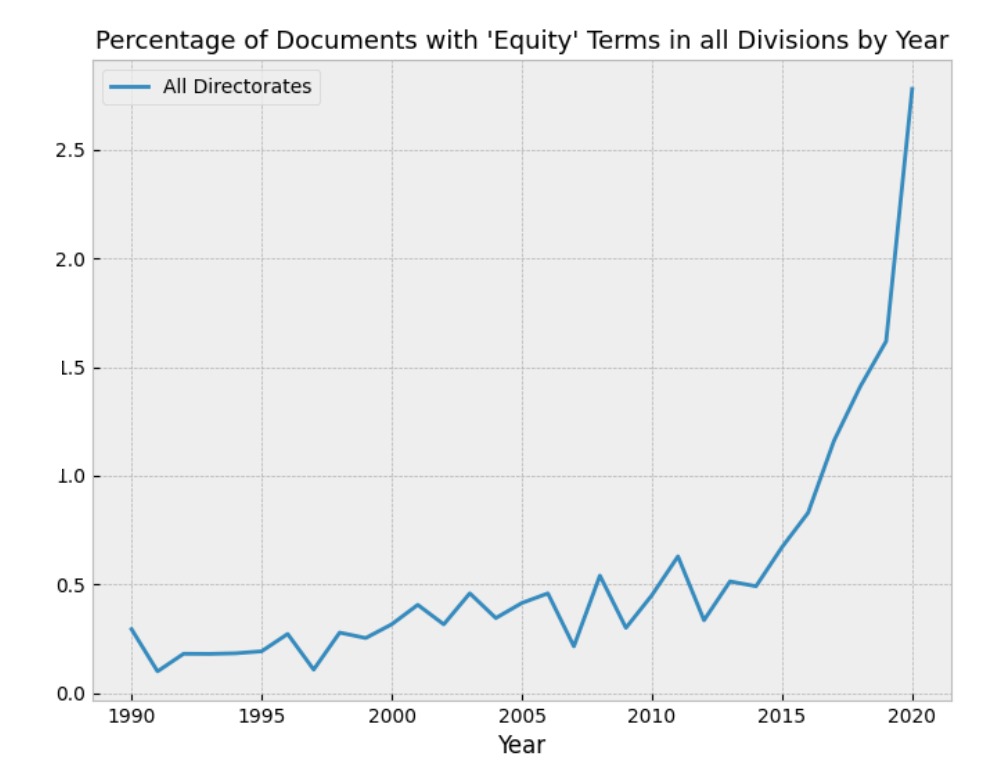
That is from a new CSPI (Richard Hanania’s group) study by Leif Rasmussen.