Category: Sports
Those new service sector jobs
Basketball Expert (Fans, Journalist, Commentator, etc.)
Role Overview
We’re looking for Basketball experts — avid fans, sports journalists, commentators, and former or semi-professional players — to evaluate basketball games. You’ll watch basketball games and answer questions in real time assessing the quality, depth, and accuracy of AI insights, helping us refine our AI’s basketball reasoning, storytelling, and strategic understanding.
Key Responsibilities
Game Evaluation: Watch basketball games and review AI-generated play-by-play commentary and post-game analysis.
Performance Scoring: Rate the accuracy, insight, and entertainment value of AI sports coverage.
Context & Understanding: Assess the AI’s grasp of player performance, game flow, and strategic decisions.
Error Detection: Identify factual mistakes, poor interpretations, or stylistic inconsistencies.
Feedback Reporting: Provide clear written feedback highlighting strengths, weaknesses, and improvement opportunities.
Collaboration: Work with analysts and developers to enhance the AI’s basketball-specific reasoning and realism.
From Mercor, pays $45 to $70 an hour. For background on Mercor, see my very recent CWT with Brendan Foody. Via Mike Rosenwald, wonderful NYT obituary from him here.
Sentences to ponder
France will delay this year’s Group of 7 summit to avoid a conflict with the mixed martial arts event planned at the White House on Donald Trump’s birthday.
Here is the article.
My Conversation with the excellent Gaurav Kapadia
Here is the audio, video, and transcript. Here is the episode summary:
Gaurav Kapadia has deliberately avoided publicity throughout his career in investing, which makes this conversation a rare window into how he thinks. He now runs XN, a firm built around concentrated bets on a small number of companies with long holding periods. However, his education in judgment began much earlier, in a two-family house in Flushing that his parents converted into a four-family house. It was there where a young Gaurav served as de facto landlord, collecting rent and negotiating late payments at age 10. That grounding now expresses itself across an unusual range of domains: Tyler invited him on the show not just as an investor, but as someone with a rare ability to judge quality in cities, talent, art, and more with equal fluency.
Tyler and Gaurav discuss how Queens has thrived without new infrastructure, what he’d change as “dictator” of Flushing, whether Robert Moses should rise or fall in status, who’s the most underrated NYC mayor, what’s needed to attract better mayoral candidates, the weirdest place in NYC, why he initially turned down opportunities in investment banking for consulting, bonding with Rishi Sunak over railroads, XN’s investment philosophy, maintaining founder energy in investment firms and how he hires to prevent complacency, AI’s impact on investing, the differences between New York and London finance, the most common fundraising mistake art museums make, why he collects only American artists within 20 years of his own age, what makes Kara Walker and Rashid Johnson and Salman Toor special, whether buying art makes you a better investor, his new magazine Totei celebrating craft and craftsmanship, and much more.
Excerpt:
COWEN: Now, I don’t intend this as commentary on any particular individual, but what is it that could be done to attract a higher quality of candidate for being mayor of New York? It’s a super important job. It’s one of the world’s greatest cities, arguably the greatest. Why isn’t there more talent running after it?
KAPADIA: It is something that I’ve thought about a great deal. I think there’s a bunch of little things that accumulate, but the main thing that happens in New York City is, people automatically assume they can’t win because it’s such a big and great city. Actually, the last few presidential elections and also the current mayoral election have taught people that anyone could win. I think that, in and of itself, is going to draw more candidates as we go forward.
What happened as an example, this time, people just assumed that one candidate had the race locked up, so a lot of good candidates, even that I know, decided not even to run. It turns out that that ended up not being the case at all. Now that people put that into their mental model, the new Bayesian analysis of that would be, “Oh, more people should run.”
The second thing: New York has a bunch of very peculiar dynamics. It’s an off-year election, and the primaries are at very awkward times. I believe there’s a history of why the primary shifted to basically the third week of June, in which there’s a very low turnout. The third week of June in New York City, when the private schools are out and an off-year election. You’re able to win the Democratic nomination and therefore the mayoral election with tens of thousands of votes in a city this big. That is absolutely insane.
A couple of things that I would probably do would be to make the primary more normal, change the election timing to make it on-cycle, even number of years. You’d have to figure out how to do that. Potentially have an open primary as well.
COWEN: If we apply the Gaurav Kapadia judgment algorithm to mayoral candidates, what’s the non-obvious quality you’re looking for?
KAPADIA: Optimism.
COWEN: Optimism.
KAPADIA: Optimism.
COWEN: Is it scarce?
KAPADIA: Extraordinarily scarce. I think there’s much more doomerism everywhere than optimism. At the end of the day, people are attracted to optimism. If you think about the machinery of the city and the state, having a clear plan — of course, you need all the basics. You need to be able to govern. It’s a very complicated city. There’re many constituents.
But I think beyond that, you have to have the ability to inspire. For some reason, almost all of the candidates, over the last couple of cycles, have really not had that — with the exception of probably one — the ability to inspire. I think that is the most underrated quality that one will need.
COWEN: I have my own answer to this question, but I’m curious to see what you say. What is, for you, the weirdest part of New York City that you know of that doesn’t really feel like it belongs to New York City at all?
Definitely recommended.
My excellent Conversation with John Amaechi
Here is the audio, video, and transcript. As I said on Twitter, John has the best “podcast voice” of any CWT guest to date. Here is the episode summary:
John Amaechi is a former NBA forward/center who became a chartered scientist, professor of leadership at Exeter Business School, and New York Times bestselling author. His newest book, It’s Not Magic: The Ordinary Skills of Exceptional Leaders, argues that leadership isn’t bestowed or innate, it’s earned through deliberate skill development.
Tyler and John discuss whether business culture is defined by the worst behavior tolerated, what rituals leadership requires, the quality of leadership in universities and consulting, why Doc Rivers started some practices at midnight, his childhood identification with the Hunchback of Notre Dame and retreat into science fiction, whether Yoda was actually a terrible leader, why he turned down $17 million from the Lakers, how mental blocks destroyed his shooting and how he overcame them, what he learned from Jerry Sloan’s cruelty versus Karl Malone’s commitment, what percentage of NBA players truly love the game, the experience of being gay in the NBA and why so few male athletes come out, when London peaked, why he loved Scottsdale but had to leave, the physical toll of professional play, the career prospects for 2nd tier players, what distinguishes him from other psychologists, why personality testing is “absolute bollocks,” what he plans to do next, and more.
Excerpt:
COWEN: Of NBA players as a whole, what percentage do you think truly love the game?
AMAECHI: It’s a hard question to answer. Well, let me give a number first, otherwise, it’s just frustrating. 40%. And a further 30% like the game, and 20% of them are really good at the game and they have other things they want to do with the opportunities that playing well in the NBA grants them.
But make no mistake, even that 30% that likes the game and the 40% that love the game, they also know that they like what the game can give them and the opportunities that can grow for them, their families and generation, they can make a generational change in their family’s life and opportunities. It’s not just about love. Love doesn’t make you good at something. And this is a mistake that people make all the time. Loving something doesn’t make you better, it just makes the hard stuff easier.
COWEN: Are there any of the true greats who did not love playing?
AMAECHI: Yeah. So I know all former players are called legends, whether you are crap like me or brilliant like Hakeem Olajuwon, right? And so I’m part of this group of legends and I’m an NBA Ambassador as well. So I go around all the time with real proper legends. And a number of them I know, and so I’m not going to throw them under the bus, but it’s the way we talk candidly in the van going between events. It’s like, “Yeah, this is a job now and it was a job then, and it was a job that wrecked our knees, destroyed our backs, made it so it’s hard for us to pick up our children.”
And so it’s a job. And we were commodities for teams who often, at least back in those days, treated you like commodities. So yeah, there’s a lot of superstars, really, really excellent players. But that’s the problem, don’t conflate not loving the game. And also, don’t be fooled. In Britain there’s this habit of athletes kissing the badge. In football, they’ve got the badge on their shirt and they go, “Mwah, yeah.” If that fools you into thinking that this person loves the game, if them jumping into the stands and hugging you fools you into thinking that they love the game, more fool you.
COWEN: Michael Cage, he loved the game. Right?
But do note that most of the Conversation is not about the NBA.
They solved for the Kansas City Chiefs enforcement equilibrium
We examine how financial pressure influences rule enforcement by leveraging a novel setting: NFL officiating. Unlike traditional regulatory environments, NFL officiating decisions are immediate, transparent, and publicly scrutinized, providing a unique empirical lens to test whether a worsening financial climate shapes enforcement behavior. Analyzing 13,136 defensive penalties from 2015 to 2023, we find that postseason officiating disproportionately favors the Mahomes-era Kansas City Chiefs, coinciding with the team’s emergence as a key driver of TV viewership/ratings and, thereby, revenue. Our study suggests that financial reliance on dominant entities can alter enforcement dynamics, a concern with implications far beyond sports governance.
That is from a new piece by Spencer Barnes, Ted Dischman, and Brandon Mendez. Via the excellent Kevin Lewis.
What should I ask John Amaechi?
Yes, I will be doing a Conversation with him. Here is Wikipedia on John:
John Uzoma Ekwugha Amaechi // ⓘ, OBE (/əˈmeɪtʃi/; born 26 November 1970) is an English psychologist, consultant and former professional basketball player. He played college basketball for the Vanderbilt Commodores and Penn State Nittany Lions, and professional basketball in the National Basketball Association (NBA). Amaechi also played in France, Greece, Italy, and the United Kingdom. Since retiring from basketball, Amaechi has worked as a psychologist and consultant, establishing his company Amaechi Performance Systems.
In February 2007, Amaechi became the first former NBA player to publicly come out as gay after doing so in his memoir Man in the Middle.
John has a new book coming out, namely It’s Not Magic: The Ordinary Skills of Exceptional Leaders. So what should I ask him?
My excellent Conversation with Nate Silver
Here is the audio, video, and transcript. Here is part of the episode summary:
Tyler and Nate dive into expected utility theory and random Nash equilibria in poker, whether Silver’s tell-reading abilities transfer to real-world situations like NBA games, why academic writing has disappointed him, his move from atheism to agnosticism, the meta-rationality of risk-taking, electoral systems and their flaws, 2028 presidential candidates, why he thinks superforecasters will continue to outperform AI for the next decade, why more athletes haven’t come out as gay, redesigning the NBA, what mentors he needs now, the cultural and psychological peculiarities of Bay area intellectual communities, why Canada can’t win a Stanley Cup, the politics of immigration in Europe and America, what he’ll work on next, and more.
Excerpt:
COWEN: If you think about the Manifold types in terms of the framework in your book, how they think about risk — is there a common feature that they’re more risk-averse, or that they worry more? Is there a common feature that they like the idea that they hold some kind of secret knowledge that other people do not have? How do you classify them? They’re just high in openness, or what is it?
SILVER: They’re high in openness to experience. I think they’re very high in conscientiousness.
COWEN: Are they? I don’t know.
SILVER: Some of them are. Some of them are, yes.
COWEN: I think of them as high variance in conscientiousness, rather than high in it.
[laughter]
SILVER: The EAs and the rationalists are more high variance, I think. There can be a certain type of gullibility is one problem. I think, obviously, EA took a lot of hits for Sam Bankman-Fried, but if anything, they probably should have taken more reputational damage. That was really bad, and there were a lot of signs of it, including his interviews with you and other people like that. It contrasts with poker players who have similar phenotypes but are much more suspicious and much more street smart.
Also, the Bay Area is weird. I feel like the West Coast is diverging more from the rest of the country.
COWEN: I agree.
SILVER: It’s like a long way away. Just the mannerisms are different. You go to a small thing. You go to a house party in the Bay Area. There may not be very much wine, for example. In New York, if the host isn’t drinking, then it’d be considered sacrilege not to have plenty of booze at a party. Little things like that, little cultural norms. You go to Seattle — it feels like Canada to me almost, and so these things are diverging more.
COWEN: Why is belief in doom correlated with practice of polyamory? And I think it is.
SILVER: If you ask Aella, I guess, she might say, if we’re all going to die or go to whatever singularity there is, we might as well have fun in the meantime. There’s some of that kind of hedonism. Although in general, it’s not a super hedonistic movement.
COWEN: It seems too economistic to me. Even I, the economist — I don’t feel people think that economistically. There’s more likely some psychological predisposition toward both views.
SILVER: I guess you could argue that society would be better organized in a more polyamorous relationship. People do it implicitly in a lot of ways anyway, including in the LGBTQ [laughs] community, which has different attitudes toward it potentially. and if there’s not as much childbearing, that can have an effect, potentially. I think it’s like they are not being constrained by their own society thing that is taken very seriously in that group. There’s enough disconnectedness and aloofness where they’re able to play it out in practice more.
That creeps a little bit into Silicon Valley too, which can be much more whimsical and fanciful than the Wall Street types I know, for example.
Recommended. Here is my 2024 episode with Nate, here is my 2016 episode with him.
The Benefits of Scholastic Athletics
This paper uses longitudinal data to study the benefits of participation in scholastic athletics starting with high school participation and continuing with college athletics, including the benefits of intramural athletics. We study the impact of participation on a number of important life outcomes, including graduation from high school and college and wages after schooling is completed. Controlling for rich measures of cognitive and personality skills and social background, we find substantial benefits at all levels. Participation in athletics promotes social mobility for disadvantaged and minority students.
Here is the paper, by
Robot soccer league in China
It is not yet good, but…I nonetheless enjoy it more than regular soccer. Here is another video.
Has Clothing Declined in Quality?
The Office of the U.S. Trade Representative (USTR) recently tweeted that they wanted to bring back apparel manufacturing to the United States. Why would anyone want more jobs with long hours and low pay, whether historically in the US or currently in places like Bangladesh? Thanks in part to international trade, the real price of clothing has fallen dramatically (see figure below). Clothing expenditure dropped from 9-10% of household budgets in the 1960s (down from 14% in 1900) to about 3% today.
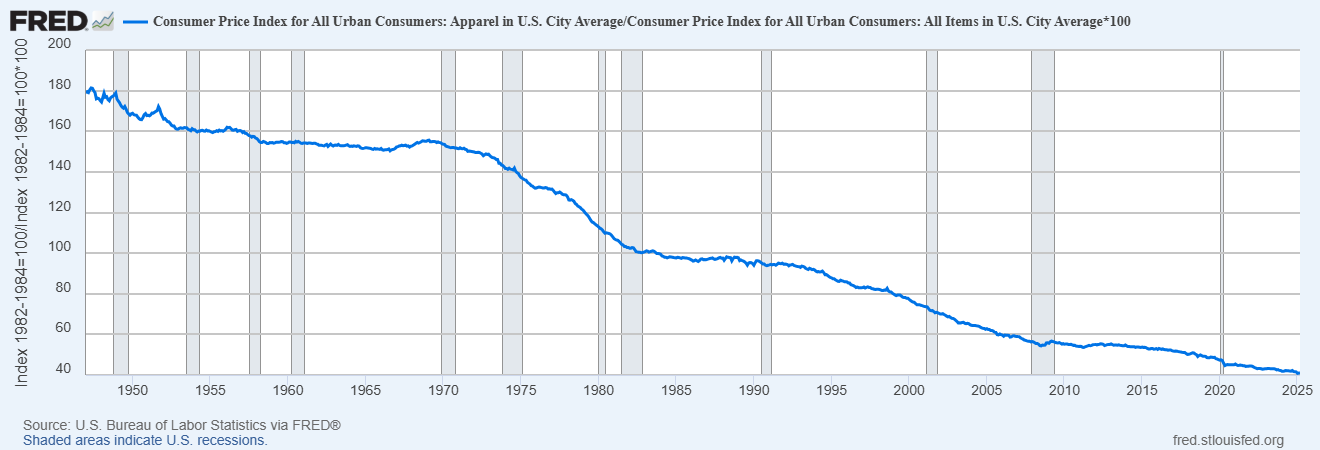
Apparently, however, not everyone agrees. While some responses to my tweet revealed misunderstandings of basic economics, one interesting counter-claim emerged–the low price of imported clothing has been a false bargain, the argument goes, because the quality of clothing has fallen.
The idea that clothing has fallen in quality is very common (although it’s worth noting that this complaint was also made more than 50 years ago, suggesting a nostalgia bias, like the fact that the kids today are always going to hell). But are there reliable statistics documenting a decline in quality? In some cases, there are! For example, jeans from the 1960s-80s, for example, were often 13–16 oz denim, compared to 9–11 oz today. According to some sources, the average garment life is down modestly. The statistical evidence is not great but the anecdotes are widespread and I shall accept them. Most sources date the decline in quality to the fast fashion trend which took off in the 1990s and that provides a clue to what is really going on.
Fast fashion, led by firms like Zara, is a business model that focuses on rapidly transforming street style and runway trends into mass-produced, low-cost clothing—sometimes from runway to store within weeks. The model is not about timeless style but about synchronized consumption: aligning production with ephemeral cultural signals, i.e. to be fashionable, which is to say to be on trend, au-courant and of the moment.
It doesn’t make sense to criticize fast fashion for lacking durability—by design, it isn’t meant to last. Making it durable would actually be wasteful. The product isn’t just clothing; it’s fashionable clothing. And in that sense, quality has improved: fast fashion is better than ever at delivering what’s current. Critics who lament declining quality miss the point—it’s fun to buy new clothes and if consumers want to buy new clothes it doesn’t make sense to produce long lasting clothes. People do own many more pieces of clothing today than in the past but the flow is the fun.
So my argument is that the decline in “quality” clothing has little to do with the shift to importing but instead is consumer-driven and better understood as an increase in the quality of fashion. Testing my theory isn’t hard. Consider clothing where function, not just fashion, is paramount: performance sportswear and Personal Protective Equipment (PPE).
There has been a massive and obvious improvement in functional clothing. The latest GoreTex jackets, for example, are more than five times as water resistant (28 000 mm hydrostatic head) compared to the best waxed cotton technology of the past (~5 000 mm) and they are breathable (!) and lighter. Or consider PolarTec winter jackets, originally developed for the military these jackets have the incredible property of releasing heat when you are active but holding it in when you are inactive. (In the past, mountain climbers and workers in extreme environments had to strip on or off layers to prevent over-heating or freezing while exerting effort or resting.) Amazing new super shoes can actually help runners to run faster! Now that is high quality. Personal protective equipment has also increased in quality dramatically. Industrial workers and intense sports enthusiasts can now wear impact resistant gloves which use non-Newtonian polymers that stiffen on impact to reduce hand injuries.
 Moreover, it’s not just functional clothing that has increased in quality. For those willing to look, there is in fact plenty of high-quality clothing readily available. From Iron Heart, for example, you can buy jeans made with 21oz selvedge indigo denim produced in Japan. Pair with a high-quality Ralph Lauren shirt, a Mackinaw Wool Cruiser Jacket and a nice pair of Alden boots. Experts like the excellent Derek Guy regularly highlight such high-quality options. Of course, when Derek Guy discusses clothes like this people complain about the price and accuse him of being an elitist snob. Sigh. Tradeoffs are everywhere.
Critics long for a past when goods were cheap, high quality, and Made in America—but that era never really existed. Clothing in the past was more expensive and often low quality. To the extent that some products in the past were of higher quality–heavier fabric jeans, for example–that was often because the producers of the time couldn’t produce it less expensively. Technology and trade have increased variety along many dimensions, including quality. As with fast fashion, lower quality on some dimensions can often produce a superior product. And, of course, it should be obvious but it needs saying: products made abroad can be just as good—or better—than those made domestically. Where something is made tells you little about how well it’s made.
The bottom line is that international trade has brought us more options and if today’s household were to redirect the historical 9 – 10 % share of income to clothing, it could absolutely buy garments that are heavier, better-constructed, and longer-lived than the typical mid-century mass-market clothing.
Men watch women’s sports more than women do
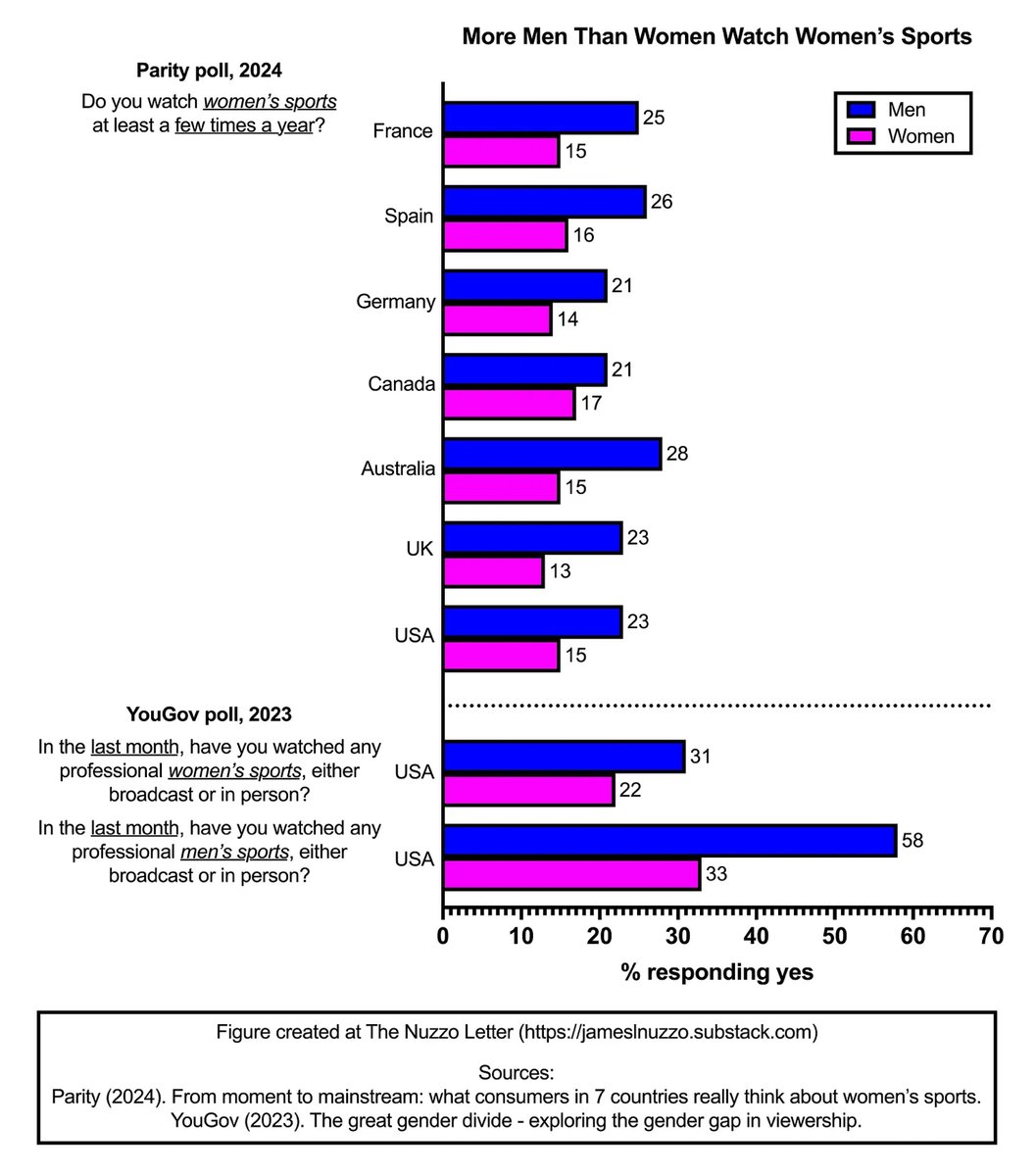
Here is the link, via Alex T.
Male coaches increase the risk-taking of female teams—Evidence from the NCAA
Highlights from the article:
The coach’s gender has a sizable and significant effect on the team’s risk-taking, a finding that is robust to an instrumental variable approach.
Women’s teams with a male head coach make risky attempts 6 percentage points more often than women’s teams with a female head coach.
The difference is persistent within games and does not change with intermediate performance.
Risk-taking has a positive effect on winning a game and teams with a female coach would win more often if they chose risky attempts more often.
The gap in risk-taking of female teams by their coach’s gender is the greater, the more experienced their head coach is.
That is from a new paper by René Böheim, Christoph Freudenthaler, and Mario Lackner.
1969
1969 was a big year for me. Most of all, we left Fall River and moved back to New Jersey, but this time to Bergen rather than Hudson County — Billy Joel comments. I’ll cover Bergen County another time, here were three other developments of import in my seven-year-old life in 1969:
1. The United States landed a man on the moon.
My parents let me stay up late to watch this, thank goodness. Of course I was very excited, and we heard all about it in school. This event drove my later interest in science fiction, space exploration, and also travel by jet. None of those were directions my career or writings went in, but they were early intellectual influences. At this point in the game, how could you not watch Star Trek reruns?
Back then, we all knew something special was happening, even I knew at age seven. I also began to understand that the United States was the country that did this, and what that meant. So I became more patriotic. The command center at NASA seemed to me a great achievement, in a way more impressive than the spaceship.
2. The New York Mets won the World Series.
Alas, I was no longer a Red Sox fan. The important thing here is that the New York Mets season, along with the moon landing of that same summer, was the first thing I truly followed with all of my attention. I learned how to keep on top of something, at least to the greatest degree possible given my constraints (which were extreme, starting with no internet but hardly ending there). In 1968 I watched baseball games, but in 1969 I followed The New York Mets and absorbed all of the available information about them, including reading newspapers, listening to radio talk shows, and digesting statistics on a regular basis.
That is a tendency that has stuck with me, and I first practiced it then and there.
3. I received my first transistor radio.
I don’t hear people talk about this much any more, but for me it was like the arrival of the internet. All of a sudden I was in regular touch with a big chunk of the world. I could hear the new music that was out. Could listen to the news. Find out sports scores. Hear talk shows. Or whatever. The menu was very America-centric, and the sound was terrible, but none of that mattered. The information superhighway had been opened for me.
I heard the Jackson Five song “I Want You Back,” and the Beatles’ “Hey Jude.” Those tunes bored me quickly, and I returned to them and their excellence only later. But I knew they were out there, and I knew they were important. At least early on, I preferred The Archies “Sugar, Sugar,” Tommy Roe’s “Dizzy,” and oddities such as Zaeger and Evans “In the Year 2525.” How about “They’re Coming to Take Me Away”?
In fact they did not take me away, rather they ensconced me securely in New Jersey, in the momentous year of 1969.
My years in Fall River, Mass.
I lived there from ages 4 to 7, which spans 1966 to 1969. At that time, Fall River about forty years past its textiles manufacturing peak, as southern competition had deindustrialized the city. My father was invited to run the Chamber of Commerce there, with the hope that he could help revitalize things, and so the family moved.
I recall liking New England, and preferring it to my earlier Hudson County, NJ environs. All of a sudden we had a large yard and things felt nicer. The neighbors were chattier and less surly. The dog (Zero) could run around the neighborhood free, which I found both astonishing and good. I did not understand that the city had fantastic architecture. My father complained about it being provincial.
Whenever we would drive back and forth from NJ to Fall River, my sister and I would see a building in Providence, RI and for whatever reason we called it “the monkey squisher.” For trips to the shore, we would go to Cape Cod, and let the dog run on the beach.
Mr. and Mrs. Jennings were the immediate neighbors, and they treated us almost like their own kids. Their own boy was grown and in the service. Two other neighbors were Kathy and Carol Fata (sp?), who were slightly older than Holly and me, and again super-friendly. I believe they were either Lebanese or Syrian, which was common in Fall River at that time.
Most of all, I was into baseball and baseball cards in those years. I used them to learn some math and statistics, and of course to learn about the players. I watched baseball games on TV all the time, and to this day I remember some baseball stats from that era. I received an autographed baseball from Russ Gibon, Red Sox catcher at the time. Naturally I was a Red Sox fan. I had an allowance of a quarter a week, and on the way home from school would stop at a small newspaper store and buy baseball cards. The 1968 World Series was a huge thrill for me, and I was rooting for the Detroit Tigers and Mickey Lolich. I still remember the close call at the plate with Bill Freehan and Lou Brock.
Most of my reading was books on science and dinosaurs, or books on baseball. I was especially fond of a science book series called “Ask Me Why?”. I looked at maps plenty, and my favorite map was that of Italy, due to the shape of the country.
I recall watching the 1968 presidential election, and having my mother explain it to me. I also watched on TV the funeral procession for RFK, and I asked my grandmother, who then lived with us, why the police guards were not moving. “If they move an inch, they take them out and shoot them!” she snapped back loudly and decisively. In those days, people said things like that.
My kindgarten teacher we called “Mrs. Penguin,” though I doubt that was her real name. She would twist the ears of kids who made trouble, though that was not me. I had a letter box, but it bored me because my reading skills were ahead of those of my classmates. There was a girl named Stephanie in my class, and I thought she was cute. School simply did not seem like a very efficient way to learn.
In my hazy memories, I very much think of the Fall River days as good ones.
Remember when I said Luka was overrated?
Oh the howls that claim elicited. Basically Dallas did not want to give him a Supermax extension for $345 million (no, Luka did not ask to be traded). So Luka is now gone, here are some notes from ESPN:
The Mavericks were motivated to move Doncic because of his constant conditioning concerns, sources told MacMahon. There had been significant frustration within the organization about Doncic’s lack of discipline regarding his diet and conditioning, which team sources considered a major factor in his injury issues.
Though Doncic was relatively svelte by his standards when he reported to camp, his weight ballooned to the high 260s early this season, sources said. He sat out five games in late November, when the Mavs listed him with a sprained right wrist, an extended absence to allow Doncic to focus on his conditioning. He had a similar early-season layoff in the 2022-23 season.
Doncic has been limited to only 22 games this season because of a variety of injuries. He has twice strained his left calf since reporting back to Dallas before training camp in late September, although the Mavs reported the fall injury only as a calf contusion, sources said.
Doncic has not played since straining his calf again on Christmas Day but has been targeting a return before the All-Star break later this month, sources told MacMahon. Davis has also been out after being diagnosed with an abdominal muscle strain earlier this week. He has sat out the Lakers’ past two games. Davis was expected to be reevaluated in a week, according to the Lakers on Wednesday.
POTMR. In the short run this trade makes both teams worse off (LA defense), although longer run LA will keep around a franchise player of sorts. Here is one comment from an NBA star. It all shows in the body language.
p.s. LAL should now trade Lebron, and Bronny, to a contender for a pile of draft picks.