Category: Uncategorized
Wednesday assorted links
1. Todd Kashdan criticizing his own work.
2. “The American Economic Journal: Microeconomics (one of the very top journals that isn’t part of the holy Top-5, hallowed be thy names) managed to go an entire year without accepting a paper!” (out of 415 submissions).
3. How the NIH behaves during an emergency.
4. Increase of women in personnel management.
5. There is no Argentine bola great stagnation.
6. Speculative.
7. Sheilagh Ogilvie does Five Books on the Industrial Revolution.
Two Vaccine Updates
First, in an article on new vaccine boosters in USA today there is this revealing statement:
Any revised Moderna vaccine would include a lower dose than the original, Moore said. The company went with a high dose in its initial vaccine to guarantee effectiveness, but she said the company is confident the dose can come down, reducing side effects without compromising protection.
Arrgh! Why wait for a new vaccine??? Fractional dosing now!

The same article also notes:
One of Moderna’s co-founders, MIT professor Robert Langer, is known for his research on microneedles, tiny Band-Aid-like patches that can deliver medications without the pain of a shot. Moderna has said nothing about delivery plans, but it’s conceivable the company might try to combine the two technologies to provide a booster that doesn’t require an injection.
The skin is highly immunologically active so you can give lower doses with a microneedle patch. The microneedles are sometimes made from sugar and don’t hurt. Microneedle delivery, however, can cause scars but I say apply the patch where the sun don’t shine and let’s go!
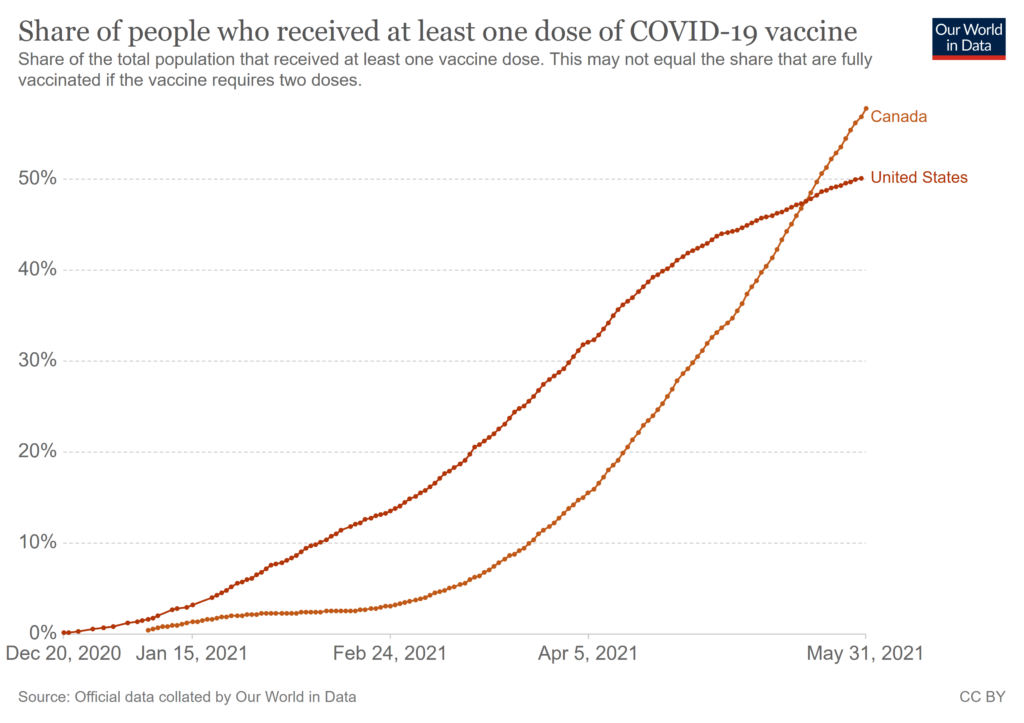
Second, Canada’s NACI has now endorsed mix and match for the AZ and Pfizer and Moderna vaccines. First Doses First has put Canada in very good shape (now ahead of the US in percent of the population with at least one dose) and this was always part of the FDF plan–delay second doses to get out more first doses and then, when supplies increase, give second doses, possibly with a better vaccine.
Do individuals make more rational decisions when the stakes are higher?
Often yes, but this is a shibboleth of economics that doesn’t always fit the facts, as has been illustrated starkly by our behaviors during the pandemic. Many people have taken too much risk, or been too risk-averse, even with high stakes on the line. Here is one excerpt from my recent Bloomberg column:
You might wonder why we are getting these big, important decisions so wrong. I have at least two hypotheses. One is that anxiety causes people to make worse decisions. Facing the danger of a deadly pandemic, for example, the higher stakes might induce me to shift into denial, if only to protect my sanity and peace of mind. I might make worse decisions than if I were simply trying to avoid the common cold, for which the stakes are far lower.
My other hypothesis involves identity and the desire for belonging. It is no accident that red states in the U.S. are under-vaccinated relative to blue states; vaccine skepticism is in part an identity marker for Trump supporters. People tend to see big decisions as more important in shaping their identity than small ones. In essence, the significance of a decision induces all kinds of surrounding social forces to “infect” that decision with partisan influences, and that decision in turn becomes a truly credible signal of what we believe.
For most economic decisions, people do still make better choices when the stakes are higher — but this isn’t a universal principle. Are you so sure, for example, that decisions about who to marry are made more rationally than those about which TV show to watch? Maybe they are, but it’s not entirely obvious.
Note that it is now much easier to make good small stakes decisions, largely because of the internet:
An accompanying change is that low-stakes decisions are easier than ever, due largely to the internet, with one crucial caveat: The decision-maker must be relatively rational. Several decades ago, if you wanted to figure out the best paper towels to buy, you might have asked around and then collated a lot of information yourself. These days it is easy enough to search the internet for the answer. Or consider the example of credit-card rewards, which are far easier to collect, manipulate and use because of the internet.
The danger of course is that the sum of all these smaller triumphs convinces people that they are rational about big dilemmas too — despite the fact that they choose rather poorly on some of them. We are not used to a world where we are worse at big decisions than the small ones. But it has been hurtling our way for some while now.
Recommended. I also cite this: “Bryan Caplan, a colleague who studies human rationality, has put the individual Covid response in only the second percentile of “my initially mediocre expectations.””
Olaf Stapledon movie coming!?
From Iceland? Narrated by Tilda Swinton?
Via Jeet Heer, and Ilya Novak. Is it any good?
Tuesday assorted links
1. The resilience of the U.S. corporate bond market. And who needs a flying car?
2. Famous economists’ grave sites.
3. “Measured intelligence did not predict increased mate appeal in either study, whereas perceived intelligence and funniness did.” Speculative.
4. Blockchain-based smart contract for Kenyan crop insurance (speculative).
5. David Beckworth podcast with Mark Carney, mostly macro.
6. Winning probabilities of horses with fast-sounding names are overstated.
7. How they used to dance, starring Doris Day.
U.S. Largest Industries, 1890
1. Transportation
2. Agriculture and Related Industries
3. Food, Beverages, and Tobacco Products
4. Metal, Metal Products, and Machinery
5. Textiles, Textile Products, and Clothing
6. Mining and Quarrying
7. Banking
8. Wood, Lumber, and Their Products
9. Leather and Allied Products
10. Slaughtering and Meat Packing
That is from the new and excellent An Illustrated Business History of the United States, by Richard Vague. How many of you really know everything that is in here? In that same year Buffalo was the tenth largest U.S. city. And the most valuable import around that time (1891-1900) was sugar, with coffee #2 and “Hides and skins” #3.
The fly swatter had not yet been invented.
Just remember: picture books are usually better than regular books.
Is the second-cheapest wine a rip-off?
The standard economic analysis of product-line pricing by Mussa and Rosen (1978) implies that higher-quality varieties command higher absolute mark-ups. It is widely claimed that this property does not apply to wine lists. Restaurateurs are believed to overprice the second-cheapest wine to exploit naïve diners embarrassed to choose the cheapest option. This paper investigates which view is correct. We find that the mark-up on the second cheapest wine is significantly below that on the four next more expensive wines. It is an urban myth that the second-cheapest wine is an especially bad buy. Percentage mark-ups are highest on mid-range wines. This is consistent with the profit-maximising pricing of a vertically differentiated product line with no behavioral elements, although other factors may contribute to the price pattern.
That is from a new paper by David de Meza and Vikram Pathania, via The Browser (which is worth paying for).
@pmarca lets loose
Don’t underestimate yourself! The great writers of the past tended to be disassociative cranks. Diogenes Laertius says Heraclitus lived “by himself in the mountains, feeding on grasses and herbs” and died by burying himself in literal dung. Rousseau condemned his own children to the hell of an 18th century orphanage while sanctimoniously passing judgment on the rest of society. Nietzsche went insane protecting a horse from a whipping, and in his last messages to the world demanded the pope be jailed and all anti-Semites shot. You see, you fit right in.
And that is one of the more anodyne parts of the interview. And yes it has been confirmed to be real. Here is another one of the boring parts:
I predict that we — the West — are going to WEIRDify the entire world, within the next 50 years, the next two generations. We will do this not by converting non-WEIRD people to WEIRD, but by getting their kids. Their kids, and their kids’ kids, are going to grow up on the Internet at least as much as they grow up in the real world, and the pull of WEIRD culture will overwhelm all existing non-WEIRD cultures. I realize this is a very strong claim, but this process is already underway; at this point I think it’s inevitable. The cost of this will be a collapse of global cultural diversity exactly as you and Rozin predict.
Niccolo Soldo is the interviewer.
Uncaged Stairway to Heaven — the only version that makes the song sound fresh
Via Fernand Pajot.
Monday assorted links
1. What do Finns think of Covid restrictions?
2. New York City’s bird paramedics (New York magazine). And how the health care DARPA is coming along.
3. “American said that alcohol would continue to be served in first class and business class…” (NYT)
4. Solve for the equilibrium: “Any doofus can be a cybercriminal now,” said Sergei A. Pavlovich, a former hacker who served 10 years in prison in his native Belarus for cybercrimes. “The intellectual barrier to entry has gotten extremely low.” (NYT)
5. Danish spying markets in everything?
6. Observations on gerrymandering.
7. No wonder we are doing so well: “The number of Master’s and Doctoral degree holders more than doubled (in the US) from 2000 to 2018.”
What I’ve been reading
1. Marc Morris, The Anglo-Saxons: A History of the Beginnings of England 400-1066. A pretty good book. It has been criticized for focusing on “dead white males,” but isn’t this a history of dead white males in large part? The photos are quite good. My main problem is simply that I find the whole era inscrutable. Still, if you wish to learn whether Aethelred the Unready was in fact…unready…this is one good place to go.
2. Andrew Steele, Ageless: The New Science of Getting Older Without Getting Old. I haven’t read all of the popular “anti-aging” books, but perhaps this is the best one? It presents the diversity of problems involved, and the difficulty of solving them, while remaining ultimately hopeful about the possibility of progress. Most of the meat of the book is in the middle chapters, which are also good for explaining how aging research relates to broader biological and disease-linked issues.
3. Kara Walker, A Black Hole is Everything a Star Longs To Be. Mostly images of her drawings, no text to speak of (though many of the drawings themselves have text). These 600 or so drawings will be on exhibit in a show in Basel that I hope to visit this summer, Covid conditions permitting. I find her work a better introduction to “current race issues” than most of the recent well-known books on race issues. Smarter and more powerful.
Steven Johnson, Extra Life: A Short History of Living Longer, is a very good history of exactly what its title promises.
Matt Grossman’s How Social Science Got Better: Overcoming Bias with More Evidence, Diversity, and Self Reflection is both substantive and honest.
Icelandic fact of the day
This passage concerns the U.S. occupation during World War II:
At its peak, the occupation of Iceland would include the equivalent, statistically speaking, of 55 million foreign troops occupying the United States based on 1940 populations. There were nearly fifty thousand men and dozens of female nurses, equaling about 40 percent of Icelanders.
By the way, from 1940 to 1946, “the purchasing power of unskilled workers (meaning just about everyone) grew by a whopping 86 percent…” About two percent of Icelandic women left as brides to American soldiers. And while Iceland lost about 300 lives during the war (mostly sailors), American servicemen helped to add another 400-500 to the native population.
One of the major political issues in the 1970s was whether the letter “Z” should be included in the Icelandic alphabet, and indeed it was abolished by law in 1973, with an exception being made for the word “pizza.”
That is all from Egill Bjarnason, How Iceland Changed the World: The Big History of a Small Island. I’ll say it again: single country books are underrated. Maybe there are no great revelations in this one, but if you have been to Iceland, or are planning a trip, it is probably the first book you would want to pick up to cover the country.
Why the lab leak theory matters
Here is Ross Douthat at the NYT:
…there’s a pretty big difference between a world where the Chinese regime can say, We weren’t responsible for Covid but we crushed the virus and the West did not, because we’re strong and they’re decadent, and a world where this was basically their Chernobyl except their incompetence and cover-up sickened not just one of their own cities but also the entire globe.
The latter scenario would also open a debate about how the United States should try to enforce international scientific research safeguards, or how we should operate in a world where they can’t be reasonably enforced.
I agree, and would add one point about why this matters so much. “Our wet market was low quality and poorly governed” is a story consistent with the Chinese elites not being entirely at fault. Wet markets, after all, are a kind of atavism, and China knows the country is going to evolve away from them over time. They represent the old order. You can think of the CCP as both building infrastructure and moving the country’s food markets into modernity (that’s infrastructure too, isn’t it?), albeit with lags. “We waited too long to get rid of the wet markets” is bad, but if anything suggests the CCP should have done all the more to revolutionize and modernize China. In contrast, the story of “our government-run research labs are low quality and poorly governed”…that seems to place the blame entirely on the shoulders of the CCP and also on its technocratic, modernizing tendencies. Under that account, the CCP spread something that “the earlier China” did not, and that strikes strongly at the heart of CCP legitimacy. Keep in mind how much the Chinese apply a historical perspective to everything.
A number of you have asked me what I think of the lab leak hypothesis. A few months ago I placed the chance of it at 20-30%, as a number of private correspondents can attest. Currently I am up to 50-60%.
A young woman speaking about her date and dating philosophy
Her other nonnegotiable is quarantine behavior. She was happy when she found out [male name redacted] takes safety seriously, interacting with only a small pod of people and limiting travel. “That showed me we had similar values,” she said. “Being caring, empathetic — and also believing in science and CDC regulations and guidelines.”
No, I am not interested in giving you a link or in identifying anybody by name. The point is this: this is one of the very best paragraphs ever written in helping you to understand the Blue State reaction to the pandemic.
Saturday assorted links
1. An escalator made of cardboard (short video).
3. Orson Welles, The Immortal Story, 58 minutes long, made for French TV 1968, one of his best. Jeanne Moreau too, full of MIE themes, and as I view it a critique of the wealthy, more substantive than the usual.
4. Markets in everything: pay for the chance to heist mannequin parts from a mountain of mannequin parts.
5. Progress Studies 101, by Sagar Devkate.
6. A recruiter on why restaurants are having trouble hiring. Of course this means that right now is a relatively bad time to be eating out a lot — higher variance of outcomes and even well-known restaurants have become harder to predict.
7. Lots of Democratic economists think Summers is right but they are afraid to say it. Context from Jason Furman here.