Category: Uncategorized
Sunday assorted links
2. Adam Smith against hegemony.
3. US median income vs. Europe.
4. The academic papers is a dead format these days (read the whole chain).
Saturday assorted links
A simple way to improve your thought and conclusions
Take some policy, action, or person whom you regard as morally questionable and indeed is morally questionable. That same policy, action, or person does some bad things, bad in conquentialist terms I now mean. Practically bad, utilitarian bad.
The odds are that you overrate the badness of those consequences by some considerable degree.
Even very smart people do this. Sometimes they do it more, because they can come up with more elaborate arguments for why the bad consequences are completely disastrous.
They might overrate the badness of those consequences by as much as 5x or 10x (gdp is a huge mound of stuff!).
So if you want to have better opinions, look for the cases where you do this and stop doing it.
Easy-peasy!
And good luck with that.
The actual helicopter drop?
When Milton Friedman pondered what would happen if a helicopter dropped $1,000 from the sky, he likely never imagined that one day a military cargo plane would scatter millions of dollars into one of Bolivia’s largest cities.
But while the Nobel Prize-winning economist worried about the inflation that an influx of cash could generate, the impact in El Alto — where a cash-packed plane crashed and killed 24 people last week while spreading 423 million bolivianos ($62 million) — is one of widespread confusion.
The new currency was legitimately printed, but the central bank has voided its serial numbers to prevent its use. While thousands swarmed the site to pick up the banknotes in one of Latin America’s poorest nations, authorities have tried to burn and destroy the new cash, arresting dozens and raiding homes in a rushed hunt for the missing bills.
That has sent Bolivians into a frenzy. No longer able to quickly tell if a banknote is valid or voided and fearing the crackdown, businesses don’t know what bills to accept anymore, leaving customers frustrated and panicked that their real money is now worthless.
“Just today, everyone refused to take my money five times,” said Yoselin Diaz, 27, who was lining up at the central bank’s main offices in La Paz. “I tried on the minibus and nothing, then I tried to buy some things and nothing, later I went to buy a photo for my father’s grave and even the funeral homes wouldn’t accept it.”
…Bolivia’s central bank has defended its measures to destroy and void the fresh cash, citing not just the principle of keeping stolen money from entering the financial system but also the need to quell social strife. At its height, authorities said about 20,000 people were trying to collect the banknotes as police fired tear gas at them.
Here is more from Bloomberg, via John de Palma.
Friday assorted links
1. Special tribute issue on James C. Scott.
2. Gauti Eggertsson: “I now find myself replicating papers and experimenting with frontier methods in an evening or a few days using Claude Code. That would have taken weeks before — which in practice meant I wouldn’t have done it at all.” And yet his vision is still far too conservative.
5. The price of war.
6. Is China an expansionist power? And China fact of the day.
7. Paul Graham on branding, design, and watches.
8. António Lobo Antunes, RIP ( NYT).
9. In fact in the Gulf there are too many vulnerable targets.
Immigration, innovation, and growth
We propose a novel identification strategy to isolate exogenous immigration shocks across US counties, by interacting quasi-random variations in the composition of ancestry across counties with the contemporaneous inflow of migrants from different countries. We show a positive causal impact of immigration on local innovation and wages at the five-year horizon. The positive dynamic impact of immigration on innovation and wages dominates the short-run negative impact of increased labor supply. A structural estimation of a model of endogenous growth and migrations suggests the increased immigration to the United States since 1965 may have increased innovation and wages by 5 percent.
That is from a new AER paper by Stephen J. Terry, et.al.
My podcast with Nebular
We’ve just published the video on YouTube, X, Spotify, and Apple Podcasts. We also published some extended show notes and the transcript on Substack.
I thought they did an excellent job here, and lots of fresh material. We start with the fertility crisis:
Murphy: We’ve always had a majority young society, and in our lifetime, we’ll have this transition to majority old society. When you make this transition and it impacts so many different areas of life, do you still believe that technology can solve our way out of it?
Cowen: Solved is never quite the word. But the older people in this room and I guess that’s only me. We have the luxury of having seen what old people were like in the 1960s and 70s, and mostly they were a wreck. So, so many people would be shot by 60. And now there are many 80-year-olds who are more dynamic than a typical 60-year-old might have been, say, in 1972.
So that will somewhat help keep us more equally dynamic. So there are countervailing trends which are quite positive. There might be You could call them mind altering substances that would help older people be young again, like Viagra for the mind. I’m not predicting that. I’m just saying there’s a lot of variables here, and I think we’ll have recourse to many interventions that will help keep things going at an acceptable level.
And this:
Murphy: Do you believe that there is life on the moons of Saturn?
Cowen: I would bet 60/40 yes. But it wouldn’t be life like us. You know, it might be little shrimpy things or even just something like bacteria. Maybe [the moons of]Jupiter also.
Interesting throughout. Here are links on Nebular and Finn Murphy.
Democracy continues
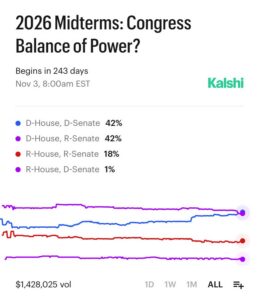 Here is a link.
Thursday assorted links
Wednesday assorted links
1. Singaporeans to receive free premium AI subscriptions from second half of 2026.
2. “In a secular world, equality is a last attempt to offer some dignity to the weak.”
4. Mr. Beast, banker (NYT).
5. Chimpanzees are fascinated by crystals (NYT).
7. Dario okie-dokie.
8. Polymarket removes market on nuclear detonation (WSJ).
By the way, I like 5.3 Instant very much.
Tuesday assorted links
1. Legal basis for the Pentagon’s designation?
3. “But what is true is that this should not be much of a surprise considering the constant rhetoric over the past few years has been that AI is a power like no other. It’s like nukes, but times a thousand. We need regulation. And when an industry repeatedly calls out for oversight, asking for someone to make the rules on how it should be used, you cannot be surprised when the Defense department take that seriously. You cannot be surprised when they make up their own interpretations of what ought to be done, because you were insufficiently prescriptive. They will listen to your articulation of any red lines and wonder, what do you mean you want to tell me how to use the mega-nuke-crazy-power that you yourself are saying you don’t know how to control?” Rohit.
4. There are too many types of shower controls.
5. The Anthropic valuation seems pretty stable. Plus other matters of interest from SSC, including an idea for how to improve prediction markets by inducing the sports betting to subsidize participation in other contracts.
6. You can now bet on German train delays.
7. Rohit: “OpenAI now is also the only case I know of a defense department vendor contract being negotiated in public iteratively. With plenty of object lessons on why nobody does it.” People, there is nothing weird going on here. It is fine to dislike various aspects of the U.S. military, after all part of their business is to kill people. But any blame you wish to levy goes toward “the system,” do not overly spin the narrative here.
Monday assorted links
2. Just say no to the monopsony model.
3. Your dose of John Cochrane.
4. More on the recent climate change estimate. It seems the paper should not have been published?
What the recent dust-up means for AI regulation
From my new Free Press column, I see these as the most important facts:
Congress has not passed explicit regulation of AI foundation models, and an executive order from President Trump limited regulation at the state level. But do not think that laissez-faire reigns. In addition to existing (largely pre-AI) laws, which lay out general principles of liability, and laws from a few states, the United States is engaged in a kind of “off the books” soft regulation.
The major AI companies keep the national security establishment apprised of the progress they are making, as has been the case with Anthropic. There is a general sense within the AI industry that if the national security authorities saw anything in the new products that was very concerning or that might undermine the national interest, they would inform the president and Congress. That would likely lead to more formal and more restrictive kinds of regulation, so the major AI companies want to show relatively safe demos and products. An informal back and forth enforces implied safety standards, without the involvement of formal legislation.
That may sound like an unusual way to do regulation, but to date the system has worked relatively well. For one thing, I believe our national security establishment has a better and more sophisticated understanding of the issues than does Congress. Congress right now simply isn’t up to the job, as indeed the institution has been failing more generally. Most representatives seem to know little about the core issues behind AI regulation.
As it stands, AI progress has been allowed to proceed, and the United States has stayed ahead of China, without major catastrophes. The burden on the companies has been manageable, and the system, at least until last week, was flexible.
Another advantage of this system is that both Congress and the administrative state can be very slow to act. The AI landscape can change in just weeks, yet our federal government is used to taking years to issue laws and directives. Had we passed AI legislation in, say, 2024, today it would be badly out of date, no matter what your point of view on what such regulation should accomplish. For instance, in 2024 few outsiders were much concerned with the properties of, or risks from, autonomous AI “agents.” Today that is the number-one topic of concern.
Though it is not driven by legislation, the status quo AI regulatory system is not anti-democratic, as it operates well within the rules passed by Congress and the administrative state. It is more correct to say the current AI guardrails rely on the threat of regulation, rather than regulation itself, with the national security state as the watchdog. The system sticks to a kind of creative ambiguity. The national security state offers no official imprimatur for the new advances, but they proceed nonetheless. Nevertheless, the various components of the national security state reserve the right to object in the future.
It is also correct, however, to believe that such a system cannot last forever. At some point creative ambiguity collapses. Someone or some institution demands a more formal answer as to what is allowed or what is not allowed. At that point a more directly legalistic system of adjudication enters the picture, and Congress likely starts paying more attention.
With the recent dispute between Hegseth and Anthropic, we have taken a step away from the previous regulatory mode of quiet cooperation. Instead, the relationship between the military and the AI companies has become a matter of public concern. Now everyone has an opinion on Hegseth, Anthropic, and OpenAI, and social media is full of debate.
No matter “whose side you take,” it would have been better to have resolved all this behind closed doors.
Sunday assorted links
2. UAE to cover expenses for affected travelers. And “emergency visas” are issued on the spot.
3. Abbas Amanat, Iran: A Modern History is for me (by far) the best general history of the country. I like the cover too.
4. From two weeks ago: “Perhaps there is a new “Trump doctrine,” namely to focus on going after lead individuals, rather than governments or institutional structures. We already did that in Venezuela, and there is talk of that being the approach in Iran. If so, that is a change in the nature of warfare, and of course others may copy it too, including against us. Is there a chance they have tried already?”
5. “Simple believers” in Ukraine shun the modern world (NYT).
Stand with free speech and the Constitution
A landmark law that limits children under the age of 16 to one hour per day on social media apps has been blocked by a US court, in a blow to child safety campaigners seeking to limit exposure to sites such as Instagram and YouTube.
In an opinion released on Friday, a federal judge in Virginia halted the enforcement of a bill passed by the state last year, under which social media companies could be fined $7,500 per violation.
The state “does not have the legal authority to block minors’ access to constitutionally protected speech until their parents give their consent by overriding a government-imposed default limit”, Judge Patricia Tolliver Giles wrote of the measure, implementing a preliminary injunction.
Giles concluded the law was “over-inclusive”. Under it, “a minor would be barred from watching an online church service if it exceeded an hour on YouTube . . . yet, that same minor is allowed to watch provider-selected religious programming exceeding an hour in length on a streaming platform,” she wrote. “This treats functionally equivalent speech differently.”
Here is more from the FT.