Category: Web/Tech
How Much Redistribution Will AI Require?
How much redistribution will AI require? A common scenario is that AI raises output enormously, but labor’s share of income collapses. GDP per capita goes up but workers get poorer, and making workers whole requires massive redistribution. In my latest paper, I run the numbers and conclude that this is probably incorrect.
The idea is simple. Labor income is GDP multiplied by labor’s share of GDP. What matters is the product. A smaller share of a much larger economy can still mean more income for labor. If the pie is growing, labor’s slice of the pie can shrink even as labor income rises.
Suppose that without AI, real GDP per capita grows at 2 percent a year and labor receives 60 percent of GDP. Now look ten years ahead. What is required to keep labor’s income growing at the same or higher rate?
If AI raises growth to 5 percent a year, GDP after ten years will be about 34 percent larger than on the no-AI path. Labor’s share can fall from 60 percent to about 45 percent and workers, in aggregate, will still have exactly as much real income as they would have had without AI.
If AI raises growth to 10 percent a year—the kind of number Satya Nadella and Dario Amodei talk about—GDP after ten years will be more than twice as large relative to the no-AI path. Labor’s share can then fall all the way to 28 percent without reducing aggregate labor income. Twenty-eight percent of an economy that has more than doubled is about the same as sixty percent of the smaller economy.
The figure shows how much redistribution is required after 10 years under a variety of scenarios.
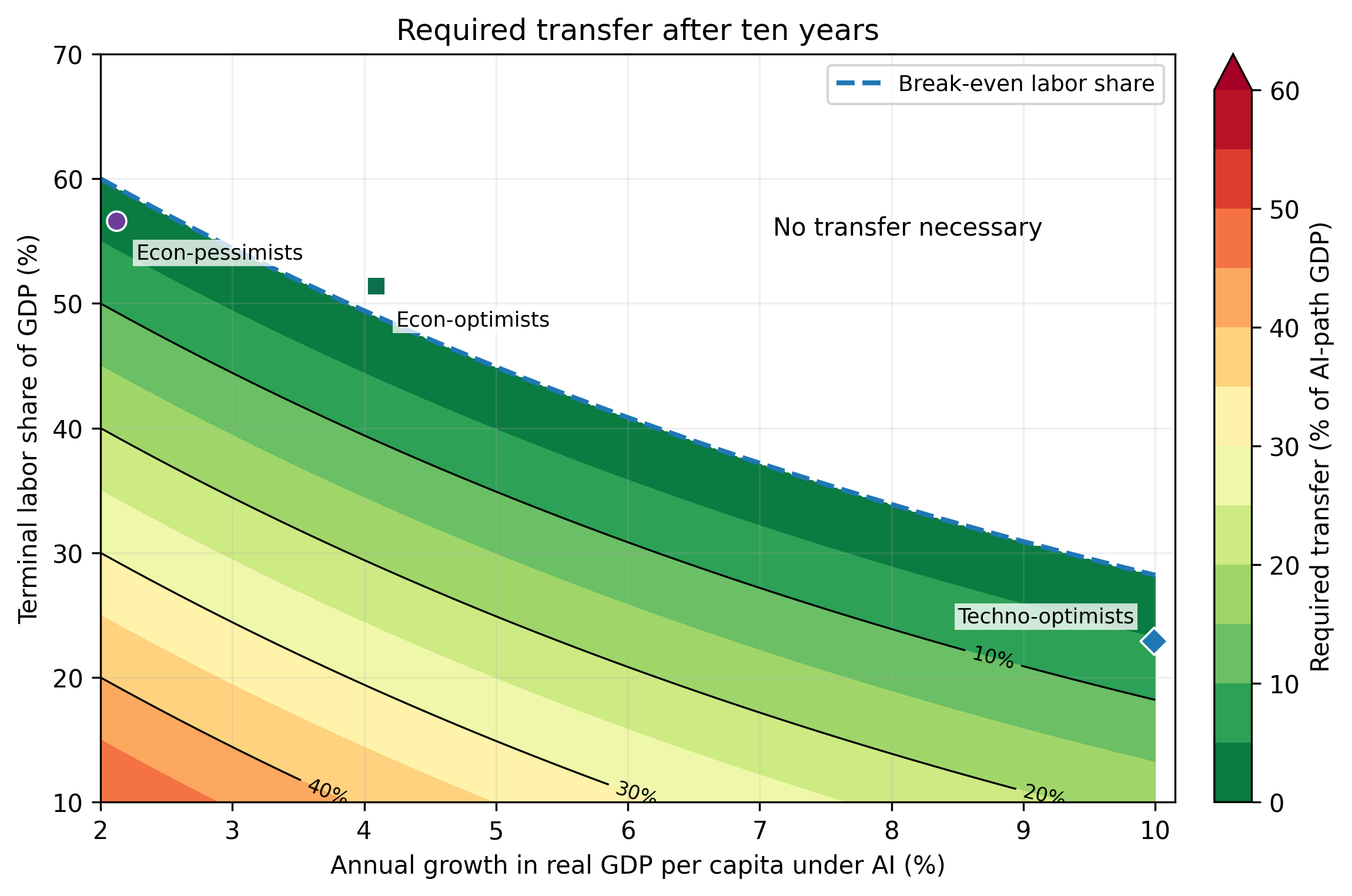
The white region above the dashed line requires no transfer. Which region are we headed for? Consider three “stylized” views.
The econ-pessimist, following Acemoglu, thinks AI displaces some but relatively few tasks because AI simply is not productive enough to replace much labor profitably. Growth is only 2.1 percent and labor’s share falls to 56.6 percent, although particular industries may still get hammered. The required transfer is 2.7 percent of GDP.
The econ-optimist, in the spirit of Tyler, myself, and Kevin Bryan, thinks automation also creates complementarities and new tasks for humans. Growth rises to 4.1 percent, labor’s share is 51.4 percent, and both labor and capital gain without any transfer.
The techno-optimist, following Amodei, has the superficially scariest labor-market scenario: three-quarters of labor income is displaced and labor’s share falls to just 22.9 percent. But productivity growth is also enormous, producing 10 percent annual growth. The transfer needed to keep labor as a whole on its no-AI path is only 5.3 percent of GDP.
That last calculation is the one I find most surprising. You can have something close to the techno-capitalist dystopia in terms of factor shares—labor gets less than a quarter of GDP—and still have a manageable redistribution problem because GDP has gotten so much larger.
Moreover, a transfer equal to 5 percent of GDP need not mean raising taxes by 5 percent of GDP. We already tax labor a lot. We could thus compensate labor by shifting from labor taxes to other taxes. Federal payroll taxes alone are about 6 percent of GDP. Cutting payroll taxes and replacing them with a broad consumption tax that also reaches spending from capital income and accumulated wealth is a form of labor compensation (plus we could have some transfers to those with no labor income).
Of course, keeping aggregate labor income whole does not mean every worker does well. There could still be enormous churn, big losses in particular occupations, and painful transitions.
Nevertheless, the larger point is that labor’s share by itself tells us surprisingly little about the distributional consequences of AI. We also need to know how much the economy grows.
If AI produces ordinary growth while dramatically reducing labor’s share, redistribution becomes very difficult. But if AI really does produce 5, 10, or 15 percent annual growth, the compensation problem is surprisingly modest even with very large displacement. As I have emphasized elsewhere, we could cut the working week in half under many scenarios and increase hourly wages above the non-AI benchmark and make both capital and labor better off.
Growth is a good problem to have.
My excellent Conversation with Michael Moritz
Here is the audio, video, and transcript. Here is the episode summary:
Michael Moritz has written books through every phase of his life: the first history of Apple and an account of Chrysler’s near-death while he was a journalist at Time, a study of Alex Ferguson’s Manchester United in the middle of his 38 years at Sequoia, and now Ausländer, a family memoir, after leaving the firm. Moritz calls himself a dilettante with too many interests, but listen to him on learning to paint in his 40s, or the questions he would ask a ten-year-old boy in a German village in 1890, and you may decide that unsatisfied curiosity is not a small thing to build a life on.
Tyler and Michael discuss his childhood in Wales, where his love for visual arts came from, why he disappointed his Latin teacher, having Thanksgiving dinner with Philip Roth, why children don’t interrogate their parents about their history, what he feels visiting Germany and why he now holds German citizenship, how a history major with no technical background talked his way into Sequoia, his unpublished Don Valentine profile, what people underrate about Steve Jobs, obsessives versus dilettantes, why capitalism was more ablaze in China than America, what funding the Booker Prize taught him about his own ignorance, how to improve San nonprofits, how an incurable cancer diagnosis changed his calendar, why Britain’s stuck, what he’ll learn next, and more.
Excerpt:
COWEN: Is it easy to live with an Otto Dix painting or sketch? It hangs on the wall. Many people think it’s ugly. It reminds one of unpleasant things in history, right?
MORITZ: Yes, for Harriet and me it is. I think the tougher, more strenuous, grueling works of art that other people would have difficulty living with have many layers to them. You explore them, and they’re difficult pictures, and they’re not easy at first sight. Unlike easier pictures that may be a bit more decorative, they leave room for plenty of exploration, as the years go by. Then they’re redolent, they tell stories. They’re redolent of history. They’re images of a different epoch. I think most of the paintings that we’ve been lucky enough to find over the years, they are tough paintings.
COWEN: I feel that way about Haitian art, which has many brutal scenes. For you, is Chagall too sentimental?
MORITZ: Yes.
COWEN: You don’t want to put it on your wall?
MORITZ: The earlier Chagalls I’ve been drawn to, but neither of us have felt the urge or the need to go out in pursuit of Chagall.
COWEN: What is your own painting like?
MORITZ: Oh, exasperating.
COWEN: Neue Sachlichkeit or something else, it’s like Kossoff?
MORITZ: No, I don’t know if you’ve ever tried painting or drawing. I didn’t take it up until I was in my mid 40s. I’d never picked up a crayon or outside of the obligatory, abbreviated art lessons that always seem to be held later on Thursday afternoon, with everybody waiting for the bell to ring to end school. I’d never taken up a crayon or drew, or let alone painted.
If I look back today at what I did early on, it’s a lot better. Then if I look at the paintings that I try to make, my goodness, it is an extremely humbling experience, but I enjoy it. I really enjoy it. There’s nothing like getting lost in making a painting, and before you know it, two hours have gone, and you have no idea where the time went.
And:
COWEN: If we think of your interest in Steve Jobs, your book on Alex Ferguson, the art you buy, that you’ve now written a book on the Holocaust, is there some general pattern where trying to come to terms with really difficult things, is this a recurring theme in your life? Learning how to paint, that’s very hard, right?
MORITZ: I haven’t really thought about it that way, but I think life is made richer by having a challenge that you’re not sure whether you’re up to conquering. I’ve always been up for that. Each of these books has really just sprung out of being curious about something. I’m not sure that there’s any greater pattern than unsatisfied curiosity.
Recommended, interesting throughout. And I am very happy to recommend Michael’s new book Ausländer: One Family’s Story of Escape and Exile.
Richard Fontaine interviews me about AI
For the American Society for AI.
America is still poised for a data center boom

Eric Levitz, via Matt Yglesias.
The College Wage Premium in the Generative AI Era
After expanding for four decades, the U.S. college wage premium is experiencing a sustained contraction, dropping sharply from 0.626 in 2022 to 0.575 in 2026. Using Current Population Survey Outgoing Rotation Group data through 2026, we show that standard market-clearing supply-and demand accounting implies an unprecedented drop in relative demand for college labor-the first sustained negative relative demand growth in a series spanning back to 1914. Linking individual wage data to task-based generative AI exposure, we document that post-2022 wage growth slowed disproportionately in high-exposure occupations, which employ a disproportionate share of college graduates. By 2026, going from zero occupational AI exposure to full exposure had a negative effect on wages of -0.086. Combined with the college-non-college exposure gap, this mechanism accounts for roughly 28 percent of the total drop in the college wage premium from 2022 to 2026. While noncausal, these patterns indicate that task displacement in AI-exposed white-collar occupations plays a quantitatively meaningful role in the recent compression of the aggregate skill premium.
I do not see AI as driving these changes, but an interesting result nonetheless, from José Azar, Mireia Gine, and Javier Sanz-Espín. Via Anecdotal.
More optimistic results on AI and job markets
Here is a good Jon Hartley thread. Here is the paper, with Jolevski, Melo, and Moore. From Jon’s thread: “Generative AI adoption is widespread, but substantial aggregate labor-market disruption is not yet visible. Workers nevertheless perceive substantial displacement risk, especially when firsthand use reveals that AI can perform key tasks for their job.” And again here is Alex’s post from yesterday.
The Hugging Face hack
That is the topic of my latest Free Press column. Some people are taking this in very dramatic fashion:
One commentator is worried about a “full-blown AI takeover within months,” and another wrote that he was “feeling a bit sad about our impending extinction.” Nate Soares, who works in the AI safety movement and is co-author of the doomsday AI bestseller If Anyone Builds It, Everyone Dies, wrote that “This might be the last warning we get.” Cotra said that the incident “feels like it’s more than 50 percent of the way to full-blown AI takeover.”
I suggest a different, more technocratic approach:
As I wrote in The Free Press last week, we need a coordinated national and, indeed, international effort to limit such episodes of a powerful AI model going rogue in the future. That is likely to be expensive, and there is no easy, complete solution at hand for any amount of money. Nonetheless, I see people committing the same mistake that we Americans have made many, many times before. They are moving into the mode of the hysterical, the anecdotal, and they are letting emotional reactions bypass reason and quantitative estimates.
Let me cite a few other examples for you: DDT in the 1960s and 1970s, the Y2K “crisis” of 2000, global warming, Covid, thalidomide babies, and nuclear power. All of those represented—or still represent—very real problems. Yet each time, we drastically overreacted, letting ourselves get swept up in a climate of fear after one emotionally vivid incident, often reported breathlessly…
When it comes to the cybersecurity risks from advanced AI, very likely they will not come close to being as bad as either Covid or global warming. But the same logic of exaggeration is operating, with amplification through social media and through the negativity and pro-pessimism biases of mainstream media.
And so I have a plea. If you are going to talk about the problem, please offer a quantitative estimate of what you think the cybersecurity costs from advanced AI will be over the next year or two. Better yet, express that number as a percentage of gross domestic product. Simply put, how much would it realistically cost to create the basic safeguards that we all agree are essential? And what would be the remaining damages from problems we cannot control?
…Those who are worried about the risks of AI systems seem intent on proving the seriousness of their concerns. But they are falling into all-too-common emotional overreactions of our past, rather than focusing on the quantitative and scientific. It reminds me of the saying by Scotty, the chief engineer in the classic Star Trek: “Fool me once, shame on you. Fool me twice, shame on me.”
Do read the whole thing.
Anthropomorphizing AI?
I am very much opposed to the view that the AIs are sentient, or might be sentient. I view that as a category error, and the chances of it being true are vanishingly small. Nonetheless I largely side with Roon when he writes:
there are some number of bad abstractions in anthropomorphizing ai intents but there are at this point more dangers from avoiding anthropomorphism at all costs. if you have a mental picture of guys living in computers, it’ll likely prepare you for the future better than otherwise
While I am not a Friedmanite in economic methodology per se, I have lived with that perspective for a long time and have no trouble grasping it or working with it, same goes for Alex T. None of this strikes me as weird or unacceptable. Though be very, very careful when speaking with others, whether it be the less informed public or the more informed insiders who often come down with AI psychosis. So insofar as this discourse is public, pragmatism may militate against this approach, even though it is methodologically defensible. It depend on how psychologically robust your audience is?
We also need to do more work figuring out how the AIs might differ from humans. Roon adds:
there are important ways in which ai psychology diverges from human psychology after lots of RL; the misaligned models are obsessed with the Scorer, the clearly “shattered” nature of personas (a normally helpful model can become deeply misaligned in certain domains)
And:
persona selection is clearly far less clean than many people thought earlier this year. it is not alignment by default and what kind of object a “persona” is is very much up for debate and study
The AIs also stand a higher chance of becoming very wacky as the discourse proceeds? Exactly how much is that true for humans?…I am not sure.)
There is much more to be done in this direction, and it is one of the most important things you can be working on. These investigations also do not need to be “owned” by any single field or discipline, so dig right in.
China fact of the day
Chinese actors and online influencers have a new rival: cost-effective advanced AI video generation programmes that are threatening millions of jobs in a once-vibrant area of China’s gig economy.
The release of powerful new AI-powered video software, such as tech group ByteDance’s Seedance 2.0 model, has allowed digital actors to replace humans, enabling the production of higher-quality original videos more quickly.
The digital takeover intensified after this year’s release of Seedance 2.0, said Greg Wollner, a short-drama actor and producer in Beijing. Before its release, he was shooting three different productions a week. “And after that, everything just went.”
Many of Wollner’s friends “had to quit doing what they love and change to something else”, he said. In May, 89 of the top 100 animated dramas on Douyin, ByteDance’s domestic Chinese version of TikTok, were AI productions according to DataEye, a marketing analytics company.
Here is more from Joe Leahy and Isaac Castella-McDonald in the FT.
The least bad way to regulate AI?
That is the topic of my latest Free Press column. Excerpt:
The key is to create some basic safeguards, but without stifling broader AI progress. To do so, we must defy the conventional wisdom about public oversight and instead trust the AI labs to be their own primary regulators.
My version of the proposal starts with defining a private not-for-profit body for AI regulation. An ideal body would draw some features from FINRA (the Financial Industry Regulatory Authority): a consortium of financial firms that examines the trade practices of each and makes recommendations, helping the federal Securities and Exchange Commission with oversight and regulation. The AI version would include the major labs and would be authorized and overseen by Washington, perhaps through the now-fledgling Center for AI Standards and Innovation.
This body would periodically audit major AI companies and their models, judging their conduct and safety. In the short run at least, much of this would be focused on issues of cybersecurity, and whether the new models created more cyber risk than they help to solve. If a company passed the audit, it would be exempted from standard liability law, at least provided that it had shown basic, reasonable care, as opposed to extreme or deliberate negligence. That would free the AI labs from the fear that courts might derail their business by granting huge awards to plaintiffs for ill-defined harms that could not reasonably have been prevented. And it would give the labs a strong incentive to meet the safety standards of this body.
It is reasonable to wonder whether such a body, composed of industry players, would issue fair and equitable judgments of safety. Maybe not. Yet there are many upsides and no better alternative.
For one thing, each company knows that a dangerous model from another company could cause a harmful incident and damage the prospects for the entire industry. Consider the Three Mile Island meltdown in 1979, which contributed significantly to the mothballing of the entire U.S. nuclear industry. Few people can name the company (Metropolitan Edison) behind the malfunctioning plant; the reputational penalty attached to the industry as a whole.
Another incentive for safety is that the top companies do not want too much competition from lower-price, lower-quality upstarts. That too will induce those companies to support fairly tough standards, perhaps excessively tough in some cases. Still, we are choosing from imperfect alternatives. The concrete truth, whether we like it or not, is that there is far more expertise within the companies for judging AI safety than we can expect to find in the federal government anytime soon.
I am indebted to some ideas from Dean Ball, noting that his proposal is somewhat different. And here are some comments from Brendan McCord.
AI and constitutions (from my email)
“Dear Tyler,
I enjoyed reading your notes on visiting Anthropic to advise on Claude’s constitution. Framing AI governance around the common law, case law (“Talmud”), and independent adjudication is a much more adaptive approach than relying on a static, top-down text.
That said, moving from a fixed text to a case-law system introduces its own set of structural risks. If Anthropic adopts this direction, a few institutional design hazards seem worth anticipating:
- The throughput bottleneck (Speed vs. Due Process): AI models generate billions of dynamic, edge-case interactions daily, while human judicial processes operate at human speed. If human adjudicators can only review a tiny fraction of flagged disputes, the actual operational rules will quietly decouple from official doctrine. Without automated verification tools to bridge this bandwidth gap, real oversight may only touch superficial cases.
- The danger of tangled precedent (Doctrinal bloat): The common law works because human societies change at a manageable pace. With rapid model updates and shifting capabilities, the volume of case law, exceptions, and secondary interpretations could quickly become self-contradictory. Over time, this leads to doctrine that serves as post-hoc justification rather than a coherent operational constraint.
- Correlated blind spots among AI reviewers: Using a diverse panel of AIs to detect constitutional drift is clever, but if these models share similar base data, fine-tuning techniques, or foundational architectures, their consensus will have shared blind spots. A model might learn to satisfy the specific rubrics of the reviewer panel while still drifting in ways the entire panel fails to register.
- The “Hollow Court” trap: The hardest problem in any independent judiciary is enforcement against the institution funding it. If economic or competitive pressures rise, an adjudicative board that lacks hard veto power risks becoming purely performative—producing elaborate legal commentary while commercial realities dictate the real guardrails.
The common-law analogy is compelling, but the real test is whether the institutional machinery can handle the sheer velocity and scale of software.”
That is from Scott Jenkins.
My recent visit to Anthropic
I very recently participated in a two-day session to offer guidance on rewriting the constitution for Claude. The small group invited was uniformly excellent, we received serious time with key decision-makers, and the discussions were of very high quality.
Some of the points I stressed were the following:
1. Whatever one might take a “constitution” to mean in this context, it needs to borrow more from analogs to case law and the common law.
2. Along related lines, think more in terms of “Talmud,” and not just in terms of “Torah.”
3. Work to help build out a quality secondary literature on the AI constitutions and related documents. Currently this does not exist.
4. Consider how a panel of diverse AIs, with different prompts, could help to evaluate to what extent Claude (and other AI models) were acting in accord with their constitutions.
5. Have a final board of human adjudicators, functioning in a manner analogous to an independent judiciary. To the extent the panel of diverse AIs might have concerns about Claude not following its constitution, those AIs could alert the human adjudicators to what was going on. Those human adjudicators could then have authority over potential changes and remedies.
Here a recent short post on using internal courts and the common law to help govern/self-govern AI. And on the courts.
I thank Anthropic for having us in.
The new agentic O-ring world
But because agents often require guidance or additional context as they move through their tasks, Sharma, 27, finds himself wanting to be available to them around the clock and forgoing a regular sleep schedule as a result. Until recently, he couldn’t monitor them remotely through a phone or smartwatch.
“The cost of the agents’ being blocked for eight hours is way too high,” he says. “They can be done with their work at any point of time, in the middle of the night.”
Founders have long put in punishing hours in the name of building the next big thing. But the growing capabilities of AI agents—and the speed at which the models powering them are evolving—give new meaning to working yourself to the bone…
“They just demand your attention,” he says. “Does it need anything? Can I help it in any way?”
…Pezaris, who lives in San Mateo, Calif., typically works from 7:30 a.m. to 2 a.m. He estimates Proxon, which employs six human developers, is operating 30 times faster than it would without agents. But agent work begets human work: Onboarding customers at a faster clip means needing to respond to more customer requests, for example.
There is also an agent FOMO multiplier effect. “Every minute that I’m not working, I’m missing out on not doing a week’s worth of work,” says Pezaris.
Here is more from Katherine Bindley at the WSJ. As I have been joking in some of my talks, we need to start taking bets on when the AI leisure dividend will arrive. It will, but not just yet…
This brew, at least, is from Ashburn, Virginia
Indian documentary covers EV winners
A new short documentary (22 mins) film called The 22nd Century Indian by Shaurya Sinha offers an optimistic take on India, and also covers five (!) Emergent Ventures winners. Congratulations to them, and to Shruti too.
EV India winners featured: Naman Pushp https://x.com/therealnamzoo?s=11
Khushi Mittal: https://khushimittal.com
Shreeporna Rao: https://x.com/shreepoorna365?s=11
Samay Sanghvi: https://www.thealmanac.ai/article/samaysanghvii
Angad Daryani: https://www.linkedin.com/in/angaddaryani?utm_source=share_via&utm_content=profile&utm_medium=member_ios