The MR Podcast: Our Favorite Models, Session 2: The Baumol Effect
On The Marginal Revolution Podcast this week we continue discussing some of our favorite models with a whole episode on the Baumol effect (with a sideline into the Linder effect). I say our favorite models, but the Baumol Effect is not one of Tyler’s favorite models! I thought this was a funny section:
TABARROK: When you look at all of these multiple sectors, the repair sector, repairing of clothing, repairing of shoes, repairing of cars, repairing of people, it’s not an accident that these are all the same thing. Healthcare is the repairing of people. Repair services, in general, have gone up because it’s a very labor-intensive area of the economy. It’s all the same thing. That’s why I like the Baumol effect, because it explains a very wide set of phenomena.
COWEN: A lot of things are easier to repair than they used to be, just to be clear. You just buy a new one.
TABARROK: That’s my point. You just buy a new one.
COWEN: It’s so cheap to buy a new one.
TABARROK: Exactly. The new one is manufactured. That’s the whole point, is the new one takes a lot less labor. The repair is much more labor intensive than the actual production of the good. When you actually produce the good, it’s on a factory floor, and you’ve got robots, and they’re all going through da-da-da-da-da-da-da. Repair services, it’s unique.
COWEN: I think you’re not being subjectivist enough in terms of how you define the service. The service for me, if my CD player breaks, is getting a stream of music again. That is much easier now and cheaper than it used to be. If you define the service as the repair, well, okay, you’re ruling out a lot of technological progress. You can think of just diversity of sources of music as a very close substitute for this narrow vision of repair. Again, from the consumer’s point of view, productivity on “repair” has been phenomenal.
TABARROK: That is a consequence of the Baumol effect, not a denial of the Baumol effect. Because of the Baumol effect, repair becomes much more expensive over time, so people look for substitutes. Yes, we have substituted into producing new goods. It works both ways. The new goods are becoming cheaper to manufacture. We are less interested in repair. Repair is becoming more expensive. We’re more interested in the new goods. That’s a consequence of the Baumol effect.
You can’t just say, “Oh, look, we solved the repair problem by throwing things out. Now we don’t have to worry about repairs.” Yes, that’s because repair became so much more expensive. A shift in relative prices caused people to innovate. I’m not saying that innovation doesn’t happen. One of the reasons that innovation happens is because the relative price of repair services is going up.
COWEN: That’s a minor effect. It’s not the case that, oh, I started listening to YouTube because it became too expensive to repair my CD player. It might be a very modest effect. Mostly, there’s technological progress. YouTube, Spotify, and other services come along, Amazon one-day delivery, whatever else. For the thing consumers care about, which is never what Baumol wanted to talk about. He always wanted to fixate on the physical properties of the goods, like the anti-Austrian he was.
It’s just like, oh, there’s been a lot of progress. It takes the form of networks with very complex capital and labor interactions. It’s very hard to even tease out what is truly capital intensive, truly labor intensive. You see this with the AI companies, all very mixed together. That just is another way of looking at why the predictions are so hard. You can only get the prediction simple by focusing very simply on these nonsubjectivist, noneconomic, physical notions of what the good has to be.
TABARROK: I think there’s too much mood affiliation there, Tyler.
COWEN: There’s not enough Kelvin Lancaster in Baumol.
Here’s the episode. Subscribe now to take a small step toward a much better world: Apple Podcasts | Spotify | YouTube.
Words of wisdom
Among these changes, the most underrated is not misinformation or kooky conspiracy theories or even populism per se — it’s relentless negativity. One thing that we’ve learned from revealed preferences on the internet is that negativity-inflected stories perform better…
The impact of ultra-negativity is symmetrical in the sense that both sides do it, but it’s asymmetrical in the sense that conservatives outnumber progressives. In practice, oscillating extremism results in a right-wing authoritarian regime, not a left-wing one.
That is from the gated Matt Yglesias. The important thing is to keep a positive, constructive attitude toward what is possible. Content creators who do not do that, no matter what their professed views, are supporting the darker sides of MAGA.
So keep up the good work people!
How the pandemic has changed the world
From Patrick Collison on Twitter:
Maybe a very prosaic observation, but I’ve been reflecting on just how much the pandemic changed the world in ways that are completely unrelated to the pandemic itself. I think I’ve underestimated it ’till now.
In a recent interview, I was struck by the comment that so many of the shops that we associate with the best of France—the poissonneries and the fromageries—closed during the pandemic, to be replaced by take-out pizza shops and the like.
College professors almost uniformly describe big changes in student behavior: lecture attendance and willingness of students to complete reading assignments are both way down.
A UK government official recently told me that British economic statistics have become much less reliable since the pandemic: data on trade, employment, and population is suspect. (The true GDP per capita figures are probably worse than what is indicated by the published data, since the 2021 census is believed to be an undercount.)
In the West, there are far fewer bustling workplaces than there used to be. In recent conversation with a well-traveled friend, he bemoaned how so many cities—places like Madrid, Buenos Aires, and Bali—have lost so much of their erstwhile vibrant nightlife.
Immigration accelerated enormously across many countries, including the US, the UK, Canada, and Australia.
In China, I hear descriptions of how fear, caution, and conservatism have persisted since the COVID lockdowns. (And Western travel to China remains massively depressed.)
Lots of the changes are neutral, or even good. Retail participation in the US stock market almost doubled overnight, say, and has persisted at that elevated rate. Firm creation in the US increased by around 50%, which is probably a very good thing.
Overall, the number of time series (either literal or figurative) that jumped discontinuously during COVID and then didn’t return to baseline is just very striking.
Which are the best historical analogs? Are there any apart from major wars?
I want to read this book!
Monday assorted links
1. Why is Argentina not a great nation?
2. The evolution of the Singapore health care system.
3. Vanderbilt in West Palm Beach? (NYT)
4. Forethought is looking to hire on AI safety.
5. What if we ranked colleges on the basis of whether or not they help you become more wise? And a separate file with rankings.
The median voter model, or the Becker pressure group model?
Or perhaps a game-theoretic model between the President and the Supreme Court? From the WSJ:
President Trump in recent weeks has exempted dozens of products from his so-called reciprocal tariffs and offered to carve out hundreds more goods from farm products to airplane parts when countries strike trade deals with the U.S.
The offer to exempt more products from tariffs reflects a growing sentiment among administration officials that the U.S. should lower levies on goods that it doesn’t domestically produce, say people familiar with administration planning. That notion “has been emerging over time” within the administration, said Everett Eissenstat, deputy director of the National Economic Council in Trump’s first term. “There is definitely that recognition.”
The move comes ahead of a Supreme Court hearing in early November on the reciprocal tariffs—a case that could force the administration to pay back many of the levies if it loses in court. The White House, Commerce Department and U.S. Trade Representative’s office didn’t respond to requests for comment.
I suppose that is good news, but of course it can introduce more cross-product and cross-nation distortions as well.
Creative Destruction in a Nutshell
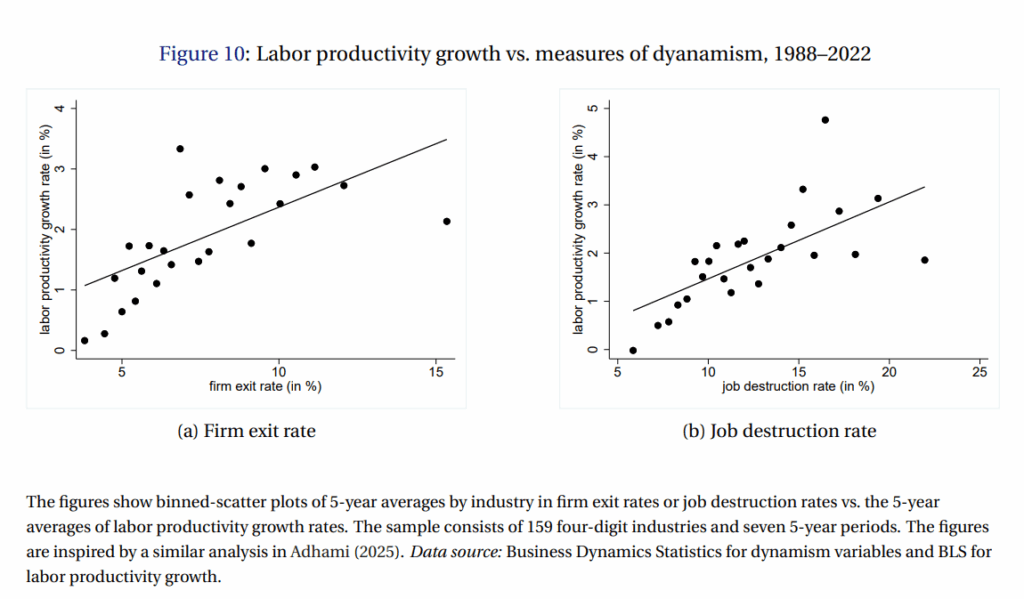
A good figure from the Nobel Prize Foundation’s Scientific Background to the Mokyr, Aghion and Howitt Nobel. The figure shows that firm exit rates and job destruction rates are positively correlated with growth in labor productivity; creative destruction in a nutshell.
What should I ask Diarmaid MacCulloch
Yes, I will be doing a Conversation with him. He has a recent book out on the history of sexuality and Christianity, but of course is renowned for a much longer series of books and writings on Christianity, the Reformation, and Tudor British history, just for a start.
Here is his Wikipedia page. So what should I ask him?
*Surviving Rome: The Economic Lives of the Ninety Percent*
By Kim Bowes, this is an excellent book, the best I know of on ordinary economic life in the Roman empire. It also shows a very good understanding of economics, unlike some forays by archeologists. Here is one excerpt:
On the income side, we’ve seen that unskilled wages, which were very low indeed, were also a very bad proxy for income. Wages were usually part of a portfolio of income, a portfolio that all family members contributed to, but one still centered on own production — either farming or textile/artisanal work. Unskilled wages supplemented own-production; they mostly weren’t equivalent to it. Roman wagges, unlike modern wages, can’t be used as a proxy for income.
Gross income from own-production, particularly farming, appears to have been much higher than previously supposed. Rotation strategies practiced by Italian and Egyptian farmers meant that per-hectare outputs were many times greater than alternate fallow models predicted, since outputs included not only wheat but also significant quantities of fodder and animals. In the northwest provinces, where rotation was less common, outputs per hectare were lower but still included some hay and larger animal herds. And every, high settlement densities and shrinking amounts of land would have urged farmers to achieve higher yields — in some places three or more times greater than previously supposed. We can’t be sure they managed this, only that low yields would have been mostly unteanble and that farmers had the tools — rotation, manuring, weeding — to achieve higher ones.
Most working class Romans, by the way, bought their clothing rather than having to make it themselves.
Recommended, you can pre-order it here.
Sunday assorted links
1. Cass Sunstein names some GOATs.
4. A theory: “Everyone under 30 is prematurely old (worried about savings, career, FIRE). Everyone over 50 is desperately young (Burning Man, psychedelics). My theory: Information abundance aged the young by showing them all future problems all at once. Information abundance also made the old young by showing them all missed experiences all at once. So now Gen Z talks like retirement planners and boomers act like teenagers. It’s so over.”
5. Further cuts at the Department of Education.
6. Spanish town bans black cat adoptions during Halloween.
7. Topkapi is a good movie. And John Woo’s Once a Thief remains underrated.
*The Loneliness of Sonia and Sunny*, by Kiran Desai
I read all the glowing reviews, and concluded it was the kind of book I probably would regard as overrated and to me dull. Then I started reading it, as indeed I will experiment and sample such things. The reviews are in fact warranted, and this is a fictional masterpiece. It is also further evidence for our current literary golden age.
You can order it here.
My choral music podcast with Rick Rubin
Here are ninety-seven minutes of me DJing choral music for Rick Rubin, and the two of us discuss each piece. From many different eras, from Perotin to the current day.
Excerpt from the discussion, this is me speaking:
“If you study 20th-century choral music, you will understand the century artistically and historically in very different terms. We often think of it as a secular or a secular-rising century, but so many of the top composers were deeply religious. They were drawn to religious music and ideas. You hear that most clearly in their choral work. It changes how you view all music and our own history; you will think of music, culture, and religion all tied together much more closely when you study choral music.”
Self-recommending!
Understanding and Addressing Temperature Impacts on Mortality
Here are some important results:
A large literature documents how ambient temperature affects human mortality. Using decades of detailed data from 30 countries, we revisit and synthesize key findings from this literature. We confirm that ambient temperature is among the largest external threats to human health, and is responsible for a remarkable 5-12% of total deaths across countries in our sample, or hundreds of thousands of deaths per year in both the U.S. and EU. In all contexts we consider, cold kills more than heat, though the temperature of minimum risk rises with age, making younger individuals more vulnerable to heat and older individuals more vulnerable to cold. We find evidence for adaptation to the local climate, with hotter places experiencing somewhat lower risk at higher temperatures, but still more overall mortality from heat due to more frequent exposure. Within countries, higher income is not associated with uniformly lower vulnerability to ambient temperature, and the overall burden of mortality from ambient temperature is not falling over time. Finally, we systematically summarize the limited set of studies that rigorously evaluate interventions that can reduce the impact of heat and cold on health. We find that many proposed and implemented policy interventions lack empirical support and do not target temperature exposures that generate the highest health burden, and that some of the most beneficial interventions for reducing the health impacts of cold or heat have little explicit to do with climate.
Those are from a recent paper by Marshall Burke, et.al.
Saturday assorted links
Rare Earths Aren’t Rare
Every decade or so there is a freakout out about China’s monopoly in rare earths. The last time was in 2010 when Paul Krugman wrote:
You really have to wonder why nobody raised an alarm while this was happening, if only on national security grounds. But policy makers simply stood by as the U.S. rare earth industry shut down….The result was a monopoly position exceeding the wildest dreams of Middle Eastern oil-fueled tyrants.
…the affair highlights the fecklessness of U.S. policy makers, who did nothing while an unreliable regime acquired a stranglehold on key materials.
A few years later I pointed out that the crisis was exaggerated:
- The Chinese government might or might not have wanted to take advantage of their temporary monopoly power but Chinese producers did a lot to evade export bans both legally and illegally.
- Firms that had been using rare earths when they were cheap decided they didn’t really need them when they were expensive.
- New suppliers came on line as prices rose.
- Innovations created substitutes and ways to get more from using less.
Well, we are at it again. Tim Worstall, a rare earths dealer and fine economist, is the one to read:
…rare earths are neither rare nor earths, and they are nearly everywhere. The biggest restriction on being able to process them is the light radioactivity the easiest ores (so easy they are a waste product of other industrial processes — monazite say) contain. If we had rational and sensible rules about light radioactivity — alas, we don’t — then that end of the process would already be done. Passing Marco Rubio’s Thorium Act would, for example, make Florida’s phosphate gypsum stacks available and they have more rare earths in them than several sticks could be shaken at.
Some also point out that only China has the ores with dysprosium and terbium — needed for the newly vital high temperature magnets. This is also one of those things that is not true. A decade back, yes, we did collectively think that was true. The ores — “ionic clays” — were specific to South China and Burma. Collective knowledge has changed and now we know that they can exist anywhere granite has weathered in subtropical climes. I have a list somewhere of a dozen Australian claimed deposits and there is at least one company actively mining such in Chile and Brazil.
…No, this is not an argument that we should have subsidised for 40 years to maintain production. It’s going to be vastly cheaper to build new now than it would have been to carry deadbeats for decades. Quite apart from anything else, we’re going to build our new stuff at the edge of the current technological envelope — not just shiny but modern.
As Tyler says, do not underrate the “elasticity of supply.”
Some simple economics of AI and macro cycles
Has AI been propping up the American economy? For instance “the Bureau of Economic Analysis’s category for investment in information processing equipment and software accounts for over 90 percent of economic growth in the first half of 2025.”
The key question is what would have been done with those resources otherwise. Regardless of their specific allocation, it is reasonable to assume they would have been allocated with considerable less urgency than the AI resources. That means more resources sitting around, with their owners exercising a bit more option value. It is probably also the case that the alternate allocations would have, on the whole, been less risky and less correlated than the AI allocations. They would have been bets on a variety of different technologies, rather than a single technology. After all, what else on the table could have been as “big” as these AI bets?
So without the AI boom yes we would have had a lower gdp growth number, but by no means do those resources just disappear. We also would have lower expected returns from the alternate resource allocations and lower risk.
Since these resource allocations seem large enough “to matter” and to create systemic risk, the American economy would have had lower returns and also lower risk. But we, collectively, opted for the scenario with higher expected returns and higher risk. (Do not think you had no role in this! You could have bid ridiculously high dollars to have the economy experiment with some new breakfast cereals instead.)
This is risk-based business cycle theory, people, much of it derived originally from Fischer Black. I wish us luck people!