Monday assorted links
1. Is Finnish youth culture turning sour?
2. Do philosophers actually think better?
3. Cross-linguistic onomatopoeias.
4. “The algae is trapped,” Knudsen explained. “It has a lot of tubes going into it. It’s controlled by chemical signals … The first time I saw it under the microscope, I wanted to join the Algae Liberation Front. I mean, it looked bad.” Link here.
5. Drinking doesn’t make you happier for long, a result from British people.
6. Attending the 2016 Esperanto conference.
7. By Jim Tankersley: recovery average is over.
Unsafe Cars Can Save Lives
Jalopnik: If seeing that a vehicle has a zero-star safety rating isn’t enough to frighten a person out of his or her mind, seeing said vehicle in a wreck probably is. Five cars designed for India—which has minimal safety requirements for vehicles—just received that number in crash testing…
The tests come from the London-based Global New Car Assessment Program…The group tested seven cars made for the Indian market and handed five of them—the Renault Kwid, Maruti Suzuki Celerio, Maruti Suzuki Eeco, Mahindra Scorpio, and Hyundai Eon, all with no airbags—a rating of zero out of five stars for adult safety…
David Ward, secretary general of Global NCAP told the Wall Street Journal:
Global NCAP strongly believes that no manufacturer anywhere in the world should be developing new models that are so clearly sub-standard,” he said. “Car makers must ensure that their new models pass the UN’s minimum crash test regulations, and support use of an airbag.
 Let’s take a closer look. These cars are very inexpensive. A Renault Kwid, for example, can be had for under $4000. In the Indian market these cars are competing against motorcycles. Only 6 percent of Indian households own a car but 47% own a motorcycle. Overall, there are more than five times as many motorcycles as cars in India.
Motorcycles are also much more dangerous than cars.
The [U.S] federal government estimates that per mile traveled in 2013, the number of deaths on motorcycles was over 26 times the number in cars.
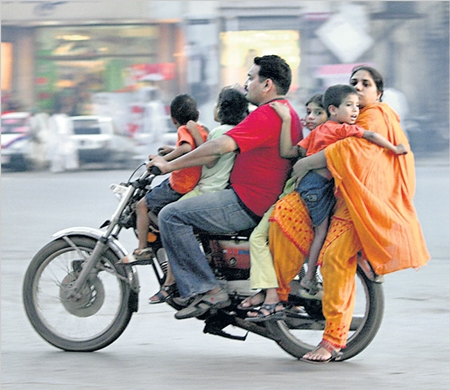
Similar ratios are found in the UK and Australia. I can think of several reasons why the ratio might be lower in India–lower speeds, for example, but also several reasons why the ratio might be higher (see picture above).
The GNCAP worries that some Indian cars don’t have airbags but forgets that no Indian motorcycles have airbags. Even a zero-star car is much safer than a motorcycle. Air bags cost about $200-$400 (somewhat older estimates here a, b, c) and are not terribly effective. (Levitt and Porter, for example, calculated that air bags saved 550 lives in 1997 compared to 15,000 lives saved by seatbelts.) At $250, airbags would increase the cost of a $5,000 car by 5%. A higher price for automobiles would reduce the number of relatively safe automobiles and increase the number of relatively dangerous motorcycles and thus an air bag requirement could result in more traffic fatalities.
A broader point is that in India today $250 is about 5% of GDP per capita ($5,700 at PPP) and that’s a high price to pay for the limited protection provided by an air bag. Lots of people in the United States wouldn’t pay $2750–5% of US GDP per capita–for an air bag. Why should Indians be any different? (Mannering and Whinston estimated U.S. willingness to pay was about $500 in the 1990s). As incomes in India rise more people will demand cars and they will demand better and safer cars but forcing people to buy an option before they are willing to pay for it is unlikely to make people better off.
Safety is relative so cars judged unsafe by global standards could save lives in India. The bigger lesson is that it’s always dangerous to impose global standards without taking into account the differing circumstances of time and place.
Military Egalitarianism: a short speculative fiction
In the Empire of Amerigo there is heated debate about the priorities of the polity.
The Egalitarians push for much higher military spending, on the grounds that many poor people around the world require Empire protection from aggressors or at the very least from severe external pressure. The Egalitarians have a subcult, called The Samanthas, who favor direct military intervention in very destructive civil wars. They are willing to cut domestic spending on social services to achieve this end, even though their founder did not draw this exact same conclusion.
The opposing party The Three-Percenters favors much higher social spending to the nation’s less fortunate citizens, who are for the most part within the global top three percent. The Three-Percenters are an openly elitist party, and they emphasize how place of birth determines an individual’s moral worth, Amerigo coming first of course with no prize for second place.
The Egalitarians have been pushing hard for affirmative action. It turns out that no one on the country’s Supreme Council has a military background, and they believe this should be rectified by an explicit system of quota. Furthermore only a few members of the legislature ever have killed another human being in service of their country. So the military point of view, as would be required to implement true egalitarian social justice, is badly underrepresented in the upper tiers of government and society.
After the great wage equalization of 2104, it became the common view that willingness to die and more importantly the willingness to kill for one’s country — or not — was the most fundamental remaining difference among citizens of Amerigo. The self-proclaimed Proud Killer Faction earns some of the lowest wages in the country, yet they continue to push for greater recognition at the federal level, realizing it is not enough to control several state governments.
So far the Three-Percenters have the more popular view, because after all humans are naturally elitist and clubbish, and so their coalition rule has remained unchallenged for several terms of government. Yet virtually all philosophers and academics back The Egalitarians, with some radicals even endorsing the Proud Killer Faction.
Addendum: There is another, now-vanquished faction of The Egalitarians, called The Medicoors. They argue the strange and indeed untenable view that those on the verge of death have almost infinitely less than anyone else, even the very poor, and so a true egalitarianism means everything should be redistributed their way to prolong their lives, even if only for a short period of time. They ruled the government for almost a century. At first they were mocked for the doctrine of being “Forward Lookers,” and then finally they were defeated by the success of their own efforts. Medical technology raised life expectancy to three hundred years of age, thereby inducing voters to think of themselves as nearly eternal, at least for the time being. Some seers have predicted that eventually the Medicoors will make a major political comeback…
Sunday assorted links
1. A major Japanese apology for a small price increase.
2. Why dirty laundry smells, paper here. And what is wrong with economic models? (ppt) Hardly anything on this topic is good, but this is.
4. Do women putt less well than men?
5. Why is there less discourse in the economics blogosphere today?
Dominican Republic markets in everything fact of the day
A 2011 Vanderbilt University survey found 22 percent of Dominican voters had been offered money or goods in exchange for their vote, the highest percentage in Latin America and the Caribbean.
After the 1996 election, former U.S. President Jimmy Carter, who led a monitoring delegation in the Dominican Republic, said he was concerned by reports of voter cards for sale; and in 2012, politician-turned-television host Taina Gautreau estimated more than 400,000 votes were bought, in an electorate of roughly 7 million.
Here is the story, via Dan Jackson.
Google Correlate
Which search terms correlate with support for which politicians? Why not at least ask this question?
John Kasich. Places that like Kasich are richer in some fairly policy-wonkish search terms: “net cost,” “renewable portfolio standard,” the economist Joseph Stiglitz, Financial Times writer Martin Wolf, and Vox writer Dylan Matthews. These terms have a ring of plausibility. They might be good fodder for small talk…if you are talking with a Kasich supporter!
But then there are terms that I don’t entirely understand: Route 73 and Haven Pizza. Maybe someone can explain those to me. It is also true that with billions of search terms to choose from, occasionally a correlation will arise by chance. These might be false positives.
Ted Cruz. Many Cruz-related search terms are related to domestic life of a certain kind: family photos, felt Christmas stockings, scentsy plug ins, balloon animals, Baby Trend car seats, and DIY cribs. Easy enchiladas are particularly Cruz-y. Mmmm, enchiladas. And udder covers…I wasn’t expecting that one. Maybe the Cruz campaign could start distributing Cruz-themed udder covers!
Donald Trump. Note that the correlations are weaker. That could be because Trump support is broad-based in the Republican Party. Or it could be that the connection between the voter and the Google-searcher is indirect (i.e. they are different individuals who live near one another).
That is from Sam Wang, via the keen-eyed Jordan Schneider. And what about the Democrats?
Near Clinton supporters it’s cheap bedroom furniture, Nicki Minaj fans, and pink hoverboard shoppers. And “career in” – Google auto-complete as a job counselor!
And the strongest correlate with Bernie Sanders support?: “candied nuts,” next in line is “best oatmeal,” ladies and gentlemen that is proof this is not just data mining and false correlations. The list is dominated by recipe terms, and “corn syrup substitute” is number four! Oh where oh where is Martin Wolf?
It is easier to forget your bad behavior — “unethical amnesia”
A study published (paywall) today (May 16) in the Proceedings of the National Academy of Sciences indicates that when we act unethically, we’re more likely to remember these actions less clearly. Researchers from Northwestern University and Harvard University coined the term “unethical amnesia” to describe this phenomenon, which they believe stems from the fact that memories of ourselves acting in ways we shouldn’t are uncomfortable.
“Unethical amnesia is driven by the desire to lower one’s distress that comes from acting unethically and to maintain a positive self-image as a moral individual,” the authors write in the paper.
To investigate, Maryam Kouchaki, a behavioral research specialist at the Kellogg School of Management at Northwestern University and her colleague Francesca Gino at Harvard Business School conducted nine separate studies with over 2,100 participants. Over the course of their work, they found that people remember the times they acted ethically, like playing a game fairly, more clearly than the times they probably cheated.
“We speculated…that people are limiting the retrieval of memories that threaten their moral self-concept and that is the reason we see pervasive ordinary unethical behaviors,” Kouchaki wrote in an email.
Here is the full story.
Saturday assorted links
1. Peak TV? And is the future of music your narcissism?
2. Not so much intergenerational mobility in Florence over the course of six centuries. And family dynasties in the Nordics.
3. Has Russia had a good monetary policy lately?
4. The Burger King culture that is Finland. And how are Nigerians dominating Scrabble?
5. The sticky self-driving car.
6. Clowns and ponies used to cheer up grumpy, delayed airport passengers.
7. John Cochrane on overtime. Many of the economists I read seem oddly reluctant to condemn — or for that matter justify — this new Obama policy. I need clowns and ponies!
Only about one-quarter of corporate stock is owned by taxable shareholders
Only about one-quarter of U.S. corporate stock is held in taxable accounts, far less than most researchers and policymakers thought. The share has declined sharply from more than four-fifths in 1965. In a report published today in the journal Tax Notes, my Tax Policy Center colleague Lydia Austin and I found the other three-quarters of shares now are held in tax-exempt accounts such as IRAs or defined benefit/contribution plans, or by foreigners, nonprofits or others.
That is Steven M. Rosenthal, here is further information.
*A Life Beyond Boundaries*,by Benedict Anderson
That is the title of his posthumous memoir, highly recommended. It is one of the best books on the charm of studying Southeast Asia, and also a very good look at how American academia rose from mediocre to excellent in the postwar era. It is short and can be consumed in a single gulp.
Here is Andrew Batson on the book. Here is Anderson on Wikipedia; he was best known as a theorist of nationalism but he also did important work on Indonesia and Thailand.
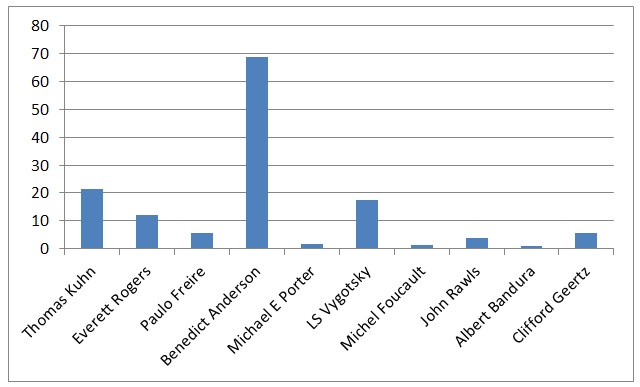
Ratio of most-cited publication to second-most-cited publication for authors among the top-10 most cited books in the social sciences:
Why isn’t there more telemedicine?
Austin Frakt tells us:
The biggest hurdle may be state medical boards. Idaho’s medical licensing board punished a doctor for prescribing an antibiotic over the phone, fining her $10,000 and forbidding her from providing telemedicine. State laws that restrict telemedicine — for instance, requiring that patients and doctors have established in-person relationships — have drawn lawsuits charging that they illegally restrict competition. Georgia’s state medical board requires a face-to-face encounter before telemedicine can be delivered, while Ohio’s does not.
A study by Julia Adler-Milstein, an assistant professor at the School of Information and the School of Public Health, University of Michigan, found that such state laws and medical board requirements influence the extent of telemedicine use by hospitals. While 70 percent or more hospitals in Maine, South Dakota, Arkansas and Alaska use telemedicine, only 13 percent in Utah and none in Rhode Island do, for instance.
In a passionate commentary on the establishment’s hesitancy to embrace telemedicine, David Asch, a University of Pennsylvania physician, pointed out that the inconvenience of face-to-face care limits its use, but arbitrarily and invisibly. The costs of waiting and travel time and those borne by rural populations with poor access to in-person care don’t appear on the books. “The innovation that telemedicine promises is not just doing the same thing remotely,” Dr. Asch wrote, “but awakening us to the many things that we thought required face-to-face contact but actually do not.”
Here is the full NYT account.
Friday assorted links
1. What we learn from collecting lots of data on San Francisco rents. And here, both are excellent and useful pieces, basically SF is ****ed.
2. How do trees sleep? Paper here: “Quantification of Overnight Movement of Birch (Betula pendula) Branches and Foliage with Short Interval Terrestrial Laser Scanning.”
3. Review of Singapore’s driverless taxis to come. And Uber knows you are willing to pay more when your battery life is low.
4. Deirdre on public bathrooms.
5. The horror markets in everything the horror.
6. Cato vindicated, apology and also broader rethink of method is due.
New York City fact of the day
Nearly three-quarters of the existing square footage in Manhattan was built between the 1900s and 1930s, according to an analysis done by KPF, an architecture firm based in New York.
That is from the new Upshot piece “Forty Percent of the Buildings in Manhattan Could Not be Built Today.”
The Developmental Roots of Conformity Bias
Michael Tomasello reviews theories of learning–some suggest that liberalism may be unnatural:
…a consistent finding in comparative studies is that human children are much more concerned than are other great apes to copy the exact actions of others, including arbitrary gestures, conventions and rituals (Tennie et al. 2009). Indeed, this tendency is so strong…when children do not see a clear goal to an actor’s action, they imitate even more precisely than if they do see a goal…
Moreover, children quickly learn to enforce arbitrary conventions and rituals:
…young children are so concerned with conformity that they will even enforce it on others, even when they themselves are not affected and the action involved is merely an arbitrary convention. For example, if children learn that on this table we play the game this way and on that table we play it another way, if a puppet then plays the game the wrong way on the wrong table, they intervene and stop him (Rakoczy, Hamann, Warneken, & Tomasello, 2010; Rakoczy, Warneken, & Tomasello, 2008)….Interestingly, when actors violate conventional norms, 3-year-olds admonish them more often if they are in-group rather than out-group members, presumably because in-group members should know better and be more committed to how “we” do it (Schmidt, Rakoczy, & Tomasello, 2011).
The enforcement of conformity is so important for young children that 5-year-olds have more positive feelings toward a norm enforcer (even though he is acting aggressively) than they do toward someone who simply lets a norm violation go (even though he is behaving in a neutral manner; Vaish, Herrmann, Markmann, & Tomasello, 2016).
In the environment of evolutionary adaptedness (EEA) an individual could not survive outside the group of their birth and so conformity was a matter of life and death. Conform or be cast out. Conformity to arbitrary convention was not in fact arbitrary but signalled affiliation. Conformity banded groups together.
Today, however, conformity is often counter-productive. Trying to enforce the arbitrary conventions of one’s in-group impedes social cooperation on the scale that makes modernity possible. Conformity also slows the development of new ideas and new ways of doing things–the essence of growth and progress. Even though conformity is now counter-productive the desire to conform and to enforce conformity is buried deep–the atavism of social justice.
Individualism and liberalism are foundational ideas for modernity but these adult ideas battle the desire to conform in our childish hearts.
Hat tip: Rolf Degen on twitter.
*Polarized: Making Sense of a Divided America*
James E. Campbell has written an excellent book on this contested and…polarizing…topic. Here is just one of many good bits:
As they [some commentators] see it, party polarization has been asymmetrical. The Republican Party allegedly has been captured by right-wing zealots while the Democratic Party has remained a reasonable center-left party. The claim of asymmetrical party polarization is half-true and completely understandable. First, there should be no mystery to asymmetry. If the parties are very competitive, as they are, and the public is skewed to the conservative end of the ideological scale, the parties should be similarly skewed. In a center-right nation, the right-wing party should be further to the right than the left-wing party is to the left. If the two parties were equally ideological, the Democrats would be in a permanent minority. That said, the increased polarization of the parties cannot be entirely attributed to the Republican Party becoming more conservative. Before the Republicans began moving to the right, Democrats had moved further to the left. Party polarization followed the staggered nature of the realignment. In the 1970s, congressional Democrats moved significantly to the left, while there was little change in congressional Republicans. The Republican shift to the right came later and was augmented by the growth of conservatism in the public. The polarization of the parties was a two-step dance — maybe three big steps: One big step to the left and two smaller steps to the right.
There is also this:
A five- or ten-percentage-point shift in ideological preferences may seem like “small potatoes,” but a nation that is 40% moderate and 60% ideological (liberal or conservative) operates quite different politically from one that is a 50-50 split.
By the way, it is sometimes noted, or noticed, that left-leaning thinkers have become crazier lately. I think overall that is true. It may be a sign that America is switching from a center-right to a center-left nation, given Campbell’s analysis above.
Recommended, due out in June from Princeton University Press. And here is Timothy Taylor on polarization.