What I’ve been reading
1. Larissa MacFarquhar, Strangers Drowning: Grappling with Impossible Idealism, Drastic Choices, and the Overpowering Urge to Help. Profiles of people who are obsessed with helping others. That is a wonderful premise for a book, somehow for my taste it didn’t run quite deep enough. Still, many people will like this one a great deal.
2. Nicholas Stargardt, The German War: A Nation Under Arms, 1939-1945. I read only about a fifth of this one. I thought it was a very high quality treatment of how German citizens perceived WWII, and also quite readable. It didn’t match my interests at the moment, but I am happy to recommend it.
3. J.M. Coetzee and Arabella Kurtz, The Good Story: Exchanges on Truth, Fiction and Psychotherapy. A running dialogue between Coetzee and a psychotherapist, some of it is interesting. Some of it. But after the early sections on the dangers of storytelling, I got bored. Surely at some point empiricial psychology deserved a mention.
4. Harry G. Frankfurt, On Inequality. A very short book, but longer than the blurb I wrote for it: “Economic equality is one of today’s most overrated ideas, and Harry G. Frankfurt’s highly compelling book explains exactly why.”
5. Philip E. Tetlock and Dan Gardner, Superforecasting: The Art and Science of Prediction. What makes some people very good at forecasting? Self-recommending, here is a good Q&A with Tetlock. The real question of course is why isn’t everyone working on this?
*The Martian*
The way the movie is good is almost the opposite of the way the book is good, so re-gear your expectations. It is the most convincing portrayal of a planet I have seen in cinema. (Planets, by the way, create erotic bonds stronger than those of actual marriages.) I enjoyed the homage shots to Bruce Dern and Silent Running, Brian De Palma’s underrated Mars film too. The horizon images of earth toward the end come as an ecstatic jarring relief. They are, by the way, aiming for the China market with a plot twist that almost seems satirical except in Beijing it is dead serious. That this film is sometimes dramatically inert is beside the point, recommended.
France fact of the day
…mergers aside, the youngest firm in the CAC 40, the main stock index, was founded in 1967.
That is from The Economist., via James Pethokoukis.
Sunday assorted links
1.Using remote sensing to police auto emissions (pdf).
2. How do blue whales stay so fat on such tiny food?
3. Thwarted MIE: grandparents try shelling out 10k for naming rights to grandson. As for parents: “They are paying consultants such as Ms. Korwitts to choose a name, testing ideas as if they were marketing slogans with college admissions officers, and creating new monikers just because they like the sound.”
The rise of the private coach at university
I have been predicting this, Emma Jacobs covers it in the FT:
This new breed of tutors catering to undergraduates is growing (admittedly from a low base). Once the guilty secret of schoolchildren seeking to get into selective schools or gain top marks in exams, private tutors are now helping British undergraduates and even postgraduates at universities. As many teenagers and twenty-somethings start their new university terms, some will be seeking the help of tutors, like Ms Kasson. Some even assist graduates applying for jobs in banks and professional services firms.
Edd Stockwell, co-founder of Tutorfair, a non-profit organisation that also provides tutoring to children whose parents cannot afford the fees, has seen the number of requests for degree-level tutorials double in the past year. Luke Shelley, director of Tavistock Tutors, says its services for undergraduates have grown “rapidly” in the past six years.
There will be very large classes, such as MOOCs and based on the kind of resources you find on MRUniversity.com. And there will be very small classes, perhaps of one or two. It’s the in-between class size, of say two hundred students, that doesn’t always make sense.
Do however note this:
In Ms Mali’s experience it is the parents that are driving the undergraduate tuition business. “Sometimes you do wonder if [the child would be more successful] if they allowed them to fail.”
This is an under-discussed point in today’s ideological environment.
The incompetence of thieves
I investigate self-reported theft data in the NLSY 1997 Cohort for the years 1997–2011. Several striking patterns emerge. First, individuals appear to be active thieves for extremely short periods – in most cases in only one year, and fewer than 5% of thieves for more than three years out of the 15 years of data. Second, self-reported earnings from theft are generally very low and there is little evidence of “successful” criminals or consistent earnings from theft. Third, measures that proxy impatience (smoking, for example) are highly correlated with theft. Fourthly, thieves and non-thieves have similar earnings during the years of peak theft activity, but thieves have lower earnings in their late 20s (after most have long since stopped committing theft). Attrition of survey respondents, underreporting and incapacitation effects do not appear to explain this. There may be “professional thieves” too rare to show up in even large samples such as the NLSY. Theft in the United States thus appears to be substantially a phenomenon of individuals entering a temporary period of intensified risk-taking in adolescence.
That is from a new Geoffrey Fain Williams paper in JEBO, via the excellent Kevin Lewis. Kevin also links to new evidence that concealed carry laws are orthogonal to crime rates.
Saturday assorted links
1. Japan will have some driverless taxis fairly soon it seems.
2. Lengthy Steve Pearlstein profile of Olivier Blanchard.
4. Interview with Colm Toibin.
5. What kind of error is a sticky price?
6. Alice Chen, Emily Oster, and Heidi Williams on why infant mortality is higher in the United States (pdf).
7. Dani Rodrik slides on what we know about structural reform (pdf).
Dare I suggest that eighty percent of the world is run on this basis?
Despite the cloud cast by the Volkswagen scandal, automakers are proposing that they be allowed a 70 percent increase in the nitrogen oxides their cars emit, unreleased documents show, as part of new European pollution tests.
Under the new plan, cars in Europe would for the first time be tested on the road, using portable monitoring equipment, in addition to laboratory testing.
The automakers, which include Volkswagen, General Motors, Daimler, BMW, Toyota, Renault, PSA Peugeot Citroën, Ford and Hyundai, are essentially conceding what outside groups have said for some time — that the industry cannot meet pollution regulations when cars are taken out of testing laboratories.
Here is the Danny Hakim NYT story.
Japan (America) fact of the day
Japanese females quietly overtake American females in terms of #labor force participation.
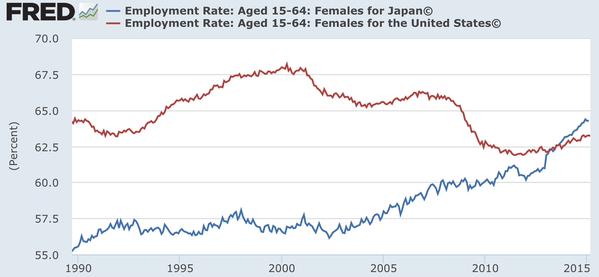
Noah writes: Note the big jump and trend break when Abe took office.
Credit scores and committed relationships
This paper presents novel evidence on the role of credit scores in the dynamics of committed relationships. We document substantial positive assortative matching with respect to credit scores, even when controlling for other socioeconomic and demographic characteristics. As a result, individual-level differences in access to credit are largely preserved at the household level. Moreover, we find that the couples’ average level of and the match quality in credit scores, measured at the time of relationship formation, are highly predictive of subsequent separations. This result arises, in part, because initial credit scores and match quality predict subsequent credit usage and financial distress, which in turn are correlated with relationship dissolution. Credit scores and match quality appear predictive of subsequent separations even beyond these credit channels, suggesting that credit scores reveal an individual’s relationship skill and level of commitment. We present ancillary evidence supporting the interpretation of this skill as trustworthiness.
That is a new Fed working paper (pdf) by Jane Dokko, Geng Li, and Jessica Hayes.
Friday assorted links
1. Why aren’t American ports more automated?
2. “…diplomacy can be a tool for addressing shared interests in a constructive manner. As a means of further exploring this idea, the Charles Koch Foundation is currently welcoming proposals from graduate students, faculty, and other policy researchers who are interesting in analyzing the costs and benefits of different approaches to foreign policy.” Link for that text is here.
4. How many Americans will receive drones for Christmas?
5. What do crows know of death?
6. John Cochrane on nudge and spam.
7. New Borio paper arguing that low interest rates erode bank profitability (pdf). And some points from the new Bernanke memoir.
Quick thoughts on the new employment report
1. Labor force participation is down once again, and we cannot dismiss the notion that a new recession may be starting. That said, at current margins I am not sure the traditional distinction between cyclical and structural factors still makes sense, so that word “recession” may be more misleading than illuminating.
2. Scott Sumner noted: “Some die hard opponents of “The Great Stagnation” had held out hope that a fall in U-6 unemployment (the broadest measure) would propel future growth. Now even that option is mostly gone, as it plunged to 10.0% in September, the same level as in February 1996.) It will go a bit lower, but it no longer represents a large cache of workers waiting in the wings to propel us forward. Get ready for the new normal—3.0% NGDP growth—it’s coming soon.”
3. There is no wage acceleration gain to be seen in the report.
4. Paul Krugman is (correctly) morphing back into more of a supply-side interpretation of secular stagnation: “Second, secular stagnation — persistent difficulties in achieving full employment — is a real concern if potential growth is slowing due to a combination of demography and weak technological progress, which seems to be happening. Lower growth means lower investment demand, so getting the private sector to spend enough gets harder.”
5. The case for a Phillips curve appears weaker than ever.
6. There is more and more evidence that we’ve shifted into a new regime where wage growth for most income classes simply doesn’t happen to any significant degree. This may not last forever, but it remains the status quo and too many people find it too hard to wrap their heads around that. That to me is the single biggest takeaway.
Neil Irwin at the NYT summarizes the report.
Corporate Prediction Markets Work Well
Prediction markets predict public events such as election outcomes better than do polls or other forecasting mechanisms. Internal corporate prediction markets in events such as sales forecasts, product launch times, and product feature demand have been less well studied. Internal corporate markets tend to have fewer participants than public markets and the participants often have strategic interests and biases. Thus, it has been an open question how well these markets operate.
Cowgill and Zitzewitz report on a number of different types of prediction markets run by Google, Ford and Firm X and although they find evidence for some biases they also find that corporate prediction markets also work better than alternative forecasting methods.
Despite large differences in market design, operation, participation, and incentives, we find that prediction market prices at our three companies are well calibrated to probabilities and improve upon alternative forecasting methods. Ford employs experts to forecast weekly vehicle sales, and we show that contemporaneous prediction market forecasts outperform the expert forecast, achieving a 25% lower mean-squared error (p = 0.104).
…The strong relative predictive performance of the Google and Ford markets is achieved despite several pricing inefficiencies. Google’s markets exhibit an optimism bias. Both Google and Ford’s markets exhibit a bias away from a naive prior (1/N, where N is the number of bins, for Google and prior sales for Ford). However, we find that these inefficiencies disappear by the end of the sample. Improvement over time is driven by two mechanisms: first, more experienced traders trade against the identified inefficiencies and earn higher returns, suggesting that traders become better calibrated with experience. Secondly, traders (of a given experience level) with higher past returns earn higher future returns, trade against identified inefficiencies, and trade more in the future. These results together suggest that traders differ in their skill levels, they learn about their ability over time, and self-selection causes the average skill level in the market to rise over time.
Addendum: It’s an interesting commentary on academic publishing that Marginal Revolution first covered this paper in a working version in 2008! An extended version was received by the Review of Economic Studies in 2010 which accepted a final version in 2014 and then published the paper in 2015.
Jason Furman and the CEA on the investment drought
Here is a pdf of his remarks, with useful graphs, excerpt:
So in recent quarters, the investment story has been about oil. But drilling cannot explain the broader trends over the past five years. Since 2010, most of the step down in investment growth was attributable to reduced growth in equipment investment, as shown in Figure 6. At the same time, intellectual property products investment has been accelerating and over the last four quarters it grew 7.3 percent, the fastest pace since 2005. In fact, stronger growth in intellectual property products investment has partially offset the slower growth in equipment investment over the past two years. Intellectual property products consists of about 45 percent research and development (R&D) investment, 45 percent software investment, and 10 percent artistic originals.
Yet if you look to Figure 8 on p.7, you can see that the overall trajectory for fixed business investment is not entirely positive, even worse if Figure 11 on p.10 (alas I cannot get them to reproduce in this post). The bottom line is this:
…today’s gross investment is 2.3 percentage points lower than its historical average…Investment net of depreciation as a share of GDP was already lower than its historical average going into the recession and today remains well below its historical average…
You will find many (appropriate) caveats in the study itself, most of all that investment in software may be different, although this can cut either way. Software has been improving rapidly, but it is also not very durable as business investments go.
Addendum: Paul Krugman comments.
A free trade agreement for South Asia?
Are free trade agreements contagious? The negotiations for TPP seem to be coming to a close, but there is the potential for a much more beneficial arrangement, namely for the subcontinent and thereabouts, can we toss in Ethiopia too?
India has said that all South Asian economies need to speedily work towards a free trade area within the region with a defined time-line, preferably 2020, as the first step towards achieving the joint vision of a South Asian Economic Union.
“I am confident that consensus can be achieved for a defined time-line for 100 per cent tariff liberalisation with special and differential treatment for Least Developed Countries (LDCs) and vulnerable economies,” Commerce & Industry Minister Nirmala Sitharaman said at the South Asia Economic Conclave organised by the Commerce Ministry and industry body CII on Tuesday.
While India has already allowed duty-free access to goods from LDC countries of South Asia as part of the South Asia Free Trade Agreement (SAFTA), it is ready to go to 100 per cent for non-LDCs, too, as per the Safta roadmap agreed by India with Pakistan in November 2012, Sitharaman said.
…At least four of the eight SAARC countries — which include India, Pakistan, Sri Lanka, Maldives, Nepal, Bhutan, Bangladesh and Afghanistan — are looking at a free trade area by 2020. India is willing to take asymmetric responsibility towards achieving the goal, she added.
The full story is here.