What should we think of the Chinese cap and trade announcement?
You’ll find a list of skeptical worries here from Chris Buckley, most of them justified. In a nutshell, if you can’t believe their gdp numbers you also can’t believe their cap and trade plan. I am nonetheless more optimistic about this recent development. It signals a few things:
1. The Chinese have decided to make “doing something about carbon” a potential source of soft power in the international arena. They are giving themselves an option on this path, and in the meantime trying to minimize the reputational deficit they face from being the world’s largest source of carbon.
2. The Chinese plan to cut pollution in at least some of their major cities soon, and they want to claim credit for that action in advance. (In fact they are surprised how rapidly some of those days of blue skies have appeared in Beijing, whether that be the added regulation or the economic slowdown.) “Carbon emissions” and “pollution” are hardly identical, but still the government is repositioning itself rapidly on the issue of pollution more generally. This is one welcome part of that broader shift, so don’t worry if not all the details add up.
3. The Chinese leadership expects the domestic economy to be weak for a while, so they can announce a semi-serious carbon cap and meet it, without actually giving up any economic growth. Of course this #3 isn’t good news on the economic front, but maybe the Chinese government first does need a period of time where such a policy has zero economic cost.
The evidence from the European Union is that their cap and trade program hasn’t worked well, mostly because of time consistency problems, namely that more and more permits are issued and the cap ends up weak over time. That same problem may or may not apply to China. But even a strong pessimist about cap and trade can be modestly optimistic about the new Chinese announcement.
Is this the most effective development program in history?
I will turn the mike over to Chris Blattman:
It’s a business plan competition for $50,000, and I think it’s a contender.
In 2011 the Nigerian government handed out 60 million dollars to about 1200 entrepreneurs, and three years later there are hundreds more new companies, generating tons of profit, and employing about 7000 new people.
David McKenzie did the incredible study.
24,000 Nigerians applied, the government selected about 6,000 to get some training and advice to develop their plan, the plans were scored, and about 1,200 were funded. They got an average of $50,000 each. Fifty thousand US dollars! Who the hell thought this was a good idea?
All the highest scoring plans got funded automatically, but McKenzie worked with the government to randomize among the runners up.
The results are amazing. Looking just at the people who had no firm to begin with, 54% of the control group have a firm after three years, compared to 93% of those who got the grant. And these firms are bigger. Just 11% of the control group have a firm with at least 10 employees, compared to 34% of those who got the grant. They’re more profitable too.
If you are the President of a developing country, one of the great problems that will occupy your thoughts is: how to get more people jobs? How to grow domestic businesses? Even I, Mr. Cash, did not think big grants would be the answer.
These entrepreneurs are not the deserving poor, to be sure, but the employees are more likely to be. They made $143 a month, so they probably weren’t the poorest of society. But 7000 people earning $7 a day they might not have earned otherwise—that is something. And this ignores the multiplier: the expansion of suppliers, the people employed by the 7000 employees spending that money, the taxes collected by the state, and so on.
Two other things occur to me:
-
What if, in 10 years, we learn that after all the struggle to build infrastructure and services and other stuff was bullshit, and ALL ALONG we should have just been funneling more cash to the middle and bottom. I do not believe the cashonistas should go so far, but today I wonder.
-
I should start responding to all the emails I get from Nigerians promising me $50,000 in cash.
*The Economist* endorses ngdp targeting
…it makes sense to look beyond inflation—and to consider targeting nominal GDP (NGDP) instead…
A target for nominal GDP (or the sum of all money earned in an economy each year, before accounting for inflation) is less radical than it sounds. It was a plausible alternative when inflation targets became common in the 1990s. A target for NGDP growth (ie, growth in cash income) copes better with cheap imports, which boost growth, but depress prices, pulling today’s central banks in two directions at once. Nominal income is also more important to debtors’ economic health than either inflation or growth, because debts are fixed in cash terms. Critics fret that NGDP is hard to measure, subject to revision, and mind-bogglingly unfamiliar to the public. Yet if NGDP sounds off-putting, growth in income does not. And although inflation can be measured easily enough, central banks now rely nearly as much on estimates of labour-market “slack”, an impossibly hazy number. Most important, an NGDP target would free central banks from the confusion caused by the broken inflation gauge. To set policy today central banks must work out how they think inflation will respond to falling unemployment, and markets must guess at their thinking. An NGDP target would not require the distinction between forecasts for growth (and hence employment) and forecasts for inflation.
There is more here, congratulations to Scott Sumner and others…
Saturday assorted links
1. Is monetary policy mainly boosting foreign borrowing? And what do MacArthur geniuses do with the money?
2. Internet competition can raise prices (beware intuitive economics).
3. Some CRISPR advances. And more Black Mirror is on the way.
4. The Chinese version of what we’ve agreed to.
5. Vaclav Smil talk.
Why has deflation returned to Japan?
Japan Times reports:
Consumer prices excluding fresh food fell 0.1 percent in August from a year earlier, the first drop since April 2013, the same month Kuroda embarked on a campaign of record asset purchases to rid Japan of its “deflationary mindset.”
My goodness is economics a difficult subject. (Scott Sumner is implicitly surprised too.) So why is this happening?
Many of you might be tempted to utter some version of the words “liquidity trap.” Even if this is one of the more reasonable versions of the liquidity trap arguments, there remains a problem.
Liquidity trap arguments imply that someone’s marginal utility of holding money is basically flat, whether that be the banks, the bank shareholders, the customers — someone. And the flatness holds for a bunch of relevant someones, not just a few people. (Or is that a flat marginal utility curve for “money plus safe short-term bonds“? Whatever.) With a flat marginal utility curve of money there are multiple equilibria, just as multiple equilibria more generally plague liquidity trap models. Velocity could be something other than what it is, because at higher or lower levels of cash balance holdings the rate of return on those holdings still would be the same.
Institutional frictions may play a role in setting the equilibrium. So why an equilibrium with falling prices? Prices are sticky to some extent, which tends to militate against those of the multiple equilibria where prices are falling. One might expect the equilibrium where the aggregate of prices rises, if only slowly. But then why would a slightly higher rate of price inflation turn back down to a lower rate?
A second view is that the money supply/credit supply is endogenous, a’ la Fischer Black, Basil Moore, and others. Until the real economy does better, the force of M times V will be weak. This view involves no particular commitment to the slope of the marginal utility of money schedule. Post 2013, prices went up for a while, because people thought Abenomics might work, but now that they see it doesn’t prices are sliding back down again.
Yet a third view is that the Japanese simply haven’t tried hard enough yet to debase their currency, see for instance Krugman on credibility or various Scott Sumner posts. In this context I would myself cite gerontocracy rather than credibility issues.
My best guess is that some version of #3 makes #2 true at the relevant margin, but I don’t think such matters are well understood.
Addendum: Scott Sumner comments, for any plausible measurement I still say the rate of price inflation is relatively low in a puzzling manner, relative to asset purchases. Large increases in money are in principle capable of offsetting relative small declines in food and energy prices, and if they do not that is simply another way of restating the puzzle.
Left-wing critique of effective altruism
I very much enjoyed the new LRB piece by Amia Srinivasan. Here is a good “standing on one foot” statement of what effective altruism recommends:
The results of all this number-crunching are sometimes satisfyingly counterintuitive. Deworming has better educational outcomes among Kenyan schoolchildren than increasing the numbers of textbooks or teachers. If you want to improve animal welfare, it’s better to stop eating eggs than beef, since caged layer hens live worse lives than farmed cows, and because eating eggs consumes more animals than eating beef: the average American consumes 0.8 layer hens but only 0.1 beef cows per year. Buying Fairtrade goods can be worse than buying regular goods, since the extra cost goes mostly to middlemen rather than farmers, and when it doesn’t, it benefits farmers in relatively rich countries: because Fairtrade standards are hard to meet, most Fairtrade coffee production comes from Mexico and Costa Rica rather than, say, Ethiopia, where the marginal pound would go much further. The green value of buying locally grown food is overblown, too, since transport accounts for only 10 per cent of the carbon footprint of food, while 80 per cent of it is generated in production; tomatoes grown in the UK can have five times the carbon footprint of tomatoes shipped from Spain because of the energy required to hothouse them. If you’re really committed to minimising your carbon footprint, MacAskill recommends donating to the carbon offsetting charity Cool Earth; he estimates that the average American could offset all his carbon emissions by donating $105 a year. There isn’t much point in unplugging your electricals, either: leaving your mobile phone charger plugged in for a whole year contributes less to your carbon footprint than one hot bath.
And here is part of the critique:
MacAskill is evidently comfortable with ways of talking that are familiar from the exponents of global capitalism: the will to quantify, the essential comparability of all goods and all evils, the obsession with productivity and efficiency, the conviction that there is a happy convergence between self-interest and morality, the seeming confidence that there is no crisis whose solution is beyond the ingenuity of man. He repeatedly talks about philanthropy as a deal too good to pass up: ‘It’s like a 99 per cent off sale, or buy one, get 99 free. It might be the most amazing deal you’ll see in your life.’ There is a seemingly unanswerable logic, at once natural and magical, simple and totalising, to both global capitalism and effective altruism. That he speaks in the proprietary language of the illness – global inequality – whose symptoms he proposes to mop up is an irony on which he doesn’t comment. Perhaps he senses that his potential followers – privileged, ambitious millennials – don’t want to hear about the iniquities of the system that has shaped their worldview. Or perhaps he thinks there’s no irony here at all: capitalism, as always, produces the means of its own correction, and effective altruism is just the latest instance.
Not my view, but well written as a piece and definitely recommended. Here is comment from Scott Alexander.
Italy fact of the day
The Catholic church is estimated to own twenty percent of all real estate in Italy, and a quarter of all real estate in Rome.
That is from Alexander Stille’s new piece on Pope Francis and the Vatican.
Friday assorted links
*By Steppe, Desert, and Ocean: The Birth of Eurasia*
By Barry Cunliffe, due out in November. I’m counting the days…
The culture that is America (Googling for God)
In the United States, there is more interest in heaven than in hell, at least based on searches. There are 1.5 times more searches for “heaven” than “hell,” 2.8 times as many searches asking what heaven looks like than what hell looks like, and 2.75 times as many searches asking whether heaven is real than whether hell is real.
…Relative to the rest of the country, for every search I looked at, retirement communities search more about hell. In retirement communities, there are a similar number of searches asking to see visuals of hell as visuals of heaven.
And:
There are 4.7 million searches every year for Jesus Christ. The pope gets 2.95 million. There are 49 million for Kim Kardashian.
That is from Seth Stephens-Dawidowitz.
Just how guilty is Volkswagen?
I have a few points:
1. There is decent evidence that many other car companies have done something similar. Read this too. Besides, Volkswagen committed a related crime in 1973. When I was a teenager (maybe still?), it was commonly known that New Jersey service stations would help your car pass the emissions test if you slipped them a small amount of money. So we shouldn’t be shocked by the new story. The incentive of the agencies is to get the regulations out the door and to avoid subsequent bad publicity, not to actually solve the problem. So yes, there is a “regulation ought to be tougher” framing, but there is also a “we’ve been overestimating the benefits of regulation” framing too. Don’t let your moral outrage, which leads you to the former lesson, distract you from absorbing some of the latter lesson too.
2. We are more outraged by deliberate attempts to break the law, compared to stochastic sloppiness leading to mistakes and accidents. But it is far from obvious that the egregious violations should be punished more severely in a Beckerian framework. In fact, if they are harder to pull off, compared to sheer neglect, perhaps they should be punished less severely, at least from a utilitarian point of view. I am not saying we should discard our intuitions about relative outrage, but we ought to look at them more closely rather than just riding them to a quick conclusion. I’ve seen it noted rather frequently that the head of the supervisory committee at Volkswagen is named Olaf Lies.
3. Don’t think this is just market failure, it springs from a rather large government subsidy program. Clive Crook makes a good point:
Remember that “clean diesel” was a government-led initiative, brought to you courtesy of Europe’s taxpayers. And, by the way, the policy had proved a massively expensive failure on its own terms even before the VW scandal broke.
…At best, the clean-diesel strategy lowered carbon emissions much less than hoped, and at ridiculous cost; at worst, as one study concludes, the policy added to global warming.
4. One back of the envelope estimate is that the added pollution killed 5 to 23 Americans each year. Now I don’t myself think we should always or even mostly use economic methods to value human lives. But if you wish to play that cost-benefit game, maybe here we have $25 million to $100 million in economic value a year destroyed. It’s not uncommon to spend $100 million marketing a bad Hollywood movie. So in economic terms (an important caveat), this is a small event. Most of the car pollution problem comes from older vehicles with poor maintenance, not fraud on the newer tests. It also seems (same link) that diesel engines are 95% cleaner since the 1980s.
5. The German automobile sector exported about $225 billion in 2014. That’s almost as big as Greek gdp.
6. Manipulated data will be one of the big, big stories of the next twenty years, or longer.
7. It is worth citing Glazer’s Law, which is designed to classify explanations for microeconomic puzzles: “It’s either taxes or fraud”
This one isn’t taxes.
China fact of the day
The country’s stocks listed in Hong Kong are trading below book value…
The full FT story by James Mackintosh is here.
Generic Drug Regulation and Pharmaceutical Price-Jacking
The drug Daraprim was increased in price from $13.60 to $750 creating social outrage. I’ve been busy but a few points are worth mentioning. The drug is not under patent so this isn’t a case of IP protectionism. The story as I read it is that Martin Shkreli, the controversial CEO of Turing pharmaceuticals, noticed that there was only one producer of Daraprim in the United States and, knowing that it’s costly to obtain even an abbreviated FDA approval to sell a generic drug, saw that he could greatly increase the price.
It’s easy to see that this issue is almost entirely about the difficulty of obtaining generic drug approval in the United States because there are many suppliers in India and prices are incredibly cheap. The prices in this list are in India rupees. 7 rupees is about 10 cents so the list is telling us that a single pill costs about 5 cents in India compared to $750 in the United States!
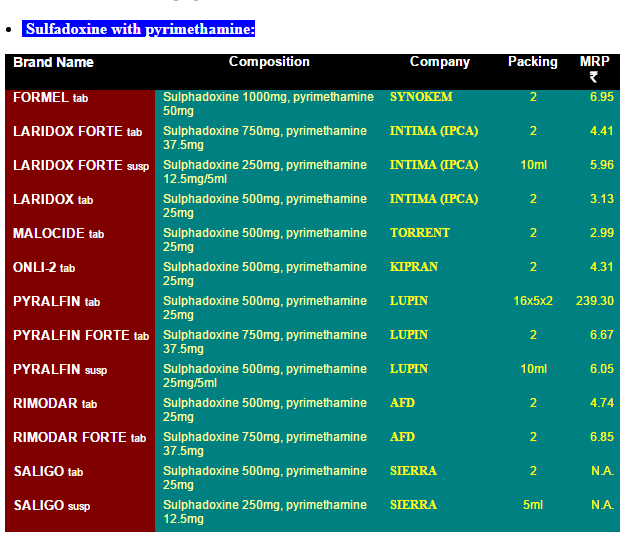
It is true that there are real issues with the quality of Indian generics. But Pyrimethamine is also widely available in Europe. I’ve long argued for reciprocity, if a drug is approved in Europe it ought to be approved here. In this case, the logic is absurdly strong. The drug is already approved here! All that we would be doing is allowing import of any generic approved as such in Europe to be sold in the United States.
Note that this is not a case of reimportation of a patented pharmaceutical for which there are real questions about the effect on innovation.
Allowing importation of any generic approved for sale in Europe would also solve the issue of so-called closed distribution.
There is no reason why the United States cannot have as vigorous a market in generic pharmaceuticals as does India.
Hat tip: Gordon Hanson.
Thursday assorted links
1. Competing to write the smallest chess program (hate).
2. Smart camera stops you from taking ordinary, cliched photographs.
3. Clifford Asness on carried interest.
4. A critique of the sexual assault survey.
5. Animals attacking drones (video).
6. Is the world running out of workers? (speculative, and probably wrong, but worth a read) And how does the welfare state affect the family?
Breaking Bad: Are Meth Labs Justified in Dry Counties?
A new paper from Fernandez, Gohmann and Pinkston shows that counties in Kentucky that forbid alcohol have more meth labs than otherwise similar counties. I like the research but in truth any paper with both Breaking Bad and Justified references is a winner in my book.
Abstract: This paper examines the influence of local alcohol prohibition on the prevalence of methamphetamine labs. Using multiple sources of data for counties in Kentucky, we compare various measures of meth manufacturing in wet, moist, and dry counties. Our preferred estimates address the endogeneity of local alcohol policies by using as instrumental variables data on religious affiliations in the 1930s, when most local-option votes took place. Alcohol prohibition status is influenced by the percentage of the population that is Baptist, consistent with the “bootleggers and Baptists” model. Our results suggest that the number of meth lab seizures in Kentucky would decrease by 24.4 percent if all counties became wet.
The authors suggest that alcohol users who buy alcohol in places where it is banned become acculturated and familiar with illegal networks making it easier for them to buy meth. In a reverse of the usual story, alcohol prohibition becomes the gateway to other illegal activities.
In my interpretation, however, the association of meth labs and alcohol prohibition is due more to supply side factors than demand side factors. In particular, a long history of moonshine production in dry Kentucky counties leads to an accumulation of knowledge about where to hide the labs, how to evade the law and who to bribe. In this version of the theory, lifting alcohol prohibition doesn’t necessarily reduce meth production because the knowledge and the networks remain in place.
A modified version of the theory can combine demand and supply factors. If there are economies of scope between alcohol production and meth production (such as bribes to local police) then a reduction in the demand for moonshine will raise the costs of producing meth.
Understanding which of these theories holds would make an important contribution to the industrial organization of illegal goods and would also have implications for how best to combat illegal good production.