Thursday assorted links
1. China markets in everything, gift edition.
2. “I do not normally buy foals, let alone embryos.”
3. The plurality of obesity epidemics.
4. Mexico hands out ten million flat screen TVs. Finland will experiment with a guaranteed annual income.
5. Susan Woodward on Armen Alchian.
6. An actual “rock star” professor, or at least he tries.
7. The slowdown in Israeli economic growth. And what’s up with Belgium? Macedonia is mobilizing its army against immigrants. “Separately, Slovakia announced yesterday that it will only accept Christian refugees to the country.“
Do fiscal transfers or markets contribute more to stabilization?
Martin Sandbu reports from the FT:
IMF research shows there is indeed more risk-sharing in federal countries such as the US and Germany. Eighty per cent of local economic fluctuations are smoothed in those countries, against 40 per cent between eurozone countries. In other words local consumption suffers only 20 per cent of any hit to local GDP (against 60 per cent for eurozone countries). Most of this smoothing, however, happens through private channels. Banks, credit markets and investments insulate disposable resources. Fiscal insurance, in contrast, only compensates for 15 per cent of local downturns in the US, and just 10 per cent in Germany. Daniel Gros has concluded that achieving US-style fiscal risk-sharing “would be of very limited usefulness” to absorb shocks in the eurozone.
The (gated) article is of interest more generally. I look forward to Sandbu’s new book, Europe’s Orphan: The Future of the Euro and the Politics of Debt, forthcoming from Princeton University Press this October.
Starting over from Katrina
One of the tragedies of Katrina was that so many of New Orleans’ residents were forced to move. But the severity of that tragedy is a function of where they were forced to move to. Was it somewhere on the Salt Lake City end of the continuum? Or was it a place like Fayetteville? The best answer we have is from the work of the sociologist Corina Graif, who tracked down the new addresses of seven hundred women displaced by Katrina—most of them lower-income and black. By virtually every measure, their new neighborhoods were better than the ones they had left behind in New Orleans. Median family income was forty-four hundred dollars higher. Ethnic diversity was greater. More people had jobs. Their exposure to “concentrated disadvantage”—an index that factors in several measures of poverty—fell by half a standard deviation.
That is from Malcolm Gladwell, interesting throughout.
Germany fact of the day, will support for immigration collapse?
Berlin has said it expects to receive a record 800,000 asylum seekers this year, more than the entire EU combined in 2014, laying bare the scale of the biggest refugee crisis to face the continent since the second world war.
Whether you consider this “good news” depends on what you are comparing it to. Most of all, we would prefer a situation where not so many people wanted asylum. In the meantime, my fear is that this immigration will not proceed in an orderly manner, and the backlash against immigration will grow stronger yet. I do not expect 2017 to resemble 2015; “unorthodox arrivals” to Europe were three times higher this July than last and at some point that process will be stopped, no matter what our moral judgment of the situation.
Interior minister Thomas de Maizière warned that the Schengen zone, which allows passport-free travel across much of mainland Europe, could not be maintained unless EU states agreed to share asylum seekers.
The Schengen agreement of course has been the best achievement of immigration policy in a long time. But can the European Union agree on a coherent asylum policy, and furthermore one which removes some of the relative burden from Germany and the UK? Keeping relatively free immigration does in fact require a good deal of regulation, most of all in Europe, but those same governments are not always good at regulating.
Here is some bad polling news from Sweden. Trouble is afoot in other corners too:
Authorities in Hungary said this week they would dispatch thousands of “border hunters” to arrest migrants entering the country from Serbia.
The forces, drawn from the Hungary’s police, will patrol the 175km long border with Serbia, where soldiers and labourers are building a 4m high razor-wire fence to keep out an estimated 300,000 migrants expected to arrive in the country this year.
I think of these developments as a good illustration of why an attempt at truly, fully open borders probably would, due to backlash, result in a lower level of immigration than the pro-immigration, immigration-increasing, low-skilled immigration increasing policies I favor. But the idea of maximizing subject to a backlash constraint is unpopular in libertarian circles, let me tell you, including at GMU lunch table. Nonetheless we are learning, I am sorry to say, that the backlash constraint is more binding than many of us had thought.
This all remains an under-reported story in many American newspapers, Even with Donald Trump still leading in the polls, it is not understood what a prominent role images of Calais are playing in British national debate. I don’t see all this as leading to anything good.
The cultural apocalypse that wasn’t
According to the O.E.S., songwriters and music directors saw their average income rise by nearly 60 percent since 1999. The census version of the story, which includes self-employed musicians, is less stellar: In 2012, musical groups and artists reported only 25 percent more in revenue than they did in 2002, which is basically treading water when you factor in inflation. And yet collectively, the figures seem to suggest that music, the creative field that has been most threatened by technological change, has become more profitable in the post-Napster era — not for the music industry, of course, but for musicians themselves.
That is from Steven Johnson, the piece is excellent throughout. And note this:
The new environment may well select for artists who are particularly adept at inventing new career paths rather than single-mindedly focusing on their craft.
Are tenure track professors better teachers?
At least at Northwestern University, the answer seems to be no. Figlio, Schapiro, and Soter report:
This study makes use of detailed student-level data from eight cohorts of first-year students at Northwestern University to investigate the relative effects of tenure track/tenured versus contingent faculty on student learning. We focus on classes taken during a student’s first term at Northwestern and employ an identification strategy in which we control for both student-level fixed effects and next-class-taken fixed effects to measure the degree to which contingent faculty contribute more or less to lasting student learning than do other faculty. We find consistent evidence that students learn relatively more from contingent faculty in their first-term courses. This result is driven by the fact that the bottom quarter of tenure track/tenured faculty (as indicted by our measure of teaching effectiveness) has lower “value added” than their contingent counterparts. Differences between contingent and tenure track/tenured faculty are present across a wide variety of subject areas and are particularly pronounced for Northwestern’s averages and less-qualified students.
Emphasis is added by me. I wonder how much of the problem is that the bottom quarter of the tenure track instructors are more likely not to have English as a first language?
The pointer is from Ben Southwood.
Are reading texts becoming harder or simpler?
Robert J. Stevens, et.al. have done a pretty serious study of this question, based on computer analysis of texts, and here is their key conclusion:
From about 1930 through 1960 or 1970, the cognitive demands of reading curricula changed little…
In the period of 1970 through 2000 we observed a fairly consistent increase in the difficulty of reading text and comprehension tasks, particularly at third grade.
For sixth graders, however, reading texts were somewhat more complex in the 1910-1930 period.
I also found this comparison interesting:
In the 1920s, 45% of all questions asked were explicit detail questions, whereas by 1990 and 2000 curricula, that had diminished to only 8% of the questions asked.
Alas I can no longer remember who deserves thanks for this pointer. Here is an earlier Alex post about whether TV shows are becoming more complicated.
Wednesday assorted links
What is China’s Unemployment Rate?
What is China’s Unemployment Rate? 4.1% For what month, what year? Doesn’t matter the answer is still 4.1%. That’s a slight exaggeration but for the last 3 years the unemployment rate has been 4.1% almost every month. Indeed, since 2002 the official unemployment rate has varied between 3.9% and 4.3%, an absurdly smooth series.
In contrast to the unemployment rate, China’s GDP growth rate has had massive swings. As a piece in Quartz puts it the unemployment rate exhibits an eerie stillness.
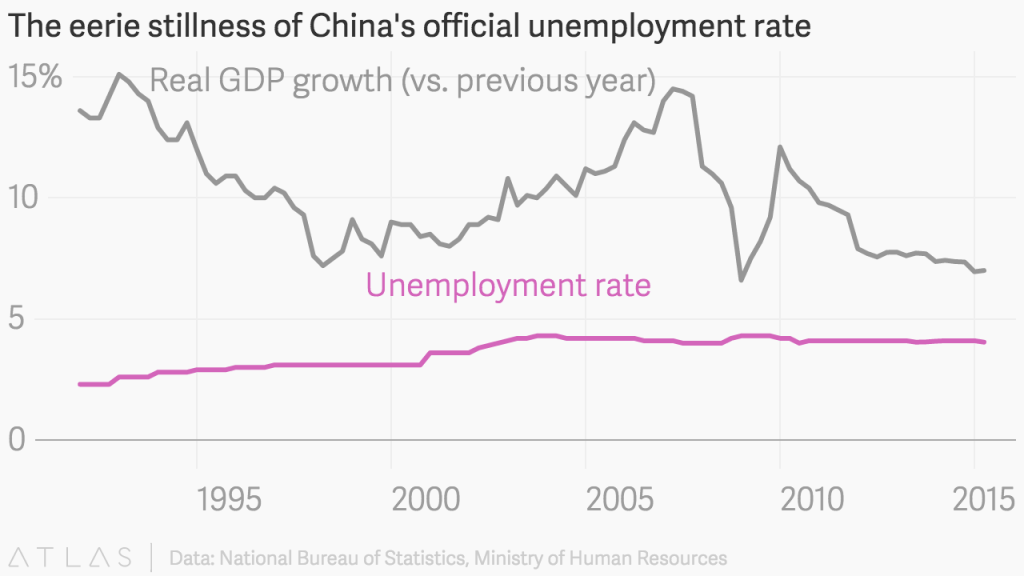
A new NBER working paper uses a newly available household survey and finds a very different series–the China-UHS series shown in black below. According to these estimates China’s unemployment rate shot up to around 11% in 2002 and has been nearly that high at least until 2009 when unfortunately the new series ends.
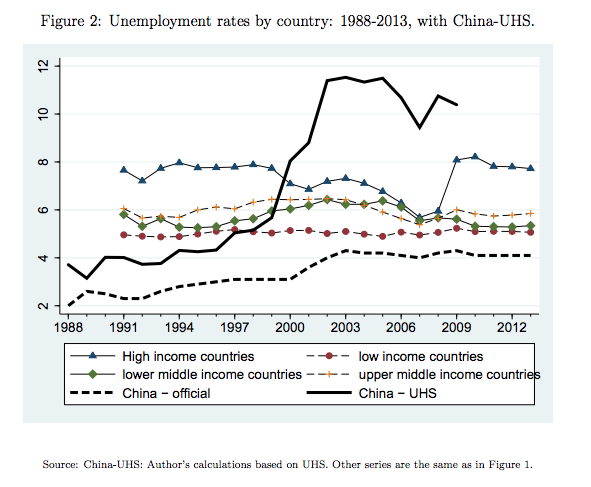
So how high is Chinese unemployment today? No one knows but it could well be closer to 10% than to 4.1%.
Keep an eye on China and don’t be surprised by the unexpected. In China it’s not just the unemployment rate that is more volatile than it appears.
The import of Donald Trump
It still seems quite unlikely to me that Trump survives much past Super Tuesday, much less wins anything. Still, he has done far better than virtually anyone expected.
So in equilibrium I expect another embodiment of his ideas to surface politically, without all of the surrounding personal outrageousness.
Think of him as a trial balloon. It’s still floating.
We might also see, for the next election cycle, further entry from rich people who mimic the outrageousness of Trump but not the particular ideas. The signal extraction problem from Trump’s continuing float is not yet solved.
In these senses the media is not wrong to focus on him. What he embodies — no matter how you interpret it — is what is new this election cycle. And the multiplicity of possible interpretations make it all the more fodder for the media mill.
Observers expect forecasters to show high confidence
Observers seem to focus on the target event and not its complement. Bagchi and Ince have a new paper on this question:
Consumers routinely rely on forecasters to make predictions about uncertain events (e.g., sporting contests, stock fluctuations). The authors demonstrate that when forecasts are higher versus lower (e.g., a 70% vs. 30% chance of team A winning a game) consumers infer that the forecaster is more confident in her prediction, has conducted more in-depth analyses, and is more trustworthy. The prediction is also judged as more accurate. This occurs because forecasts are evaluated based on how well they predict the target event occurring (team A winning). Higher forecasts indicate greater likelihood of the target event occurring, and signal a confident analyst, while lower forecasts indicate lower likelihood and lower confidence in the target event occurring. But because, with lower forecasts, consumers still focus on the target event (and not its complement), lower confidence in the target event occurring is erroneously interpreted as the forecaster being less confident in her overall prediction (instead of more confident in the complementary event occurring—team A losing). The authors identify boundary conditions, generalize to other prediction formats, and demonstrate consequences.
Of course this also has relevance for the evolutionary processes governing pundits.
Here is a related press release (pdf). For the pointer I thank Charles Klingman.
Amazon employment and the tax wedge
A few points on the Amazon story everyone is talking about:
1. First, if the story is somewhat true but exaggerated (a plausible scenario for something anecdotally based), the story may help Amazon with its current (but not prospective) employees. A lot of people suddenly are feeling better treated than the perceived average, and that may boost their morale and productivity. Yet they still feel the surrounding pressures to succeed. As a countervailing force, Amazon is now less of a high status place to work and that may lower productivity and also it may hurt recruiting.
2. Given the existence of a tax wedge, Amazon employees are perhaps treated better than they would be in an optimum. There is in general an inefficient substitution into non-pecuniary means of reimbursing workers because workplace income is taxed but workplace perks are not. So arguably Amazon is treating its workers too well. Think of this as another form of corporate tax arbitrage.
3. There is no right to an upper middle class lifestyle. And for a large number of people, getting one is not easy.
Claims about retail
…warehouse clubs have had to this point a greater effect on retail than e-commerce has…
That is from Ali Hortaçsu and Chad Syverson, here is their broader NBER survey of what is new in the economics of retail. You also can take this as further confirmation that the productivity effects of the internet are not in fact so much understated.
Tuesday assorted links
1. Interview with Campbell Harvey.
2. Common knowledge and Aumann’s agreement theorem.
4. Research advice from David Weil. Follow it.
5. Tesla. And human leather (is it a fake site?) What is the Bitcoin civil war about? Tim Lee on the same.
6. By how many has Obamacare reduced the number of the uninsured?
Why Elon Musk Wants to Go to Mars
Tim Urban at Wait but Why has a fascinating longform series on How and Why SpaceX Will Colonize Mars which itself is part of a longer series on Elon Musk and his companies. Here’s just one bit:
The Scary Thing About the Universe
Species extinctions are kind of like human deaths—they’re happening constantly, at a mild and steady rate. But a mass extinction event is, for species, like a war or a sweeping epidemic is for humans—an unusual event that kills off a large chunk of the population in one blow. Humans have never experienced a mass extinction event, and if one happened, there’s a reasonable chance it would end the human race—either because the event itself would kill us (like a collision with a large enough asteroid), or the effects of an event would (like something that decimates the food supply or dramatically changes the temperature or atmospheric composition). The extinction graph below shows animal extinction over time (using marine extinction as an indicator). I’ve labeled the five major extinction events and the percentage of total species lost during each one (not included on this graph is what many believe is becoming a new mass extinction, happening right now, caused by the impact of humans):1
…Let’s imagine the Earth is a hard drive, and each species on Earth, including our own, is a Microsoft Excel document on the hard drive filled with trillions of rows of data. Using our shortened timescale, where 50 million years = one month, here’s what we know:
- Right now, it’s August of 2015
- The hard drive (i.e. the Earth) came into existence 7.5 years ago, in early 2008
- A year ago, in August of 2014, the hard drive was loaded up with Excel documents (i.e. the origin of animals). Since then, new Excel docs have been continually created and others have developed an error message and stopped opening (i.e gone extinct).
- Since August 2014, the hard drive has crashed five times—i.e. extinction events—in November 2014, in December 2014, in March 2015, April 2015, and July 2015. Each time the hard drive crashed, it rebooted a few hours later, but after rebooting, about 70% of the Excel docs were no longer there. Except the March 2015 crash, which erased 95% of the documents.
- Now it’s mid-August 2015, and the homo sapiens Excel doc was created about two hours ago.
Now—if you owned a hard drive with an extraordinarily important Excel doc on it, and you knew that the hard drive pretty reliably tended to crash every month or two, with the last crash happening five weeks ago—what’s the very obvious thing you’d do?
You’d copy the document onto a second hard drive.
That’s why Elon Musk wants to put a million people on Mars.

On a related note the latest Planet Money podcast is How to Stop an Asteroid. It’s funny and informative and yours truly makes an appearance. Worth a listen.