How much does it cost to overthrow the government of Gambia?
More than 220k, apparently:
The gang allegedly numbered 18-20 people and spent $220,798 on the attack, including $4,000 on two sniper “Barret” .50 calibre rifles that the accountant who compiled their expenses said were “not really necessary, but could be very useful”. Each man had $4,000 to cover costs while they were in Gambia.
But the coup attempt failed and this week, US federal prosecutors charged a Texas businessman with conspiring with a former US Army sergeant and others to orchestrate an attack in Gambia on the last two days of 2014.
There is more here in the FT. And here is a tidbit of note:
US authorities accuse Cherno Njie, a 57-year-old US citizen of Gambian descent who made a small fortune in the housing industry in Texas, of bankrolling the coup.
The article is interesting throughout, there was at least the ostensible motive of restoring democracy to the country. I wonder to what extent he viewed this as a philanthropic rather than selfish venture.
Obama’s free community college plan
David Leonhardt writes:
The plan — which would require congressional approval — would apply to students attending a two-year college, including part time, so long as the college offered credits that could transfer to a four-year college or provided training that led to jobs.
David’s article is excellent and has much useful information:
As Reihan Salam of National Review notes, community college tuition is already low. In fact, it’s zero, on average, for lower-income families, after taking financial aid into account. Vox’s Libby Nelson wrote, “Community college tuition for poorer students is often entirely covered by the need-based Pell Grant.”
One potential implication is that by making community college universally free, the government is mostly reducing the cost for higher-income families.
Calculating the completion rate at community colleges is difficult, this estimate does some work to get it up to 38 percent. What would the completion rate be for the marginal students encouraged under the Obama plan? We don’t know, but I’ll guess at 20-30%, no more. That’s the real problem.
Furthermore some of the value of education is signaling to the labor market that you are able to finish college. I do think the learning component of education is generally more important, but for “marginally not attending community college individuals” — who are often regarded with suspicion by employers — I would not be surprised if the signaling component were one third or more of the value of a degree. To that extent, pushing more marginals into the degree funnel lowers the value of the degree for the others who were getting it already by lowering the average productivity of the pool of finishers. That would lower the efficiency gains from the program and also partially offset some of the intended distributional consequences.
Mike Konczal likes the idea, and believes it may lower higher education prices more generally. Libby Nelson at Vox considers it to be a middle class benefit. Neil McCluskey at Cato is negative. Carrie Sheffield is critical. Here is a look at potential winners and losers in the higher education sector. The plan could lead to federal money replacing state money, rather than leveraging it.
Citing the growing economy and improving labor market, Andrew Flowers noted:
…college enrollment is declining for recent high school graduates (those 16 to 24 years old). And it’s falling fastest for community colleges.
Overall my take is that the significant gains are to be had at the family level and at the primary education level, and that the price of community college is not a major bottleneck under the status quo.
Angus on austerity (words of wisdom)
From this graph I concluded one of two things must be true depending on one’s definition of austerity.
Either austerity means nominal cuts and we never had any of it, or austerity means cuts relative to trend and we are still savagely in its grasp.
Relative to the 2000-2009 decade trend, total government spending is roughly 35% lower in q3 of 2014 than it should be. Hard to say austerity is over by that metric.
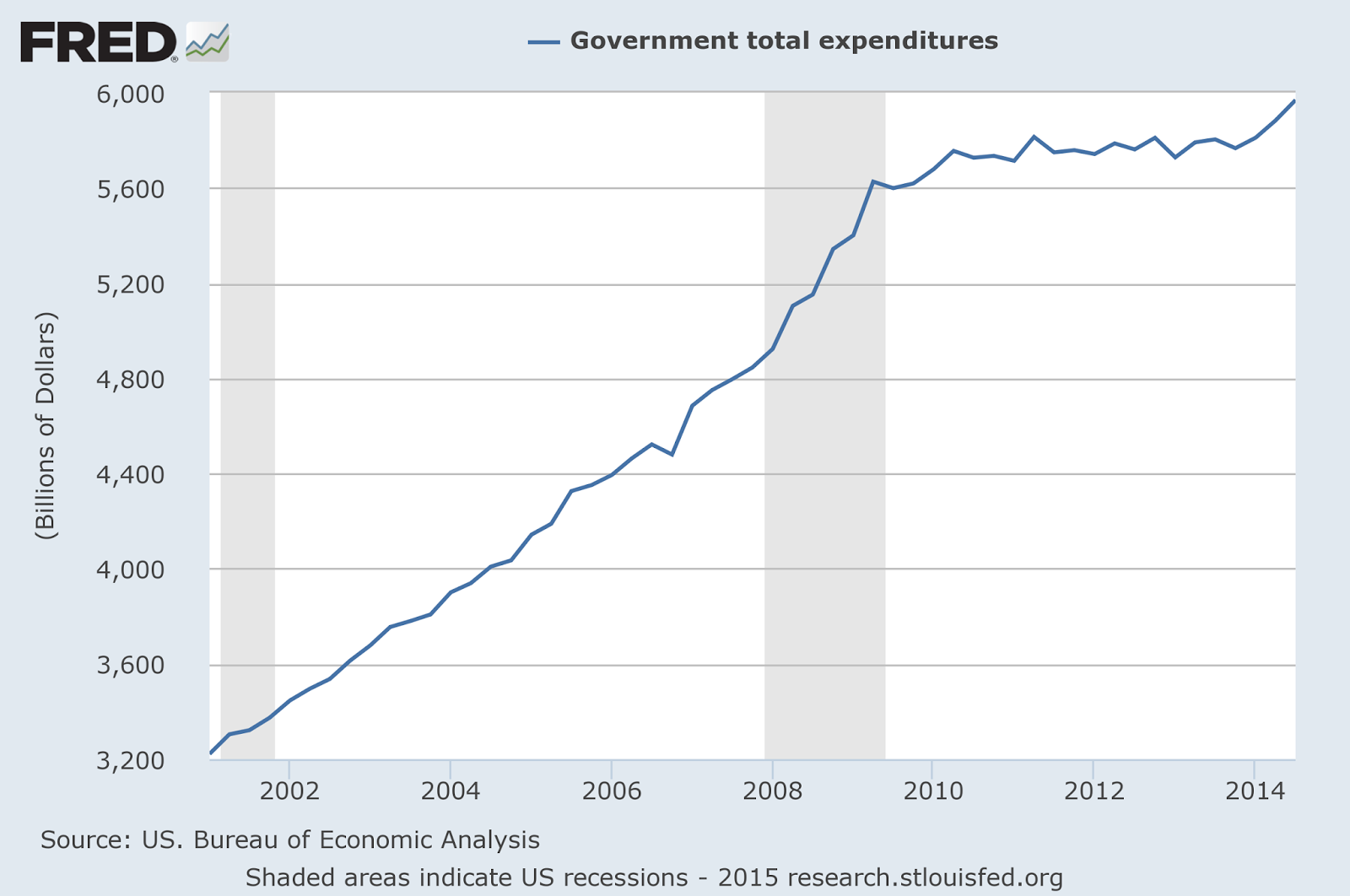
The full link is here. As I wrote in an email to an unnamed correspondent earlier today: “I gladly admit that reading me in 2006 was not a good guide for what happened in 2007-2008. A bunch of those guys should admit the same about the current day…”
Markets in everything: the ugly mirror
Tucked between their 4K televisions and their induction cooktop stove, Panasonic’s booth at the Consumer Electronic Show is also home to a futuristic magic mirror way more terrifying than that disembodied mask from Snow White.
The Japanese heavy-hitter’s smart mirror has digital displays, including a secondary projection of your own reflection. The projection can be virtually altered to display different makeup looks, hairdos, and even facial hair styles.
But here’s where it gets really fun: it can also pinpoint all your flaws, from tiny wrinkles to barely-perceptible pores, and then “recommend” a series of beauty products and treatments in order to improve your look. Because apparently we weren’t picking apart our reflections enough as it is.
It also keeps track of your horrible, hideous flaws, so you can see if all the money you spent is working, or if you ought to spend more money.
“Once you start using products, you can track whether or not they’ve been working,” sales rep Joey Liao explained cheerfully, gesturing to another volunteer who sat pouting at a vanity. “So if she buys a very expensive new night cream and a month later has made no progress, goodbye night cream! You don’t need to invest in that anymore. You can use a different product.”
That story was sent to me by the excellent Mark Thorson, who also points us to the Norwegian Caribbean cruise that has a special snow room.
Is Jennifer Lawrence Underpaid?
The Daily Beast, Business Insider and The Washington Post all argue that leaked information about Jennifer Lawrence’s pay on American Hustle indicates gender discrimination. Here’s the Washington Post:
If Jennifer Lawrence doesn’t get paid as much as her male colleagues for the same work, ordinary women don’t stand a chance.
Sony’s hacked e-mails have revealed a troubling truth — that even the wealthiest and most powerful women among us are burdened by the ever-present gender pay gap.
 The picture these articles present is one of poor, little Jenny Lawrence being taken advantage of by powerful, male studio heads who are laughing all the way to the bank. Time for a reality check.
When it comes to business, Jennifer Lawrence isn’t a woman she is a multi-million dollar enterprise. Lawrence Enterprises is run not by Jennifer alone but also by a bevy of managers, agents, publicists and lawyers. If Lawrence is underpaid each of these people (quite a few of them men, by the way) are also underpaid. In particular, Lawrence is repped by CAA of which the WSJ recently wrote:
Within the entertainment industry, the glass-and-steel headquarters of Creative Artists Agency LLC is called the “Death Star,” a reference to its occupants’ reputation as cold-hearted Hollywood power brokers.
Do you think the cold-hearted Hollywood power brokers of CAA are leaving money on the table? No effing way. Which is one reason why Jennifer Lawrence is number 12 on Forbes Celebrity 100 list, coming in just below Steven Spielberg. By the way, 5 of the top 10 on the Celebrity 100 are women and number 1 on that list? Beyonce.
Very good sentences about austerity
Yes, it would be useful to do a more systematic study of fiscal austerity, but the Keynesians don’t seem to know how to do so. All I see are cross sectional studies that mix together countries with an independent monetary policy, with those that lack an independent monetary policy (like the eurozone members.) Mark Sadowski did a regression with only those countries having an independent monetary policy, and found the effect went away. No correlation between austerity and growth. This objection to Krugman’s graphs has been made over and over again, but he never responds.
Simon Wren-Lewis also gets the GDP growth data wrong, in a way that makes austerity look worse. He claims that RGDP growth was 2.3% in 2012 and 2.2% in 2013 (the year of austerity in the US.) But that’s annual y-o-y data, and since the austerity began on January 1st 2013, you need Q4 over Q4 data. In fact, RGDP growth in 2012, Q4 over Q4, was only 1.67%, whereas growth in the austerity year of 2013 nearly doubled to 3.13%.
Wren-Lewis says “other stuff happens.” Yes, but the “other stuff” that happened in 2013 is exactly what you might expect with aggressive monetary stimulus, whereas the other stuff that happened when Britain saw a couple years of low RGDP growth, was not at all what the Keynesian model predicts. The British growth slowdown was a productivity story (their job creation is more impressive than the US), and productivity slowdowns suggest supply-side factors (declining North Sea oil output, a structural shift from high compensation City jobs to low compensation service sector jobs, etc.)
Do I need to tell you that is from Scott Sumner? I would add that the “other stuff” — for some but not all countries — is that the regenerative powers of a market economy are stronger than most Keynesians are willing to let on. And you can buy into the entire Keynesian apparatus (I don’t) and still recognize that most of the time fiscal policy simply isn’t that important.
Assorted links
1. The Strange Reason Murakami Fans Gather At A Hokkaido Sheep Farm Every Year. And the campaign to create koala mittens.
2. North Korean defectors review The Interview.
3. Children and play in the Holocaust.
4. Japan’s birth rate problem is worse than thought.
5. Robin Hanson on vote trading and quadratic voting.
6. The best films of the decade so far?
Cardiff Garcia on the AEA meetings, and the health care cost slowdown
Here is one bit of many:
The embedded papers by Louise Sheiner of Brookings, Chapin White of the Rand Corporation, and Thomas Getzen of Temple University are recommended. To be simplistic, there was agreement that much of the slowdown was likely the result of the recession and sluggish recovery, as slow economic growth translated into less health spending and also slower wage growth for health care workers. But not all of it.
Sheiner finds that outside of spending on prescription drugs — which has been flat since 2008 because of the patent cliff — there actually hasn’t been any unexplained slowdown in health spending relative to the fifteen years before the recession. In this context, “unexplained” means a change in health spending that can’t be attributed to the business cycle. She also adds the intriguing observation that in a downturn, more health workers join the labour force, often because their spouses have lost their own jobs — but wages for health workers fall. The shortage of registered nurses mostly evaporated after the recession of 2008, she said.
White looked more closely at the Medicare slowdown and believes that the Affordable Care Act’s price cuts did have an impact, as did a recent crackdown on fraud by the Centers for Medicare & Medicaid Services.
I hope the rest is not “too gated” for you, hat tip goes to Claudia Sahm. And Philip Greenspun reports on the meetings.
Heads-up limit hold’em poker is solved
Here is a bit more on the poker story Tyler mentioned yesterday.
An important variant of poker, heads-up limit hold’em (HULHE), has been essentially solved–meaning that a computer can now play the game so well that it wouldn’t lose much and might even win against a theoretically perfect player over a lifetime of play. Solving the game required new algorithms and significant computational power.
HULHE has 3.16 × 10¹⁷ possible states the game can reach, making it larger than Connect Four and smaller than checkers. However, because HULHE is an imperfect-information game, many of these states cannot be distinguished by the acting player, as they involve information about unseen past events (i.e., private cards dealt to the opponent). As a result, the game has 3.19 × 10¹⁴ decision points where a player is required to make a decision….There are two challenges for established CFR variants to handle games at this scale: memory and computation.
The solution supports some conventional strategies but also contains new insights:
Human players have disagreed about whether it may be desirable to “limp” (i.e., call as the very first action rather than raise) with certain hands. Conventional wisdom is that limping forgoes the opportunity to provoke an immediate fold by the opponent, and so raising is preferred. Our solution emphatically agrees (see the absence of blue in Fig. 4A). The strategy limps just 0.06% of the time and with no hand more than 0.5%. In other situations, the strategy gives insights beyond conventional wisdom, indicating areas where humans might improve. The strategy almost never “caps” (i.e., makes the final allowed raise) in the first round as the dealer, whereas some strong human players cap the betting with a wide range of hands. Even when holding the strongest hand—a pair of aces—the strategy caps the betting less than 0.01% of the time, and the hand most likely to cap is a pair of twos, with probability 0.06%. Perhaps more important, the strategy chooses to play (i.e., not fold) a broader range of hands as the nondealer than most human players (see the relatively small amount of red in Fig. 4B). It is also much more likely to re-raise when holding a low-rank pair (such as threes or fours) (44).
Why is this important? The only previous games of any difficulty that have been solved are perfect information games–games where each player knows everything that has previously happened. Tic-tac-toe and chess are perfect information games because everything that has happened is summarized in the state of the board. In imperfect games there is hidden information, such as in card games where the opposing players cards are hidden.
It’s clear that most games in the real world (and that includes “games” of nuclear strategy, bargaining, and detection and monitoring) are imperfect information games. Even though the sample space for HULHE is very large it’s smaller than these real world strategy games (and smaller than other forms of poker). Nevertheless, it’s clear that people are “solving” the real world games not by working through the sample space but by pruning it. A combination of search and heuristic pruning in the perfect information game of chess has already produced computers that are better than any human player. What the solution to this relatively small and somewhat unimportant imperfect information game indicates is that the computers are soon going to be better than you and I at the “human” capabilities of threat, bluff and deception.
Has Los Angeles fixed its gang problem?
That is the new and excellent Sam Quinones article from Pacific Standard, here is one excerpt:
Some of this is a state and national story, as violent crime declined by about 16 percent in both California and the nation from 2008 through 2012. But the decline has been steeper in many gang-plagued cities: 26 percent in Oxnard, 28 percent in Riverside, 30 percent in Compton, 30 percent in Pasadena, 30 percent in Montebello, 50 percent in Bell Gardens, 50 percent in El Monte.
Santa Ana once counted 70-plus homicides a year, many of them gang-related. That’s down to 15 so far in 2014, even as Santa Ana remains one of the densest, youngest, and poorest big cities in California. “Before, they were into turf,” says Detective Jeff Launi, a longtime Santa Ana Police gang investigator. “They’re still doing it, but now they’re more interested in making money.”
No place feels so changed as the city of Los Angeles. In 2014, the Los Angeles Police Department announced that gang crime had dropped by nearly half since 2008.
Obviously this is welcome news, not only for its own sake, but also for those of us who have been arguing that Latino immigration is going to work out.
Thomas C. Schelling on why international terrorism is so rare
From a 1991 essay, “What purposes can “international terrorism” serve?”:
…I want to offer another conjecture on why international terrorism is so rare…whereas individual acts of terrorism may be easily within the capabilities of quite ordinary individuals , a sustained campaign on any scale may require more people and more organization than could be viable in most target countries. And there may be some negative feedback from the low success rate to the low attempt rate: Resourceful individuals, people with brains or people with money, may find terrorism so unpromising that they do not choose to contribute effort or money. And any organization that is secret and dangerous risks both defection and infiltration; a group of people large enough to carry on a sustained campaign, perhaps simultaneously in different target areas, may simply be too vulnerable in defection and infiltration. Even seeking financial help risks being informed on.
That is one of the essays in the book Violence, Terrorism, and Justice, edited by R.G. Frey and Christopher W. Morris. By the way, Schelling cites the campaign of Palestinian radicals against Palestinian moderates as one of the examples of a successful terrorist plan.
Have game theorists plus computers cracked the game of poker?
A new computer algorithm can play one of the most popular variants of poker essentially perfectly. Its creators say that it is virtually “incapable of losing against any opponent in a fair game”.
…That means that this particular variant of poker, called heads-up limit hold’em (HULHE), can be considered solved. The algorithm is described in a paper in Science1.
The strategy the authors have computed is so close to perfect “as to render pointless further work on this game”, says Eric Jackson, a computer-poker researcher based in Menlo Park, California.
“I think that it will come as a surprise to experts that a game this big has been solved this soon,” Jackson adds.
…Bowling and colleagues designed their algorithm so that it would learn from experience, getting to its champion-level skills required playing more than 1,500 games. At the beginning, it made its decisions randomly, but then it updated itself by attaching a ‘regret’ value to each decision, depending on how poorly it fared.
This procedure, known as counterfactual regret minimization, has been widely adopted in the Annual Computer Poker Competition, which has run since 2006. But Bowling and colleagues have improved it by allowing the algorithm to re-evaluate decisions considered to be poor in earlier training rounds.
The other crucial innovation was the handling of the vast amounts of information that need to be stored to develop and use the strategy, which is of the order of 262 terabytes. This volume of data demands disk storage, which is slow to access. The researchers figured out a data-compression method that reduces the volume to a more manageable 11 terabytes and which adds only 5% to the computation time from the use of disk storage.
“I think the counterfactual regret algorithm is the major advance,” says computer scientist Jonathan Shapiro at the University of Manchester, UK. “But they have done several other very clever things to make this problem computationally feasible.”
The computer does engage in a certain amount of bluffing, full story here, via Vaughan Bell.
Assorted links
1. Marco Rubio on Average is Over, and other works which have influenced him.
2. Economist David Colander studies the market for English Ph.D.s.
3. Claims about Indian castrations.
4. Predictions about media for 2015.
5. Jeff Peretz on D’Angelo. And Linda Colley reviews Robert Tombs on England.
In which professions are Americans most likely to be married?
Catherine Rampell reports:
While engineers, mathematicians and scientists today are (unfairly) stereotyped as awkward nerds who don’t know how to interact with the opposite sex, in 1950 they were among the occupations most likely to be married. Today, the most commonly conjugated occupations are instead more often medical professionals with doctorates, starting with dentists (81 percent of whom are hitched)…
The top of the list looks like this:
1) Dentist
2) Chief executive
3) Sales engineer
4) Physician
5) Podiatrist
6) Optometrist
7) Farm product buyer
8) Precision grinder
9) Religious worker
10) Tool and die maker
We also learn this:
Turns out that in 1950, many of the occupations whose members were most likely to end up divorced were creative or artistic ones (artist, writer/director, dancer, designer, writer), which perhaps reflects the communities that were most accepting of divorce at the time. In 2010, the occupations with the highest divorce rates were predominantly in manufacturing or other areas that have been subject to downsizing (drilling machine operator, knitter textile operative, force operator, winding machine operative, postal clerk). This seems to support the idea that economic stability is a good predictor of marital status.
Do read the whole thing.
Assorted Charlie Hebdo links
1. Ross Douthat, on “the blasphemy we need.”
2. “A thorough understanding of the Iconoclast period in Byzantium is complicated by the fact that most of the surviving sources were written by the ultimate victors in the controversy, the iconodules.” That is from Wikipedia on the Iconoclastic debates.
3. Against Daumier (splendid visuals too).
4. Juan Cole on the attacks. And Will Wilkinson. And insulting Monty Python (video).
5. And, for something completely different, here is a video of dos niños colombianos.