More women are among the top earners
Claudia Sahm has given us the link (pdf) for Guvenen, Kaplan, and Song, David Wessel the summary. The paper abstract is this:
We analyze changes in the gender structure at the top of the earnings distribution in the United States over the last 30 years using a 10% sample of individual earnings histories from the Social Security Administration. Despite making large inroads, females still constitute a small proportion of the top percentiles: the glass ceiling, albeit a thinner one, remains. We measure the contribution of changes in labor force participation, changes in the persistence of top earnings, and changes in industry and age composition to the change in the gender composition of top earners. A large proportion of the increased share of females among top earners is accounted for by the mending of, what we refer to as, the paper floor — the phenomenon whereby female top earners were much more likely than male top earners to drop out of the top percentiles. We also provide new evidence at the top of the earnings distribution for both genders: the rising share of top earnings accruing to workers in the Finance and Insurance industry, the relative transitory status of top earners, the emergence of top earnings gender gaps over the life cycle, and gender di erences among lifetime top.
David pulls this out:
A trio of economists, wielding big data from Social Security’s records, says that in 1981-85, women constituted just 1.9% of the top 0.1% of earners (based on average earnings for those years) and 5.2% of the top 1%.
But a quarter-century later, in 2008-12, women were 10.5% of the top 0.1% and 27.5% of the top 1%.
Who will win the next Nobel Prize in economics?
Jon Hilsenrath says Bernanke deserves one, I agree. I would gladly see a Bernanke-Woodford-Svensson prize, perhaps working in Mark Gertler too.
But for this year’s pick, due October 13, I am predicting William J. Baumol, possibly with William G. Bowen, for work on the cost-disease. As you probably know, this hypothesis suggested that the costs of education and health care would continue to rise in relative terms, thereby creating significant economic problems. Not a bad prediction for 1966, and of course it has become a truly important issue.
One problem is that the initial Baumol and Bowen hypothesis focused on the performing arts, rather than health care and education. A lot of live performance is pretty robust, although not always European high culture, and furthermore the internet has proven a much closer substitute in the minds of consumers than many people had expected. So the cost-disease argument, in the area where it was originally formulated, hasn’t panned out but rather has evolved into a kind of merit good demand — “I wish more people were paying for Mozart rather than for sports and live music in bars.”
A second problem is whether it should be Baumol or Baumol and Bowen. Bowen was co-author on the major and initial work, but Baumol has numerous other contributions, including contestability, operations research and economics, entrepreneurship, externalities and Pigouvian taxes, portfolio theory, and even in the older literatures on money demand and also sales maximization for business firms. One can well imagine Baumol paired with one or two other people, perhaps from industrial organization, and the cost-disease as one but not the only reason for the prize. Or if they give it to him and Bowen, it looks more like an “economics of education” prize, with a mention of health care tacked on.
So yes, that’s my pick. Keep in mind people, in the past I have never, ever gotten the timing of the pick right. Not once. But Baumol is now ninety-two, so I think this will be his year. Of course the Bayesian will note that last year he was ninety-one.
Assorted links
1. Are European money market funds breaking the buck?
2. The top ten essays since 1950.
3. Did the Fed and Treasury work against each other?
4. Reddit tales of ZMP workers.
5. What is the Bezos plan for The Washington Post?
6. Brad DeLong’s points on Ebola.
7. The great Srinivas, the Indian mandolin virtuoso, has passed away.
Will the Catalonian independence referendum take place?
This is perhaps today’s underreported news story:
Catalonia’s regional government said Tuesday it was suspending its promotion of an independence referendum, a day after a decision by Spain’s Constitutional Court blocking the nonbinding vote.
Catalonia’s leaders still hoped to hold the vote on Nov. 9, said spokesman Francesc Homs, but meanwhile they are halting the campaign for the referendum to avoid subjecting public servants to possible legal liability for defying the court.
There is more here. Here is an El Pais in English story about how they hope to fight back and continue anyway, but it sounds like a losing cause. Here is a story on a protest march to defend the referendum idea. Developing…
What is the relevant bias when Westerners try to predict what Chinese leaders will do?
I see a whole bunch of candidates here, each backed by a broadly plausible psychological story:
1. They are more ruthless than we realize.
2. They are more like us than we realize.
2b. #1 and #2.
3. They have longer time horizons than we imagine.
4. Due to extreme political constraints, they have far shorter time horizons than we think.
5. They are more inured to the risk of economic depression and hardship than we grasp.
6. They are more obsessed with parallels to earlier Chinese history than a typical Westerner would find natural.
7. They are less rational than social science rational choice models would predict, having one or two major blind spots on matters of critical importance.
8. The Chinese see themselves as weaker and less stable than we see them.
9. All of the above.
10. Good luck.
The CIA Starbucks (intelligence markets in everything)
Emily Wax-Thibodeaux reports:
The new supervisor thought his idea was innocent enough. He wanted the baristas to write the names of customers on their cups to speed up lines and ease confusion, just like other Starbucks do around the world.
But these aren’t just any customers. They are regulars at the CIA Starbucks.
“They could use the alias ‘Polly-O string cheese’ for all I care,” said a food services supervisor at the Central Intelligence Agency, asking that his identity remain unpublished for security reasons. “But giving any name at all was making people — you know, the undercover agents — feel very uncomfortable. It just didn’t work for this location.”
This purveyor of skinny lattes and double cappuccinos is deep inside the agency’s forested Langley, Va., compound.
…The baristas go through rigorous interviews and background checks and need to be escorted by agency “minders” to leave their work area. There are no frequent-customer award cards, because officials fear the data stored on the cards could be mined by marketers and fall into the wrong hands, outing secret agents.
And this:
The chief of the team that helped find Osama Bin Laden, for instance, recruited a key deputy for the effort at the Starbucks, said another officer who could not be named.
Employees at the branch also are not allowed to bring smart phones inside. The piece is interesting throughout.
The return to education in France?
Pierre Mouganie has a new paper:
In 1997, the French government put into effect a law that permanently exempted young French male citizens born after Jan 1, 1979 from mandatory military service while still requiring those born before that cutoff date to serve. This paper uses a regression discontinuity design to identify the effect of peacetime conscription on education and labor market outcomes. Results indicate that conscription eligibility induces a significant increase in years of education, which is consistent with conscription avoidance behavior. However, this increased education does not result in either an increase in graduation rates, or in employment and wages. Additional evidence shows conscription has no direct effect on earnings, suggesting that the returns to education induced by this policy was zero.
You should note of course that the “return to education you wish to do for non-draft-avoiding reasons” still may be positive or strongly positive. Nonetheless this is an object lesson in the point that the goal is not to increase educational attainment per se, but rather good outcomes probably require “education plus some of the prerequisites and complements of education.” The large number of unemployed engineers in some of the Arabic countries illustrate a related point.
For the pointer I thank the excellent Kevin Lewis.
Assorted links
Caffeine-infused underwear fails (there is a great stagnation)
Bras, girdles and leggings infused with caffeine and sold as weight loss aids were more decaf than espresso, and the companies that sold them have agreed to refund money to customers and pull their ads, U.S. regulators said on Monday.
The Federal Trade Commission said Wacoal America and Norm Thompson Outfitters, which owns Sahalie and others, were accused of deceptive advertising that claimed their caffeine-impregnated clothing would cause the wearer to lose weight and have less cellulite.
There is more here, and for the pointer I thank Glenn Mercer.
How popular is Occupy Central?
A poll last week by the Chinese University of Hong Kong showed that 46.3% of the city’s residents opposed Occupy Central while 31.3% supported it. But the group has more support among the young. According to the poll, 47% of people under 24 back Occupy Central compared with 20.9% of those ages 40-59.
There is more here.
How prominent are European renewables?
Deconstruction of the EU’s actual greenness must start by separating old renewables from new renewables — an essential task because in most countries the old renewables still provide the largest combined contribution in the green category. Readers of European news might be forgiven if they thought that wind turbines and PV panels, both heavily promoted and subsidized by many governments, lead the charge toward the continent’s renewable future. Actually, “solid biofuels” continue to be by far the largest category. In plain English, solid biofuels are wood, the oldest of fuels, be it trunks directly harvested for heat and electricity generation and burned as chips, or large amounts of wood-processing waste — a category particularly abundant in the EU’s two Nordic members with large forestry sectors. In 2012, 80 percent of Finland’s and 52 percent of Sweden’s renewable energy came from wood, and the average for EU-28 was 47 percent; even for Germany, the most aggressive developer of wind and solar, it was about 36 percent.
Burning logging and wood-processing wastes make sense; importing wood chips from overseas in order to meet green quotas does not. In 2013, the EU was burning more than 6 million tons of imported wood pellets. According to Forests and the European Union Resource Network, if all the EU states were to meet their 2020 green quotas, some of them would have to burn 50-100 percent more wood than they did in 2010. Imports now come mostly from North American and Russian forests, but Brazil is considered as the best source for future imports.
The irrationality of wood-based electricity generation is perhaps best illustrated by the conversion of Britain’s largest, originally coal-fired station to burning wood chips: initially they were to come from Brazil, but eventually more than 6 million tons a year will come from the swamp forests of North Carolina and tree plantations in Georgia. And wood-burning electricity generation would not be carbon-neutral even if all the trees cut down for chips were promptly replanted and if all of them regrew quickly and completely: more trees would have to be planted in order to offset carbon released by fossil fuels used in harvesting, processing, and intercontinental transportation of imported wood.
That is from Vaclav Smil, there is more here.
The true competition has arrived, just ask the Thai Delicious Committee
Hopscotching the globe as Thailand’s prime minister, Yingluck Shinawatra repeatedly encountered a distressing problem: bad Thai food.
Too often, she found, the meals she sampled at Thai restaurants abroad were unworthy of the name, too bland to be called genuine Thai cooking. The problem bothered her enough to raise it at a cabinet meeting.
Her political party has since been thrown out of office, in a May military coup, but her initiative in culinary diplomacy lives on.
At a gala dinner at a ritzy Bangkok hotel on Tuesday the government will unveil its project to standardize the art of Thai food — with a robot.
Diplomats and dignitaries have been invited to witness the debut of a machine that its promoters say can scientifically evaluate Thai cuisine, telling the difference, for instance, between a properly prepared green curry with just the right mix of Thai basil, curry paste and fresh coconut cream, and a lame imitation.
Has there ever been a better committee name than this?:
The government-financed Thai Delicious Committee, which oversaw the development of the machine, describes it as “an intelligent robot that measures smell and taste in food ingredients through sensor technology in order to measure taste like a food critic.”
In a country of 67 million people, there are somewhere near the same number of strongly held opinions about Thai cooking. A heated debate here on the merits of a particular nam prik kapi, a spicy chili dip of fermented shrimp paste, lime juice and palm sugar, could easily go on for an hour without coming close to resolution.
The full story is here, excellent throughout, and for the pointer I thank Otis Reid.
Assorted links
If you can work from home, where should home be?
If you can work from home, where should home be? NomadList has combined data on internet speed, the cost of rental housing and food, local weather conditions including air quality and other factors to come up with an interesting list. Here’s the top ten.
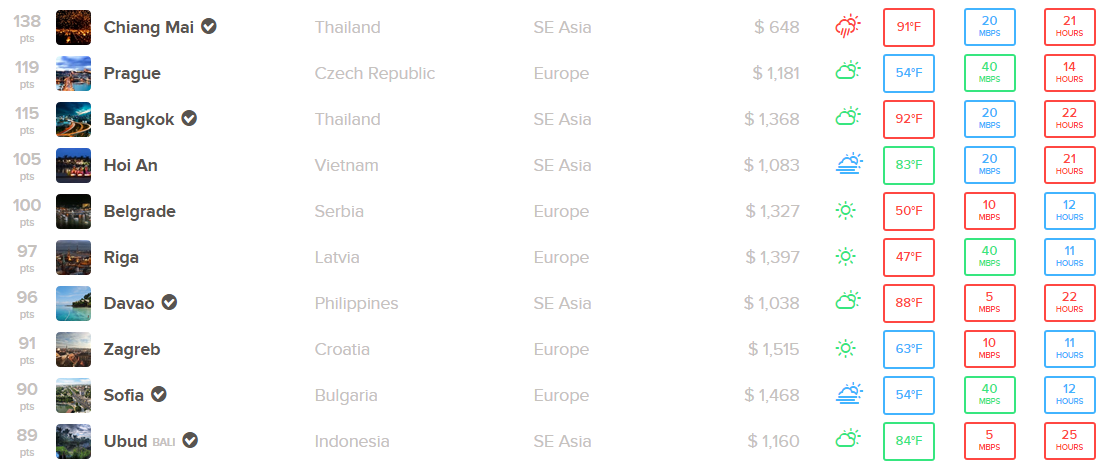
The third edition of the textbook is on the way but maybe a sabbatical in Chiang Mai or Prague for the fourth edition. One advantage of Prague is that from there it’s easy to get to anywhere else in Europe, Chiang Mai is more restricted and the Philippines even more so. Either way, however, these would be good places to write about purchasing power parity, assuming it hasn’t kicked in by then.
Swiss reject single payer health care
Swiss voters on Sunday rejected a plan to ditch the country’s all-private health insurance system and create a state-run scheme, exit polls showed.
Some 64 percent of the electorate shot down a plan pushed by left-leaning parties who say the current system is busting the budgets of ordinary residents, figures from polling agency gfs.bern showed.
Going public would have been a seismic shift for a country whose health system is often hailed abroad as a model of efficiency, but is a growing source of frustration at home because of soaring costs.
“Over the past 20 years in Switzerland, health costs have grown 80 percent and insurance premiums 125 percent,” ophthalmologist Michel Matter told AFP.