How should we quantify coolness? (from the comments)
David H. writes:
Yes, this Forbes list is a miserable failure, but it got me thinking about how to quantify coolness. Good restaurants are valuable, but to be cool, restaurants also need to be affordable and a little off-putting. If I were doing this, I would generate a list of touring bands that rank highly in RYM, knock out the superstars, and then see what US cities they played in the last 4 years. Each band-visit would count as a portion of coolness for that city, and a partial portion for the immediate vicinity. Also, RYM records which cities the bands came from. That should count for a lot. Then I would look for cities with an outsized and lively gay scene. I’m not sure how the causation works – whether a gay scene adds substantial coolness or whether it follows coolness – but the correlation seems pretty clear to me.
Coolness is unstable partly because it’s much more difficult to achieve in expensive cities. San Francisco and Berkeley are sinking in coolness partly for this reason. A truly cool city needs a critical mass of underemployed creative types who will devote a great deal of time to “the scene”, and this is hard to do when you’re paying $6+ for each of your beers. So, the lower the urban rents and general cost of living, the cooler the city, other things being equal.
OK, Forbes was right that proportion of young people living in the city is important. I also think that trends are important, like: Which cities are gaining young people, and which are losing them?
What else?
The link to RYM was added by me. I would think that a truly cool place cannot be rated as cool by too many other sources. How about that retirement community in Florida, an incorporated city, ruled largely by contract, where only the elderly live and the visits of grown children are regulated and rationed? How about the city in America which has the highest birth rate? Isn’t that kind of cool? Seriously. That would put Memphis, Ogden, and Provo in the lead. What’s so cool about tracking RYM?
Assorted links
1. 2003.
3. Old interview with Susan Sontag.
4. “Humans Need Not Apply” (video on mechanization). And how good will Siri-like entities get?
5. Rescuing orphaned baby elephants.
6. George W. Hilton, UCLA economist and transportation historian, has passed away.
Ferguson fact of the day
Violent crime rate in 2012
Ferguson 217.3
U.S. Average 214.0
The link, with further data, is here. Property crime in Ferguson has been much higher than the national average, in one year (2004) violent crime in Ferguson was lower than the national average. An index for all crimes in Ferguson has fallen by about 25% since 2000.
The pointer there is from @Bitspitter.
What should the European Central Bank actually do?
As parts of the eurozone seem to be creeping into deflation, a number of you have written and asked me what I think the ECB should be doing. Here are my views on three options:
1. Quantitative easing. People mean different things by this, but I am not sure that a complicated answer would be much better than a simpler one. I view it as better than nothing, but there is a risk it amounts to little more than a short- vs. long-term asset swap, which is hardly a solution.
2. Nominal gdp targeting. In general I like this idea, but which ngdp gets targeted? Eurozone ngdp, presumably. But when you have multiple countries, individual countries can end up with insufficient nominal gdp even if the eurozone meets a well-specified target overall. (Given independent bank regulators, debt structures, fiscal authorities and the like, I view this as more serious than say the 50 U.S. states, which have a higher level of integration, most of all at the policy level.) How much of a guarantee is there that Portugal would reap expansionary benefits, given the private credit contraction in that country? The potential clustering of ngdp growth in some parts of the eurozone is another way of stating why the currency union wasn’t a good idea in the first place. This is still much better than doing nothing, but as a monetary policy rule ngdp seems better designed for the single-country case.
There is another issue with ngdp targeting for the ECB, and that is markets simply might not believe it. If that were the case, what then should the ECB actually do to see through the promise? That brings us to #3:
3. A new and different inflation target. My current wish would be a new ECB mandate specifying a minimum core inflation rate of three percent for each of the largest countries in the eurozone, say France, Germany, Italy, and Spain. If any of these four countries seemed to be coming in under three percent inflation, the ECB would have to do more. And if need be, you could extend this rule through to more countries, with Malta and Cyprus probably at the end of that list.
Sumnerians should note this also might be the best way to actually meet an operational ngdp target for a fair number of eurozone countries. Note that I accept many of Scott’s critiques of inflation rate targeting, at least on a theoretical level. The (only?) advantage of this policy is that citizens would know what it means. They would know they hate it, in the same way that say Americans hate higher gas prices. They would know this is a higher inflation policy and the ECB would know it could not spin it any other way. A fair amount of inflation and thus monetary stimulus would in fact result.
Of course that is also why this is unlikely to happen. We’ll probably get some form of ineffective QE as a cop-out but better-than-nothing attempt.
“Needing a policy that you hate” — maybe there should be a phrase in Nahuatl for that?
Addendum: Scott Sumner comments.
The email culture that is German, with reference to optimal queuing theory
Daimler employees can head to the beach this summer without worrying about checking emails, sparing their partners and children the frustration of work-related matters intruding on the family vacation.
The Stuttgart-based car and truckmaker said about 100,000 German employees can now choose to have all their incoming emails automatically deleted when they are on holiday so they do not return to a bulging in-box.
For that matter they will not feel any pressure to check work email while they are away. From the FT there is more here.
You will notice this is related to some ideas from optimal queuing theory. The sender is notified that the email will be obliterated, and if it is important, he or she can send again and rejoin the queue once the recipient is back from vacation. In other words, when a long queue of email might otherwise form, potential queue creators are told they have to wait and restart later on, but at the back of the line, so to speak.
Some part of me finds this deeply wrong, but perhaps as a blogger/infovore I am not the person to ask. And there is this, which I don’t believe can be the long-term equilibrium:
It is up to Daimler employees to decide whether they wish to use the system, but Daimler assured staff it would not record who had done so.
There is a legal/regulatory angle too:
Germany’s labour ministry told managers to stop emailing or calling staff out-of-hours except in an emergency.
Is Washington, D.C. America’s “coolest” city?
It turns out we are getting our own branch of Momofuku. And Forbes recently decided DC is the coolest city in the United States. As an act of apparent satire, they followed up by naming Bethesda #19. I say Bethesda is about the least cool town around, Annandale should have done better.
What do I think? Well, Washington would be cooler if it were breeding its own Momofuku equivalents; northern Virginia did produce or at least refine or perhaps drive crazy the unreliable Peter Chang. David Chang, the Momofuku guy, did grow up in northern Virginia and ate in the “American-Chinese” restaurants of Vienna, VA, before striking out on his own in New York City, rated by Forbes as the eleventh coolest city in America (doesn’t NYC have to be either #1 or “totally not cool at all”? Can you really sandwich it between #10 Dallas and #12 Oakland?).
You know, I very much enjoy and admire quite a few Forbes writers, most of all Modeled Behavior. So I don’t mean for what follows to cast any aspersions on Forbes, but…you know…Forbes itself isn’t actually all that cool, not in the world of media at least.
Can we agree that…Washington really does deserve to be Forbes’s idea of the coolest city in America?
(I thank J.O. for a useful conversation related to this blog post.)
Assorted links
1. Why isn’t Brazil doing better? (one of my favorite Scott Sumner posts)
2. Transparency in job titles.
3. Why oil price volatility has been low.
4. David Weigel on Robin Williams and depression.
The economics of complex tax incentives
I’ve long wondered about this question, now there is a paper about it, from Johannes Abeler and Simon Jäger, forthcoming, “Complex Tax Incentives,” American Economic Journal: Economic Policy. The abstract is here:
How does tax complexity affect people’s reaction to tax changes? To answer this question, we conduct an experiment in which subjects work for a piece rate and face taxes. One treatment features a simple, the other a complex tax system. The payoff-maximizing output level and the incentives around this optimum are, however, identical across treatments. We introduce the same sequence of additional taxes in both treatments. Subjects in the complex treatment underreact to new taxes; some ignore new taxes entirely. The underreaction is stronger for subjects with lower cognitive ability. Contrary to predictions from models of rational inattention, subjects are equally likely to ignore large or small incentive changes.
I would think the real world danger is that intermediaries will teach people how to game complex tax systems over time. Still, the actual tax incentive faced by individuals may not be so transparent even to informed and strategic advisors, nor are the advisors always able to communicate actionable advice to the individuals facing the taxes.
Here is Simon’s paper on the returns to German higher education.
FDA Device Regulation
In the interests of length I had to sacrifice a few points in my WSJ review of Innovation Breakdown by Joseph Gulfo (excerpted on MR yesterday). In the review, I argued that the FDA could speed the approval of medical devices and reduce uncertainty by not reviewing directly but becoming a certifier of certifiers as is done in Europe.
In fact, a US model is already in place. OSHA, the Occupational Safety and Health, requires that a range of electrical products and materials meet certain safety standards but it outsources certification to Underwriters Laboratories and other Nationally Recognized Testing Laboratories. We could and should do the same for medical devices and for drugs. Indeed, if a device or drug is permitted in a developed, advanced economy such as in Europe, Australia and Japan then I see no reason why it ought not to be provisionally approved in the United States (and vice-versa).
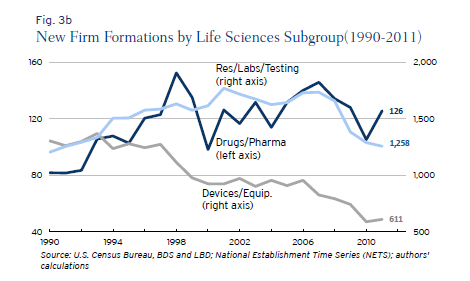
My paper with DiMasi and Milne showed that some FDA drug divisions appear to be much more productive than other divisions suggesting possibilities for substantial improvements if best practices were uniformly adopted. There also appear to be substantial differences between the regulation of drugs and devices especially in recent years. Ian Hathaway and Robert Litan have a new paper on Entrepreneurship and Job Creation in the U.S. Life Sciences Sector that shows that new firm creation in the medical device sector has fallen drastically since 1990 and far more than in the drug sector. Although there are likely many causes, the drop in the number of new firms is consistent with Gulfo’s experience of regulatory uncertainty and may suggest increases in regulatory cost for devices relative to drugs. Here is Hathaway and Litan:
The medical devices and equipment sector, on the other hand, saw new firm formations decline steadily and persistently between 1990 and 2011—falling by 695 firms or 53 percent during that period. Its share of new life sciences firms fell to 31 percent in 2011 from 50 percent in 1990. Unlike its life sciences sector counterparts, the decline in new firm formations in this segment appears to stretch beyond the cyclical effects of the Great Recession.
Do the advantages of undergraduate prestige persist?
Joni Hersch of Vanderbilt has a new paper on this topic. Given the multiple dimensions of unobserved quality, I wonder if there is any method which can convince me on such questions. Still, I am glad to see someone putting the effort in. Here is what the author came up with:
Income disparities arise not only from differences in the level of education but also from differences in status associated with an individual’s degree-granting college or university. While higher ability among those who graduate from elite undergraduate institutions may account for much of the earnings premium associated with elite education, ability should be largely equalized among those who graduate from similarly selective graduate programs. Few graduates of nonselective institutions earn post-baccalaureate degrees from elite institutions, and even when they do, undergraduate institutional prestige continues to influence earnings overall and among those with law, medical, graduate business and doctoral degrees.
For the pointer I thank the excellent Kevin Lewis. Kevin also refers us to this unorthodox paper on the Finns, namely why are they so smart yet win so few Nobel Prizes.
Fair trade markets in everything?
“Fair Trade” Cocaine Is A Thing Now
For instance:
Even more intriguing is the use of marketing strategies that mimic corporate social responsibility initiatives. These may take the form of financial sponsorship of organizations likely to be viewed favorably by online drug consumers. For example, one Australian drug vendor recently advertised their enterprise as a: “Proud financial supporter of WikiLeaks and Bluelight.”
At the more extreme end of socially progressive marketing strategies used by online dealers are those that involve the promotion of drugs on the basis of supposedly “ethical”, “fair trade”, “organic” or “conflict-free” sources of supply:
“We are a team of libertarian cocaine dealers. We never buy coke from cartels! We never buy coke from police! We help farmers from Peru, Bolivia and some chemistry students in Brazil, Paraguay and Argentina. We do fair trade!”
Naturally, it is impossible to verify these claims.
For the pointer I thank Annie Lowrey.
*Colorless Tsukuru Tazaki and his Years of Pilgrimage* (What I’ve been reading)
That is the new Haruki Murakami book, which Amazon sent me a day early. It is (dark) fun, but not deep and not top drawer Murakami. Most of his fans will like it enough to be glad they bought it.
Fear: A Novel of World War I, by Gabriel Chevalier, is being touted as the “latter day All Quiet on the Western Front.” At first I thought that was just exaggerated promo, but it is quite good.
Justin McGuirk, Radical Cities: Across Latin America In Search of a New Architecture is broader than the title implies and recommended to anyone who follows that part of the world.
Assorted links
Innovation Breakdown
From my review today in the WSJ of Innovation Breakdown by Joseph Gulfo:
Yo is a smartphone app. MelaFind is a medical device. Yo sends one meaningless message: “Yo!” MelaFind tells you: “biopsy this and don’t biopsy that.” MelaFind saves lives. Yo does not. Guess which firm found it easier to put their product in consumers hands? Oy.
In “Innovation Breakdown: How the FDA and Wall Street Cripple Medical Advances,” Joseph Gulfo tells the tumultuous history of MELA Sciences, the company that invented MelaFind. When Dr. Gulfo joined the firm as president and CEO in 2004, the company’s brilliant team of scientists had spent many years and tens of millions of dollars to develop MelaFind, a “camera with a brain”—optical technology that would scan potential melanomas in multiple spectra and then, using sophisticated algorithms and large datasets, diagnose which were most likely to be cancerous.
MELA Sciences conducts an extensive clinical trial according to a protocol agreed on by the FDA and all looks good. After the clinical trial is completed, however, the FDA backs away from the protocol and comes out against MelaFind.
…The title of Dr. Gulfo’s book is “Innovation Breakdown” but “Innovator’s Breakdown” might have been more apt. The letter sent the author into survival mode. He battled the FDA, calmed investors, and defended against the lawsuit all while trying to keep the company afloat. Under stress, Dr. Gulfo’s health began to decline: He lost 29 pounds, his hair began to fall out, and the pain in his gut became so intense he needed an endoscopy. When his wife begged him to quit, he refused. They turned into roommates. “We were nothing more than cordial. I basically shut my wife out of my life,” he writes.
…The climax to this medical thriller comes when, in “the greatest 15 minutes of [his] life,” Dr. Gulfo delivers an impassioned speech, à la “Twelve Angry Men,” to the FDA’s advisory committee. The committee voted for approval, 8 to 7, and, perhaps with the congressional hearing in mind, the FDA approved MelaFind in September 2011.
It was a major triumph for the company, but Dr. Gulfo was beat. He retired from the company in June 2013—just in time to save his marriage.
Yet remarkably, given his experience, Mr. Gulfo writes that he still believes in a strong FDA. He argues in the book that better “leadership” and a few tweaks to existing rules can fix the problem. He’s wrong.
Compare MelaFind’s experience in the U.S. with its reception in Europe: MelaFind was submitted for marketing approval in Europe in May 2011. It was approved just five months later. One key reason for Europe’s efficient approval process is that European governments don’t review medical devices directly. Instead they certify independent “notified bodies” that specialize and compete to review new products. The European system works more quickly than the U.S. system, and there is no evidence that it results in reduced patient safety. Rather than tweak the current system, why doesn’t the U.S. just adopt the European model and call it a day? Our health and our economy would be better off for it.
Google’s Sergey Brin recently said that he didn’t want to be a health entrepreneur because “It’s just a painful business to be in . . . the regulatory burden in the U.S. is so high that I think it would dissuade a lot of entrepreneurs.” Mr. Brin won’t find anything in Dr. Gulfo’s book to persuade him otherwise. Until we get our regulatory system in order, expect a lot more Yo’s and not enough life-saving innovations.
Why is there so much unemployment in Gaza?
Assaf Zimring writes to me:
Since we tend to associate high unemployment with any economic calamity, people don’t seem to think a lot about why we see very high unemployment in Gaza. But I am puzzled by it. How come an economy with such tremendous shortages fails to employ 40% of its workers in an attempt to meet these shortages?
Has the (by now, fairly loose) blockade pushed the MPL to zero for 40% of workers? Is it uncertainty that stops investment? Did large aid payments (in some years – 50% of GDP) cause some kind of a Dutch disease of an epic scale (though I am not sure that would lead to unemployment)? I wonder if you have any thoughts about that.
At the first link you will find some interesting papers by Assaf on the Gaza blockade and other Gaza shocks. One option of course is simply that hardly anyone is really employed, although there is massive underemployment in grey and black market economies, including for the digging of tunnels and subsistence agriculture.