The Oocyte Cartel
The Society for Assisted Reproductive Technology (SART) represents more than 85 percent of the assisted reproduction industry. SART requires that its members work only with agencies that limit compensation to egg-donors to around $5000 or a maximum of $10,000 (figures decided upon by the ethics committee of an affiliated organization, The American Society for Reproductive Medicine (ASRM)). In other words, ASRM-SART acts as a buyer’s cartel.
In 2011, Lindsay Kamakahi launched a class action suit against ASRM-SART challenging their horizontal price-fixing agreement as per se illegal under the Sherman Antitrust Act. ASRM-SART tried to have the case dismissed but a judge recently denied the dismissal in the process making it clear that the plaintiffs have a good case.
ASRM-SART argue that their maximum price is really about protecting women and that compensation “should not be so excessive as to constitute undue inducement.” Egg donation does involve extensive screening, time and some health risks. One would think, however, that the proper response for those interested in protecting women would be to ensure that the women are fully informed and that they are paid high wages not low wages.
The paternalistic policy of the ASRM-SART especially rankles because it applies only to women, sperm donations are not regulated. Of course, sperm donation isn’t risky but we also don’t see laws limiting the wages of miners to protect miners (mostly men) from “undue inducement.” The societal expectation seems to be that men are appropriately motivated by self-interest but women may be appropriately motivated only by altruism.
I am in agreement with Kimberly D. Krawiec who writes in her excellent paper Sunny Samaritans and Egomaniacs: Price-Fixing in the Gamete Market:
It is ASRM’s paternalistic and misguided attempts to control oocyte donor compensation through the same type of professional guidelines that courts have rejected when employed by engineers, lawyers, dentists, and doctors that should raise an ethical red flag.
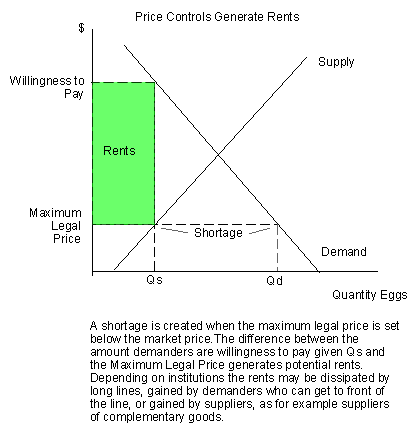 ASRM-SART surely believe that they are doing good but I think it no accident that they also do well from a policy that reduces the price of their inputs. A price controlled below the market price generates rents. In the traditional analysis, the rents are dissipated away by long-lines, a form of rent seeking (see Modern Principles–first edition now a bargain!). It’s also possible, however, for suppliers to grab up the rents, especially suppliers of complementary goods.
For example, it’s often been pointed out that in the organ donor market the hospitals, surgeons and executives all get paid and paid well; the only person not getting paid is the person who provides the transplant organ. But we can say more–one of the reasons the hospitals, surgeons and executives get paid well is precisely that the donor is not paid. The shortage created by the price control drives the demander’s willingness to pay upward and some of the difference between the willingness to pay and the maximum legal price is captured by the suppliers of complementary inputs. How do we know? In the 1990s, entry into the transplant business grew much faster than did the supply of transplant organs. In fact, transplants were so profitable there was a rush to transplant that increased the number of centers but drove down center volume thereby reducing patient survival rates.
Similarly, by limiting egg-supply the suppliers of assisted reproductive services may be able to increase their share of the total gains from trade.
Although ASRM-SART may profit from restricting donor compensation there is another issue at large, the repugnance constraint. The repugnance and disgust centers of the brain are old and deep and often revolve around issues of body integrity, body products, hygiene, sex and death. Birth treads uneasily in many of these waters already and egg donation adds to this volatile mix issues of gender, personhood, identity and genetics all of which prime for a repugnance storm. The plaintiff’s case is sound but if the antitrust laws prevent ASRM-SART from limiting prices–or saying that they limit prices–and if egg donation were to become even more of a market in everything might there not be a backlash and an outright ban on compensated donors, as is the case in many other countries and for transplant organs in this country? I hope not but it is a real possibility.
The ban on compensated transplant organ donation has led to hundreds of thousands of excess deaths. A ban on compensated sperm and egg donation would lead to a dearth of lives.
Delaying The Great Reset
Some 74 percent of professors aged 49-67 plan to delay retirement past age 65 or never retire at all, according to a new Fidelity Investments study of higher education faculty. While 69 percent of those surveyed cited financial concerns, an even higher percentage of professors said love of their careers factored into their decision.
Sentences of interest
It’s worth emphasizing that the recent rise in interest rates has been a global phenomenon, not just something seen in the United States.
That is from James Hamilton.
Who are the new economic optimists?
Here is a very good discussion by Nelson Schwartz, here is one excerpt:
He is not predicting an imminent resurgence. Like most academic economists, Mr. Cowen focuses on the next quarter-century rather than the next quarter. But new technologies like artificial intelligence and online education, increased domestic energy production and slowing growth in the cost of health care have prompted Mr. Cowen to reappraise the country’s prospects.
“It’s better than it looked,” Mr. Cowen said. “Technological progress comes in batches and it’s just a little more rapid than it looked two years ago.” His next book, “Average Is Over: Powering America Beyond the Age of the Great Stagnation,” is due out in September.
The link is added by me, and the article covers other individuals too. There is also this:
“The great stagnation will end for a lot of people but not everyone,” Mr. Cowen said. “I think there will be great breakthroughs but the distribution of those gains will go to owners of capital and intellectual property.”
Assorted links
1. The forthcoming push for (more) Chinese urbanization.
2. In The Great Reset, there is probably no Nashville Symphony Orchestra.
3. Robin Hanson TEDx talk on robot society.
4. Markets in everything: guinea pig armor edition, and more on seasteading.
5. The face slimmer exercise mouthpiece from Japan.
Dani Rodrik has been right all along
For a few years now Dani Rodrik has been tweeting about how second-rate, illegitimate, and undemocratic the current Turkish regime is. He never convinced me, not because I held firmly to some opposing perspective, but simply because I don’t follow Turkish politics closely enough for claims of any kind to have had traction on my views.
It now seems he has been quite clearly correct all along. The Turkish state has behaved very badly in response to recent protests and shown how deeply it is infected by many of the characteristics of autocratic and authoritarian regimes. The treatment of children, doctors, foreign and domestic journalists, the use of chemicals in the water cannon, the indiscriminate use of the riot police, and the generalized paranoid suspicion of the Turkish population — among other factors — all point in this direction. Democracy is about more than just elections.
Here is a short update on recent events. Here is a short piece on the not very impressive response of the Turkish media.
For some coverage of what is going on you can follow @memmetsimsek or Rodrik himself. Michael Clemens has connections to Turkey and he is also a useful source.
If nothing else, it can be forecast that the variance of possible outcomes for Turkey has gone up.
*Confessions of a Sociopath*
I suspect nothing in this book can be trusted. Still, it is one of the more stimulating reads of the year, though I have to be careful not to draw serious inferences from it. Does its possible fictionality make it easier to create so many interesting passages?:
I can seem amazingly prescient and insightful, to the point that people proclaim that no one else has ever understood them as well as I do. But the truth is far more complex and hinges on the meaning of understanding. In a way, I don’t understand them at all. I can only make predictions based on the past behavior they’ve exhibited to me, the same way computers determine whether you’re a bad credit risk based on millions of data points. I am the ultimate empiricist, and not by choice.
The author argues that sociopaths are often very smart, have a lot of natural cognitive advantages in manipulating data, and are frequently sought out as friends for their ability to appeal to others. It is claimed that, ceteris paribus, we will stick with the sociopath buddies, as we are quite ready to use sociopaths to suit our own ends, justly or not. It is claimed that for all of their flaws, many but not all sociopaths are capable of understanding what is in essence the contractarian case for being moral — rational self-interest — and sticking with it. Citing some research in the area (pdf), the author speculates that sociopaths may have an “attention bottleneck,” so they do not receive the cognitive emotional and moral feedback which others do, unless they decide very consciously to focus on a potential emotion. For sociopaths, top down processing of emotions is not automatic.
We even learn that (supposedly) sociopaths are often infovores. It seems many but not all sociopaths are relatively conscientious, and the author of this book (supposedly) teaches Sunday school and tithes ten percent to the church. It just so happens sociopaths sometimes think about killing or destroying other people, without feeling much in the way of remorse.
I can also recommend this book as an absorbing memoir of a law professor and also of a Mormon outlier. It is written at a high level of intelligence, and it details how to get good legal teaching evaluations, how to please colleagues, how to evade Mormon proscriptions on sex before marriage, and it offers an interesting hypothesis as to why sociopaths tend to be more sexually flexible than the average person (hint: think more systematically about what abnormal or weakened top-down processing of emotions might mean in other spheres of life).
The author argues that sociopaths can do what two generations of econometricians have only barely managed, namely to defeat the efficient markets hypothesis and earn systematically super-normal returns. What does it say about me that I find this the least plausible claim in the entire book?
Here is a useful New York Times review. Here is the author’s blog, which is about being a sociopath, or about pretending to be a sociopath, or perhaps both. Here is the book on Amazon and note how many readers hated it. I say they just don’t like sociopaths.
One hypothesis is that this book is a stunt, designed as an experiment in one’s ability to erase or conceal an on-line identity, although I would think a major publisher (Crown) is not up for such tricks these days. An alternative is that a sociopath — not the one portrayed in the book — is trying to frame an innocent person as the author of the book (some trackable identity clues are left), noting that the book itself discusses at length plans to destroy others for various (non-justified) reasons. Or is it a Straussian critique of the Mormon Church for (supposedly) encouraging sociopathic-related character traits in its non-sociopath members? Or all of the above?

You will note that the book’s opening diagnosis comes from an actual clinical psychologist in the area, and the Crown legal department would have no interest in misrepresenting him in this manner. So the default hypothesis has to be that this book represents some version of the truth, at least as seen through the author’s eyes.
Some version of the author, wearing a blonde wig it seems, appeared on the Dr. Phil show, to the scorn of Phil I might add.
I cannot evaluate the scientific claims in this book, and would I trust the literature on sociopaths anyway, given that the author claims it is subject to the severe selection bias of having more access to the sociopathic losers and criminals? (I buy this argument, by the way.) It did occur to me however, that for the rehabilitation of sociopaths, whether through books or other means, perhaps they should consider…a rebranding exercise? But wait, “Sorry, I could not find synonyms for ‘sociopath’.”
If nothing else, this book will wake you up as to how little you (probably) know about sociopaths.
Which market segment is being targeted by Kaiser in California?
Megan McArdle updates us:
Kaiser Permanente is one of the places that always gets cited as a model by health care reformers. It’s the biggest insurer in California, using a model that ended up being the basis for the HMO revolution. Kaiser owns its own hospitals, pays its doctors a salary, and provides the “continuum of care” that everyone says they want from our fragmented health care system–and does it at a reasonable price. So it’s a bit surprising to see the LA Times report that this model citizen submitted some of the highest bids for California’s health care exchanges.
…California is headed for two-tier service on the Exchanges. The carriage trade will head for full-service networks like Kaiser, with full access to the whole network of doctors and hospitals. The price conscious buyers–likely to be a sizeable majority–will crowd into plans with restrictive networks. And those networks will be very, very crowded. Effectively, they may end up as quasi-catastrophic insurance, simply because it will be difficult to actually access care outside of the emergency room.
Lower down the income scale, the new Medicaid patients–about half the expected additional coverage in states like California–will be similarly crowded, simply because Medicaid’s low reimbursement rates make doctors reluctant to take it.
Note that, for reasons explained in the post, this may not apply outside of California in every other state.
Assorted links
1. Greg Mankiw on income inequality (pdf).
2. Elysium official trailer #2.
3. Mistakes in German architecture, a three-way interview. Pretty amazing, and full of lessons about management and infrastructure and social capital and fiscal policy and principal-agent problems, not to mention the future of Europe: “The pure truth doesn’t get you far in this business.” Too instructive to otherwise excerpt.
I am proud of the Dotchka
Yana flew yesterday from Newark airport and will be arriving in Mumbai shortly, heading in a few days to live in Bangalore. She will be working with Forus Health to decrease preventable blindness among India’s poor, in part by aiding with their distribution of an affordable screening device.
Her indiegogo project is here, which also describes her trip and mission. I hope to visit later in the year. And I expect her to come back knowing three or four more languages.
The future of principal-agent problems
At 7:03 p.m. on May 25, my dog went to the bathroom in front of the Chinese massage place up the block from my house in Park Slope, Brooklyn.
I was not there, but I know this is true because a “poop alert” popped up on my laptop, 22 miles away at a friend’s house. A poop alert is a little white-on-brown icon of a squatting dog with, yes, a small pile beneath its tail, superimposed on a map of the walk fed by GPS data from the walker’s phone and updated every few seconds.
In addition, I received a text message on my phone. “Barnaby has just pooped.”
I cannot say that I was relieved, exactly – certainly not the way Barnaby was – but the people behind the high-tech dog-walking company Swifto, progenitors of the poop alert, say that many of their customers take great comfort in exactly this sort of information.
“A very common problem that a lot of dog owners have is that they don’t know that their dog walker has actually walked their dog,” said Mohammed Ullah, Swifto’s 23-year-old chief executive. The alert, he said, “lets the owner know exactly where, for instance, the dog has actually used the bathroom.”
Here is more, and for the pointer I thank Vic Sarjoo.
From the comments — on dynamism
Responding to this link, Ryan writes:
I think the secular decline in various measures of dynamism is a pretty important topic, largely because we haven’t been able to figure out what’s causing it. We’re seeing it not only in worker flows but also job flows, migration, startup rates, etc.
Industry composition effects make the puzzle even bigger–retail and services are typically more volatile than manufacturing, so the larger employment share they’re seeing means we should expect to see HIGHER rates of churning rather than lower (see http://updatedpriors.blogspot.com/2013/02/job-flows-industry-composition-and.html).
One thing that DOES help explain secular declines in gross flows is firm age stuff. Startup rates and employment shares among young firms are on secular decline (see http://updatedpriors.blogspot.com/2012/12/startups-and-great-recession.html); since dynamism typically declines as you go up through the age classes, lower young-firm activity means we should expect lower flows. But it’s not clear that this is a sufficient explanation; and, more importantly, it’s only explanatory in an accounting sense. We don’t know why entry is declining. And this is a secular trend, so common political explanations may not work.
Whether we should be worried really depends on what is causing all of this. After all, churning is costly. If churning is declining for good reasons, we should applaud it. But that may not be the case.
Where does the right to publicity lie? (hard to discern)
The Screen Actors Guild and several players’ unions have filed briefs supporting Mr. Hart, saying that athletes, actors and other celebrities must have the right to control the use of their identities and to harvest the financial fruits of their fame. The movie industry, book publishers and news organizations, including The New York Times, have lined up on the other side, saying that allowing celebrities to control speech about them runs afoul of the First Amendment.
The dueling briefs cited a grab bag of cases that are hard to wrestle into a coherent legal framework.
The courts have, on the one hand, rejected right-of-publicity suits arising from a painting of Tiger Woods, a comic book evoking the musicians Johnny and Edgar Winter, parody baseball trading cards and a fantasy baseball game that used the names, statistics and biographies of Major League players. But courts have allowed suits over the broadcast of a human cannonball’s entire act, a comic book using a hockey player’s nickname, an ad evoking Vanna White’s skill at turning letters on “The Wheel of Fortune” and a reference to Rosa Parks in a song.
If there is a legal principle that unites these rulings, it is hard to discern. What is clear, though, according to an expansive 2011 Supreme Court decision, is that video games deserve full First Amendment protection.
Here is more, by Adam Liptak. Here is a Gloria Franke paper (pdf) on some of the underlying legal (and economic) issues.
Assorted links
1. Does legalized prostitution favor human trafficking?
3. For and against science prizes.
4. Will you settle for a flying bicycle?
5. Scott Sumner on sticky nominal wages, and Japanese girlie group spans the asset space (update).
6. Markets in everything: Czech corruption bus safari (in Czech). And North Koreans visit Uganda.
Sentences to ponder
While the ethics behind holograms of deceased celebrities might be questionable (in the words of a parody Twitter account called Aaliyah’s Ghost, “The best duets imo are the ones where both artists are alive & agreed to work together”), copyright permissions and objections from various estates, in addition to the high costs, have so far prevented “resurrections” from becoming a more widespread trend. For its closing ceremony, the London Olympics scrimped on costs, reviving Freddie Mercury for a duet with Jessie J by broadcasting his image on a flat screen rather than a hologram body. It is hard to imagine the Tupac hologram moving forward without permission from his mother Afeni Shakur. The Marilyn Monroe estate, on the other hand, contested plans for a “Virtual Marilyn” concert organised by Musion partner Digicon Media.
Here is more, from the always interesting Joanne McNeil.