How much would it matter if we deregulated health insurance across state lines?
Allowing insurance sales across state lines comes up perennially as a way to drive down the cost of health care.
Conservatives argue that allowing a plan from a state with relatively few benefit mandates – say, Wyoming – to sell its package in a mandate-heavy state (like New York) would give consumers access to options that are more affordable than what they get now.
Liberals tend to argue this is a bad idea, contending that it would create a “race to the bottom,” where insurers compete to offer the skimpiest benefit packages.
A new paper from Georgetown University researchers suggests a third possible outcome: Absolutely nothing at all will happen. They looked at the three states – Maine, Georgia and Wyoming – that have passed laws allowing insurers from other states to participate in their markets. All have done so within the past two years.
So far, none of the three have seen out-of-state carriers come into their market or express interest in doing so. It seems to have nothing to do with state benefit mandates, and everything to do with the big challenge of setting up a network of providers that new subscribers could see.
“The number one barrier is really building that provider network that’s attractive enough to get patients to sign up,” said lead study author Sabrina Corlette. “To do that, you have to offer providers attractive reimbursement rates, which makes it difficult to get them in network.”
Corlette and her colleagues talked to insurers and regulators in all three states. And they heard this barrier come up again and again: Entering a new state is really difficult, whether there are benefit mandates or not. “We kept hearing about the cost of building a provider network that’s strong enough to market,” she said.
Huffington Post covers Marginal Revolution University
The very good article is here, excerpt:
Cowen said the Internet has changed so many aspects of our lives, so “Why should education stay behind?
“Education is changing rapidly and we want to go to our graves feeling we were on the right side of history, so-to-speak,” he said.
Seoul food notes
There is always a pumpkin, smoked duck, or clam and noodles dish you haven’t seen before. The way to eat well here is to seek out the small restaurants, on the edge of residential districts, with no English language signs, which appear to not rely very heavily on the division of labor and which serve not too many dishes. Bibim bap (shaken vigorously inside a lunch box, I might add) is like a fine risotto and the quality of cabbage alone makes Seoul a world-class city.
Particular restaurant recommendations are pointless, and in any case hard to track down. Just follow basic principles. The street food, by the way, is only so-so.
At one restaurant, as a kind of joke, I asked “What is best?”, not even expecting my English to be understood. The waiter became very excited and opened the menu to a page entitled “Best food,” which listed five dishes. I ordered two of them.
I see no reason to explore upscale dining here. For surprise and uniqueness, I am not sure the world currently offers a better dining city than Seoul. My most expensive meals are still falling below $20, averaging $10-$12, and they are occasionally below $5.
“How capitalism can save art”
That is the new Op-Ed by Camille Paglia, excerpt:
Creativity is in fact flourishing untrammeled in the applied arts, above all industrial design. Over the past 20 years, I have noticed that the most flexible, dynamic, inquisitive minds among my students have been industrial design majors. Industrial designers are bracingly free of ideology and cant. The industrial designer is trained to be a clear-eyed observer of the commercial world—which, like it or not, is modern reality.
…Young people today are avidly immersed in this hyper-technological environment, where their primary aesthetic experiences are derived from beautifully engineered industrial design. Personalized hand-held devices are their letters, diaries, telephones and newspapers, as well as their round-the-clock conduits for music, videos and movies. But there is no spiritual dimension to an iPhone, as there is to great works of art.
Paglia’s new book is here. For the pointer I thank Alex T.
Assorted links
1. Anti-Gangnam markets in everything.

2. Some remaining problems for self-driving cars (temporary road signs, snow, going in reverse).
3. Swedish lunch egalitarianism, and some policy lessons from Sweden.
4. Draft version of new Jeff Hummel book on war as the health of the state.
5. Monsanto seed patent case to get Supreme Court review, lots at stake here.
Our food and agriculture videos are up at MRU
Here is the description from the site:
The Food and Agriculture Productivity section of the Development Economics course is now available.
Early economics was largely the economics of agriculture, and these days food supply remains a critically important topic in development economics, especially in the poorer countries. Take India for instance — currently about half of the Indian labor force works in agriculture.
We cover some of the most fundamental questions about food supply and offer some optional videos on food as well. It’s not just about fighting hunger and starvation — agricultural surpluses are part of the path toward industrialization.
Particular topics include micronutrients, GMOs, the recent rice price spikes, garlic, watermelon, and “Yams, a Man’s Crop,” among others.
Truth Bounties
The Truth Market is an interesting combination of prediction markets, bounty hunting and crowd funding that aims to separate the wheat from the chaff of truth claims. Here is how it works:
You hear a statement that you think is bogus (or you hear the denial of something that you think is true). You open a challenge in which you offer to pay a truth bounty of $x if someone can prove that the bogus statement is true (or prove false the statement that you think is true). Other people can join your challenge, adding to the bounty. If the total bounty exceed a significant threshold the challenge goes live.
Once a challenge is live, anyone can earn the bounty if their evidence for or against the claim meets the standards of a neutral, professional, scientifically trained group of adjudicators (provided by TruthMarket). If within a given time-frame no one wins the bounty the bounties are returned to the contributors minus 20% which goes to the initial sponsor of the challenge. The initial sponsor can now also trumpet that despite significant cash no one was able to prove the bogus claim (or refute the true claim).
Thus, there are incentives to offer challenges, incentives to answer challenges, and incentives to pay attention to the results. TruthMarket has some serious people on its management team and advisory board. There are already challenges about global warming, cell phones, defensive gun use and other issues.
Will the Truth Market work? In order to work, TruthMarket will need a track record of significant money bounties and adjudicated claims. As of yet, I don’t see many (any? the site is unclear although this is the most important part of the process).
Most important, people have to regard winning a bounty and the failure to win a bounty as informative. My experience, however, is that the people who regard betting as informative are already rational and well-informed about other issues so the bounty isn’t necessary to prosecute the truth claim.
The Amazing Randi’s one million dollar prize for “evidence of any paranormal, supernatural, or occult power or event,” was first offered in 1964 but has never been claimed. In theory, that tells us a lot. In practice, the failure of the prize to be won does not seem to have changed many people’s beliefs.
All those years ago
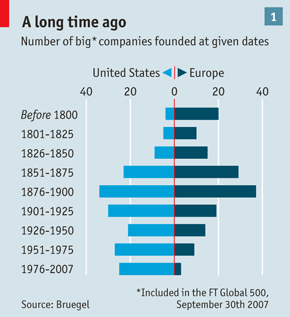
That is from The Economist, via Michael Mandel and Paul Graham.
Arvind Subramanian is pessimistic about Indian growth prospects
“The Indian state is increasingly unable to provide a range of basic services: health, education, physical security, rule of law, water and sanitation. The writ of the Indian state, for example, covers only about 80% of India, with the tribal belt essentially contested by Maoist insurgents. The private sector can substitute for some of these deficiencies but never completely. – In the long run, growth is determined by effective state capacity: that is India’s weakness compared with China.”
Here is more, in the form of a debate. Hat tip goes to Tom Murphy.
Assorted links
My favorite things Korea
1. Movie. If I had to pick one, I might opt for Old Boy. The deeper point is that you should watch them all. If it is a Korean movie, and you can get your hands on it (as a non-Korean), it is probably excellent. This is a remarkable regularity and a good selection filter for exploring. This list is one place to start but not to stop. The Host is a fun spoof of monster movies and Shiri is a gripping thriller. Watch any Korean movie which Scott Sumner recommends. Even some of the clunkier Korean movies, such as The Housemaid, are better than most Hollywood fare.
2. Actress: Grace Park from Battlestar Galactica, and there is also Shin Eun-kyung.
3. Actor: John Cho, of Harold and Kumar fame. It is unlikely he is the best.
4. Video artist: Nam June Paik.
5. Classical pianist: Kun-Woo Paik, I find he is better represented on disc (Ravel, Liszt, Scriabin) than on YouTube. For violinist there is Sarah Chang, YouTube here.
6. Economist: Ha-Joon Chang comes to mind, although I disagree with most of his work. Here is my podcast interview with him.
7. Poet: Ko Un is the only one I have read. It is hard to judge any poet outside of his or her native language, but I definitely had the feeling something was there.
8. Novelist: Kyung-sook Shin is alas the only one I can name.
9. Movie, set in: Korean movies aside, you might consider Pork Chop Hill.
10. Painter: Contemporary art is a rich vein for South Korea. This catalog is one good place to start.
The bottom line: This is an impressive showing and it is improving rapidly. The killer categories is movies.
The making of K-Pop
Standing beside me was Jon Toth, a twenty-nine-year-old white guy, a computer scientist who had driven twelve hours straight from New Mexico. Toth is a fan of Girls’ Generation, a nine-member girl group in the process of recording its American début album, with Interscope Records. At the time he stumbled across the Girls, on YouTube, Toth was an alt-rock guy; he loved Weezer. “I was definitely not the kind of guy you’d expect to get into a nine-girl Asian group,” he told me. But before long Toth was studying Korean, in order to understand the lyrics and also Korean TV shows. Then he started cooking Korean food. Eventually, he travelled all the way to Seoul, where, for the first time, he was able to see the Girls—Tiffany, Sooyoung, Jessica, Taeyeon, Sunny, Hyoyeon, Yuri, Yoona, and Seohyun—perform live. It was a life-changing experience.
“You think you love them, but then you see Tiffany point directly at you and wink, and everything else that exists in the world just disappears,” Toth wrote on Soshified, a Girls’ fan site. “You think you love them, but then you see Sooyoung look you dead in the eye and say in English, ‘Thank you for coming.’ ” Toth concluded, “I might not know how much I love these girls.”
Here is much more, interesting throughout. How about this?:
Double-fold-eyelid surgery, which makes eyes look more Western, is a popular reward for children who get good marks on school exams. The popularity of the K-pop idols has also brought Chinese, Japanese, and Singaporean “medical tourists” to Seoul to have their faces altered to look more like the Korean stars. Some hotels have partnered with hospitals so that guests can have in-house procedures; the Ritz-Carlton Seoul, for example, offers an eighty-eight-thousand-dollar “anti-aging beauty package.” Women come to have their cheekbones shaved down and undergo “double jaw surgery,” in which the upper and lower jawbones are cracked apart and repositioned, to give the whole skull a more tapered look.
For the pointer I thank Viktor.
Sentences to ponder
Starting January 1 of 2013 the top tax rate on dividends in the US will officially become the highest in the developed world. If you live in NY for example, the top rate on stock dividends will be close to 50% – which is significantly higher than France.
…According to JPMorgan, this dividend tax will reduce mature firms’ valuations by $1.5 trillion. That’s going to hit private and state pensions as well as IRA, 401K, and 529 accounts.
And JPMorgan adds:
Capitalizing this foregone capital income generates a $1.5 trillion reduction in equity market value, or about 6% of the $24 trillion value of corporate equities at the end of 2Q. Standard wealth effects suggest this will reduce consumer spending by a little over $50 billion, or about 0.5%.
A German icon moves on
After 63 semesters spanning nearly 40 years of studying, German engineer Werner Kahmann finally managed to get his university diploma. In an interview with the Süddeutsche Zeitung he explained why it took him so long.
Here is one part of the story:
The first time Kahmann put his diploma on hold, he broke his leg playing football. The second time, it was 1984 and his daughter was born so he took time out to help raise her. “Then in 2004 when student fees were introduced, I de-matriculated again.”
In 2011, the fee system changed and Kahmann found himself with his nose in a book one again. But this time, it was for real – he earned his diploma a year later, even though the university did not even run the course anymore.
There would be downsides to being a graduate though, he said. “Paying for public transport and not getting reduced tickets for the zoo,” being two of Kahmann’s complaints.
For the pointer I thank Chris Reicher.