Does unemployment drive rebellion?
Maybe not. There is a new piece out by Eli Berman, Michael Callen, Joseph H. Felter and Jacob N. Shapiro, in Journal of Conflict Resolution, August 2011. Here is an ungated version, excerpt:
Most aid spending by governments seeking to rebuild social and political order is based on an opportunity-cost theory of distracting potential recruits. The logic is that gainfully employed young men are less likely to participate in political violence, implying a positive correlation between unemployment and violence in places with active insurgencies. We test that prediction on insurgencies in Iraq and the Philippines, using survey data on unemployment and two newly- available measures of insurgency: (1) attacks against government and allied forces; and (2) violence that kills civilians. Contrary to the opportunity-cost theory, we find a robust negative correlation between unemployment and attacks against government and allied forces and no significant relationship between unemployment and the rate of insurgent attacks that kill civilians.
Here is a WQ summary of some additional findings from the paper.
A wee bit of financial history
If March 4, 1933, and February 11, 2009, marked the nadirs of public confidence in Wall Street, then the years 1928 and 1999 marked the zeniths, when Goldman Sachs sold shares to the public for the only two times in its history. In December 1928, the partners of Goldman Sachs sold shares in a subsidiary called Goldman Sachs Trading Corporation–for its day, a complex, highly leveraged instrument with many layers that made transparency all but impossible. By the time of Roosevelt’s inauguration in 1933, the shares were nearly worthless. For the next 70 years, burned by that experience and FDR’s excoriation in 1933, the firm’s partners retreated to their roots as a private partnership, using their own personal capital with only modest leverage to advance their role as a financial intermediary.
By 1999, Goldman’s reputation had recovered to its previous zenith–to the point that a public offering again was possible. Its partners had debated the merits of such a change for years, and, even when the decision was made to go forward, the decision was reached only after vigorous debate and much disagreement. In favor of going public were those partners who saw a need for a larger capital base to allow the firm to compete in the increasingly globalized economy with the larger players both in the U.S. and overseas. Furthermore, once a public market was established for its shares, Goldman would have a currency other than cash with which to acquire other businesses and grow into financial services it could not afford to enter as a private partnership. On the other side of the argument were those partners who were worried about the impact that transition to a public firm would have on the firm’s culture. Heretofore, the firm had been known for its low ego and gang-tackling ethos, with aggressive personalities kept in check by the partnership potential that was strongly linked to both productivity and cultural fit.
What neither the firm’s partners nor outside observers were able to foresee was the resulting change in the firm’s risk tolerance…
For the pointer I thank John Phillips.
*Library Journal* review of *An Economist Gets Lunch*
Part In Defense of Food: An Eater’s Manifesto and part Roadfood, this is a culinary coming-out party for Cowen (economics, George Mason Univ.), who up to now has been known for more standard economic works like The Great Stagnation. This latest book combines economic and environmental messages, all written in a highly entertaining and informative style—often with a counterintuitive twist. The real story, though, is the author and his techniques for finding and eating delicious, inexpensive food from all over the world. Thus, we get tips on how to obtain good Chinese food from local, not-so-authentic places; which strip malls are likely to have the best restaurants (who knew they were in strip malls to begin with?); using Google to turn up unexpected restaurant gems; and why places filled with fun, laughing, drinking people often don’t have good food. An entire chapter is devoted to barbecue, and another provides specific suggestions for eating well in numerous countries.
VERDICT A fun and informative book that environmentalists, economists, and (most of all) foodies will enjoy. Recommended for all. [See Prepub Alert, 10/7/11.]—Susan Hurst, Miami Univ. Libs., Oxford, OH
Scott Winship summary on mobility and inequality
Read it here, excerpt:
…evidence on earnings mobility in the sense of where parents and children rank suggests that our uniqueness lies in how ineffective we are at lifting up men who were poor as children. In other words, we have no more downward mobility from the middle than other nations, no less upward mobility from the middle, and no less downward mobility from the top. Nor do we have less upward mobility from the bottom among women. Only in terms of low upward mobility from the bottom among men does the U.S. stand out.
Assorted links
*Buckley: William F. Buckley and the Rise of American Conservatism*
By Carl T. Bogus. It is an excellent and admirable book, highly readable, and also a good example of how liberals should write about conservatives.
You can order it here. My previous coverage of Carl T. Bogus is here.
Toy nationalism the polity that is Russia
There hadn’t been many – indeed any – rallies like it before in Russia. Last month saw dozens of toys, from teddy bears to Lego figurines, standing out in the snow of a Siberian city with banners complaining about corruption and electoral malpractice.
At the time, Russian authorities in Barnaul declared the protest “an unsanctioned public event”.
Now a petition to hold another protest featuring 100 Kinder Surprise toys, 100 Lego people, 20 model soldiers, 15 soft toys and 10 toy cars has been rejected because the toys have been deemed not to be “citizens of Russia”.
“As you understand, toys, especially imported toys, are not only not citizens of Russia but they are not even people,” Andrei Lyapunov, a spokesman for Barnaul, told local media.
The story is here and for the pointer I thank Michelle Dawson.
Not from Atlas Shrugged
The Hill: Six House Democrats, led by Rep. Dennis Kucinich (D-Ohio), want to set up a “Reasonable Profits Board” to control gas profits.
The Democrats, worried about higher gas prices, want to set up a board that would apply a “windfall profit tax” as high as 100 percent on the sale of oil and gas, according to their legislation.
…The Gas Price Spike Act, H.R. 3784, would apply a windfall tax on the sale of oil and gas that ranges from 50 percent to 100 percent on all surplus earnings exceeding “a reasonable profit.” It would set up a Reasonable Profits Board made up of three presidential nominees that will serve three-year terms.
And here directly from the proposed bill:
(4) REASONABLE PROFIT.—The term ‘reasonable profit’ means the amount determined by the Reasonable Profits Board to be a reasonable profit on the sale.
Addendum: Here is Bryan Caplan’s classic, Atlas Shrugged and Public Choice: The Obvious Parallels and here is the award-winning Atlas Shrugged app.
The economics of higher non-profit and for-profit education
Here is a 2009 paper of mine with Sam Papenfuss (pdf), a later version of which was published in this book edited by Joshua Hall. The paper deliberately sidesteps the recent scandals and focuses on fundamentalist explanations of why higher education might be provided on a non-profit or for-profit basis.
The key stylized facts are this:
Two primary features characterize the observed educational for-profits. First, for-profits tend to specialize in highly practical or vocational forms of training. For-profits are especially prominent in areas where student performance can be measured by a relatively objective, standardized test. Nonprofits, in contrast, have a stronger presence in the liberal arts, although they are by no means restricted to that arena..
This is a general pattern, and not unique to the United States today:
A comparison of for-profit and non-profit institutions in the Philippines [in the 1970s] bears out many of the differences noted above. Filipino for-profits tend to charge lower fees, specialize in education of lower academic reputation, spend less on capital equipment, and serve students who plan on pursuing vocational careers or taking a standardized vocational test upon graduation…Students at for-profits are approximately ten times more likely to take the tests. Adjusting for the lower pass rate from for-profits, the for-profits are putting about five times the number of students through the tests as the non-profits, even though for-profits educated no more than three-fifths of all Filipino students at the time.
Here is one possible (partial) resolution:
Faculty governance implies that for-profits and nonprofits place different relative weight on reputation and profits. The for-profit selects students and faculty on the basis of how easily their reputational benefits can be captured by shareholders, whereas the non-profit places greater weight on the reputational benefits that are kept by faculty. The for-profit pursues “reputation as valued by students in dollar terms” and the nonprofit pursues “reputation with the external world,” or “reputation as a public good.” In the resulting equilibrium, for-profits achieve lower status.
…The hypothesis therefore predicts a segmented market for higher education. Students who seek the highest levels of certification and reputation will attend non-profit institutions, which are run by faculty and use their prestige to raise donations. Students whose quality can be certified by an outside vocational exam do not need the non-profit reputational endorsement. They will pursue the more efficient instruction offered by for-profits.
There is a good recent paper by David Deming, Claudia Goldin, and Lawrence F. Katz on educational for-profits, available here. Here is a 2010 Dick Vedder piece on for-profits, more positive than most recent accounts.
Department of Yikes
…his German counterpart [finance minister] suggested postponing Greek elections and installing [sic] a new government without political parties.
I do understand the financial motive here, but this is not a good idea! It is even less of a good idea to say so in public. Is the goal simply to irritate the Greeks so much that they leave the Eurozone on their own? Twitter rumors are suggesting that Finland and the Netherlands are raising similar ideas, namely postponing elections and, it seems, simply ruling the country through its budget? I am not sure how this is supposed to work, or to be received in Greece, or why it should be a good precedent for the European Union. The FT story is here.
Why is there so little money in politics?
With campaign season approaching, maybe it is time to reprise this public choice classic from Stephen Ansolabehere, John M. de Figueiredo and James M. Snyder Jr. (pdf), here is the abstract:
In this paper, we argue that campaign contributions are not a form of policy-buying, but are rather a form of political participation and consumption. We summarize the data on campaign spending, and show through our descriptive statistics and our econometric analysis that individuals, not special interests, are the main source of campaign contributions. Moreover, we demonstrate that campaign giving is a normal good, dependent upon income, and campaign contributions as a percent of GDP have not risen appreciably in over 100 years – if anything, they have probably fallen. We then show that only one in four studies from the previous literature support the popular notion that contributions buy legislators’ votes. Finally, we illustrate that when one controls for unobserved constituent and legislator effects, there is little relationship between money and legislator votes. Thus, the question is not why there is so little money [in] politics, but rather why organized interests give at all. We conclude by offering potential answers to this question.
For the pointer I thank Matt Mitchell.
Assorted links
1. DasParkHotel, and claims about German humor.
2. A Joke.
3. Noah Smith has a new job, and the tale.
4. Model this: Edward Elgar prices are falling.
5. Sales of Charles Dickens books in his lifetime, and how much does movie piracy matter?
The Age of Reason
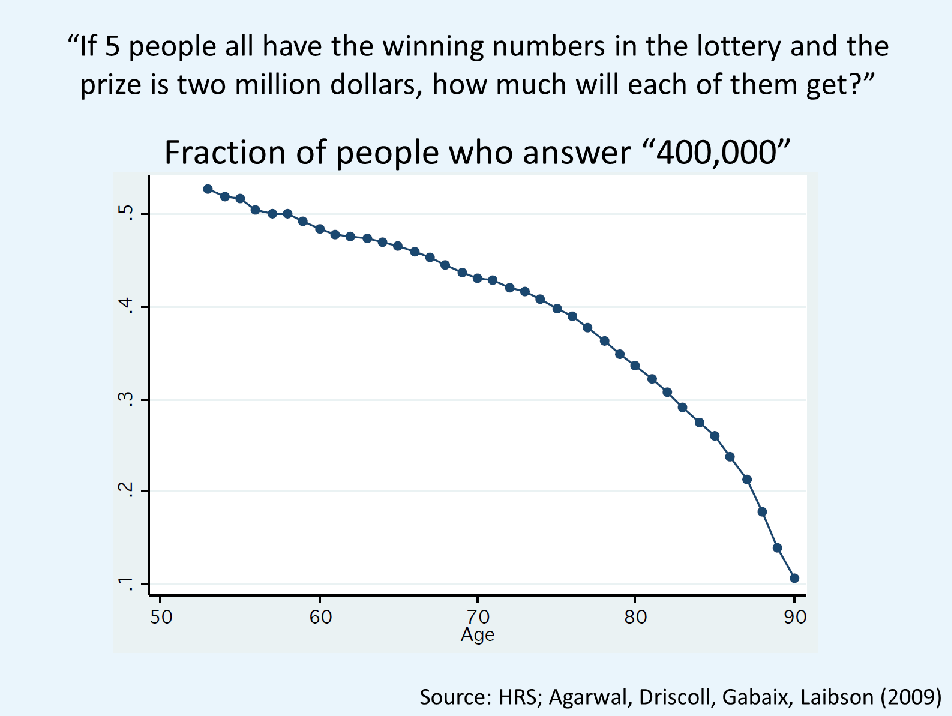
I don’t know which is scarier the height of the curve around age 50 or the slope of the curve (fyi, my guess is cohort effects are small). The slide is from David Laibson who has much more on aging and dementia; also raises issues of the value of medical care that maintains the body but not the mind.
Sentences to ponder
…when Prime Minister Mario Monti remarked that having a job for life in today’s economy was no longer feasible for young people — indeed, it was “monotonous” — he set off a barrage of protests, laying bare one of the sacrosanct tenets of Italian society that the euro zone crisis has placed at risk.
Reaction was fast, furious, bipartisan and intergenerational. “I think the prime minister has to be careful with the words he uses because people are a little angry,” Claudia Vori, a 31-year-old Rome native who has had 18 different jobs since graduating from high school in 1999…
This point is not irrelevant:
Debate has been especially intense over Article 18 of the 1970 Workers Statute, which forbids companies with more that 15 employees from firing people without just cause. The unions say that line cannot be crossed.
The article is here. How many years does it take to a) undo this, and b) have it kick in as a positive for growth? This again also gets back to the question of why Germany does not wish to pay for everything. By the way, is anyone writing a behavioral economics piece about how “crisis fatigue” increasingly is shaping eurozone policy?
Life as a pure rent-seeker? Or as the ultimate Kirznerian entrepreneur?
Or both. Gary Bemsel has visual acuity:
He can scan hundreds of video slots a minute, with an eagle eye honed by the past 15 years making his living as a racetrack stooper — someone who bends down to gather betting slips off the track floor in the hope of finding a mistakenly discarded winner.
…“It’s a legitimate living — the money’s been left behind,” he said on Wednesday. “It’s surer money than stooping; it’s steadier, and it’s cleaner — you don’t have to fish through garbage cans.”
Mr. Bemsel has not given up stooping. After a loop through the racino, he has enough cash to hit the betting window in the track and then scour the floor and trash for winning tickets. Slipping deftly through crowds of cheering and swearing horseplayers, he can read slips on the ground and tell immediately if they are winners. For face-down slips, he has developed a nimble, soccer-style flip move using both feet — so he barely has to stoop at all.
Yet returns are down:
“The first few weeks you could hit the A.T.M. machines for stray $20 bills lodged up in the dispenser,” Mr. Bemsel said. “But certain guys caught onto it, and now they stake out a machine all day, snatching them up.”
Nor has it worked out entirely well for him:
He works 12-hour days and finds $600 to $1,200 a week, Mr. Bemsel said, but winds up blowing most of it on bad horse picks. “The whole reason I do this is to feed my gambling addiction,” he said. “It’s an illness.”
The excellent article is here, and for the pointer I thank Ben Greenfield.