Who’s preposterous?
I don't usually pull out media quotes to mock them, but this one caught my eye. There is a new book out — Lucy — and it is the (fictional) story of a woman who is part human, part bonobo chimpanzee, but who looks quite human. Michiko Kakutani wrote this criticism about the story:
It seems preposterous that the United States government or its agents would throw this teenage girl into a cage on an Air Force base.
Huh? If the point is that they would sooner use a Navy base, that can be granted. More generally, don't we live in a world where the U.S. government tries to assassinate some of its citizens, arbitrarily detains and holds many people — even innocent people –, and until recently tortured many people, and how about the still-legal Judge Rotenberg Center? As an aside, how do we treat full-blooded chimpanzees?

Kakutani's sentence made me want to buy the book.
Whole Earth Discipline
Here's my final quote (earlier quotes here and here) from Stuart Brand's Whole Earth Discipline: An Ecopragmatist Manifesto, a quote which sums up the thesis of the book:
Accustomed to saving natural systems from civilization, Greens now have the unfamiliar task of saving civilization from a natural system…
Brand is talking about climate change and in particular the possibility of rapid, difficult to reverse, tipping points in climate. Brand has a challenging message for environmentalists: If we take the threat of climate change seriously we must recognize that Cities are Green, Nukes are Green and Genetic Engineering is Green.
Brand's long history with the environmental movement should give his message credibility with that group. Brand's rationalism, reasonableness, and pro-technology, pro-civilization outlook gave his environmental message credibility with me.
Why are corporations saving so much?
There has been much recent discussion of the topic and I apologize (to RA, among others) for being late to the party. Here is one piece by Yves Smith in the NYT and here is an Economist symposium on the topic, with many first-rate contributors. Overall I am puzzled at the nature of the worry here. Corporations with cash surpluses are not destroying real resources, nor are they stuffing cash in their mattresses. They are investing in financial assets.
Take a financially conservative corporation, which holds its surplus in the form of T-Bills. If it bought the T-Bills fresh at auction, that's lending money out to the government and the capital is still deployed. Isn't that called…in some circles…stimulus? (I've even heard the multiplier might be 1.4! Or does only the borrower get credit and not the lender?) It's trickier if the corporation buys the T-Bill on the secondary market, but still a) someone else has the money now, and b) this resale opportunity encourages other investors to buy freshly created T-Bills, thus putting capital in the hands of the government. In terms of final effect, there should be a near-equivalence between buying old and new T-Bills.
Of course you might think the government is not spending this money well, but that's the problem of the government, not the corporate surpluses, which indeed are being invested. I ran a surplus this last year and paid off some of my mortgage; does anyone think I destroyed net real resource investment? (In fact I redistributed profits away from the financial sector, I suspect, which is good for the real economy at this point.)
If velocity is too slow for a social optimum, is it the corporations — who strive to rapidly invest excess cash in the till — who are at fault? Even if corporations are not helping matters, are they doing anything worse than passing off a hot potato?
You might make an external cost argument. Perhaps each corporation does well by holding T-Bills, but the system as a whole suffers under the encroachment of state power and public sector expansion. That's not an argument which many proponents….do I even need to finish this sentence?
It is perfectly fine to claim that we have a sectoral misallocation and that high corporate cash reserves are a symptom of this problem, for instance maybe there is too much lending to the safer, commercial paper-issuing big corporations and not enough lending for higher-yielding, riskier start-ups (no one knows which risks to take), or whichever story you wish to tell. I hold a version of that view myself, but it's very different from believing that high cash reserves are stifling investment per se.
By the way, these high cash reserves are one reason why I don't think Alex's nominal wage stickiness story explains current unemployment.
Why is it so frequent that economists take Keynes's analysis of sitting on currency and apply it to savings and investment?
File under "Yet another discussion of the Junker problem."
Berlin Holocaust plaques, or Stolpersteine
There are small sidewalk-affixed plaques in many locations in Berlin, including on my street. Here are some visual examples and here are many more. They sit by the victim's former home and list the victim's name, the date he or she was taken away, and date and place he or she was murdered. The word given is the more brutal "murdered" (ermordet), not "killed."

Most plaques refer to Holocaust victims, although one nearby plaque is for a German general who apparently disliked the Nazis (and vice versa) and others are for gypsies, gays, and resistance fighters. Here are further sites on the plaques, including in German. Here is Wikipedia on the plaques; some homeowners do fear price depreciation. Since the plaques are placed in public space, the homeowner has no veto rights.
The plaques are the brainchild of Gunther Demnig, a sculptor from Cologne who has made them his life's work. A plaque costs 95 euros and a sponsor, often a relative or former friend, commissions Demnig to make a "Stolperstein," as he calls them in German, or a "stone to stumble upon." The story of the origin of the plaques is here. Demnig's parents were ardent Nazis, which he reports caused him to feel some responsibility for what happened. He relies on records collected by the Gestapo itself.
The first Stolpersteine he laid illegally in the mid 1990s. As of April of this year, Demnig himself has installed over 22,000 of the plaques. Here is Demnig's home page.
The city of Munich has since relented in its ban, and now it allows the plaques.
Cut Medicare first
As I’ve said before, if we’re going to cut spending on retirement programs then it makes much more sense to reduce Medicare outlays by $1 than to reduce Social Security benefits by $1. Social Security benefits can be used to buy health care, and reducing Medicare spending could reduce system-wide health care costs. What’s more, if we’re going to cut spending on retirement programs then such cuts should be broadly shared and not exclusively inflicted on younger people. Such moves are both fairer and more credible. Last, if you want to cut Social Security benefits you should just cut Social Security benefits. Reducing outlays via the mechanism of a higher retirement age is going to mean that the incidence of the cuts falls most heavily on people with physically taxing–or simply boring and annoying–jobs. It’s one of the most regressive possible ways of trimming spending.
That's from Matt Yglesias.
Sentences to ponder
…you could completely wipe out the poorest 81 nations in the world, with a total population of 2.8 billion, and the blow to global GDP would "only" be about 5 percent…
That's from Rortybomb. Here is more, mostly on climate change.
Assorted links
1. Approved hairstyles for Iran (more here).
2. Orgies, and varying linguistic defaults among the Francophones.
3. Economic progress in Brazil.
4. Betting markets in everything, including in "Betting markets in everything."
5. How well do horses understand us?
6. What does the Dunning-Kruger effect really mean? (excellent post)
Waterless Urinals
I found this sign over the waterless urinal at the Woods Hole Oceanographic Institute (where I am hanging out this summer) difficult to parse (or follow).
Ordinarily I wouldn't devote a blog post to this kind of thing but believe it or not, this month's Wired has an excellent article on the science, economics and considerable politics of waterless urinals. Here's one bit:
Plumbing codes never contemplated a urinal without water. As a result, Falcon’s fixtures couldn’t be installed legally in most parts of the country. Krug assumed it would be a routine matter to amend the model codes on which most state and city codes are based, but Massey and other plumbers began to argue vehemently against it. The reason the urinal hadn’t changed in decades was because it worked, they argued. Urine could be dangerous, Massey said, and the urinal was not something to trifle with. As a result, in 2003 the organizations that administer the two dominant model codes in the US rejected Falcon’s request to permit installation of waterless urinals. “The plumbers blindsided us,” Krug says. “We didn’t understand what we were up against.”
One thing that does annoy me is the claim that these urinals "save" 40,000 thousand gallons of water a year. Water is not an endangered species. With local exceptions, water is a renewable resource and in plentiful supply. At the average U.S. price, you can buy 40,000 gallons of water for about $80.
Robin Hanson receives ein Wunsch
German scientists are planning the country’s biggest biomedical study. The National Cohort will be an intensive investigation of the health, lifestyle and genetics of 200,000 people, at an estimated cost of €210m over 10 years.
…They intend to use the National Cohort “to investigate how chronic diseases are conditioned by lifestyle and environmental issues, as well as by genetic predisposition”.
“Technology has now advanced to the point at which we can use a population study to find and evaluate biomarkers and other tools for early detection of disease,” said Prof Kaaks.
These people will receive extensive medical examinations at the beginning and along the way. Here is one example of what will be done:
The German scientists are keen, for example, to discover how exercise protects against disease. “Better quantitative estimates are required of how much protection there is to be had and how much physical activity is required to obtain it,” said Prof Kaaks. That means studying a very large number of participants whose activity can be assessed regularly over many years or even decades.
Germany has less variation in health care access than does the U.S., but still this is another variable which could be studied, given this data.
Laundering money, literally
Low-denomination U.S bank notes change hands until they fall apart here in Africa, and the bills are routinely carried in underwear and shoes through crime-ridden slums.
Some have become almost too smelly to handle, so Zimbabweans have taken to putting their $1 bills through the spin cycle and hanging them up to dry with clothes pins alongside sheets and items of clothing.
It's the best solution – apart from rubber gloves or disinfectant wipes – in a continent where the U.S. dollar has long been the currency of choice and where the lifespan of a dollar far exceeds what the U.S. Federal Reserve intends.
Zimbabwe's coalition government officially declared the U.S. dollar legal tender last year to eradicate world record inflation of billions of percent in the local Zimbabwe dollar as the economy collapsed.
The U.S. Federal Reserve destroys about 7,000 tons of worn-out money every year. It says the average $1 bill circulates in the United States for about 20 months – nowhere near its African life span of many years.
That's one way to conduct a countercyclical monetary policy, namely put old bills in the wash. Yet it is tricky because velocity should decline as well. (Do they get the proper degree of monetary endogeneity? Is this actually a free banking model?) Rather than unloading your money quickly, you have other options:
Zimbabweans say the U.S. notes do best with gentle hand-washing in warm water. But at a laundry and dry cleaner in eastern Harare, a machine cycle does little harm either to the cotton-weave type of paper. Locals say chemical "dry cleaning" is not recommended – it fades the color of the famed greenback.
The full article is here. For the pointer I thank Jeremy Davis.
Haiti update, again
Late afternoon torrential rains soak belongings and leave lake-size puddles in which mosquitoes breed, then spread malaria. Deep, raspy coughs can be heard everywhere. Scabies and other infections transform children's soft skin into irritating red bumpy rashes. Bellies are swelling and hair turning orange from malnutrition. Vomiting and diarrhea are as common as flies.
That is only one piece of the bad news presented in the article, which also documents a rise in violence.
Assorted links
Le Club Pigou?
French tourists who run into trouble after taking unnecessary risks overseas could have to pay for their rescue and repatriation under legislation debated today by MPs in Paris.
The proposed law, put forward by a government tired of having to foot the bill, would enable the state to demand reimbursement for "all or part of the costs … of foreign rescue operations" if it deems that travellers had ventured knowingly and without "legitimate motive" into risky territory.
According to the foreign ministry, the bill is an attempt to encourage a "culture of responsibility" among French travellers at a time of frequent kidnappings, hijackings and civil instability across the world.
Germany already does this to some extent; for instance a German backpacker rescued in Colombia had to pay twelve thousand euros to cover the cost of her helicopter trip. The full story is here.
The Peltzman Effect
The NHTSA had volunteers drive a test track in cars with automatic lane departure correction, and then interviewed the drivers for their impressions. Although the report does not describe the undoubted look of horror on the examiner’s face while interviewing one female, 20-something subject, it does relay the gist of her comments.
After she praised the ability of the car to self-correct when she drifted from her lane, she noted that she would love to have this feature in her own car. Then, after a night of drinking in the city, she would not have to sleep at a friend’s house before returning to her rural home.
From CSV. The Peltzman effect doesn’t mean that improvements in safety are always negated but it does remind us that we can never ignore the human response.
Hamburg notes, Hafen-City
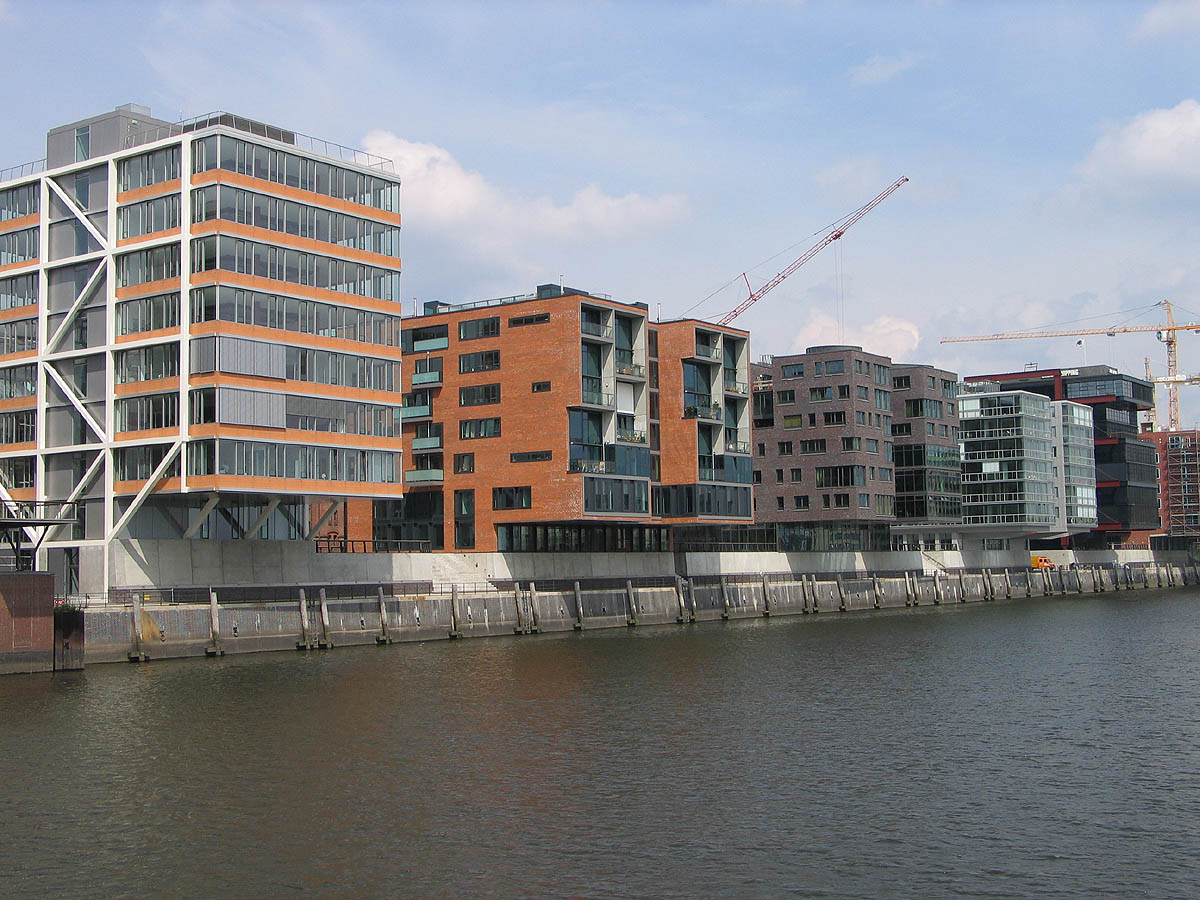
Compared to my previous visit twenty-five years ago, the run-down parts of the city are much worse; it is hard to believe you are in northern Europe. The nice parts of the city are more splendid. They are building a new city section altogether — Hafen-City – at a hard-to-discern rate of occupancy, can you say Austro-Hamburg business cycle theory? It's all mixed with in 18th century warehouses. Here are some apartments for sale. Here is one good introduction to the project.
In Hamburg they serve smoked eel with moist scrambled eggs, on delicious black bread.
A good chunk of the people in Hamburg could pass for Scandinavian; that's not the case in Berlin.
For contemporary work, Hamburg's Hafen-City is the architectural marvel of the Western world. It is Europe's single largest development project, not counting whole countries of course. Who said we no longer build coherent, splendid-looking neighborhoods? It is sadly under-discussed (addendum: but not here). For my unusual taste, the views from Hafen-City, through the harbor, all the way down to Hamburg-Altona, are among the very best in Europe. The bridges, the elevations and overpasses, the rows of brick, steel, and glass, the transport links, the integration with the water, and the "imaginary harbor," cosmopolitan in nature of course, remind me of what I would expect to find in the lost notebooks of a brilliant "Outsider" artist, except it's all for real.
One lengthy description, in German (but good visuals), is here.