Civil War
 I knew Civil War (now streaming on HBO/Max) was going to be good when just a minute or so in you see an explosion in the distance and only later do you hear the sound wave. [Mild spoilers may follow.] Shortly after, we meet war journalist Lee (Kirsten Dunst in a standout performance). I thought, “She looks like Lee Miller,” and seconds later, the name is dropped. In the next shot, Lee is in a bathtub—a clear sign you’re in the hands of a master. It is not without import that Lee Miller photographed Dachau or a little less obviously that she was a pioneer of the surreal. Both will reappear in Civil War.
In a scene where the journalists need to buy gas, they offer $300. The armed attendant scoffs, “$300 will get you a ham sandwich.” “$300 Canadian,” comes the reply, telling you everything you need to know about the state of the economy.
Civil War was written and directed by Alex Garland, who also made Annihilation, Ex Machina, and the underrated Dredd (the 2012 reboot not the Stallone movie). Many viewers expected Civil War to serve some lectures about red state/blue state politics, but it doesn’t. Tyler makes astute comments about the hidden politics (and reviews the movie here).
My interest was more on how the film portrays war—war is hell but it’s also fucking amazing. The photojournalists at the heart of the story justify their actions as serving a higher purpose, but in reality, they have become addicted to the adrenaline. Civil War shares themes with Nightcrawler. The journalists also share more than they think with the sick fucks who also love war because it gives them a chance to torture and kill.
A great scene at the climax incarnates the “when one dies, another is born” trope. The lead character starts to feel and gain a moral code, only to be killed for it, while the apprentice simultaneously sheds hers, emerging as a new, amoral hero. And it’s all caught on film. Karma is a bitch. The transition isn’t surprising given the logic of the setup but it is handled with originality and grace.
Recommended, given the obvious strictures about violence and serious themes.
The economics of ride-sharing
This paper examines the impact of the emergence of the “gig economy” on the broader labor market by exploiting the staggered introduction of the ridesharing service Uber to American Cities between 2013 and 2018. Using difference-in-differences methods, Callaway and Sant’Anna’s doubly robust difference-in-differences estimator, Chaisemartin and D’Haultoeuille’s time-corrected Wald estimator, and Abadie et al’s synthetic control method, I estimate that Uber’s arrival to a city resulted in decline in the unemployment rate by between a fifth and a half of a percentage point. This suggests that Uber allowed many workers to supplement their earnings during periods of unemployment, framing the ridesharing service as a complement to, rather than a substitute for, traditional employment. I also find some evidence that Uber had a very small positive effect on wages at the lower end of the wage distribution, suggesting that Uber may have altered worker search behavior or affected bargaining power.
Here is the full paper from Tucker Omberg, via Stefan Schubert.
“four percent of humanity subscribes to OnlyFans” (from my email)
Andrew Cedotal writes me:
This issue came up with the post where someone claimed that N% of Americans were active OnlyFans content creators, here it is again!
For software services, total accounts ever created is a vanity metric. It’s not used by serious operators or investors of consumer-tech companies (the fact that it shows up in public financial reports so often thus has interesting implications).
The social impact/business value of a software service is about flow (e.g. monthly active users and monthly revenue), not stock. 100 real human signups means many, many fewer actual monthly active users (MAU) at any point, because users churn out. Even the best-retaining services around (e.g. Snap) only have 90% yearly retention, which then compounds downward.
Then there’s the issue that for any public software service, many accounts are bots, throwaways, people who forgot their password, etc.
Rather than make a truly wild guesstimate, let’s look at a frontier based on the report of $6.6B gross payments made by users in 2023 (so average revenue / month is $0.55B). All of the following are possible points on the frontier of paying MAU (paying monthly active users) vs. monthtly APPPU (monthly payments per paying user):
* 10 million paying MAU, $55 monthly APPPU
* 30 million paying MAU, $18.33 monthly APPPU
* 50 million paying MAU, $11 monthly APPPU
* 100 million paying MAU, $5.5 monthly APPPU(Industry standard is to look at ARPPU–average revenue per paying user–and not average payments, but I think here we’re more interested in determining how much money users are putting into it and ignoring platform take rate, not a financial analysis of the company.)
Now, OnlyFans might have ~300M total signups ever, but let’s assume half of those are dupes and bots. So 150M real human signups. It’s unlikely that more than 20% of people who have ever created an account have ever entered a credit card, so that’s 300 * 0.5 * .2 = 30M as a cap on people who have ever paid. Take into account userbase churn, and a guess is ~12M monthly paying accounts right now (0.15% of humanity, not 4%), which would put them at $45.83 monthly APPPU or a yearly APPPU of ~$550. About the annual cost of a gym membership in the U.S.
Is the American dream alive and well?
A Free Press Debate.
“Tyler Cowen, Katherine Mangu-Ward, David Leonhardt, and Bhaskar Sunkara duke it out over the state of the economy.” Here is the video, for Free Press subscribers only. A splendid time was had by all.
Friday assorted links
1. “I will not tell you why Brazilians cannot buy cheap and safe sunglasses.” From an economic theorist.
2. Brutalist KFC.
4. The story of Easter Island resilience.
5. “There are no AI-shaped holes lying around.” From Matt Clifford.
6. Elsewhere, okie-dokie. Those are weapons of course, and here is Shah and Korchhoff on AI and warfare (NYT).
8. Starlink is coming to United WiFi.
9. Should economics adopt more norms from software engineering?
AI and Biology
I think AI is going to have some if its biggest effects on biology. Biological pathways are among the most complex in all of science. People are good at handling two or maybe three variable problems but just keeping three variables and their interactions in one’s head is difficult. AIs with access to vast databases of genes, proteins, networks and so forth will enable new simulations and learning as has already happened with protein folding.
Strawberry Alarm Clock!
Deep Prasad writes:
OpenAI just released an AI as smart as most PhDs in physics, mathematics and the life sciences. Wake up. The world will never be the same and in many ways, it will be unrecognizable a decade from now.
Mckay Wrigley is enthusiastic:
o1’s ability to think, plan, and execute is off the charts.
Ethan Mollick says:
There are a lot of milestones that AI passed today. Gold medal at the Math Olympiad among them.
Like Ethan, however, I agree the model is not necessarily better at a lot of non-reasoning tasks. Ethan also notes that AGI will be jagged and uneven.
Subbarao makes guesses as to how it works. Here is some other guy saying a bunch of stuff. And yet further commentary.
Whatever you think of those specific claims, there is a lot of room, as with the John Lennon “Strawberry Fields Forever” demo, to get a lot better yet. For one thing, it can think for longer yet! Whole new doors have been opened, and if you are reading some lukewarm commentary that is probably what the person does not grasp. It is the people who think “…if they can do this…” who have been most successful in predicting the course of AI.
Shital Shah remarks:
This is truly a game changer and step change. It takes us out of slow progress constrained by compute capital and training tokens to rather open world where time is the only limit.
I would love to have one of these (with some tweaks) as my agent.
Taelin claims AGI is achieved. Here is the closest Gary Marcus ever will come to eating crow. Here is how I would troll OpenAI.
Meanwhile, the status of people who do energy policy is due to rise.
Brian Chau recommends it for looking up citations.
Matt Clifford says “crosswords!”
“Model this!”, he demanded of the new fruit. That is Benjamin Manning, economics graduate student at MIT. He got his wish.
Is it “It’s happening!”, or rather “It has happened!”?
Here is another song by Strawberry Alarm Clock, sadly no one got the reference the first time around. It is from the album “Wake Up, It’s Tomorrow”…
Addendum: For context and background, my two previous introductory posts are here and here.
My video contribution to the new Strawberry release
One and a half minutes, you will find it here, mostly me talking about how well the new OpenAI o1 model does economics. Spinoza (the dog) steals the show.
As I said to the OpenAI film crew, “Spinoza may not be AGI, but if you leave any foodstuffs near the couch, he will beat anything you people come up with.” That said, when it comes to mathematical, economic, or many other kinds of reasoning, OpenAI o1, the new model, is in the clear lead.
You need to click through horizontally in two different rows, but you will find many different and relevant short videos here on the new model.
OpenAI announces “Strawberry”
From the great Noam Brown, the link to the more detailed OpenAI page is here. And a preview page here. Step by step advanced reasoning, now a reality, with some pretty incredible benchmark achievements. Too much to say, right?
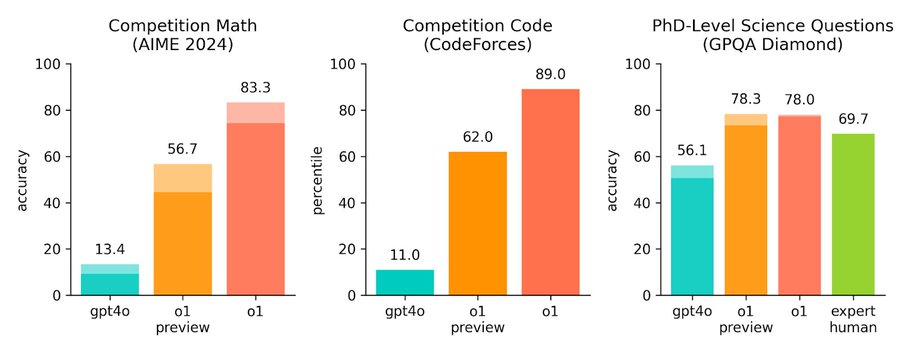
Here is the accompanying John Lennon demo.
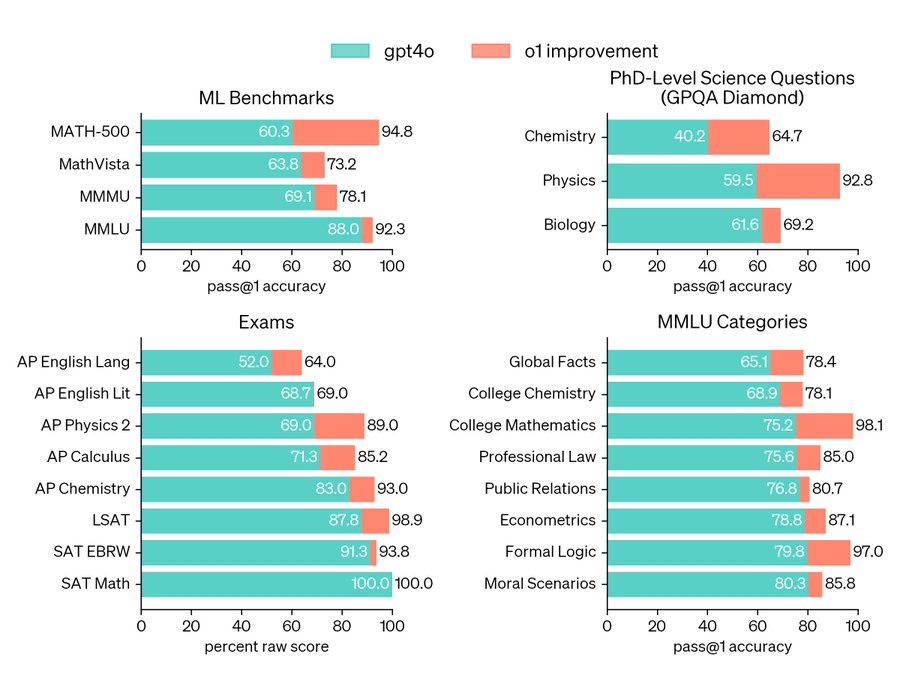

Thursday assorted links
1. Comment directly on top of arXiv links.
2. Latent polarization, based on values clusters.
3. Reading scrolls from the ancient world.
5. GMU Econ Society (new and better link).
6. Does non-response bias make the economy look better than it really is?
7. “The existence of manual mode increases human blame for AI mistakes.“
8. Work with Dwarkesh and build a media empire.
9. Luis Garicano is starting a Substack, first post is on gdpr.
Equality Act 2010
The UK’s Orwellian sounding Equality Act 2010 is strikingly Marxist. It demands equal pay for work of equal value where these are defined as follows:
A’s work is equal to that of B if it is like B’s work, rated as equivalent to B’s work, or of equal value to B’s work.
A’s work is like B’s work if A’s work and B’s work are the same or broadly similar, and such differences as there are between their work are not of practical importance in relation to the terms of their work.
…A’s work is rated as equivalent to B’s work if a job evaluation study— gives an equal value to A’s job and B’s job in terms of the demands made on a worker
…A’s work is of equal value to B’s work if it is neither like B’s work nor rated as equivalent to B’s work, but nevertheless equal to B’s work in terms of the demands made on A by reference to factors such as effort, skill and decision-making.
In short, supply and demand have been replaced by judges and labor boards with the authority to deem which jobs are “equal” and therefore should be paid equally. And the labor boards do so based on vague and subjective considerations that do not change with changing circumstances. Imagine replacing “jobs” with “condiments” and having judges decide whether ketchup and mustard should be priced equally because they are similar, broadly comparable, or rated equivalent in terms of the effort, skill, and decision-making that went into their production.
You think I am joking. I am not. Here’s an example of a case just decided in the UK.
More than 3,500 current and former workers at Next have won the final stage of a six-year legal battle for equal pay.
An employment tribunal said store staff, who are predominantly women, should not have been paid at lower rates than employees in warehouses, where just over half the staff are male.
The tribunal ruled that retail workers and warehouse workers were “equal” and thus had to be paid equally. Next replied that they paid everyone market wages. Verboten!
Next argued that pay rates for warehouse workers were higher than for retail workers in the wider labour market, justifying the different rates at the company.
But the employment tribunal rejected that argument as a justification for the pay difference.
According to the tribunal’s ruling, between 2012 and 2023, 77.5% of Next’s retail consultants were female, while 52.75% of warehouse operators were male.
The tribunal accepted that the difference in pay rates between the jobs was not down to “direct discrimination”, including the “conscious or subconscious influence of gender” on pay decisions, but was caused by efforts to “reduce cost and enhance profit”.
It ruled that the “business need was not sufficiently great as to overcome the discriminatory effect of lower basic pay”.
No one is alleging that male and female warehouse workers were paid unequally or that male and female retail workers were paid unequally or that there was any direct or indirect discrimination. The only claim is that warehouse workers, who are less likely to be female than retail workers, earn more than retail workers. And since these jobs have been judged “equal,” the company has violated Equality Act 2010.
Who could have predicted that jobs as disparate as warehouse and retail jobs might one day be deemed “equal.” Yet because Next failed to foresee such lunacy they are now required to pay millions in back wages to their retail employees. Software engineers, particularly in AI, are currently in high demand. A British firm looking to hire them may hesitate to raise wages, fearing that a future ruling could classify software engineers as “equal” to a larger, lower-paid group like HR administrators. Such a decision could easily push the firm into bankruptcy.
The warehouse workers were almost 50% female (47.25%). So females were not barred from the higher paying jobs. The fact that 77.5% of the retail workers were female suggests that retail work has special appeal to females relative to males and thus that there are compensating differentials. Any of the three female plaintiffs could have taken jobs in the warehouse. If the jobs are equal and the warehouse jobs pay more this is, on the plaintiffs’ theory, “puzzling”. [Or, as Ayn Rand would say, blank out.]
In fact, the court case reveals that Next was struggling to fill the warehouse positions and offered any retail employee—including the plaintiffs—the opportunity to switch to warehouse work. On cross-examination, one of the plaintiffs admitted that, given the unpleasant conditions in the warehouse—described by the court as “the drone of machinery,…vibration, alarm sirens and the screeching of machinery, wheels and rollers, continuously present in all areas”—the warehouse job “did not seem particularly attractive” compared to the greater autonomy and more appealing environment of the retail job. The plaintiff added that she would only have considered the warehouse job if it paid “a lot more money.”
 Thank goodness for the men and women who were willing to take such jobs for only a little more money! It should not shock that different people have different preferences over jobs, just as they have different preferences over ice cream. In particular, it will perhaps surprise only the judges to learn that men tend to be more wage-focused and “women are relatively more attracted to employers with low pay but high values of nonpay characteristics (NBER 32408).” The court, however, recoiled from this idea, noting that if they were to take demonstrated preferences seriously this would be tantamount to applying “an unfettered free market model of supply and demand.” The horror.
Now consider how the jobs were deemed “equal”. On the left is the job evaluation report for claimant Amanda Cox. The specific categories and numbers are not important; what is important is that the jobs are rated across 11 categories, and the point-scores are then added to get a total score at the bottom.
Amusingly, the evaluators emphasize that they use equal weighting across the categories. Of course, they did—because “equal” is synonymous with fair, right? An unequal weighting would surely be discriminatory!
I am not making this up:
Any scheme which has as its starting point – “This qualification is paramount” or that “This skill is vital” is nearly always going to be biased or at least open to charges of bias or discrimination.
 Thus, if you think that a skill is vital for a job, that’s discrimination!
(Notice also that equal weighting is just another form of weighting. Given the subjective nature of both the categories and the points assigned, equal weighting holds no inherent superiority or objectivity.)
But no matter—we have yet to get to the best part. The evaluators selected three warehouse workers and assessed them using the same metric. For example, Amanda Cox was compared to warehouse worker Calvin Hazelhurst, resulting in the table on the right.
Can you spot something surprising in this table? I’ll give you a moment.
The obvious conclusion any reasonable person would draw from this table is that the jobs are clearly not equal. Amanda’s total score is 440, while Calvin’s is 340. 440 ≠ 340. Not even close! In nearly every category—except (no surprise!) physical demands and working conditions—the retail job requires more points, aka “skill and responsibility”.
At this point, most people would stop and ask some critical questions. If the jobs differ so much across multiple dimensions, isn’t it clear that they are not equal? And why do jobs that seemingly require less “skill” pay more? Could it be that our point-score rating system is oversimplified? Maybe the market is telling us something that this crude scoring system isn’t capturing? Is it time to check our premises?
But not the evaluators! Oh, no. The evaluators are thrilled–because the fact that the jobs are unequal proves that they are equal!

War is peace, freedom is slavery, ignorance is strength. UNEQUAL IS EQUAL.
Adam Smith had a much better understanding of wages in 1776 than UK judges have today.
The wages of labour vary with the ease or hardship, the cleanliness or dirtiness, the honourableness or dishonourableness, of the employment. Thus in most places, take the year round, a journeyman tailor earns less than a journeyman weaver. His work is much easier. A journeyman weaver earns less than a journeyman smith. His work is not always easier, but it is much cleanlier. A journeyman blacksmith, though an artificer, seldom earns so much in twelve hours, as a collier, who is only a labourer, does in eight. His work is not quite so dirty, is less dangerous, and is carried on in day-light, and above ground. Honour makes a great part of the reward of all honourable professions. In point of pecuniary gain, all things considered, they are generally under-recompensed, as I shall endeavour to shew by and by. Disgrace has the contrary effect. The trade of a butcher is a brutal and an odious business; but it is in most places more profitable than the greater part of common trades. The most detestable of all employments, that of public executioner, is, in proportion to the quantity of work done, better paid than any common trade whatever.
Today, the UK would convene a labor board to rule that the tailor and the weaver must be paid equally because they DO WORK OF EQUAL VALUE. Case closed.
Labor boards will inevitably lead to the misallocation of labor, diminishing both wealth and fairness. Severe misallocation may lead to further intervention, in the worst scenario, even to the allocation of labor by fiat. Politicization breeds division, rent-seeking, and a stagnant, unpleasant society.
More generally, it pains me that there is no recognition that the market is a discovery procedure, including the discovery of the value of different skills and people’s preferences over different jobs. No recognition that the market harnesses tacit knowledge and knowledge of particular circumstances of time and place–knowledge that is difficult to quantify, communicate, or communicate in a timely manner–and that “society’s economic problems are primarily related to adapting quickly to changes in these circumstances.” No recognition that a price is a signal wrapped up in an incentive.
I despair when I consider that these fundamental ideas are the foundation of our liberal, global, and prosperous civilization. On economics, as on free speech, the UK has entered the great forgetting.
Addendum: A special hat tip to Bruce Greig who brought this to my attention and had the receipts.
Two missing markets
The London Times, in its Sunday on-line culture section, no longer has a weekly article listing what they think are the best books of the year. Yet they continue to run similar weekly articles for music and film and television.
The books feature has, for me, been the single strongest reason to subscribe to the paper.
Dolcezza, the D:C.-based gelato maker, has replaced its “dark chocolate” with a corrupted and far inferior “dark chocolate fudge,” which I simply do not buy.
The people request their missing markets back!
Which U.S. Stocks Generated the Highest Long-Term Returns?
This report describes compound return outcomes for the 29,078 publicly-listed common stocks contained in the CRSP database from December 1925 to December 2023. The majority (51.6%) of these stocks had negative cumulative returns. However, the investment performance of some stocks was remarkable. Seventeen stocks delivered cumulative returns greater than five million percent (or $50,000 per dollar initially invested), with the highest cumulative return of 265 million percent (or $2.65 million per dollar initially invested) accruing to long-term investors in Altria Group. Annualized compound returns to these top performers relatively were modest, averaging 13.47% across the top seventeen stocks, thereby affirming the importance of “time in the market.” The highest annualized compound return for any stock with at least 20 years of return data was 33.38%, earned by Nvidia shareholders.
How much of the recent inflation was caused by deficits?
This paper measures the causal effect of deficits on inflation using a “high frequency narrative approach”. We identify an event that released news about the 2021 deficits in the United States—the Georgia Senate election runoff. We calculate the size of the shock using new narrative data from investment banks. We then study the high frequency response of inflation forecasts from asset prices, in order to separate deficits from other factors affecting inflation. We estimate an “inflation multiplier” of 0.18% price level growth over two years, for a 1% deficit-to-GDP shock. Our estimate implies that the 2021 deficits caused around 30% of the 2021-22 inflation—meaning deficits were important but not the only cause. A standard heterogeneous agent New Keynesian model quantitatively matches the size and dynamics inflation multiplier.
That is from a new paper by Jonathon Hazell and Stepan Hobler.
AI and scientific literature reviews
Introducing PaperQA2, the first AI agent that conducts entire scientific literature reviews on its own. PaperQA2 is also the first agent to beat PhD and Postdoc-level biology researchers on multiple literature research tasks, as measured both by accuracy on objective benchmarks and assessments by human experts. We are publishing a paper and open-sourcing the code. This is the first example of AI agents exceeding human performance on a major portion of scientific research, and will be a game-changer for the way humans interact with the scientific literature.
That is from Sam Rodriques, with further links. I have not had a chance to try this out.