That was then, this is now, German edition


Via Scott Sumner.
Monday assorted links
A thread on Japan
https://x.com/peruvian_bull/status/1820199767336702052?s=61
The cheery point, if you wish to go that route, is that both the Japanese stock market and yen simply are back to December 2023 levels.
England and Wales fact of the day
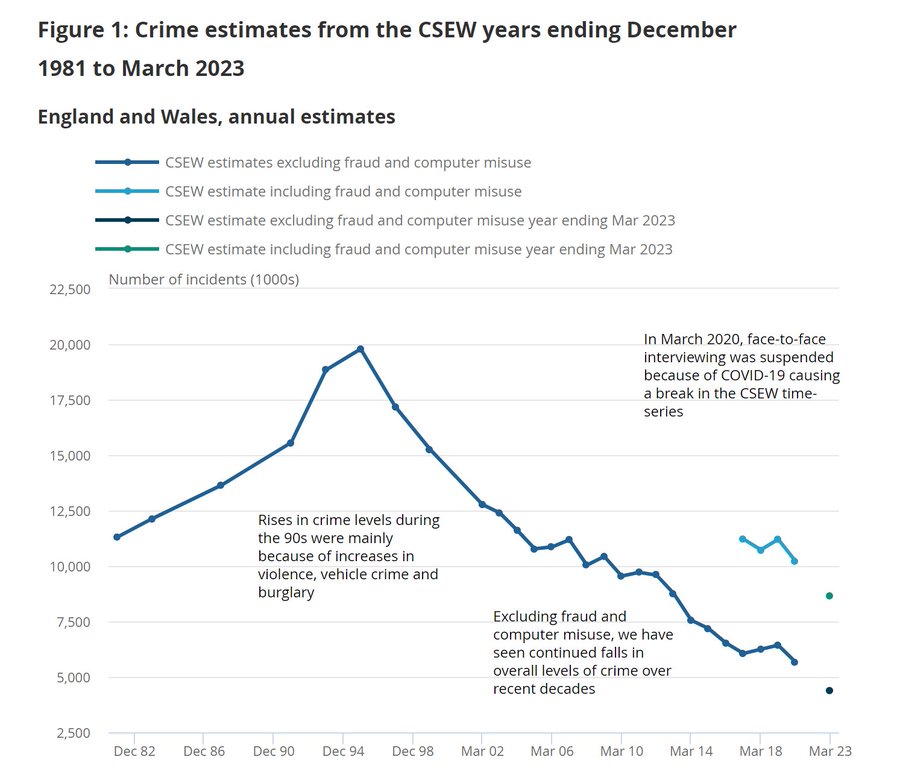
Here is the source.
Dark oxygen: jubiliant for others, cry for yourself and your kin
To summarize the new results:
An international team of researchers recently discovered that oxygen is being made by potato-shaped metallic nodules deep under the surface of the Pacific Ocean. In July, their findings, which throw into dispute the concepts of oxygen production, were published in the Nature Geoscience jonal. The discovery could lead to a reconsideration of the origins of complex life on Earth.
The findings from a team of researchers led by Professor Andrew Sweetman at the U.K.’s Scottish Association for Marine Science, show that oxygen is being produced at around 4,000 metres below the surface of the ocean in complete darkness. This contradicts previous scientific assumptions that only living organisms, including plants and algae, can use energy to create oxygen through photosynthesis, using sunlight for the reaction.
As Julian Gough suggests, most life probably is on icy moons. This means a lot more life! Over a time slice, it could mean billions of additional lives out there. Did you pop up the champagne?
The bad news is that the chance that Robin Hanson’s “Great Filter” lies behind us is somewhat smaller. Which boosts the chance that it may lie in our near future. Did you pull out the tissues?
On net, did this news change your mood at all? Why or why not?
Sunday assorted links
1. Tiger vs. small bear (NYT).
2. Is granting AIs legal freedoms one way to approach alignment issues?
4. D.C.’s first Jane Austen ball.
5. Data on childless cat ladies.
6. Janan Ganesh on how and what to read (FT, noting I think he underrates our ability to pick out the very best current books).
Prices vs. price paths
Recently I have been writing about how the federal government should not go further in bargaining or forcing down the prices of pharmaceutical drugs. Supply is elastic and the benefits from new pharma drugs are enormous.
But it is not as simple as being “for higher prices.” There is also a price trajectory over time. Higher prices today can induce more competition, which can mean lower prices tomorrow, maybe even much lower prices. If not tomorrow, perhaps five or ten years hence.
Higher prices today can mean greater efforts at price discrimination, including over time. That too can mean lower prices (compared to the counterfactual) at later points in time, or sometimes today as well.
So yes it is fine to be for higher prices for pharmaceuticals. But in many scenarios you end up being for lower prices too, just not all the time and just not for everybody.
So shout it from the rooftops: “I am not the demonic Satan, I am for both higher and lower prices as part of a complex mix, to expand elastic supply.” Catchy, right?
What to think about ranked choice voting?
That is the topic of my latest Bloomberg column, here is one key segment:
Game theory can help explain how ranked choice voting changes the behavior of candidates, as well as the elites who support them. Consider a ranked choice election that has five or six candidates. To win the election, you can’t just appeal to your base. You also can’t alienate your opponent’s base. You want supporters of other candidates to regard you as “not too bad,” because if they hate you, they could rank you very low and get you tossed out of the running quickly.
Candidates are thus encouraged to moderate their positions and their behavior — that is, not to call each other too many names. If the favorite candidate of one voter calls the favorite of another “weird,” for example — to choose an example not quite at random — the latter voter might respond by voting down the name-caller to the very bottom.
The result? Negative campaigning diminishes, and politics moderates. The effect can be especially pronounced in party primaries, which sometimes are dominated by the most extreme voters.
The candidates also compete in different ways. In particular, they try to outdo each other when it comes to constituency service, which is a way of being popular without offending anybody.
The broader evidence on ranked choice voting shows that, when used, it has made US politics more moderate. Alaska’s ranked choice voting helped moderate Republican Lisa Murkowski beat her more ideological opponents in 2022. In Idaho, some conservatives regard ranked choice voting with suspicion, fearing it is a plot to neutralize their influence.
In Ireland, politics is fairly non-ideological on most matters of policy, and elections are not typically seen as major, course-altering events. After more than a century with this system, the Irish seem happy to keep it.
The lesson here is that it is not possible to evaluate ranked choice voting in the abstract. It usually makes politics less extreme and less ideological, but those are descriptive terms, not normative ones. I would prefer California’s politics to be less ideological, for example, but that is because it embodies an ideology distinct from mine. And sometimes the more extreme and ideological positions are entirely correct, as for instance John Stuart Mill’s advocacy of women’s suffrage and birth control in the 19th century.
In general, ranked choice voting is best for places where voters feel things are already on the right track and ought to stay there. It is a voting system for the self-satisfied. Which parts of contemporary America might that describe? No voting method yet devised can settle that question.
Tyler Cowen playlist for Rick Rubin
This one is for religious music, taken from various religions around the world, including yes Sikhs too. Here are Rick Rubin playlists from other people, including Carlos Santana.
Saturday assorted links
2. When you put animals on the banknotes.
3. How Nicholas Carlini uses AI.
4. Jon Hartley podcast with Acemoglu.
5. Scott Sumner on Bitcoin in the government portfolio. Or try the link here: https://www.themoneyillusion.com/provoked-by-a-provocative-piece/
ChatGPT Advanced Voice Mode
It is extremely versatile, very responsive to feedback, and has response lags comparable to that of a human, or better yet. Just keep on telling it what to do, if you need to. If you ask it to be better, guess what? It gets better. Her really is here. Now.
Some complain that the foreign voices have American accents, presumably this is from the training data? This will be fixed soon enough. In the meantime, prompt it in the destination language.
It’s happening, and this is to date one of the most vivid and impressive illustrations of what is possible. A mere three years ago this would have seemed like witchcraft.
El Salvador notes
Here are a few observations from the trip:
1. El Salvador does truly seem safe, arguably “Canada safe” or maybe safer yet.
2. Hardly ever have I had quicker and more convenient airport and entry procedures.
3. Hardly any tourists are there, unless you count returning El Salvadorans from the United States.
4. For a small country, always visit the #2 city, in this case Santa Ana. There is nothing to do there, but that is part of the point. You can stroll through the local Walmart.
5. Mostly you should eat pupusas in less formal settings. The basic corn, beans, and cheese products of the country are excellent, though they get worse the nicer the restaurant.
6. There is one exception to #5: go eat at El XoLo, it is one of the best meals I have had in years. The squash dishes and the cochinita were best, and you get a fun look at the El Salvadoran elite.
7. You can go to lovely ocean spots and no one will be there.
8. I visited the colonial city of Suchitoto again, after a nine (?) year absence. It had perhaps 10x the amount of commerce as last time.
9. El Rosario, the brutalist church, is one of the great landmarks of the New World.
10. The gifted Chinese library in San Salvador is hilarious, here is some photos.
11. Measured gdp growth in El Salvador is a disappointment. But consumption seems to be growing rapidly, both in the numbers and what one sees on the ground. Which series matters more? This is a common paradox in development economics.
12. Taking 3-4 day trips in groups of five or six is very much underrated. Hope you can organize your own outings!
13. People love it when you tell them you are from Virginia.
14. I may consider “future of safety” issues in more detail in a later post.
15. Overall, I would encourage you to go, go, go. From Washington, D.C. it is a simple, direct four hour flight — isn’t that closer than Denver? What are you waiting for?
Shaping the Habits of Teen Drivers
Here is one new method to lower teen-age driving deaths:
We show that a targeted law can modify teens’ risky behavior. We examine the effects of an Australian intervention banning first-year drivers from driving late at night with multiple peers, which had accounted for one-fifth of their traffic fatalities. Using data on individual drivers linked to crash outcomes, we find the reform more than halves targeted crashes, casualties and deaths. There are large positive spillovers through lower crashes earlier in the evening and beyond the first year, suggesting broad and persistent declines in high-risk driving. Overall, the targeted intervention delivers gains comparable to harsher restrictions that delay teen driving.
That is by Timothy J. Moore and Todd Morris in American Economic Journal: Economic Policy.
Friday assorted links
The Unseen Fallout: Chernobyl’s Deadly Air Pollution Legacy
A fascinating new paper The Political Economic Determinants of Nuclear Power: Evidence from Chernobyl by Makarin, Qian, and Wang was recently presented at the NBER Pol. Economy conference. The paper is nominally about how fossil fuel companies and coal miners in the US and UK used the Chernobyl disaster to successfully lobby against building more nuclear power plants. The data collection here is impressive but that is just how democracy works. I found the political economy section less interesting than some of the background material.
First, the Chernobyl disaster ended nuclear power plant (NPP) construction in the United States (top-left panel), the country with the most NPPs in the world . Surprisingly, the Three Mile Island accident in 1979 (much less serious than Chernobyl) had very little effect on construction; albeit the 1-2 punch with Chernobyl in 1986 surely didn’t help. The same pattern is very clear across all countries and also all democracies (top-right panel). The bottom two panels show the same data but looking at new plants rather than the cumulative total–there was a sharp break in 1986 with growth quickly converging to zero new plants per year.

Fewer nuclear plants than otherwise would have been the case might have made a disaster less likely but there were countervailing forces:
We document that the decline in new NPPs in democracies after Chernobyl was accompanied by an increase in the average age of the NPPs in use. To satisfy the rise in energy demand, reactors built prior to Chernobyl continued operating past their initially scheduled retirement dates. Using data on NPP incident reports, we show that such plants are more likely to have accidents. The data imply that Chernobyl resulted in the continued operation of older and more dangerous NPPs in the democracies.
Moreover, safety declined because the existing plants got older but in addition “the slowdown of new NPP construction…delayed the adoption of new safer plants.” This is a point about innovation that I have often emphasized (see also here)
The key to innovation is continuous refinement and improvement…. Learning by doing requires doing….Thus, when considering innovation today, it’s essential to think about not only the current state of technology but also about the entire trajectory of development. A treatment that’s marginally better today may be much better tomorrow.
Regulation increased costs substantially:
The U.S. NRC requires six-to-seven-years to approve NPPs. The total construction time afterwards ranges from decades to indefinite. Cost overruns and changing regulatory requirements during the construction process sometime forces construction to be abandoned after significant sunk costs have been made. This often leads investors to abandon construction after already sunk billions of dollars of investment. Worldwide, companies have stopped construction on 90 reactors since the 1980s. 40 of those were in the U.S. alone. For example, in 2017, two South Carolina utilities abandoned two unfinished Westinghouse AP1000 reactors due to significant construction delays and cost overruns. At the time, this left two other U.S. AP1000 reactors under construction in Georgia. The original cost estimate of $14 billion for these two reactors rose to $23 billion. Construction only continued when the U.S. federal government promised financial support. These were the first new reactors in the U.S. in decades. In contrast, recent NPPs in China have taken only four to six years and $2 billion dollars per reactor. When considering the choice of investing in nuclear energy versus fossil fuel energy, note that a typical natural gas plant takes approximately two years to construct (Lovering et al., 2016).
Chernobyl, to be clear, was a very costly disaster
The initial emergency response, together with later decontamination of the environment, required more than 500,000 personnel and an estimated US$68 billion (2019 USD). Between five and seven percent of government spending in Ukraine is still related to Chernobyl. (emphasis added, AT) In Belarus, Chernobyl-related expenses fell from twenty-two percent of the national budget in 1991 to six percent by 2002.
The biggest safety effect of the decline in nuclear power plants was the increase in air pollution. The authors use satellite date on ambient particles to show that when a new nuclear plant comes online pollution in nearby cities declines significantly. Second, they use the decline in pollution to create preliminary estimates of the effect of pollution on health:
According to our calculations, the construction of an additional NPP, by reducing the total suspended particles (TSP) in the ambient environment, could on average save 816,058 additional life years.
According to our baseline estimates (Table 1), over the past 38 years, Chernobyl reduced the total number of NPPs worldwide by 389, which is almost entirely driven by the slowdown of new construction in democracies. Our calculations thus suggest that, globally, more than 318 million expected life years have been lost in democratic countries due to the decline in NPP growth in these countries after Chernobyl.
The authors use the Air Quality Life Index from the University of Chicago which I think is on the high side of estimates. Nevertheless, as you know, I think the new air pollution literature is credible (also here) so I think the bottom line is almost certainly correct. Namely, Chernobyl caused many more deaths by reducing nuclear power plant construction and increasing air pollution than by its direct effects which were small albeit not negligible.