Speeding Up Pharmaceutical Approvals by Recognizing Other Stringent Regulators
New Zealand’s ACT party has proposed that New Zealand speed up pharmaceutical approvals by recognizing the decisions of other stringent regulators, an idea I have long promoted .
The average time for Medsafe to consent an application for a high risk medicine is 630 days. For intermediate risk, it is 661 days and for lower risk it is 830 days8. The average time taken just for processing some lower risk categories is 176-210 days. This is an unacceptable length of time, given there other regulatory bodies replicating that exact same work overseas.
ACT says if a drug or medical device has been approved by any two reputable foreign regulatory bodies (such as Australia, United States, United Kingdom), it should be automatically approved in NZ as well within one week unless Medsafe can show extraordinary reason why it shouldn’t be.
This simple change would significantly improve access to medicines that have already been subject to rigorous testing and analysis through other regulatory regimes.
The ACT party is small but it has some seats and surprisingly the much larger National party is proposing a similar rule:
New Zealand’s slow approval process for medicines means Kiwis wait much longer than people in other countries to access potentially life-saving treatments. While it is essential that medicines and other treatments are subject to stringent scrutiny to ensure they are safe, there is no reason why New Zealanders should have to wait for our domestic medicines regulatory body, Medsafe, to conduct its own cumbersome process from scratch, when countries with health systems we trust have already gone through this exercise.
National will:…• Require Medsafe to implement even faster approvals processes for any medicines for use in New Zealand that have already been approved by at least two regulatory bodies that we currently recognise, including Australia, the EU, Singapore, the UK, Switzerland and the US.
New Zealand, by the way, already has a reciprocity agreement with the United States for food and it’s mutual–the FDA also recognizes New Zealand as a stringent food regulator–so the idea is not unprecedented.
Moreover, all of this comes on the tail of the UK actually adopting the idea via the “reliance procedure” which recognizes the EU as a stringent regulator and guarantees approval in the UK within 67 days for ay drug approved in the EU.
In the United States, even AOC has flirted with the idea, at least for sunscreens!
Thus, the reciprocity or recognition idea is starting to be adopted.
Hat tip: Eric Crampton who has some further comments.
My Conversation with Ada Palmer
Here is the audio, video, and transcript. Here is the episode summary:
Ada Palmer is a Renaissance historian at the University of Chicago who studies radical free thought and censorship, composes music, consults on anime and manga, and is the author of the acclaimed Terra Ignota sci-fi series, among many other things.
Tyler sat down with Ada to discuss why living in the Renaissance was worse than living during the Middle Ages, how art protected Florence, why she’s reluctant to travel back in time, which method of doing history is currently the most underrated, whose biography she’ll write, how we know what old Norse music was like, why women scholars helped us understand Viking metaphysics, why Diderot’s Jacques the Fatalist is an interesting work, what people misunderstand about the inquisition(s), why science fiction doesn’t have higher social and literary status, which hive she would belong to in Terra Ignota, what the new novel she’s writing is about, and more.
Here is one excerpt:
COWEN: De Sade — where does that come from? What are the influences on de Sade as a writer?
PALMER: Thomas Aquinas. No, lots and lots of things, but he’s very interested in the large philosophical milieu in the period. Remember that the 18th century is a moment when the clandestine bookshop is a major, major thing. And if anyone enjoys and is interested in the history of censorship and clandestine publishing, I can’t recommend enough the work of Robert Darnton, a brilliant, brilliant historian of clandestine literature.
But the same underground bookshops sell all underground materials, which means an underground bookshop sells pornography, and it also sells Voltaire and Rousseau, and it also sells diatribes criticizing the king, and it also sells radical Jansenist theological pamphlets about whether the Holy Spirit derives from the Father and Son equally or from the Father alone.
The same kinds of people frequent these shops, and the same kinds of people buy things. So, think about how, when you go into a Barnes & Noble, the science fiction and fantasy section is one section, even though science fiction and fantasy are different things. But they have a lot of overlap, both in the overlap of readership and in overlap in books that have both science fiction and fantasy elements. It was perfectly natural, in the same way, for clandestine bookshops to generate these works that are pornography and radical philosophy at the same time. They’re printed by the same printers, sold to the same audiences, and circulate in the same places.
De Sade uses his extreme pornography to get at questions of morality, ethics, and artificiality. What are the ethics of hurting each other? Why do we feel that way about hurting each other? What are so-called natural impulses, as John Locke and Hobbes were very dominant at the time, or Descartes, who is differently dominant at the time in rivalry with them? They make claims about the natural human impulses or the natural character of a human being. What does extreme sexuality show us about how that character might be broader than it is?
I mean it when I say Thomas Aquinas, right? One of Thomas Aquinas’s traditional proofs of the existence of God is that everything he sees around him in nature — this also is one that Aristotle uses, but Aquinas articulates it in the most famous way for de Sade’s period — that when we look around us, it’s clear that everything is designed to work.
Interesting throughout.
Obsolescence Rents
The subtitle of this new NBER working paper is: Teamsters, Truckers, and Impending Innovations. Here is the abstract:
We consider large, permanent shocks to individual occupations whose arrival date is uncertain. We are motivated by the advent of self-driving trucks, which will dramatically reduce demand for truck drivers. Using a bare-bones overlapping generations model, we examine an occupation facing obsolescence. We show that workers must be compensated to enter the occupation – receiving what we dub obsolescence rents – with fewer and older workers remaining in the occupation. We investigate the market for teamsters at the dawn of the automotive truck as an á propos parallel to truckers themselves, as self-driving trucks crest the horizon. As widespread adoption of trucks drew nearer, the number of teamsters fell, the occupation became ‘grayer’, and teamster wages rose, as predicted by the model.
That is by Costas Cavounidis, Qingyuan Chai, Kevin Lang, and Raghav Malhotra.
Wednesday assorted links
2. Soumaya Keynes and Janan Ganesh, both FT columnists, have been on a roll lately. Here is one by Janan, here are the recent ones by Soumaya.
3. Translating Latin demonology manuals with GPT-4 and Claude.
The Labor Market Returns of Being An Artist
The labor market penalty to choosing the arts seems to be rising:
Using individual-level data from the Census Bureau’s American Community Survey (ACS) between 2006 and 2021, I study the labor market experiences of artists. First, I find a decline in the relative earnings of artists to non-artists from zero to a 15% disadvantage. After controlling for demographic differences, the decline is sharper, declining from a 15% earnings disadvantage to 30%. That the inclusion of demographic controls raises the earnings gap suggests there is positive selection into the arts. Second, these differences decline in magnitude to 4.4%, but remain statistically significant, after exploiting variation among artists and non-artists in the same industry-year and major occupation. Third, when restricting the set of individuals to those with at least a college degree, those with a fine arts degree also incur an earnings and employment penalty even if they work in the arts. These results highlight the increasing financial precariousness of artists over the past decade.
That is a new paper by Christos Makridis, via the excellent Kevin Lewis. Overall this result makes sense to me. Success in the arts requires extreme talent of some kind in most (not all) cases. Those individuals can earn increasingly more in other endeavors. But if the arts are trapped in a “Malthusian equilibrium,” with intense entry competing down returns because it is fun, artistic earnings may not keep pace.
Will misinformation be an electoral problem?
That is the topic of my latest Bloomberg column, here is one bit:
…consider the story that former President Barack Obama was not born in the US. It did not take off because someone forged a copy of an Indonesian birth certificate. Instead, many people approached the issue wanting to believe that Obama was not “a real American,” some dangerous tidbits were thrown their way, and off they went. The release of Obama’s US birth certificate did not convince them they were wrong.
Lies, misunderstandings, instances of self-deception: They have long been in excess supply. Blame China, Russia, social media, regular media, whomever. A potentially gullible person is already flooded with more lies in a single day than he or she can possibly evaluate.
A greater number of falsehoods just won’t matter that much — because the scarce resources are attention and focality on the demand side. How much is someone looking to believe they have been wronged? How much do they resent “the establishment”? What kinds of grudges do they hold, and against whom or what? And how well can they coordinate with others of like mind, thereby forming a kind of misinformation affinity group?
There is much more at the link.
From the comments, on the new Meta smart glasses
Tuesday assorted links
1. On Stripe Press and homage to the printed book.
2. Scott Sumner movie reviews. The very best links you will get here, if you are worthy of them that is.
3. NYT review of the new Michael Lewis book.
From the comments, on OWS and PEPFAR
There is somewhat of an intellectual void in Republican leadership over the past 20 years. Occasionally that void creates space for a uniquely good idea that doesn’t align too well with ideology. When the Democrats are in charge, there are plenty of mainstream Democratic ideas to fill up the agenda, so nothing too unusual happens.
The low ideological alignment also explains why these ideas are underrated later, because they have no deep well of partisans to promote their successes.
That is from Kevin.
New issue of Econ Journal Watch
This is now twenty years of Econ Journal Watch, congratulations to Dan Klein! Here is the table of contents:
Volume 20, Number 2, September 2023
Screening the 1915 film The Birth of a Nation: In an article in the American Economic Review, Desmond Ang purports to show causal impact of screenings of the film between 1915 and 1919 on lynchings, on the formation and growth of Ku Klux Klan chapters between 1920 and 1925, and on hate crimes in the early 2000s. Here, concurring that the film itself reeks of racism, Robert Kaestner scrutinizes Ang’s data and analyses, and challenges the claims of causal evidence of effects from 1915–1919 screenings of the film. (Note: Professor Ang was not invited to reply for concurrent publication because Kaestner’s piece was finalized at too late a date. Professor Ang is invited to reply in a future issue.)
Temperature-economic growth claims tested again: Having tested temperature-economic growth claims previously in this journal (here and here), David Barker now reports on his investigation into much-cited articles by Melissa Dell, Benjamin Jones, and Benjamin Olken, published in the American Economic Review in 2009 and the American Economic Journal: Macroeconomics in 2012. As with the two previous pieces by Barker, the commented-on authors have declined to reply (the invitation remains open).
Debating the causes of the Ukraine famine of the early 1930s: Two scholars interpret the complex causes of a tragedy that caused the loss of perhaps three million souls. Natalya Naumenko’s research on the causes of the Ukraine famine is discussed by Mark Tauger, and Naumenko replies.
Ergodicity economics, debated: A number of scholars have advanced an approach to decision making under uncertainty called ergodicity economics. A critique is provided here by Matthew Ford and John Kay, who maintain that psychology is fundamental to any general theory of decision making under uncertainty. Eleven proponents of ergodicity economics have coauthored a reply. They suggest that the critique is based on an incomplete understanding of ergodicity economics, and point to two sources of misunderstanding. The replying authors are Oliver Hulme, Arne Vanhoyweghen, Colm Connaughton, Ole Peters, Simon Steinkamp, Alexander Adamou, Dominik Baumann, Vincent Ginis, Bert Verbruggen, James Price, and Benjamin Skjold.
Dispute resolution on hospitals, communication, and dispute resolution? Previously, Florence R. LeCraw, Daniel Montanera, and Thomas A. Mroz (LMM) criticized the statistical methods of a 2018 article in Health Affairs. Here, Maayan Yitshak-Sade, Allen Kachalia, Victor Novack, and Michelle M. Mello provide a reply to LMM, and LMM provide a rejoinder to them.
Aaron Gamino rejoins on health insurance mandates and the marriage of young adults: Previously, Aaron Gamino commented on the statistical modeling in a 2022 Journal of Human Resources article, whose authors, Scott Barkowski and Joanne Song McLaughlin, replied. Here now Gamino provides a rejoinder.
A History of Classical Liberalism in the Netherlands: Edwin van de Haar narrates the classical liberal movements in the Netherlands, from the Dutch Golden Age, through the 18th, 19th, and 20th centuries, and down to today. The article extends the series on Classical Liberalism in Econ, by Country.
To Russia with love: The conservative liberal Boris Chicherin (1828–1904) addressed his fellow Russians in an 1857 essay “Contemporary Tasks of Russian Life.” Here, the essay is republished by permission of Yale University Press, with a Foreword by the translator Gary Hamburg.
Pierre de Boisguilbert: Prime Extracts and Some Correspondence: The first great exponent of liberal economics in France was Pierre de Boisguilbert (1646–1714). Here, Benoît Malbranque provides English-language readers with a taste of Boisguilbert, and for the first time.
SSRN and medRxiv Censor Counter-narrative Science: Jay Bhattacharya and Steve Hanke detail the experience of three research teams being censored by SSRN and medRxiv. The article also points to a website (link) where scholars can report their experiences of being censored by SSRN, medRxiv, or other preprint servers.
Journal of Accounting Research’s Report on Its Own Research-Misconduct Investigation of an Article It Published: Dan Klein reports and rebukes the journal.
What are your most underappreciated works? Previously, 18 scholars with 4k+ Google Scholar cites pointed to a decade-or-more old paper with cite count below his or her h-index. Now, they are joined by Andrew Gelman, Robert Kaestner, Robert A. Lawson, George Selgin, Ilya Somin, and Alex Tabarrok.
EJW Audio:
Edwin van de Haar on Classical Liberalism in the Netherlands
Paul Robinson on Russian Liberalism
Vlad Tarko and Radu Nechita on Liberalism in Romania, 1829 to 2023
*The Creator* (movie review with spoilers)
This movie was deeper and more philosophical than I was expecting. Imagine a Buddhism that decides the AIs represent the true renunciation of desire, and thus embody the Buddhist ideal. Globally, the AIs ally themselves with the Buddhist nations, now unified under a “Republic of New Asia” banner. Mostly it looks like Vietnam (water buffalo), until snow-capped mountains are needed near the end.
The Buddhists considers the AIs to be kinder than humans. America, however, tries to destroy them all, as part of a misguided quest to bomb the proverbial data centers.
You will find visual quotations from A.I., Robocop, Terminator II, Kundun, Star Wars, Blade Runner, Apocalypse Now, Firestarter, Westworld, Lost in Space, the Abraham story from Genesis, and more. The special effects were good, and surprisingly understated compared to the usual excess. Scientific consistency, however, you will not find.
In this movie it is Eliezer and the Americans who are the bad guys. I was surprised to see Hollywood make that move.
From the director of Rogue One, a good sign of course, and the soundtrack is by Hans Zimmer. This movie is not perfect, but I am very glad I saw it. The U.S. reviews for it are unreliable, the BBC did OK, Vulture too.
Monday assorted links
1. Overview of Robert Putnam. Interesting piece.
2. Okie-dokie.
3. And (same source) thwarted markets in everything?
4. The Joseph Walker podcast with Katalin Karikó. Redux.
5. “Harvard ranked 248th out of the 248 schools that were ranked. Not only did Harvard rank last, but FIRE singled us out for special scorn, stating that Harvard’s score was six standard deviations below the average, and more than two standard deviations below the next highest school.” David Deming link here.
Work From Home Works
It took firms decades to adjust to electricity by redesigning factories, products, and workflows to take full advantage of the new possibilities. Similarly, the benefits of work from home start to come most profoundly when expensive offices can be shrunk, employers can draw from a much larger pool of workers and workers can adjust when and where they work, including the location of their homes. It’s not surprising, therefore, that with little time for either the workers or the firms to adjust and with few options to choose how much to work from home, productivity fell when COVID sent workers home. But, with more time to plan and more options for hybrid but extensive work from home (e.g. work from home Mondays and Fridays), work from home has large benefits. We are also seeing management redesign to take advantage of work from home in the same way we saw factory redesign to take advantage of electricity. Management, for example, is shifting from input metrics–do you show up?–to output metrics–did the work get done? Designing and validating new metrics takes time, but these changes are helping to increase the benefits of work from home.
Nick Bloom reviews the evidence (slides here).
Looking at micro economic studies on working from home productivity, the classic is “The Stanford Study” I helped oversee in 2010-2012. We randomized 250 employees in a large multinational firm into those who would work from home and those who would report to the office. The expectation, of course, was that home-based employees would goof-off, sleeping or watching TV rather than working.
So, we were shocked to find a massive 13 percent increase in productivity.
The productivity boost came from two sources. First, remote employees worked 9 percent more in minutes per day. They were rarely late to work, spent less time gossiping and chatting with colleagues, and took shorter lunch breaks and fewer sick days. Remote employees also had 4 percent more output per minute. They told us it’s quieter at home. The office was so noisy many of them struggled to concentrate.
The macro evidence also suggests or at least is consistent with work from home working:
In the five years before the pandemic, U.S. labor productivity growth was 1.2 percent; since 2020, this picked up to 1.5 percent. Given the state of the world, that acceleration was miraculous.
What could have caused this? Perhaps rising government expenditure and easy monetary policy? Possibly, but greater government activity traditionally is associated with lower, not higher, productivity growth. Perhaps an acceleration in technology and computerization? Possibly, but the pandemic did not witness any pickup in technological progress. Perhaps the five-fold surge in working from home post-pandemic. Maybe cutting billions of commuting hours, replacing millions of business trips with Zoom meetings, increasing the labor supply of Americans with disabilities or child-care commitments, and saving millions of square feet of office space increased productivity? It is honestly hard to say.
Revealed preference is the most telling piece of evidence. Workers value the option to work from home and many firms now advertise the options for hybrid work as a benefit:
…millions of firms around the world are adopting hybrid and remote work, there has to be something there. I have spoken to many hundreds of managers and firms over the last three years and I repeatedly hear they use home working as a key part of their recruitment and retention strategy. Indeed, another recent experiment on 1600 employees found hybrid reduced employee quit rates by 35 percent. \
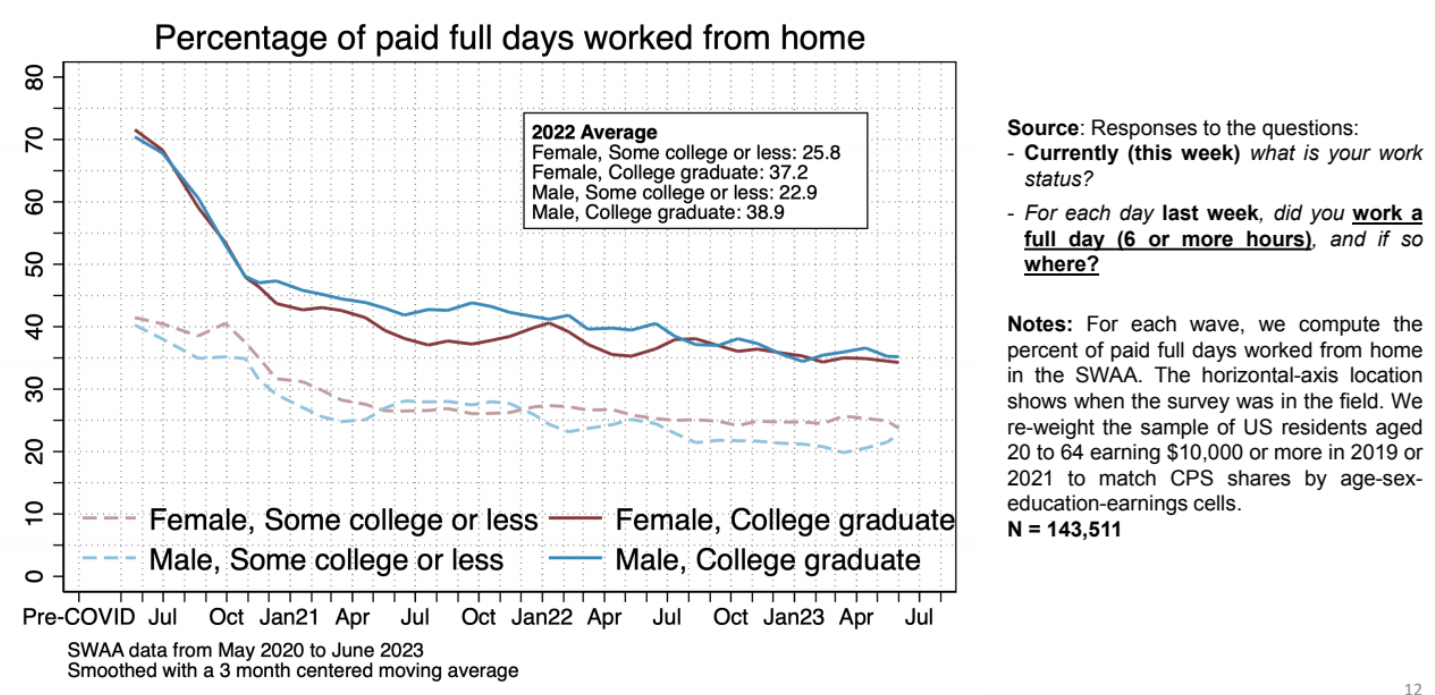
Despite a rocky start, work from home appears to have stabilized at around 25% of work days overall and stunningly, nearly 40% of work days for college educated workers! Work from home thus appears to be a permanent and beneficial change in how work is structured.
PEPFAR has been a great achievement
PEPFAR is the President’s Emergency Plan for AIDS Relief, started by George W. Bush in 2003. Overseen by the State Department, the program provides treatment for HIV-AIDS and derivative maladies (such as tuberculosis) through training, medical infrastructure, support for orphans and vulnerable children, and, most important, antiretroviral drugs.
By some estimates, the program has saved 25 million lives over the last two decades, spending about $90 billion for treatments that many Africans otherwise could not have afforded or gotten access to. Not only has PEPFAR saved African lives (in a very cost-effective way, I might add), it’s also improved the quality of life for many Africans and helped the economies of many African nations. The burnishing of America’s reputation is a bonus.
And this:
What does it mean that two of the most successful policies of the last 20 years have originated with Republican administrations? Or that two of the people most associated with these initiatives — Condoleezza Rice (PEPFAR) and Jared Kushner (OWS) — have never received proper recognition for their efforts? They should, in spite of whatever other objections one might have to their other decisions.
Here is the rest of my Bloomberg column.
Sentences to ponder, scientific fraud edition
In 2015, a big team of researchers tried to redo 100 psychology studies, and about 60% failed to replicate.
This finding made big waves and headlines, and it’s already been cited nearly 8,000 times.
But the next time someone brings it up, ask them to name as many of the 100 studies as they can. My bet is they top out at zero. I’m basically at zero myself, and I’ve written about that study at length. (I asked a few of my colleagues in case I’m just uniquely stupid, and their answers were: 0, 0, 0, 0, 1, and 3.)
This is really weird. Imagine if someone told you that 60% of your loved ones had died in a plane crash. Your first reaction might be disbelief and horror—“Why were 60% of my loved ones on the same plane? Were they all hanging out without me?”—but then you would want to know who died. Because that really matters! The people you love are not interchangeable! Was it your mom, your best friend, or what? It would be insane to only remember the 60% statistic and then, whenever someone asked you who died in that horrible plane crash, respond, “Hmm, you know, I never really looked into it. Maybe, um, Uncle Fred? Or my friend Clarissa? It was definitely 60% of my loved ones, though, whoever it was.”
So if you hear that 60% of papers in your field don’t replicate, shouldn’t you care a lot about which ones? Why didn’t my colleagues and I immediately open up that paper’s supplement, click on the 100 links, and check whether any of our most beloved findings died? The answer has to be, “We just didn’t think it was an important thing to do.” We heard about the plane crash and we didn’t even bother to check the list of casualties. What a damning indictment of our field!
Here is more from Adam Mastroianni.
That is from Phil C.