Sunday assorted links
Shruti interviews V. Anantha Nageswaran on the Indian economy
He is currently serving as the Chief Economic Advisor to the Government of India, and also is the co-author of the books Economics of Derivatives and The Rise of Finance: Causes, Consequences and Cures. The podcast covers import substitution and strategic resilience, futures and options market, gross fixed capital formation, crypto markets, India’s growth trajectory, and much more.
Here is the audio and video on YouTube. Here is a linked transcript. Excerpt:
RAJAGOPALAN: The policy response to this has come in a couple of different ways. One has come through SEBI. It has started raising contract sizes and limiting weekly expiration,and so on. Another instrument has come through taxation. There have been STT [Securities Transactions Tax] hikes in consecutive budgets,but there is one thing about STT that I want to understand a little bit better from someone like you who has thought about this deeply.
Now, STT on futures is being levied on the notional value of the contract, which is the full traded price, whereas the STT on the options is levied on the premium, which is a small fraction of the overall underlying value of the notional exposure. The effective tax that is imposed is much more on the futures trade, manyfold more actually, than it is on the options trade, whereas the speculation is mostly happening on the options side, which is also where most of the retail investors are losing money because the futures side is much better capitalized, larger firms, and so on.
NAGESWARAN: No, also the futures side is probably used more by institutions, and therefore, they are able to put up the margin requirement, etc., better than the options trades, where the individuals are being sold almost like the₹10 sachet-type options, and the options…
RAJAGOPALAN: Exactly, sachetization options, absolutely.
NAGESWARAN: Yes. Go ahead.
RAJAGOPALAN: Now with each successive hike in the STT,we’re seeing the gap widen. It’s on the margin, making futures relatively more expensive than options just because it’s taxing each trade. It’s like a toll fee that’s paid almost on every transaction. Your book was precisely about understanding these kinds of policy instruments. Given that now we have a tax instrument which inadvertently favors the more speculative instrument. Is that a good way of thinking about it, or how would you think about this problem?
NAGESWARAN: No, I think you have given me a lot to think about on this. I probably haven’t applied my mind as much to the mechanics of the STT being levied on the premium when it comes to options, but on the notional value of the contract when it comes to futures. Actually, you have given me something to think about. As you said, it could be having the unintended consequence of reducing the hedging role of futures, which probably is playing a better role there and encouraging the speculative element. Let me think about it and also probably take back this aspect of the conversation back to my colleagues in the revenue department, in the Ministry of Finance. Thank you for that, yes.
Of great importance for the world’s most populous country.
Is Tinder actually OK?
Online dating apps have transformed the dating market, yet their broader effects remain unclear. We study Tinder’s impact on college students using its initial marketing focus on Greek organizations for identification. We show that the full-scale launch of Tinder led to a sharp, persistent increase in sexual activity, but with little corresponding impact on the formation of long-term relationships or relationship quality. Dating outcome inequality, especially among men, rose, alongside rates of sexual assault and STDs. However, despite these changes, Tinder’s introduction did not worsen students’ mental health on average and may have even led to improvements for female students.
That is from a new paper published in AEJ: Applied Economics, by Berkeren Büyükeren, Alexey Makarin, and Heyu Xiong.
Saturday assorted links
3. “The gesture establishes a hierarchy in which Tyler Cowen determines the hierarchy.”
4. How the spreadsheeet reshaped America.
5. What works of literature were written by the elderly?
6. The Anglosphere is ahead on AI adoption.
9. Austin Vernon on Hormuz and its resolution through economic means.
Republican Congressional deference to Trump is in fact democratic
That does not mean it is good! From Jeffrey M. Stonecash:
Congress is portrayed as compliant with President Donald J. Trump’s agenda because he is intimidating its members. This neglects an alternative explanation that focuses on the increased congruence of presidential and congressional electoral bases. Trump is the beneficiary of a geographical realignment that took decades and has created a high degree of overlap of the two bases. This analysis tracks that process from 1952 to 2024. It has produced a situation in which policy concerns overlap and encourage congressional compliance.
A bilateral AI pause?
Dean ball has some thoughts and hesitations:
Here are some questions I wish “Pause” and “Stop” advocates would address:
1. Assuming we achieve the desired policy goal through a bilateral US/China agreement, what would be the specific metric or objective we would say needs to be satisfied in advance? Who decides whether we have satisfied them? What if one one party believes we have satisfied them but the other does not?
2. If the goal is achieved through a bilateral US/China agreement, would we need capital controls to ensure that U.S. investors cannot fund semiconductor fabs, data centers, or AI research labs in countries other than the U.S. and China?
3. Would we need to revoke the passports of U.S.-based AI researchers and semiconductor engineers to prevent them leaving America to join AI-related ventures elsewhere? How else would the U.S. and China keep researchers within their borders?
4. How should we grapple with the fact that (2) and (3) are common features of autocratic regimes?
5. Do the above questions mean that this really should be a global agreement, signed by all countries on Earth, or at least those with the theoretical ability to host large-scale data centers (probably Vanuatu doesn’t need to be on board)?
What should I ask Andrew Graham-Dixon?
He is one of the world’s leading art critics, all of his books are excellent, and he has a new and very good work coming out titled Vermeer: A Life Lost and Found. He also has a well-known book on Caravaggio, on Michelangelo, and I am especially fond of his book on British art.
Here is his Wikipedia page. Here is his home page. So what should I ask him?
Social Security Should Be a Forced Savings Program Not a Welfare Program
There is a growing movement to eliminate the wage cap on Social Security taxes while capping benefits. The argument, often from the center-right, is that Social Security is insolvent and that “tough” choices are needed to save it. But this moves the system in exactly the wrong direction.
One of the better features of Social Security is that it has never been purely redistributive. It has also functioned, in part, as a forced-savings program. The Social Security Administration itself emphasizes that benefits depend on earnings history: earn more, retire with more. Why do some people receive large Social Security checks? Because they paid a lot more into the system.
Eliminating the wage cap while capping benefits weakens, and in the limit destroys, that connection. It turns Social Security away from forced saving and toward retirement welfare financed by a broader tax on earnings. That is a bad idea.
The problem is not just that this creates another welfare program. It also worsens marginal incentives. A tax that buys you a claim on future benefits is not the same as a pure tax. Suppose 10 percent of your salary goes into a 401(k). That reduces current consumption, but it is not simply money lost to the state. You receive an asset in return. It is closer to a purchase than to a tax–a reason to work more not a reason to work less.
Social Security is not a personal retirement account, but it does contain that logic. There is a connection between taxes paid and benefits received. To the extent that workers understand that connection, the payroll tax is less distortionary than an ordinary tax of the same size. Part of what workers pay is offset by the expectation of future benefits.
Gut that connection, however, and the tax becomes more distortionary even if total taxes paid and total benefits received stay the same. The averages can remain unchanged while the marginal incentives deteriorate. Once additional taxes no longer generate additional benefits, the system looks much more like a straight tax on work.
A much better reform would move in the opposite direction: strengthen the link between contributions and benefits. Make Social Security more like what many people already think it is—an individual account that accumulates benefits over time. The stronger that link, the lower the effective tax wedge.
This would also improve the politics of the system. A welfare program invites zero-sum conflict: my benefit comes at your expense. A claim-based system is less divisive. It ties benefits more clearly to contributions and makes rising prosperity good for everyone. In that kind of system, we can all become richer—including low-wage immigrants—without treating retirement policy as a fight over who gets to pick whose pocket.
Addendum: James Buchanan first made these points here. John Cochrane gets the economics right, of course.
Marginal Garfield
Marginal Garfield generates an original Garfield cartoon every day based on posts from Marginal Revolution! Here is the first strip. You can guess the post. Is there now any reason to come to MR? What a world.
You can also check out Rationalist Garfield which pulls from Less Wrong.
We thank Tim Hwang.
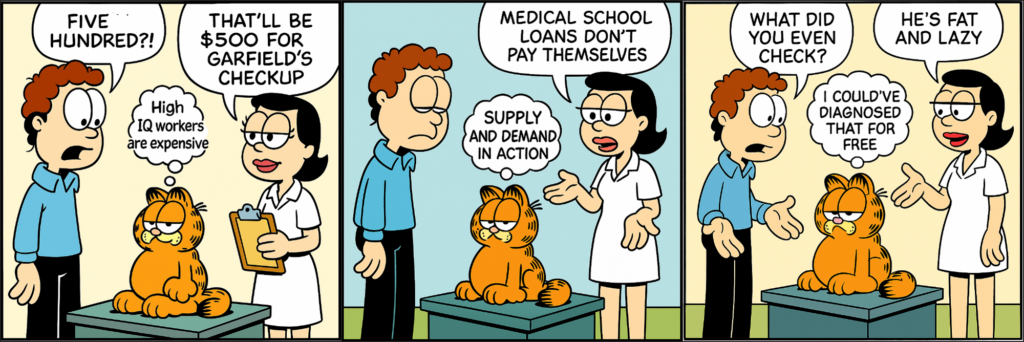
Henry Oliver calls it a Swiftian ending
To The Marginal Revolution: Rise and Decline, and the Pending AI Revolution, here is the very close of the book:
There is however a slightly scarier version of this story yet. Maybe our intuitions about the world, including the economic world, were never so strong in the first place. Maybe we put so much value on “intuitive” results, in 20th century microeconomics, as a kind of cope and also security blanket, to make up for this deficiency. But our intuitions, even assuming them to be largely correct, always were just a small corner of understanding, swimming in a larger froth of epistemic chaos. And now the illusion has been stripped bare, and the true complexities of economic reasoning are being revealed.
As Arnold Kling would say, “Have a nice day.”
Can I say again “Have a nice day”?
My excellent Conversation with Paul Gillingham
Here is the audio, video, and transcript. Here is the episode summary:
Tyler calls Paul Gillingham’s new book, Mexico: A 500-Year History, the single best introduction to the country’s past—and one of the best nonfiction books of 2026. Paul brings both an outsider’s eye and ground-level knowledge to Mexican history, having grown up in Cork — a place he’d argue gave him an instinctive feel for fierce local autonomy and land hunger —earning his doctorate on the Mexican Revolution under Alan Knight at Oxford, and doing his fieldwork in the pueblos of Guerrero.
He and Tyler range across five centuries of Mexican history, from why Mexico held together after independence when every other post-colonial superstate collapsed, to why Yucatán is now one of the safest places on earth, what two leaders from Oaxaca tell us about Mexican politics, how Mexico avoided the military coups that plagued the rest of Latin America, what Cárdenas’s land reform actually achieved versus what it promised, whether the ejido system held Mexico back, why Mexico worried too much about land and not enough about human capital, how Mexico’s fertility rate fell below America’s, why Guerrero has been violent for two centuries, why the new judicial reforms are a disaster, where to find the best food in Mexico and Manhattan, what a cache of illicit Mexican silver sitting on a ship in the English Channel has to do with his next book, and more.
Excerpt:
COWEN: Now, after independence in 1821, why did not the rest of Mexico fragment the way Central America did a few years later, where it splits off from the Mexican empire? What determines the line? What sticks together with Mexico, and what does not?
GILLINGHAM: That’s a very good question because it’s one of the things that really makes Mexico stand out in that period, those histories, is that after independence, the rest of the Americas, you get a series of super-states. You get Gran Colombia, which is most of the Andes, and going across what’s now Venezuela. You get the United Provinces of the Rio Plate. These are huge, very difficult to conceive of super-states, and they fail within a decade. Elsewhere, you look at other post-colonial states, thinking particularly of India, within a couple of years, you’re fragmented and failed. Mexico doesn’t. Mexico actually stands up with the exceptions you put of Central America, which is formally part of it, in fact, but leaves within short order.
It’s one of these questions of what Álvaro Enrigue calls the miracle that Mexico exists. To explain it is a paradox. To make a try at it, I think that there is a common theme in Mexican history, which runs across most of those five centuries, which is a remarkable degree of hands-off government. It’s imposed. Mexico has a lot of mountains. It’s very difficult to rule from any central pole. Savvy governments, or governments with no choice, which are quite often the same thing, are very hands-off. Federalism is built into Mexico’s soul. I think that’s one of the reasons, from early on, Mexico actually out-punches the rest of the Americas in terms of sticking together as a territorial unit.
COWEN: As you know, in the early 19th century, there are rebellions in Yucatán, the Caste Wars, but Yucatán does not split off from Mexico. What keeps that together?
GILLINGHAM: Yucatán has always felt itself to be a different country, effectively, and that runs through to the present. You can see the cultural reasons, obviously, and the Maya and the other great, sophisticated urban culture of the 16th century and before. It makes sense that they should feel themselves very different from the rest of what becomes Mexico. In fact, it comes through in small but revealing ways. Back in the 20th century, people find themselves being asked whether they want a Yucatán beer or a foreign beer, and a foreign beer being anything in Mexico outside Yucatán.
Why doesn’t Yucatán leave? I think that it came extremely close. In fact, there’s a moment in the 1840s when Mexico and Texas form an alliance, and Texas is chartering warships out to Yucatán to try and prevent any naval incursions. Why on earth does Yucatán stay? I think it’s because of the absence of an alternative capital, because Yucatán is profoundly racially divided. It’s one of the few places in Mexico where you could say that really is a fairly stark racial divide. You have a plantocracy, in some ways, like the US South before the Civil War.
You’ve got a relatively small white plantocracy centered in Mérida. They have no interest whatsoever in leading an independent struggle. While the Maya achieve an underestimated level of sophistication as a state, it’s still not at the point where you would get, for more than a couple of years, a really joined-up independence movement spanning all races, all areas, and the entire peninsula.
Recommended, interesting and substantive throughout. In the United States at least, Mexico remains a greatly underdiscussed nation.
What is economics these days?
From The Marginal Revolution: Rise and Decline, and the Pending AI Revolution:
The day before drafting this paragraph, I blogged a paper on confidence gaps between men and women. It was a paper written by economists, published in the prestigious American Economic Review, the profession’s number one journal. Is this actually sociology, or personality or social psychology, or part of some gender studies field? No one in the economics profession cares to discuss that anymore. It is not that there is a dogmatic attachment to what used to be called “economic imperialism,” rather the view is that if the paper is good enough … it is good enough to publish. I also recently read a paper on using cell phone data to estimate how many people actually were attending church. Freakonomics guru Steve Levitt wrote and published well-known papers on the choice of baby names and corruption in Sumo wrestling116See Exley and Nielsen (2024), and on cell phones see Pope (2024)..
The dirty little secret is that what distinguishes economics as a field, right now, is a mix of higher standards, harder work, better math, and higher IQs. That is the real (dare I say marginal?) contribution of “empirical economics today,” not marginalism per se, though of course contemporary models typically are consistent with marginalist reasoning…
One modest sign of all these changes is how many advisors, when speaking to individuals considering economics graduate school, recommend math or even computer science as a possible background undergraduate major. While most are still undergraduate economics majors, if only because that is where their interest in economics came from, no one seems to mind if they are not. These days, a background in mathematics or computer science is at least as useful for the graduate work to come. Once you get to graduate school, you will have to learn plenty of math and programming anyway, so why not start off in those fields? The prevailing attitude is that the economics you can figure out along the way, or for some topics you may not need to know much of it at all. How complicated are all those economic principles anyway? General skills of apprenticeship and plain ol’ hard work are growing in importance too, as top graduate programs increasingly want their incoming students to have done a “predoc” with an accomplished researcher somewhere along the way.
That is from the chapter on the future of economics in a world with advanced AI.
Addendum: On The Marginal Revolution book, I would most of all like to thank Jeff Holmes for the great job he did on the project, all of the actual work (other than the writing) is from him. He is also producer of CWT, I owe much to him!
Thursday assorted links
1. Tracy Kidder, RIP (NYT).
2. Pat Steir, RIP (NYT).
3. How software businesses will survive.
*The Marginal Revolution: Rise and Decline, and the Pending AI Revolution*
I am offering a new piece of work — I do not quite call it a book — online and free. It has four chapters, is about 40,000 words, is fully written by me (not a word from the AIs), and it is attached to an AI with a dual page display, in this case Claude. Think of it as a non-fiction novella of sorts, you can access it here. You can read it on the screen, turn it into a pdf (and upload into your own AI), send it to your Kindle, or discuss it with Claude.
Here is the Table of Contents:
1. What Is Marginalism?
2. William Stanley Jevons, Builder and Destroyer of Marginalism
3. Why Did It Take So Long for the Science of Economics to Develop?
4. Why Marginalism Will Dwindle, and What Will Replace It?
Here are the first few paragraphs of the work:
How is it that ideas, and human capabilities, become lost? And how is that new insights come to pass? If eventually the insight seems obvious, why didn’t we see it before? Or maybe we did see it before, but didn’t really know we were on to something important? Why do new insights arrive suddenly, in a kind of flood? How do new worldviews replace older ones?
And what does all of that have to do with the future of science, the future of research, and the future of economics in particular? Especially when we try to understand how the ongoing artificial intelligence revolution is going to reshape human knowledge, and the all-important question of what economists should do.
Those are the motivating questions behind this work, but I will address them in what is initially an indirect fashion. I will start by considering a case study, namely the most important revolution in economics, the Marginal Revolution (to be defined shortly). The Marginal Revolution made modern economics possible. What was the Marginal Revolution? How did it start? Why did it take so very long to come to fruition? From those investigations we will get a sense of how economic ideas, and sometimes ideas more generally, develop. And that in turn will help us see where the science, art, and practice of economics is headed today.
Recommended! I will be covering it more soon.
Solve for the China tech equilibrium
Authorities in Beijing have barred two executives from a Singapore-based AI firm from leaving China amid a review of the company’s $2 billion acquisition by U.S. social media giant Meta, according to a report by the Financial Times on Wednesday.
Xiao Hong and Ji Yichao — the CEO and chief scientist, respectively, of Manus — were summoned to Beijing this month and questioned over a possible violation of foreign direct investment reporting rules related to the acquisition before being told they could not leave the country, the report said.
Here is more from The Washington Post. In my view, the American lead in AI is somewhat larger than a model comparison alone might suggest.