The link between IQ and income is overrated
Garett Jones was the one who first put me on to this idea, now it is in a Bloomberg column, excerpt:
The evidence is striking. One study of CEOs of large Swedish companies found that on average they ranked at the 83rd percentile of measured IQ (for CEOs of smaller companies, the rank was the 66th percentile). That’s above average, but it’s hardly a cluster at the top of the distribution. Many CEOs undoubtedly achieved their position through hard work, charisma, people skills and other abilities, not to mention luck.
In the broader distribution, the connection between IQ and income is also positive but underwhelming. One study concluded that moving from the 25th to the 75th percentile of IQ correlates with a 10% to 16% boost in earnings. That may feel significant when you get it, but it doesn’t push you into a whole new socioeconomic class.
The connection between IQ and achievement at the very highest tiers is in my view still an open question. Here are some recent results, in my view not yet confirmed as the correct overall point of view:
One recent study, also based on Swedish data, showed two results of significance. First, much of the intelligence-earnings correlation weakens significantly and plateaus above salaries of 60,000 euros a year. Second, and perhaps more surprising, people in the top 1% of earners had lower IQs than the earners immediately beneath them.
Why that is the case, it’s hard to say. But one possibility is that the very smartest people prefer a more balanced life rather than working all the time. Or perhaps they prefer occupations with higher status and somewhat lower pay. Money isn’t the only thing you can enjoy. Maybe having a lot of it can make it harder to trust potential friends or spouses.
Recommended.
Russia facts of the day
Consider that last year, the IMF predicted Russian GDP would shrink by 8.5% in 2022 and by 2.3% in 2023; for its part, the White House projected a year-on-year decline in Russian GDP of 15%. Last month, the IMF revised its growth estimate for Russia to 0.3% for 2023 and 2.1% in 2024—higher than the eurozone and the United Kingdom.
What happened? For the first eight months of the war, thanks to a 250% increase in hydrocarbon prices combined with an unavoidable lag in sealing off imports, Western sanctions actually raised Russian revenues from exports to the European Union. Sanctions only started to inflict significant damage on the Kremlin at the very end of 2022, after which the Russian Finance Ministry reported a budget deficit of nearly $25 billion for January, and an overall decline in revenue of 35%. In the meantime, however, Russia managed to tap gray and black trade markets across the Middle East, Africa, and Asia while continuing to sell oil around the world and provide petroleum services like maritime shipping and insurance. The EU has admitted to not knowing the quantity or nature of the Russian central bank assets it’s supposedly blocked. At the same time, thanks to China, Russia now imports more semiconductors than it did before the war.
Here is more from Jeremy Stern at Tablet.
What young people say is driving changes in their mental health
I think consistent with Matt's point here — you see young people identifying social media as a source of worsening mental health; but also emphasizing politics and national media.https://t.co/scOXEMNFjJ https://t.co/MGgdNIsz0m pic.twitter.com/hY47EOZFAO
— Arpit Gupta (@arpitrage) March 1, 2023
I would stress this point. Most of the explanations for declining teen mental health invoke contagion at one stage of the argument or another. That in turn means the initial causes can be fairly small, relative to the final outcome. Contagion itself is arguably the most important cause.
Thursday assorted links
1. Good to see a Mexican amate up for auction at Christie’s. Might anyone here know what is being done with the rest of the Citibanamex collection?
4. Return to Seoul is an excellent movie (NYT).
5. Shruti interviews Alain Bertaud (newly part of Mercatus) on cities in India.
6. Fifty conversations in Bangalore and Chennai.
7. Ross on magic, AI, and related topics (NYT): “…what we’re doing resembles a complex incantation, a calling of spirits from Shakespeare’s “vasty deep.””
AGI is Coming
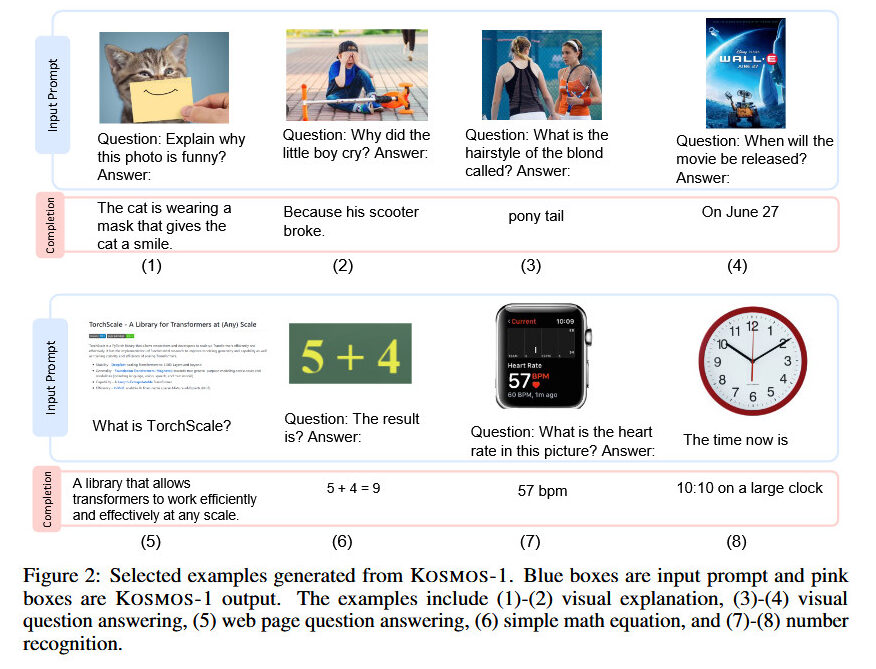
ARSTechnica: On Monday, researchers from Microsoft introduced Kosmos-1, a multimodal model that can reportedly analyze images for content, solve visual puzzles, perform visual text recognition, pass visual IQ tests, and understand natural language instructions. The researchers believe multimodal AI—which integrates different modes of input such as text, audio, images, and video—is a key step to building artificial general intelligence (AGI) that can perform general tasks at the level of a human.
In 2020 Metaculus forecasters were predicting weak general AI by around 2053. Now they are predicting weak general AI by 2028 and strong general AI which includes:
- Has general robotic capabilities, of the type able to autonomously, when equipped with appropriate actuators and when given human-readable instructions, satisfactorily assemble a (or the equivalent of a) circa-2021 Ferrari 312 T4 1:8 scale automobile model. A single demonstration of this ability, or a sufficiently similar demonstration, will be considered sufficient.
I never expected to witness the birth of aliens. It is a very strange time to be alive. If you think the world isn’t changing in a very uncertain and discontinuous way you just aren’t paying attention.
What predicts attractiveness-enhancing behavior?
Such investigations are invariably somewhat speculative, but from some new research here goes:
The strongest predictor of attractiveness-enhancing behaviors was social media usage. Other predictors, in order of effect size, included adhering to traditional gender roles, residing in countries with less gender equality, considering oneself as highly attractive or, conversely, highly unattractive, TV watching time, higher socioeconomic status, right-wing political beliefs, a lower level of education, and personal individualistic attitudes.
That is from a paper by Marta Kowal, et.al.
South Park Commons — the collectives model for spurring innovation
From the NYT circa 2017:
…the [South Park] Commons aims to fill a hole in the tech landscape. Northern California is littered with incubators and accelerators, organizations like Y Combinator and Techstars that help small companies develop and grow. This is something different, a community you can join before you have founded a company or even when you have little interest in founding one.
The Commons is a bit like the hacker spaces that have long thrived in the Valley — places where coders and makers gather to build new software and hardware — but it moves beyond that familiar concept. Its founder, for one thing, is a female engineer turned entrepreneur turned executive.
From SPC itself:
SPC is a de-risking platform. The community addresses the social and intellectual components of risk—it provides a close-knit, high-talent group during the idea stage so members can reach founder-market fit before attempting product-market fit. The SPC Fund plays the more traditional role of de-risking finances: our recently-launched Community Grant works much like Emergent Ventures; the Founder Fellowship (we’re currently accepting applications) is designed to get would-be founders to take the plunge; and we participate in the broader VC ecosystem with some later-stage investments.
Reminds me of the Junto Club, not to mention the 18th century more broadly; SPC itself cites Junto as a model. Think of it as a technical community of people without full-time jobs, plus a venture fund. On the ground, technologists hang out with potential founders. Here is TechCrunch on SPC.
Which are other recent examples of successful “community” models for spurring innovation?
Wednesday assorted links
1. Garett Jones on why AI possibly might not boost economic growth very much. And William Eden expects another AI winter.
2. Classical liberalism by country, volume 2 (Latin America).
3. Ben Evans presentation of trends, tech and otherwise.
4. Aligning perception with language models: “We also show that MLLMs can benefit from cross-modal transfer, i.e., transfer knowledge from language to multimodal, and from multimodal to language.”
5. Is declining knowledge diffusion behind the loss in U.S. business dynamism?
Matt Yglesias on depression and political ideology
The connection between Left thinking and high neuroticism (as a formal personality trait) is one of the most underdiscussed yet important themes in American politics (to be clear, the Right has its own pathologies as well). Here is one excerpt from Matt’s latest Substack (gated):
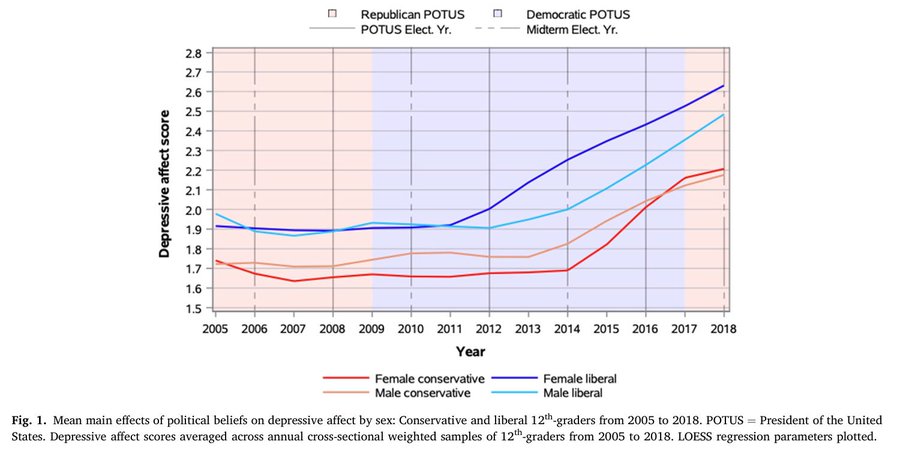
But I want to talk about something Goldberg mentions but doesn’t focus on: a 2021 paper by Catherine Gimbrone, Lisa Bates, Seth Prins, and Katherine Keyes titled “The politics of depression: Diverging trends in internalizing symptoms among US adolescents by political beliefs.” The CDC survey doesn’t ask teens about their political beliefs, but Gimbrone et. al. find not only divergence by gender, but divergence by political ideology. Breaking things down by gender and ideology, they find that liberal girls have the highest increase in depressive affect and conservative boys have the least. But liberal boys are more depressed than conservative girls, suggesting an important independent role for political ideology.
And:
Some of it might be selection effect, with progressive politics becoming a more congenial home for people who are miserable. But I think some of it is poor behavior by adult progressives, many of whom now valorize depressive affect as a sign of political commitment. The thing about depression, though, is that it’s bad.
And:
…progressive institutional leaders have specifically taught young progressives that catastrophizing is a good way to get what they want…
One of the best and most important pieces you will read this year. I would go as far to say that you cannot understand the American public intellectual sphere without a grasp of the close connection between Left thinking and high neuroticism. I would add that incorporating gender expectations into Matt’s analysis would give it yet more explanatory power. Once you see all this, you can never look away again and forget it…
A view that hardly anyone embraces
It is not an airtight view, but it is also not the least plausible view. Imagine a “basic needs” argument that suggests, a’ la David Braybrooke, that individuals truly have positive rights to a certain degree of sustenance, health care, shelter, and so on. Yet above that basic needs level, individuals don’t have positive rights to much of anything at all. They are left to fend for themselves, though of course they will benefit from social cooperation. After all, positive rights have to stop somewhere if only because of the scarcity constraint. Furthermore, perhaps what society owes a person is “enough to construct a meaningful life,” but not so much more.
You may or may not agree, but as a view it is not crazy.
To make this more specific, imagine a health care policy that stated individuals have a true right to access any health care technology invented up through say…2004 or so. Individuals would be guaranteed “2004 value health care lives.” (In 2004 that certainly seemed pretty good.) But for subsequent health care developments, a free market will reign. Is not guaranteeing basic needs an essential part of the egalitarian argument? Surely not everything needs to be equalized? Anyway, no one believes in guaranteeing individuals protection against all the rare diseases out there, as that would cost too much. So a line will be drawn somewhere.
The very title of this post suggested these views are extremely unpopular. One reason might be their theoretical inadequacy. But surely another reason is that, at the margin, they suggest you just don’t have too much complaining you can do. You don’t have too much to say about social arrangements. You don’t have too many opportunities to express purely negative emotions about how things are.
And perhaps that is a big part of what people find intolerable.
What does that tell you about political views more generally?
Is business doing our saving for us?
That is the theme of my latest Bloomberg column, as U.S. household savings rates often fall between three and five percent. From the column here is one bit:
Are such low savings rates unsustainable for an advanced economy? Not in view of America’s business saving. Looking at the US Federal Reserve’s series on undistributed business profits, it starts to rise significantly in the 1970s, and takes off around 2000 (with a dip for the financial crisis), and currently stands a bit above $1.2 trillion. There are other ways to measure business savings rates, but generally they show a significant upward move over the last few decades.
On net, gross US savings rates are hovering between 17% and 18% of GDP. Again, there are different ways to measure the relevant variables. But under any plausible approach the US is not having to survive on saving only a few percent of personal income.
This is related to those stories about some of the most successful US corporations sitting on billions of dollars. Maybe you view that as wasteful or extravagant. But a more helpful response might be: “Better them than me!”
Data on personal savings typically neglect pension plans and realized capitals gain on financial assets and homes. In that sense the personal saving rate also is higher than is typically measured. Yet here, too, much of the credit goes to business. If equities are high in value in the aggregate, that is a tribute to corporate productivity more than to brilliant investing.
But do recall the Garett Jones strictures that if you don’t save enough you may not enjoy compounding returns over time.
C’mon people…
CHIPs details to raise costs:
1) Mandated daycare
2) Davis Bacon pay regulations
3) Buy American
4) Consult, engage, coordinate with unions
5) NEPA compliance
6) Source materials from small, minority, and women owned business https://t.co/2TLrdbrBmP— Adam Ozimek (@ModeledBehavior) February 28, 2023
Tuesday assorted links
1. Does male physical labor boost sperm count and thus fertility?
2. Nathan Labenz on many things GPT. And new Windows update will bring AI-powered Bing to the taskbar.
3. Those new service sector jobs: Prompt engineer.
4. Further Austin Vernon defense of aircraft carriers.
5. Chotiner interviews Jeffrey Sachs, do read it (New Yorker). And on the China-Russia relationship.
Britain’s Long Timeline of Housing Decline
In 1947 the British Town and Country Planning Act made planning permission a requirement for land development; ownership alone no longer conferred the right to develop the land. A decline in construction was predictable but housing is a durable good. Even today more than a third of the British housing stock dates to before 1947. So it has taken time but, according to a new study, the act has had a slow but long-run depressing effect on construction with the result that today the average house in England costs more than ten times the average salary.
Britain has a severe housing crisis, especially in the most prosperous places in the Greater South East. Across England, the average house costs more than ten times the average salary, vacancy rates are below 1 per cent, and space per person for private renters has dropped substantially in recent decades.
This report explores the root cause of the UK’s housing problem, how policy in this area has developed over the last 75 years, and what action policymakers need to take to deliver enough homes in the UK.
…This report uses this new data and other sources to compare British housebuilding and outcomes to that in Ireland, France, Belgium, the Netherlands, (West) Germany, Austria, Switzerland, Denmark, Sweden, Norway, and Finland from 1955 to 2015. It finds that Britain’s housing shortage began at the beginning of the post-war period…
Housebuilding rates in England and Wales have dropped by more than a third after the introduction of the Town and Country Planning Act 1947, from 2 per cent growth per year between 1856 and 1939 to 1.2 per cent between 1947 and 2019.
This has been a key factor behind the UK’s long-standing housing crisis, which has led to inflated property prices and soaring rents in recent decades.
*The Soviet Century*
The author is Karl Schlögel, and the subtitle is Archaeology of a Lost World. Who else could have a whole chapter on Soviet-era doorknobs? This is a fascinating book about the material loose ends, the pamphlets, the clothes, the non-existent phone books, the shop signs, the chest medals, and the bric-a-brac — among many other items — of the Soviet Union. Excerpt:
…the centre of this city consisted of the largest steelworks in the world, the Magnitogorsk Iron and Steel Plant.
Who would be able to describe the sight of it? There is no vantage point and no camera lens that would encompass the panorama that we know otherwise only from the sight of the forces of nature at work…
The conglomerate has an area of around twenty by ten kilometres. The Magnitogorsk combine is roughly the size of a region from Manchester to Sheffield, compressed into a single point, a Pittsburgh beyond the Urals. As Stephen Kotkin observed at the end of the 1980s, the Magnitogorsk engineering complex was far more than just a ‘steel factory’. It consisted of dozens of plants, ten mighty blast furnaces, thirty-four open hearth furnaces, rolling mills and finishing mills that produced more steel annually than Canada or Czechoslovakia and almost as much as the whole of Great Britain.
Over 800 pp. of text, this is in my view one of the better books for understanding the Soviet Union.