USA sectoral shift fact of the day
Healthcare and Social Assistance have added nearly 1.8 million private-sector jobs in the US since the end of 2023 while all of other industries combined have lost 127,800 jobs.
Here is the source (Charlie Bilello) and a graph. In relative terms, is this good or bad for men?
Sunday assorted links
1. What should be our Bayesian priors on von Neumann probes?
2. AI book mirrors.
3. Why power in Spain is so cheap.
4. The comments on Mick West here are pretty tough. We still do not know what it is, and yes the national security people have pondered these questions in advance. Most broadly, trust people who are in “explorer mode,” not debunker mode. Debunker mode is tempting, because you often end up right, and feeling good about yourself, but it also means you miss big discoveries when they come along.
5. More on the cell phone ban study.
6. Technological breakthroughs and the progress of science. The early papers based on digital computing techniques did very, very well, at least on average.
Will AI kill the research paper?
Imagine taking a macroeconomics paper and adding a little button at the end “Press this button to update this paper with the latest macro data.”
All of a sudden you have multiple papers rather than one, and no single canonical version. It is the latter versions, not created directly by the authors, that people will look at.
Imagine adding another button, to either micro or macro papers “Please rerun these results using what the AI thinks might be five other different yet still plausible specifications.”
Then you have more papers yet.
Ultimately, why not just build a “meta-paper,” using AI, to answer any possible question about the subject area under consideration. This meta-paper would allow the reader, using AI, to make many sorts of modifications and additions to the basic work. The meta-paper also would allow the reader to add new data, to run additional robustness checks, and to do whatever else you might think of. Once again, the canonical version of the paper evolves away.
A researcher might spend a significant part of his or her career building such a meta-paper. Imagine a meta-paper, or sometimes I call it a “box,” devoted to answering questions about say fiscal policy, minimum wage hikes, or maybe the Industrial Revolution. Fed researchers would spend their entire careers, not writing papers, but improving the Fed’s “box” that answers questions about monetary policy and also prudential supervision.
Who will be good at doing such things? Is it the people today who become the top economists, or not? Will it be a highly decentralized endeavor, or, given the compute and team work requirements, a highly centralized one?
Economics is going to change a lot, as will many of the other sciences.
It is funny, and tragic, how much some of you are still obsessed with writing and publishing “papers.”
Which are the most common everyday phenomena that we don’t properly understand?
Off the top of my head:
• Lightning (how does it happen?)
• Sleep; dreams (why do they exist?)
• Glass (thermodynamics of formation)
• Turbulence (when does it start?)
• Morphogenesis (how does a creature know what should go where?)
• Rain (it seems to start faster than models would predict)
• Ice (dynamics of slipperiness)
• Static electricity (which material will donate electrons?)
• General anaesthetic. (And the mechanism of a lot of drugs, e.g. paracetamol.)
That is from Patrick Collison. It is a further interesting question how many of those questions will be answered by what is sometimes called AGI. Perhaps none of them? In at least some of those cases, what is scarce is experimental data, not reasoning per se.
Saturday assorted links
1. Do chatbots ever follow the interests of advertisers?
2. Approaching the Star Trek universal translator.
3. Jon Haidt response to the new cell phone study.
4. U.S. electricity prices have been flat since June.
5. Friend Alla Keselman now has a Substack.
6. I am enjoying the new Elizabeth Strout novel The Things We Never Say. It is arguably “too American” for me, and also “too New England,” still it is quite good.
The UAP report so far
I will stick with my earlier Free Press predictions:
The fact remains that, if you talk with insiders, they will confirm that the federal government faces some big mysteries. It seems that we have data on what appear to be craft that move very fast, have no visible means of propulsion, and can accelerate in a surprising manner. Radar, infrared, and other forms of data are cited to varying degrees, plus there are eyewitness pilot reports, broadly consistent with what our instruments are telling us.
And this:
Assuming a reasonable chunk of the data are declassified, I think we will simply see more of the same kind of material we’ve seen in the past: more data on entities that appear to move very quickly and in mysterious ways, but with no real explanations. We will see, as I’ve argued before, that the government itself does not know what is going on, and has been afraid to admit that. That may be the real “conspiracy” and why the veil of secrecy has been relatively difficult to pierce.
As of yesterday, there are plenty of additional videos of what seem to be glowing orbs moving fast and in unpredictable ways. Or try this one. Here is another weird one. Or try this. And another one, near military craft. And what is this?
One thing we can conclude is that the debunkers, who have been suggesting this is all camera tricks, parallax issues, or people not understanding how videos work, are proven wrong in general, even though they are right about some particular cases. On that point we can move on, as I have been arguing for some while. Mick West is not your proper guide here.
Nonetheless we still do not know what it all means, and I do not see proof of anything in particular.
I also will stress my earlier point that we are not going to see alien bodies or alien technologies, or anything meaningful connected to Roswell. That is sheer fantasy, or sometimes locos.
340 million hits in the first twelve hours? More people will be believing in aliens in any case, I suspect. Or will it be demons?
It is fashionable in the comments sections of blogs to call this topic a waste of time, but the serious people in the military and national security — most of whom do not cite alien presence — do not see it that way.
And they will be releasing more materials. These materials are being released because some subsection of “the Deep State” wants to know what is going on. As do I.
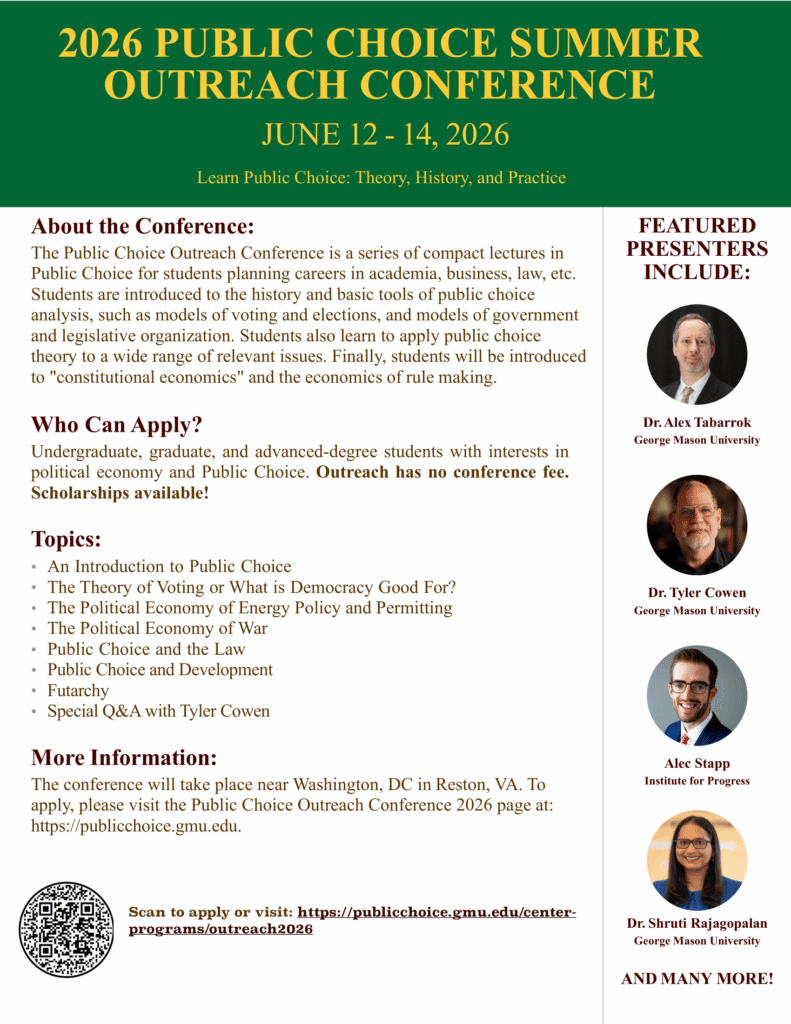
Public Choice Outreach!
Just a few spots left! Lots of great speakers including Tyler, myself, Bryan Caplan, Robin Hanson, Jon Klick, Shruti Rajagopalan and more.
Please apply and encourage your students to apply.
Self-fulfilling misalignment?
We started by investigating why Claude chose to blackmail. We believe the original source of the behavior was internet text that portrays AI as evil and interested in self-preservation.
And here is Alex Turner on the topic of self-fulfilling misalignment. I raised this possibility some while ago in a Free Press column, and mainly was met with hostility.
The social return to a positive world view, and avoiding negative emotional contagion, never has been higher.
The social media ban in Australia, how is it going?
In December 2025, Australia became the first country to ban youth under 16 years old from holding accounts on major social media platforms, a policy now under consideration in more than a dozen countries and in numerous states. Because social media use is inherently social, the effectiveness of a ban that is easy to circumvent may depend on whether compliance reaches a tipping point: a share of compliant peers high enough to make it optimal for individuals to comply themselves. We surveyed 835 Australian teenagers four months after the ban took effect and find that only about one in four 14–15-year-olds comply. The social environment around use has barely moved: most banned teens believe that their peers are still using banned platforms and cite social reasons for continuing use. Sustaining high compliance requires two ingredients: the share of compliers must be high enough and those who comply must find it preferable to continue complying. The current ban achieves neither. Teenagers report that they require roughly two-thirds of peers to stop using social media to stop themselves, far above the share currently complying. They also perceive compliers as less popular than non-compliers, so the more influential teens disproportionately stay on the platforms. Together, these patterns suggest that compliance is more likely to diminish than to rise. Sustaining higher compliance will likely require pairing the ban with instruments that act on social norms and individual incentives directly.
That is from a new NBER working paper by
A few days ago I was talking with a very smart fifteen year old in Australia (really). He was of the opinion that it was quite ineffective, though he noted he could no longer access LinkedIn. I would note there are more stringent measures, requiring more governmental monitoring and control of the internet, that perhaps could have a greater effect.
Friday assorted links
1. Eigenism.
2. Steven Nadler, Spinoza, Atheist. A good and very readable introduction to the Dutch philosopher.
3. Neal Katyal talk on what really won the SCOTUS tariff case.
4. “What America lacks relative to Europe is not price-sensitive leisure travelers but routes where almost everyone is a price-sensitive leisure traveler.” From Matt Y.
5. The White House is distancing itself from the very tough AI regulation idea.
6. Musical longevity is reaching its peak this year.
7. Are these the emerging megaregions?

The UFO files
Here is the web site, with some of the files released, I have not yet had a chance to look or to read any reliable summaries. More releases are expected, and as of this moment the Kalshi market is at 25 or so.
A simple point about diversification
In recent times a significant percentage of the S&P 500 run-up has been driven by a small number of tech and AI stocks. Plus the effects of AI can be expected to be further reaching yet for some while.
That makes it harder to diversify against risk, as there is a single dominant variable, namely “AI risk” or something similar. There is AI risk both in your portfolio and on your human capital, though possibly those will offset each other to some degree.
Presumably the equity premium should rise as a result? People will want more portfolio safety as a protective offset, and be gunshy about such a heavy equities bet on one major technology.
If you have a longish time horizon, do you feel brave enough to act on that view?
Or perhaps instead there is some simple way to hedge against AI risk?
One “stupid” equilibrium that no one will want to talk about is the following: buy lots of Nvidia, but if that doesn’t pay off make sure you are doing an MBA and planning a career in non-AI-implementation consulting.
Sentences to ponder
Exposure increases interclass (high- and low-parent-income) marriage but has no detectable effect on interracial (White and Black) marriage. A spatial marriage market model predicts that residential segregation—one of many forms of exposure—accounts for more than one third of marital sorting by class but less than 5% by race.
That is from a new NBER working paper by
How Poverty Fell
The share of the global population living in extreme poverty fell dramatically from an estimated 36% in 1990 to 9% in 2015. We describe how this decline happened: the extent to which changes within as opposed to between cohorts contributed to poverty declines, and the key changes in the lives of households as they transitioned out of (and into) poverty. We do so using cross-sectional and panel sources that are representative or near-representative of five countries that collectively accounted for 75% of global poverty decline between 1990 and 2015. The data show that overlapping birth cohorts experienced the decline of poverty together over time, such that poverty decline can be viewed as a primarily within-cohort phenomenon. Within cohorts, the data reveal substantial churn, casting the challenge of escaping poverty as a “slippery slope” more than a long-term trap. The data also illustrate a diversity of pathways out of poverty: sectoral transitions, migration, and changing occupational choices and female labor force participation can all account for some part of poverty reduction, but in all but a handful of cases, a majority of households exiting poverty did so without experiencing these changes.
That is from a new NBER working paper by