Richard Hanania interviews me
78 minutes. With transcript. It starts off as a normal “talent conversation,” but soon takes other paths. We discuss feminization in some detail, libertarianism too. Here is part of Richard’s summary:
Another one of Tyler’s traits that came out in this conversation is his detached skepticism regarding fashionable intellectual trends. For example, I’d taken it for granted that social media has made elite culture more pessimistic and angry, but his answer when I asked about the topic made me reconsider my view.
Interesting throughout, and here is one excerpt:
Tyler: It seems to me social media are probably bad for 12- to 14-year-old girls, and probably good for most of the rest of us. That would be my most intuitive answer, but very subject to revision.
Richard: I think it’s good. I mean, I think it’s good for me…
Tyler: But they’re bad for a lot of academics. I guess, they get classified in…
Richard: They might be at the…
Tyler: They get lumped in with the 12 to 14-year-old girls, right?
Richard: [laughs] There might be a similarity there.
Tyler: They have something in common.
Recommended.
China loan fact of the day
Three of the largest recipients of China’s rescue lending have been Pakistan, Sri Lanka and Argentina, which together have received as much as $32.83bn since 2017, according to data compiled by AidData, a research lab at William & Mary, a university in the US.
Other countries receiving rescue lending from Chinese state institutions included Kenya, Venezuela, Ecuador, Angola, Laos, Suriname, Belarus, Egypt, Mongolia and Ukraine, according to AidData, which did not provide details for these countries.
Here is more from the FT. I don’t actually see this ending well.
*The Culture Transplant: How Migrants Make the Economies They Move To a Lot Like the Ones They Left*
That is the new forthcoming book by Garett Jones (and his wisdom), I am very much looking forward to reading/rereading the final version of this one! (See the link for my blurb based on a pre-pub reading.) Here is the Amazon summary:
Over the last two decades, as economists began using big datasets and modern computing power to reveal the sources of national prosperity, their statistical results kept pointing toward the power of culture to drive the wealth of nations. In The Culture Transplant, Garett Jones documents the cultural foundations of cross-country income differences, showing that immigrants import cultural attitudes from their homelands―toward saving, toward trust, and toward the role of government―that persist for decades, and likely for centuries, in their new national homes. Full assimilation in a generation or two, Jones reports, is a myth. And the cultural traits migrants bring to their new homes have enduring effects upon a nation’s economic potential.
Built upon mainstream, well-reviewed academic research that hasn’t pierced the public consciousness, this book offers a compelling refutation of an unspoken consensus that a nation’s economic and political institutions won’t be changed by immigration. Jones refutes the common view that we can discuss migration policy without considering whether migration can, over a few generations, substantially transform the economic and political institutions of a nation. And since most of the world’s technological innovations come from just a handful of nations, Jones concludes, the entire world has a stake in whether migration policy will help or hurt the quality of government and thus the quality of scientific breakthroughs in those rare innovation powerhouses.
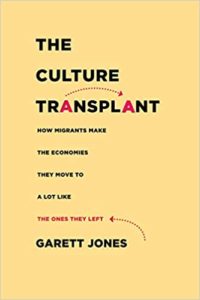
You can pre-order here, due out November 15.
Sunday assorted links
1. Some new results on air pollution and cancer?
3. Renewables and land use challenges. And more here (NYT), important.
4. Arnold Kling on the labor market and inflation.
5. Even indigenous groups voted against Chilean constitutional reform (in Spanish).
6. Are Zero Covid policies creating a human capital crisis in China?
The forthcoming rate of economic growth?
With the current pace of development in AI and as demos turn into full featured products and services, I can see the overall US GDP growth rising from recent avg 2-3% to 20+% in 10 years This is a seismic shift, which is really hard to think and reason about…
That is from Mohammad Bavarian. Somehow I do not think that will be the case, even in my most technologically optimistic moments. As Brad DeLong stresses, the second Industrial Revolution starting about 1870 was the true one, and we woke up fifty years later to an entirely different world, based on electricity and consumer society and extreme physical mobility. Yet I am not aware of any extreme gdp or productivity stats during the intermediate period. In fact the numbers I have seen seem a little….mediocre. I say side with the reality, not with the numbers, but this is one of the questions I wish was studied much more. Is it simply the case that stringing together a series of qualitatively discrete changes inevitably will outrace our ability to measure it?
By the way, it seems the new malaria vaccine works pretty well.
The new Bryan Caplan book
The title has attracted a lot of attention and controversy, it is Don’t be a Feminist: Essays on Genuine Justice, description here. Bryan writes a letter to his daughter, telling her not to be a feminist.
To counter Bryan, many people are trying to cite the “official” definition of feminism, which runs something like:
feminism, the belief in social, economic, and political equality of the sexes.
Who could not believe in that? But here is a case where the official definition (which comes in varying versions) is off base. Many people do not consider themselves feminists but would endorse those conclusions or come close to endorsing those conclusions entirely (I’m not sure what “social” equality for the sexes is supposed to mean.) Or can’t you be a pretty radical fighter for women’s rights, without necessarily believing full equality (of which kind?) is possible? What if you thought women shouldn’t be drafted into the military for combat? Would that disqualify you? Could Mary Wollstonecraft qualify on that basis? Yet Wikipedia presents her as the founder of feminism.
Bryan’s preferred definition of feminism is:
feminism: the view that society generally treats men more fairly than women
That also seems off base to me. If you were a feminist, but all of a sudden society does something quite unfair to men (drafts them to fight an unjust and dangerous war?), does that mean you might have to stop calling yourself a feminist? Somehow the definition ought to be more weighted toward the status of women and remedies for women, rather than treating men and women symmetrically. It seems weird to get people thinking about all of the injustices faced by men.
I don’t go around calling myself a feminist. There is too much in “the other people who call themselves feminists” that I don’t agree with. And it seems to me too aggregative a notion, and furthermore an attempt to win an argument by putting forward a definition that other people will be afraid to countermand. Nonetheless here is a view I do agree with:
There is an important emancipatory perspective, one that would improve the lives of many women, and it consists of a better understanding of how social institutions to date have disadvantaged women, and a series of proposals for improvement. Furthermore large numbers of men still do not understand the import of such a perspective, one reason for that being they have never lived the lives of women.
Unlike Bryan’s definition, this puts the treatment of women at the center of the issue. And unlike some of the mainstream definitions, it does not focus on the issue of equality, which I think will be difficult to meet or even define. Do we have to let men play in women’s tennis? In women’s chess tournaments? Whether yes or no, I don’t think the definition of feminism should hinge on those questions.
If you want to call that above description of mine feminism, fine, but I am finding that word spoils more debates and discussions than it improves. I won’t be using it. By the way, John Stuart Mill’s On the Subjection of Women remains one of the very best books ever written, on any topic, and indeed I have drawn my views from Mill. Everyone should read it. He never used the word feminist either.
I also would stress that my definition does not rule out emancipatory perspectives for men or other gender categories, or for that matter other non-gender categories, quite the contrary. Freedom and opportunity are at the center of my conception, and that means for everybody, which allows for a nice kind of symmetry.
In the meantime, I will read Bryan’s book once it comes out Monday. I’ve seen its component pieces already in Bryan’s other writings, I just am not sure which ones are in the book.
By the way, I wonder if Bryan’s views on gender are fully consistent with his views on poverty. He advocates marrying, staying married, etc., that whole formula thing. But if men are treated so badly in society, maybe in many cases there just aren’t enough marriageable men to go around? What are the women (and the men) to do then?
2022 as the year of AI?
That is the topic of my latest Bloomberg column, here is one excerpt:
But the benefits of AI do not accrue only to those in the technology sector. AI makes many goods and services cheaper, and that in turn benefits the poor and disadvantaged. If software routes packages and shipments more efficiently, then transportation costs will be lower. If software and AI programs help economize on the use of electricity, then it will be easier to mitigate climate change. As computational biology improves health care, the sick will benefit.
The people who least need AI are the super-rich. They already can hire armies of servants to manage their obligations, schedules, and so on. They do not need to economize on the use of human labor. The rest of us do, whether directly or indirectly through the businesses we patronize.
Another benefit for lower-income groups is that current manifestations of AI do not usually displace the jobs of the poor. Many poor individuals hold jobs in the service sector or perform manual labor. Those tasks are either hard to automate (a robot gardener?) or, because wages are low, less profitable to automate.
It may be true that the costs of AI in the labor force — displaced jobs — are more visible than the benefits of AI — new jobs and lower prices. So it’s not surprising if AI is not entirely popular.
Recommended.
US Economic Freedom is Falling
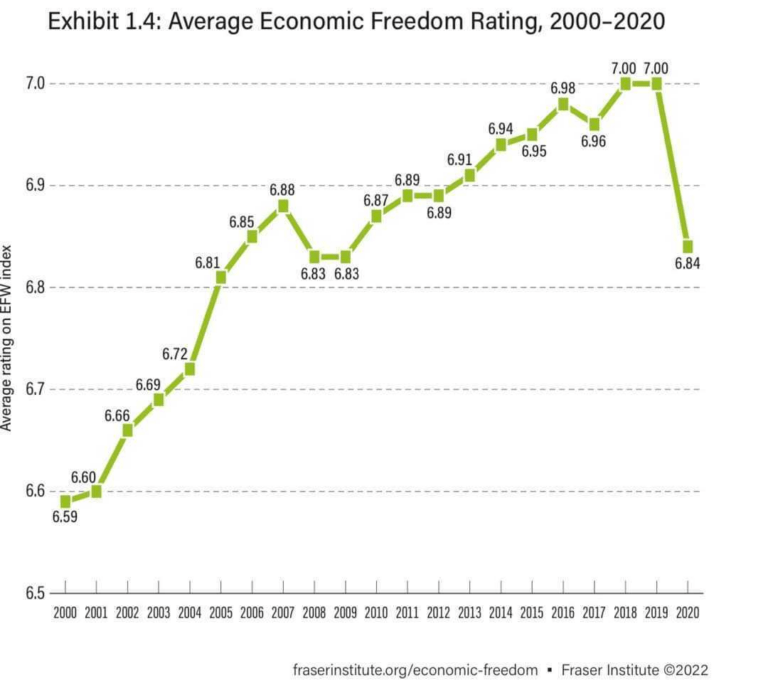
A big drop in Economic Freedom, mostly due to pandemic policies. Not surprising but will we recover? This is from the just released Economic Freedom of the World 2022 Annual Report.
Saturday assorted links
1. Differences in art appreciation in autism.
2. Korean cross-border Coase theorem, lottery ticket, with a nod to Oliver Williamson.
3. How did the 2020 airline bailouts work out?
4. Do not three-way stop signs Pareto dominate four-way stop signs? And why had you never thought about that before?
Do conservatives believe in a dangerous world?
One recent study says no:
Decades of research suggest a correlation between belief in a dangerous world and political conservatism. However, research relied on a scale that may overemphasize certain types of dangers. Furthermore, few other world beliefs have been investigated, such that fundamental worldview differences between liberals and conservatives remain largely unknown. A preregistered study of nine samples (N = 5,461; mostly US Americans) found a negligible association between a newly improved measure of generalized dangerous world belief and conservatism, and that the original scale emphasized certain dangers more salient to conservatives (e.g., societal decline) over others most salient for liberals (e.g., injustice). Across many measures of political attitudes, other world beliefs—such as beliefs that the world is Hierarchical, Intentional, Just, and Worth Exploring—each explained several times more variance than dangerous world belief. This suggests the relevance of dangerous world belief to political attitudes has been overstated, and examining other world beliefs may yield insights.
That is from Jeremy D.W. Clinton and Nicholas Kerry. I do not think you should over-index on these new results. But in general you should start seeing this literature as increasingly dubious.
*Parfit: A Philosopher and His Mission to Save Morality*
Now on Amazon for pre-order, due out April 18, 2023.

By Dave Edmonds. I read an earlier version and it was just fantastic.
Is “imposter syndrome” a good thing?
That is the topic of my latest Bloomberg column, here is one excerpt:
Impostor syndrome is a positively good thing. When searching for talent, I look for people who feel they suffer from impostor syndrome. If you think you are not qualified to do what you are doing, it is a sign you are setting your sights high and reaching for a new and perhaps unprecedented level of achievement…
Another advantage to feeling like an impostor is that it gives you better insight into your fellow humans. Estimates vary, but up to 82% of people may suffer from some form of impostor syndrome. Even if that is on the high side, impostor syndrome is very common. On a professional level, if you want to be in better touch with your colleagues, maybe it is a good idea for you to try out some new and unfamiliar tasks, and they can too. It will make everyone more understanding and more sympathetic — especially important qualities for being a successful boss.
Recommended. And if you are not currently an impostor, perhaps you should try impersonating one!
Friday assorted links
1. “Still, “I’m worried that with all this newfound fame, this was Creepy Chloe’s plan all along for world domination,” Beard joked. “She’s just using Briar and her power of cuteness to get a foothold.”” Link here.
2. The titled culture that is German. And here is the UK.
3. How well do behavioral scientists predict?
4. History of Gander airport in Newfoundland.
5. New Lawrence H, White book coming on monetary economics.
6. Arbitrage: ‘All fun and games until the health inspector shows up.‘
The true long-termist has passed from the scene
RIP…
AEA Hypocrisy
Here’s the AEA’s official statement on inclusion:
The AEA seeks to create a professional environment with equal opportunity and fair treatment for all economists, regardless of age, sex, gender identity and expression, race, ethnicity, national origin, religion, sexual orientation, disability, health condition, marital status, parental status, genetic information, political affiliation, professional status, or personal connections.
Yet the AEA is requiring any attendees at the annual meeting to be vaccinated and boosted, a standard which excludes half of the US population! How is that equal opportunity and fair treatment? I suppose some people will want to say “health condition” doesn’t include vaccinated or not…dubious legerdemain…but there’s no question the AEA vaccination policy is a huge violation of the spirit of inclusion.