Social Security Should Be a Forced Savings Program Not a Welfare Program
There is a growing movement to eliminate the wage cap on Social Security taxes while capping benefits. The argument, often from the center-right, is that Social Security is insolvent and that “tough” choices are needed to save it. But this moves the system in exactly the wrong direction.
One of the better features of Social Security is that it has never been purely redistributive. It has also functioned, in part, as a forced-savings program. The Social Security Administration itself emphasizes that benefits depend on earnings history: earn more, retire with more. Why do some people receive large Social Security checks? Because they paid a lot more into the system.
Eliminating the wage cap while capping benefits weakens, and in the limit destroys, that connection. It turns Social Security away from forced saving and toward retirement welfare financed by a broader tax on earnings. That is a bad idea.
The problem is not just that this creates another welfare program. It also worsens marginal incentives. A tax that buys you a claim on future benefits is not the same as a pure tax. Suppose 10 percent of your salary goes into a 401(k). That reduces current consumption, but it is not simply money lost to the state. You receive an asset in return. It is closer to a purchase than to a tax–a reason to work more not a reason to work less.
Social Security is not a personal retirement account, but it does contain that logic. There is a connection between taxes paid and benefits received. To the extent that workers understand that connection, the payroll tax is less distortionary than an ordinary tax of the same size. Part of what workers pay is offset by the expectation of future benefits.
Gut that connection, however, and the tax becomes more distortionary even if total taxes paid and total benefits received stay the same. The averages can remain unchanged while the marginal incentives deteriorate. Once additional taxes no longer generate additional benefits, the system looks much more like a straight tax on work.
A much better reform would move in the opposite direction: strengthen the link between contributions and benefits. Make Social Security more like what many people already think it is—an individual account that accumulates benefits over time. The stronger that link, the lower the effective tax wedge.
This would also improve the politics of the system. A welfare program invites zero-sum conflict: my benefit comes at your expense. A claim-based system is less divisive. It ties benefits more clearly to contributions and makes rising prosperity good for everyone. In that kind of system, we can all become richer—including low-wage immigrants—without treating retirement policy as a fight over who gets to pick whose pocket.
Addendum: James Buchanan first made these points here. John Cochrane gets the economics right, of course.
Marginal Garfield
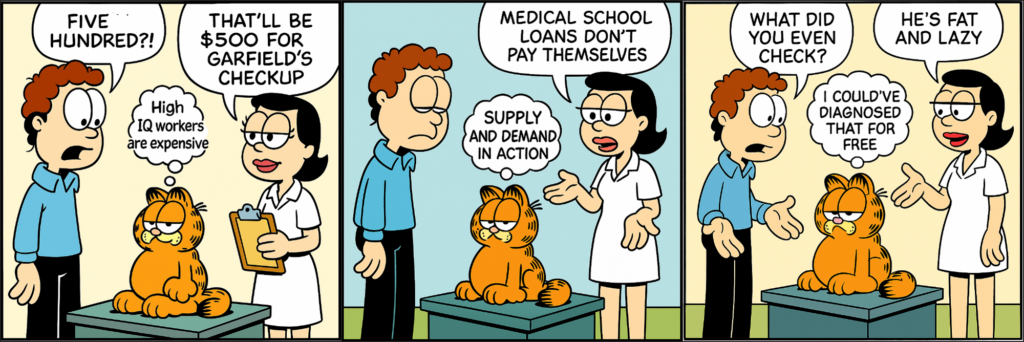
Marginal Garfield generates an original Garfield cartoon every day based on posts from Marginal Revolution! Here is the first strip. You can guess the post. Is there now any reason to come to MR? What a world.
You can also check out Rationalist Garfield which pulls from Less Wrong.
We thank Tim Hwang.
Henry Oliver calls it a Swiftian ending
To The Marginal Revolution: Rise and Decline, and the Pending AI Revolution, here is the very close of the book:
There is however a slightly scarier version of this story yet. Maybe our intuitions about the world, including the economic world, were never so strong in the first place. Maybe we put so much value on “intuitive” results, in 20th century microeconomics, as a kind of cope and also security blanket, to make up for this deficiency. But our intuitions, even assuming them to be largely correct, always were just a small corner of understanding, swimming in a larger froth of epistemic chaos. And now the illusion has been stripped bare, and the true complexities of economic reasoning are being revealed.
As Arnold Kling would say, “Have a nice day.”
Can I say again “Have a nice day”?
My excellent Conversation with Paul Gillingham
Here is the audio, video, and transcript. Here is the episode summary:
Tyler calls Paul Gillingham’s new book, Mexico: A 500-Year History, the single best introduction to the country’s past—and one of the best nonfiction books of 2026. Paul brings both an outsider’s eye and ground-level knowledge to Mexican history, having grown up in Cork — a place he’d argue gave him an instinctive feel for fierce local autonomy and land hunger —earning his doctorate on the Mexican Revolution under Alan Knight at Oxford, and doing his fieldwork in the pueblos of Guerrero.
He and Tyler range across five centuries of Mexican history, from why Mexico held together after independence when every other post-colonial superstate collapsed, to why Yucatán is now one of the safest places on earth, what two leaders from Oaxaca tell us about Mexican politics, how Mexico avoided the military coups that plagued the rest of Latin America, what Cárdenas’s land reform actually achieved versus what it promised, whether the ejido system held Mexico back, why Mexico worried too much about land and not enough about human capital, how Mexico’s fertility rate fell below America’s, why Guerrero has been violent for two centuries, why the new judicial reforms are a disaster, where to find the best food in Mexico and Manhattan, what a cache of illicit Mexican silver sitting on a ship in the English Channel has to do with his next book, and more.
Excerpt:
COWEN: Now, after independence in 1821, why did not the rest of Mexico fragment the way Central America did a few years later, where it splits off from the Mexican empire? What determines the line? What sticks together with Mexico, and what does not?
GILLINGHAM: That’s a very good question because it’s one of the things that really makes Mexico stand out in that period, those histories, is that after independence, the rest of the Americas, you get a series of super-states. You get Gran Colombia, which is most of the Andes, and going across what’s now Venezuela. You get the United Provinces of the Rio Plate. These are huge, very difficult to conceive of super-states, and they fail within a decade. Elsewhere, you look at other post-colonial states, thinking particularly of India, within a couple of years, you’re fragmented and failed. Mexico doesn’t. Mexico actually stands up with the exceptions you put of Central America, which is formally part of it, in fact, but leaves within short order.
It’s one of these questions of what Álvaro Enrigue calls the miracle that Mexico exists. To explain it is a paradox. To make a try at it, I think that there is a common theme in Mexican history, which runs across most of those five centuries, which is a remarkable degree of hands-off government. It’s imposed. Mexico has a lot of mountains. It’s very difficult to rule from any central pole. Savvy governments, or governments with no choice, which are quite often the same thing, are very hands-off. Federalism is built into Mexico’s soul. I think that’s one of the reasons, from early on, Mexico actually out-punches the rest of the Americas in terms of sticking together as a territorial unit.
COWEN: As you know, in the early 19th century, there are rebellions in Yucatán, the Caste Wars, but Yucatán does not split off from Mexico. What keeps that together?
GILLINGHAM: Yucatán has always felt itself to be a different country, effectively, and that runs through to the present. You can see the cultural reasons, obviously, and the Maya and the other great, sophisticated urban culture of the 16th century and before. It makes sense that they should feel themselves very different from the rest of what becomes Mexico. In fact, it comes through in small but revealing ways. Back in the 20th century, people find themselves being asked whether they want a Yucatán beer or a foreign beer, and a foreign beer being anything in Mexico outside Yucatán.
Why doesn’t Yucatán leave? I think that it came extremely close. In fact, there’s a moment in the 1840s when Mexico and Texas form an alliance, and Texas is chartering warships out to Yucatán to try and prevent any naval incursions. Why on earth does Yucatán stay? I think it’s because of the absence of an alternative capital, because Yucatán is profoundly racially divided. It’s one of the few places in Mexico where you could say that really is a fairly stark racial divide. You have a plantocracy, in some ways, like the US South before the Civil War.
You’ve got a relatively small white plantocracy centered in Mérida. They have no interest whatsoever in leading an independent struggle. While the Maya achieve an underestimated level of sophistication as a state, it’s still not at the point where you would get, for more than a couple of years, a really joined-up independence movement spanning all races, all areas, and the entire peninsula.
Recommended, interesting and substantive throughout. In the United States at least, Mexico remains a greatly underdiscussed nation.
What is economics these days?
From The Marginal Revolution: Rise and Decline, and the Pending AI Revolution:
The day before drafting this paragraph, I blogged a paper on confidence gaps between men and women. It was a paper written by economists, published in the prestigious American Economic Review, the profession’s number one journal. Is this actually sociology, or personality or social psychology, or part of some gender studies field? No one in the economics profession cares to discuss that anymore. It is not that there is a dogmatic attachment to what used to be called “economic imperialism,” rather the view is that if the paper is good enough … it is good enough to publish. I also recently read a paper on using cell phone data to estimate how many people actually were attending church. Freakonomics guru Steve Levitt wrote and published well-known papers on the choice of baby names and corruption in Sumo wrestling116See Exley and Nielsen (2024), and on cell phones see Pope (2024)..
The dirty little secret is that what distinguishes economics as a field, right now, is a mix of higher standards, harder work, better math, and higher IQs. That is the real (dare I say marginal?) contribution of “empirical economics today,” not marginalism per se, though of course contemporary models typically are consistent with marginalist reasoning…
One modest sign of all these changes is how many advisors, when speaking to individuals considering economics graduate school, recommend math or even computer science as a possible background undergraduate major. While most are still undergraduate economics majors, if only because that is where their interest in economics came from, no one seems to mind if they are not. These days, a background in mathematics or computer science is at least as useful for the graduate work to come. Once you get to graduate school, you will have to learn plenty of math and programming anyway, so why not start off in those fields? The prevailing attitude is that the economics you can figure out along the way, or for some topics you may not need to know much of it at all. How complicated are all those economic principles anyway? General skills of apprenticeship and plain ol’ hard work are growing in importance too, as top graduate programs increasingly want their incoming students to have done a “predoc” with an accomplished researcher somewhere along the way.
That is from the chapter on the future of economics in a world with advanced AI.
Addendum: On The Marginal Revolution book, I would most of all like to thank Jeff Holmes for the great job he did on the project, all of the actual work (other than the writing) is from him. He is also producer of CWT, I owe much to him!
Thursday assorted links
1. Tracy Kidder, RIP (NYT).
2. Pat Steir, RIP (NYT).
3. How software businesses will survive.
*The Marginal Revolution: Rise and Decline, and the Pending AI Revolution*
I am offering a new piece of work — I do not quite call it a book — online and free. It has four chapters, is about 40,000 words, is fully written by me (not a word from the AIs), and it is attached to an AI with a dual page display, in this case Claude. Think of it as a non-fiction novella of sorts, you can access it here. You can read it on the screen, turn it into a pdf (and upload into your own AI), send it to your Kindle, or discuss it with Claude.
Here is the Table of Contents:
1. What Is Marginalism?
2. William Stanley Jevons, Builder and Destroyer of Marginalism
3. Why Did It Take So Long for the Science of Economics to Develop?
4. Why Marginalism Will Dwindle, and What Will Replace It?
Here are the first few paragraphs of the work:
How is it that ideas, and human capabilities, become lost? And how is that new insights come to pass? If eventually the insight seems obvious, why didn’t we see it before? Or maybe we did see it before, but didn’t really know we were on to something important? Why do new insights arrive suddenly, in a kind of flood? How do new worldviews replace older ones?
And what does all of that have to do with the future of science, the future of research, and the future of economics in particular? Especially when we try to understand how the ongoing artificial intelligence revolution is going to reshape human knowledge, and the all-important question of what economists should do.
Those are the motivating questions behind this work, but I will address them in what is initially an indirect fashion. I will start by considering a case study, namely the most important revolution in economics, the Marginal Revolution (to be defined shortly). The Marginal Revolution made modern economics possible. What was the Marginal Revolution? How did it start? Why did it take so very long to come to fruition? From those investigations we will get a sense of how economic ideas, and sometimes ideas more generally, develop. And that in turn will help us see where the science, art, and practice of economics is headed today.
Recommended! I will be covering it more soon.
Solve for the China tech equilibrium
Authorities in Beijing have barred two executives from a Singapore-based AI firm from leaving China amid a review of the company’s $2 billion acquisition by U.S. social media giant Meta, according to a report by the Financial Times on Wednesday.
Xiao Hong and Ji Yichao — the CEO and chief scientist, respectively, of Manus — were summoned to Beijing this month and questioned over a possible violation of foreign direct investment reporting rules related to the acquisition before being told they could not leave the country, the report said.
Here is more from The Washington Post. In my view, the American lead in AI is somewhat larger than a model comparison alone might suggest.
Wednesday assorted links
What should I ask Katja Hoyer?
Yes, I will be doing a Conversation with her. Here is Wikipedia:
Hoyer was born in Wilhelm-Pieck-Stadt Guben, Bezirk Cottbus, German Democratic Republic (GDR), where her mother was a teacher and her father an officer of the National People’s Army. She received a Master’s degree from the University of Jena and moved to the United Kingdom in about 2010.
Hoyer is a visiting research fellow at King’s College London and has published two books about the history of Germany. She is also a journalist for The Spectator, The Washington Post, Times Literary Supplement, UnHerd, and Die Welt.
Her first book, Blood and Iron, about the German Empire from 1871 to 1918, was well reviewed, even though some reviewers suggested that she had played down the negative aspects of the period and of Otto von Bismarck‘s legacy. Her second book, Beyond the Wall, about the history of the GDR from 1949 to 1990, was well reviewed in the United Kingdom, but less well received in Germany.
She also has a new, forthcoming book on the history of the city of Weimar, namely Weimar: Life on the Edge of Catastrophe. So what should I ask her?
An economic framework for space immigration
Large-scale, voluntary space settlement must be economically rational to be viable. Here, we deploy the Roy model, an economic model used to understand immigration, to illuminate the economic factors important for space settlement and develop qualitative understanding of robust features of space settlement that do not depend on the details of the space economy. We find that getting the cost of living in space down by approximately 2 orders of magnitude is necessary to generate a space population on the order of 1 million people and the typical net utility of immigrating will be on the order of this cost. In addition, if the space economy is driven by productive activities of space settlers and there is some correlation between Earth and space skills and income, space settlers are likely to be drawn from the upper tail of Earth income distribution. An ideal way to incentivize immigration by these high-skill, high-income individuals is to declare the space economy free of redistributive taxes. Alternatively, if space settlement is driven by an insurance policy on civilization involving monetary transfers from Earth to space settlers, the space settlers are likely to be drawn from the lower tail of Earth income distribution, and only minimal marginal income beyond the cost of living in space will be necessary to create positive net utility of immigrating for them. The usefulness of the Roy model is demonstrated by its flexibility in providing qualitative insight in these disparate situations.
That is from a new paper by Dorian S. Abbot and Anup Malani.
Ryan Hauser interviews me in print
Here is the link, here is one excerpt:
What was your path into AI, and what are you working on now?
I first became interested in AI when I saw the chess computer Tinker Belle wheeled into a New Jersey chess tournament in I think 1975. I followed the Kasparov matches closely, and the more general progress of AI in chess. I read chess master David Levy telling me that chess was far too intuitive for computers ever to do well. He was wrong, and then I realized that AI could be intuitive and creative too. That was a long time ago.
In 2013 I published a book on the future of AI called Average is Over. I feel it has predicted our current time very accurately. I also taught Asimov’s I, Robot – a work far ahead of its time – for twenty years.
Right now I am simply working to keep afloat and to stay abreast of recent AI developments. I blog and write columns on the topic frequently, and have regular visits to the major labs. I encourage universities to experiment with AI education.
I mention William Byrd and Paul McCartney as well.
Tuesday assorted links
Johan Fourie interviews me at University of Stellenbosch
Physician Incomes and the Extreme Shortage of High IQ Workers
Physician incomes are extraordinarily high in the United States. A new NBER paper finds that U.S. physicians earn roughly two to four times as much as their counterparts in Canada, the Netherlands, and Sweden.
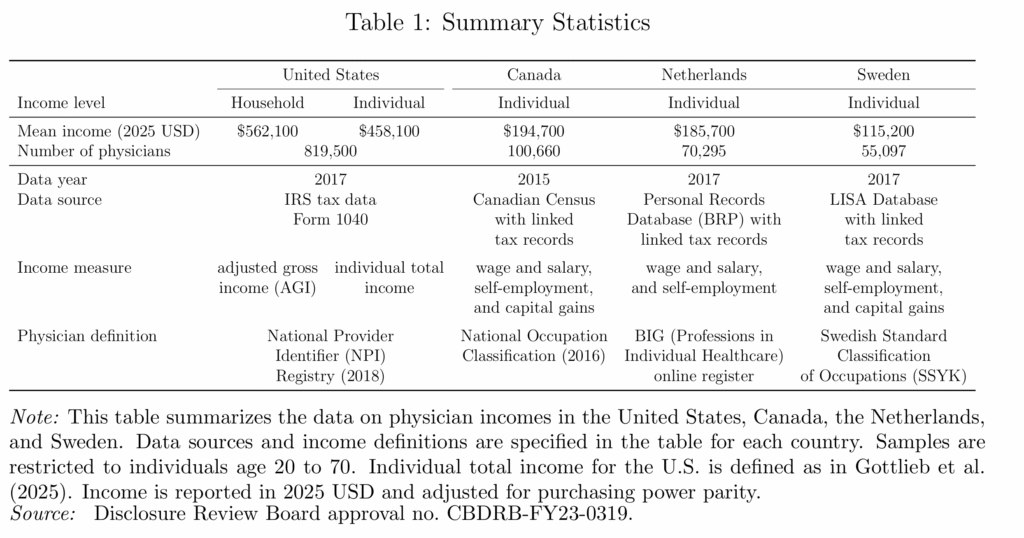
Why? Is it some feature particular to the US health care sector? Probably not. The same paper finds that physicians in the US have about the same relative income ranking as in Canada, the Netherlands, and Sweden. In other words, lots of high-skill workers in the US earn high incomes and physicians don’t look unusual relative to these other high-skill groups.
That is exactly what one would expect in an economy with an extreme shortage of high-IQ, high-skill workers. The US is a uniquely productive economy for high-skill workers which is why the US demand for foreign workers and the foreign demand to immigrate are so strong, especially at the high end.. By one estimate, “immigrants account for 32 percent of aggregate U.S. innovation.”
Immigration of high-skill workers such as with the H-1B and EB-1,2,3 programs, together with stronger U.S. education, is one way to reduce the shortage of high-skill workers. The alternative is simpler: make the economy less dynamic and less rewarding for talent. Then wages would fall and fewer ambitious people would bother coming. A solution but only if your preferred cure for scarcity is decline.