The Parent Trap–Review of Hilger
 Nate Hilger has written a brave book. Almost everyone will find something to hate about The Parent Trap. Indeed, I hated parts of it. Yet Hilger is willing to say truths that are often not said and for that I would rather applaud than cancel.
Hilger argues that the problems of poverty, pathology and inequality that bedevil the United States are not primarily due to poor schools, discrimination, or low incomes per se. The primary cause is parents: parents who are unable to teach their children the skills that are necessary to succeed in the modern world. Since parents can’t teach the necessary skills, Hilger calls for the state to take their place with a dramatic expansion of not just child care but collective parenting.
Let’s unpack some details. Begin with schooling. It’s very common to bemoan the state of schools in the “inner city” or to complain about “local financing” which supposedly guarantees that poor counties will have underfunded schools. All of this, however, is decades out-of-date.
A hundred years ago there really were massive public-school resource gaps by class and race. These days, however, state and federal spending play a larger role than local property tax revenue and distribute educational resources more progressively….In fact, when we include federal aid, 42 states spent more on poor school districts than on rich school districts in 2012. The same pattern holds between schools within districts
….The highest spending districts are large urban centers such as New York City, Boston and Baltimore. These cities spend large sums to educate rich and poor children alike. p. 10-11
Hilger is correct. No matter what you saw on The Wire, Baltimore spends more than sixteen thousand dollars per student, among the highest in the nation in large school districts and above average for the nation as a whole. Public schools are quite egalitarian in funding with any bias running towards more funding for poorer districts.
Schools, Hilger writes are “actually the smallest and most equalizing part of a much larger skill-building system.” The real problem, says Hilger, are parents.
But what about discrimination? When it comes to wage discrimination, Hilger is brutally honest:
If we compare individuals with similar cognitive test scores, Black college graduates earn higher wages than white college graduates. Studies that don’t control for test score differences but examine earnings gaps within specific professions—lawyers, physicians, nurses, engineers, scientists—tend to find Black workers earn zero to 10 percent less than white workers. These gaps could reflect discrimination, unmeasured skill differences, or other factors such as geography. In any case, such gaps are small compared to the 50 percent overall Black-white earnings gap and reinforce the idea that closing skills gaps would go a long way toward closing income gaps.
Hilger argues that racism does play an important role in explaining Black-white wage differentials but it’s the historical racism that made black parents less skilled and less able to pass on skills to their children. In the twentieth century, Asians, Hilger argues, were discriminated against in the United States at least much as Black Americans. But the Asians that came to the United States had high skills while the legacy of slavery meant that Black Americans began with low skills. Asians, therefore, were better able to overcome discrimination. The success of Nigerians and Jamaican immigrants in the United States also speaks to this point. (Long time readers may recall that in 2016 I dubbed Hilger’s paper on Asian Americans and Black Americans the Politically Incorrect Paper of the Year .)
Parental investment is surely important but Hilger overstates his case. He writes as if poorer parents have neither the abilities nor the time to teach their children while richer, better educated parents simply invest lots of hours and money imbuing their children with skills:
…the enormous variation in parents’ own academic skills has big implications for kids because we also demand that parents try to be tutors. During normal times, parents in America spend an average of six hours per week helping—or trying to help—their kids with school work. Six hours per week is more than K12 math and English teachers get with children…good tutoring by parents for six hours a week, every week, year after year of childhood could raise children’s future earnings by as much as $300,000.
The data on the effectiveness of SAT test-prep suggests that these efforts are not nearly so effective as Hilger argues. The parental investment story also doesn’t fit my experience. I didn’t spend six hours a week helping my kids with their homework. I doubt most parents do. I simply assumed my kids would do their work. I do recall that we signed my kids up for tutoring at Kumon, the Japanese math education center. My kids would complain bitterly when we took them for drill on the weekend. It was mostly filling out rote forms and my kids would hide or bury their drill sheets so we were always behind. Driving my kids to the Kumon center, monitoring them. and forcing them to do the work when they rebelled like longshoreman on work-to-rule was time consuming and it was ruining our weekends. I felt guilty, but after a while, my wife and I gave up. Today one of my sons is a civil engineer and the other is a math and economics major at UVA.
Hilger has an answer to this line of objection, or at least he says he does, but to my mind it’s a very odd answer. He argues, relying heavily on Sacerdote, that adoption studies show that more skilled parents result in more skilled kids. I find that answer odd because my reading of Sacerdote is that the effect of parents are small after you control for genetics—this is, as Hilger acknowledges, the conventional wisdom among psychologists. (See Caplan for an excellent review of the literature). It is true that Sacerdote plays up the effect of parents, but it looks small to me. Here is the effect of the adopted mother’s maternal education on the child’s education.

As you can see there is an effect but it is almost all from the mother going from having less than a high school education to graduating high school (11 to 12 years). In contrast, the mother can move from graduating high school to having a PhD and there is very little change in the education level of an adoptee. Note, however, that the effect on non-adoptees, i.e. biological children, is much larger throughout the entire range which suggests the influence of nature not nurture.
I am not surprised that there is some effect of parental education on child’s education because going to college is in part a cultural issue. Parents can influence cultural aspects of their children’s identity such as whether a child grows up up nominally Catholic, Mormon, or Hindu but they have relatively little effect on child religiosity, let alone personality or IQ. I think that a large fraction of the college wage premium is signaling (50% is a moderate estimate, Caplan thinks 90% is closer to the truth), so I am also not overly excited about college attendance as a marker of success.
The effect of parental income on the income of child adoptees is even more dramatic than on education—which is to say negligible. The income of the adopted parents has zero effect (!) on child’s income even as parent’s income varies by a factor of 20! The only correlation is with non-adoptee income—which again suggests the influence of nature not nurture.
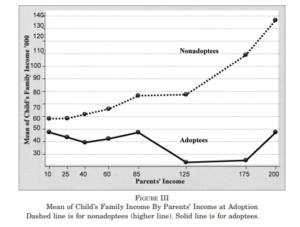
At this point in the book, it was almost inevitable that we were going to get yet another paean to the Perry Preschool Project and indeed Hilger waxes enthusiastically about Perry. Seriously? The Perry Preschool project started in the 1960s and had just 123 participants (58 in treatment and 65 in control!). There are more papers about the Perry Preschool project than there were participants. I am jaded.
Aside from the small sample size, the project had imperfect randomization and missing data and most importantly limited external validity. The Perry Preschool project treated a small group of disadvantaged African American children with low-IQs (IQs of 70-85 were part of the selection criteria). The treatment is usually described as “active learning pre-school” but it was more intrusive than that. Every week counselors would go to the homes of the kids to teach the parents (mostly mothers) how to raise their children. The training was important to the program. Indeed, Hilger notes, without sense of irony, that “facilitating greater skill growth in low-income children was so complicated that it required home visitors with advanced postsecondary degrees.” (p. 89). And what were the results?
The results were good! (Heckman et al. 2010, Belfield et al. 2006). But in the popular literature the impression one gets is that the program took a bunch of disadvantaged kids and helped them read and write, making them more middle-class and successful. Some of that happened but the big gains actually happened because the participants, especially the boys, were so socially dangerous and destructive that even a bit of normalization made life substantially better for everyone else. In particular 82% of the treated group of 33 males had been arrested by age 40, including for one murder, 4 rapes, 8 robberies, 11 assaults and 14 burglaries. The control group were worse. In the control group of 39 males there were 2 murders. Indeed the reduction of one murder in the treatment group accounts for a significant benefit of the entire Perry PreSchool project.
Hilger, to his credit, is reasonably clear that what is really needed is an intensive program for disadvantaged African Americans, especially males. In a stunning sentence he writes:
The more we rely on families rather than professionals to build skills in children, the tighter we link people’s current prospects to the prospects of their ancestors. p. 134
But he soon forgets or papers over the context of the Perry Preschool project and like everyone else in the literature uses this to support a national program for which there is no external validity. It’s hard to believe, given the lack of external validity, but Heckman et al. (2010) only exagerate mildly when they write:
The economic case for expanding preschool education for disadvantaged children is largely based on evidence from the HighScope Perry Preschool Program…
Hilger’s case for the difficulty of parenting is well taken—the FAFSA was a nightmare that taxed two PhDs in my family. But the bottom line is that most parents do just fine. Moreover, it’s shocking that in recounting the difficulties of parenting Hilger says hardly one word about an obvious factor which makes parenting more than twice as hard. Namely, single parenting. I was a single parent. Once for a whole week. Don’t do it. Get married, stay married. Perhaps Hilger didn’t want to appear to be too conservative.
Instead of recommending marriage and small targeted programs and more experiments, Hilger goes full Plato.
What would it look like if we [asked]…less not more of parents? It would look like professional experts managing more than the meagre 10 percent of children’s time currently managed by our public K12 system—much more. p. 184
And why should we do this? Because we are all part slaves and part slave-owners on a giant collective farm:
As fellow citizens who benefit from tax revenue, we all—even those of us without children—collectively own about 30 percent of any additional income other people’s children wind up earning. p. 197
Ugh. We own ourselves, not one another. Society isn’t about maximizing the collective it’s about free individuals coming together to produce rules so that we can enjoy the benefits of collective action while still living in a diverse society that respects individual rights, beliefs, and ways of living.
I told you I hated parts of The Parent Trap but Hilger has written an interesting and challenging book and he is mostly right that neither schooling nor labor market discrimination play a major role in the black-white wage gap. Hilger is probably also right that we spend too much on the elderly relative to the young. The idea of greater state involvement in the raising of children is on the table today in a way it hasn’t been for some time. See also Dana Susskind’s recent book Parent Nation. Changes on the margin may be warranted. Nevertheless, I stand with Aristotle and not Plato in thinking that raising children is better done by parents than by the state.
How much are Republicans and Democrats polarized really?
On the topic of income redistribution, if you just ask them how much should happen, on a scale of 1 to 7:
Perhaps the most striking evidence of polarization is that in the 1–7 scale, the modal response among Republicans is 1, and the modal response among Democrats is 7.
If you look at their actual behavior, Republicans for instance are only slightly more likely to contest an increase in their tax property assessments. Or this:
One question in the online survey…asks about property taxes instead of federal taxes: “Do you consider the amount of property taxes you pay to be too low, about right, or too high?”…the share of Democrats responding that property taxes are too high (36.9 percent) is not much lower than the corresponding share of Republicans (42.9 percent).
Or if you ask people if they should pay lower property taxes, the difference is real but modest:
…the desired tax reduction is 28.46 percent for Republicans versus 23.42 percent for Democrats.
Or if you ask them how property taxes should be distributed across different income classes:
Democrats want to assign 25.92 percent of property taxes to the poorer household, and Republicans want to assign 25.71 percent to the poorer household…
The Democrats do favor somewhat more taxation for the wealthiest class of households. Yet:
The results indicate that as the difference in home values increases, the modal respondent still desires proportional taxes.
The conclusion:
…Republicans and Democrats may say that they feel differently about income redistribution, but those differences disappear when facing real, high-stakes choices. We posit a different, yet still simple, explanation: partisan differences in preferences for redistribution are exaggerated by some, but not all, survey questions.
That is all from a new (May!) AER piece by Brad Nathan, Ricardo Perez-Truglia, and Alejandro Zentner, titled “Is the Partisan Divide Real? Polarization in Preferences for Redistribution.” I have long thought that over time, membership in “the right wing” will be predicted more by “hatred of hypocrisy” than by many of the more traditional pro- free market values of times hence.
Vodou Economics on the NYT on Haiti
From Craig Palsson, an expert in the economic history of Haiti and also fluent in Creole. Here goes:
My main argument is The New York Times is trying to expand from the paper of record to the academic journal of record. This is not the first time NYT has done this. The 1619 project had the same ambitions and similarly ignored academic standards. While I am an academic, I don’t see this as an existential threat. But I do think it has consequences. The 1619 project is now influencing academic work and school curricula…
To me, the biggest problem with the articles is a shocking lack of nuance and too much causal language for conclusions we cannot make. We can see this in the article titled, Invade Haiti, Wall Street Urged. The U.S. Obliged. Even that title lacks nuance and uses strong causal language…
The NYT article barely even considers the other motivations for invading Haiti. It alludes to political instability, but do you come away from that article understanding that the caco forces that resisted the Occupation were the same ones overthrowing the government before the invasion? It mentions the US paranoia that Germany might try to take over Haiti. But do you read the article and understand that Germans controlled about 80% of Haiti’s commerce? Or that the invasion happens during World War I, when Europe warned about German businesses operating in Latin America?
There is much more at the link, and Craig shows how the articles are geared to deliver a particular kind of selective moral message about guilt and blame, not to give the reader a decent understanding of Haiti and its history. A lot of the series focuses on the terrible French decision to extract reparations from Haiti, starting in the 19th century. You will not be taught, however, that Haiti and the Dominican Republic have diverged significantly since 1960, and since then the DR has become one of the wealthier nations in Latin America and Haiti has collapsed politically and is mired in extreme poverty, probably the worst in this hemisphere. Perhaps that divergence since 1960 needs to be addressed and cannot simply be reduced to much earlier imperialist crimes. There is even a massive Haitian decline since the 1990s, a time of relative hope.
I am not a “New York Times hater,” and would readily admit and indeed emphasize that significant parts of the newspaper are much, much better than anything else out there. But on particular topics, you just know you are being taken for a ride.
Tuesday assorted links
1. Motorcycles and ferries are dangerous, in that order.
2. More on civil defense in Taiwan.
3. The great Dervla Murphy has passed away.
4. Last payphone in NYC to be removed.
5. Emily Oster makes Time 100 most influential people list.
6. To what extent is tritium a limit on nuclear fusion?
7. RH being provocative (in some regards I am the opposite of his approach as outlined here).
8. Profile of Anita Summers. And in praise of Steph Curry.
9. New, skeptical study on Long Covid. And Derek Lowe with more on that.
Why We Can’t House the Homeless
During the pandemic, New York State allocated $100 million to turn struggling New York City hotels into low-cost housing. What could be simpler? Hotels are already used to house people so converting a hotel to more longer-term housing ought to be much simpler and cheaper than building from scratch or converting a parking structure into housing. Nope.
Politico: “There are very few hotels that physically could be converted and comply with the requirements of today’s zoning and building code without substantial, expansive reconstruction, partial removal or demolition,” said James Colgate, a land use partner at Bryan Cave Leighton Paisner LLP who has advised clients on zoning issues including the conversions of hotels. “That would increase the costs greatly.”
For example, a building’s elevators, doorways, or rooms may be slightly short of the size required for a residential structure. Residential buildings are also required to have a certain amount of rear-yard space that a hotel may not have.
“You would literally have to be chopping off part of the building,” Rosen said.
…The legislation dictates that each unit include a kitchen or kitchenette with a full-sized refrigerator, cooktop and sink — something Rosen said made utilizing the program “simply too expensive.”
“This is the classic case of the perfect being the enemy of the possible,” said Mark Ginsberg, a partner at the firm Curtis + Ginsberg Architects, which has worked on hotel conversions.
Some advocates who pushed the creation of the program say those provisions were necessary to ensure it didn’t generate substandard housing.

Substandard housing compared to what? Living on the street? And get this person.
“We didn’t want a program that cut corners to make it more palatable to developers,” said Joseph Loonam, housing campaign coordinator for the progressive advocacy group VOCAL-NY. “We wanted a program that centered the needs of homeless New Yorkers, which is true high quality affordable housing where they can have full autonomy and dignity.”
Well, they got what they wanted, the program wasn’t palatable to developers as only one application has been received and none of the money spent. Thanks progressive advocacy group for centering the needs of homeless New Yorkers.
Thinking at the margin
So why don’t poor Arkansas people currently living in homes move there [California]? Because they’d be homeless. But homeless people in Arkansas are already homeless, so they benefit from all of the positive factors that make LA a desirable place to live, without the drawback of paying high prices for an apartment.
That is from Scott Sumner, with much more at the link. Now can Scott explain why do so many LA apartments come without a fridge?
A Heideggerian review of *Talent*
Two questions that Cowen and Gross highlight strike me as deeply Heideggerian. “What tabs are open on your browser right now?” and “what is the equivalent of musical scales that you are practicing every day to get better at what you do?” Both are about surfacing a person’s care. Don’t tell me what you care about; rather, show me. Heidegger’s argument that truth is about “disclosure” and not just correctness is also evident in these questions.
So, in short, if Cowen and Gross are right about talent, and I think they are, up to a point—if hidden talent is underrated and under-appreciated owing to our biases—then it’s because the world is not sufficiently Heideggerian. We are too inauthentic, selecting for the wrong measures of success, promoting people who get good grades and the like, instead of celebrating those who are animated by an intensity of care. We celebrate those whose accomplishments reflect fear of death rather than “anxiety before the Nothing.” Perhaps the intensity of care metric is insufficient and unstable, even dangerous. But that is a second-order problem.
The sheer fact that Cowen and Gross have mainstreamed Heideggerian thought and operationalized it (and in a context so anathema to Heidegger the man) is worth applauding.
Here is more from Zohar Atkins.
*21st Century Monetary Policy*
I am pleased to have received an autographed copy of this very carefully done work. I think it is (by far) the best treatment of what the Fed has been up to since the 1970s, at least on the monetary policy front. There really isn’t anyone who would know better than Ben, keeping in mind he was not only Fed chair but also a top, possibly Nobel-quality monetary economist and also economic historian. The clarity and writing quality are high.
In one way, however, this is an unusual book — there is remarkably little “of Ben” in the book. To be clear, Ben already has published his personal memoir. Still, if most of this book had been written by someone else, I would not have known. Or maybe that is what it means to “put Ben in this book.” Imagine Elon Musk writing a book on rocketry and focusing on the rockets.
In any case recommended. Here is a good David Leonhardt NYT review. It is striking to me how few reviews there are so far — why? Therein lies a lesson too, though I have yet to figure out what it is.
Poor New Jersey the benefits of self-service gasoline
Most of the world’s population lives in countries that ban the self-service sale of gasoline. Causal effects of this regulation can hardly be assessed in these countries due to a lack of policy changes, but a recent quasi-experiment in the state of Oregon allows us to analyze the impact of the ban. From 1992 to 2017, the state of Oregon was one of two US states that banned self-service at gasoline stations. Oregon adjusted regulations at the start of 2018 to allow self-service at gasoline stations in counties with populations below 40,000 individuals. I examine the repeal of this self-service ban and its effects on gasoline prices. I apply a difference-in-differences design using high frequency data of gasoline prices and find that repealing the self-service ban reduced gasoline prices by 4.4 cents per gallon in affected Oregon counties. This effect represents approximately $90 in expected annual savings for a household with three licensed drivers. The results are statistically significant in all specifications and are essential to the policy debate on whether to keep self-service bans in U.S. states and countries with the same regulation.
That is from Vitor Melo at Clemson University, via the excellent Kevin Lewis.
Air Pollution and Student Performance in the U.S.
We combine satellite-based pollution data and test scores from over 10,000 U.S. school districts to estimate the relationship between air pollution and test scores. To deal with potential endogeneity we instrument for air quality using (i) year-to-year coal production variation and (ii) a shift-share instrument that interacts fuel shares used for nearby power production with national growth rates. We find that each one-unit increase in particulate pollution reduces test scores by 0.02 standard deviations. Our findings indicate that declines in particulate pollution exposure raised test scores and reduced the black-white test score gap by 0.06 and 0.01 standard deviations, respectively.
That is from Michael Gilraine and Angela Zheng. Maybe you, like me, do not find any one of these studies to be a real clincher. But please do reread Alex on the sum total of the evidence…and here.
And yet another part of Colombia’s political spectrum
Earlier I considered the leading left-wing candidate, here (FT) is the insurgent, 77-year-old populist right-wing candidate Rodolfo Hernández:
Straight-talking and sometimes abrasive, Hernández is prone to gaffes. In an interview in 2016 he described himself as “a follower of a great German thinker, Adolf Hitler”, only to correct himself later and say he confused Hitler with Albert Einstein. As mayor, he angered Bucaramanga’s firefighters by lambasting them as “fat and lazy”.
Perhaps in the broader world something structural is afoot?
Job security is not getting worse
There is a widespread belief that work is less secure than in the past, that an increasing share of workers are part of the “pprecariat”. It is hard to find much evidence for this in objective measures of job security, but perhaps subjective measures show different trends. This paper shows that in the US, UK, and Germany workers feel as secure as they ever have in the last thirty years. This is partly because job insecurity is very cyclical and (pre-COVID) unemployment rates very low, but there is also no clear underlying trend towards increased subjective measures of job insecurity. This conclusion seems robust to controlling for the changing mix of the labor force, and is true for specific sub-sets of workers.
That is from Alan Manning and Graham Mazeine, forthcoming in the Review of Economics and Statistics. Via the excellent Kevin Lewis.
Sunday assorted links
Testing Freedom
I did a podcast with Brink Lindsey of the Niskanen Center. Here’s one bit on the FDA’s long-history of banning home tests:
Brink Lindsey: …it’s on the rapid testing that we had inexplicable delays. Rapid tests, home tests were ubiquitous in Europe and Asia months before they were in the United States. What was going on?
Alex Tabarrok: So I think it’s not actually inexplicable because the FDA has a long, long history of just hating people testing themselves. So the FDA was against pregnancy tests, they didn’t like that, they said women they need to consult with a doctor, only the physician can do the test because literally women could become hysterical if they were pregnant or if they weren’t pregnant, this was a safety issue. There was no question that the test itself was safe or worked. Instead what the FDA said, “We can regulate this because the user using it, this could create safety issues because they could commit suicide or they could do something crazy.” So they totally expanded the meaning of safety from is the test safe to can somebody be trusted to use a pregnancy test?
Then we had exactly the same thing with AIDS testing. So we delayed personal at-home tests for AIDS for literally 25 years. 25 years these tests were unavailable because the FDA again said, “Well, they’re dangerous.” And why are they dangerous? “Well, we don’t know what people will do with this knowledge about their own bodies.” Now, of course, you can get an HIV test from Amazon and the world hasn’t collapsed. They did the same thing with genetic tests from companies like 23andMe. So I said, “Our bodies ourselves, our DNA ourselves.” That people have a right to know about the functioning of their own bodies. This to me is a very clear violation of the Constitutions on multiple respects. It just stuns me, it just stuns me that anybody could think that you don’t have a right to know, we’re going to prevent you from learning something about the operation of your own body.
Again, the issue here was never does the test work. In fact, the labs which produce these tests, those labs are regulated outside of the FDA. So whether the test actually works, whether yes, it identifies this gene, all issues of that nature, what is the sensitivity and the specificity, are the tests produced in a proper laboratory, I don’t have a lot of problem with that because that’s all something which the consumers themselves would want. What I do have a problem with is then the FDA saying, “No, you can’t have access to this test because we don’t know what you’re going to do about it, what you’re going to think about it.” And that to me is outrageous.
Here’s the full transcript and video.
The stuff of horror movies?
Though the trend is a positive one:
We study the intergenerational persistence of inequality by estimating grandmother-mother associations in the loss of a child, using pooled data from 119 Demographic and Health Surveys in 44 developing countries. Compared with compatriots of the same age, women with at least one sibling who died in childhood face 39% higher odds of having experienced at least one own-child death, or 7 percentage points at age 49. Place fixed effects reduce estimated mortality persistence by 47%; socioeconomic covariates explain far less. Within countries over time, persistence falls with aggregate child mortality, so that mortality decline disproportionately benefits high-mortality lineages.
That is from a new NBER working paper by Frances R. Lu and Tom Vogl.