What I’ve been browsing
A lot of my reading time has been absorbed by job market papers (some of them covered here on MR) and CWT prep, in the meantime I have been browsing these with profit:
Alexandra Popoff, Vasily Grossman and the Soviet Century covers what the title promises.
David Wallace-Wells, The Uninhabitable Earth: Life After Warming. The title aside, a very good and very well-written book on the basics of climate change.
Sophus A. Reinert, The Academy of Fisticuffs: Political Economy and Commercial Society in Enlightenment Italy, is the best English-language book I know of on the Italian Enlightenment. Everything you wanted to know about Pietro Verri but were afraid to ask.
Margaret C. Jacob, The Secular Enlightenment, again delivers good coverage of what the title promises.
Matthias Doepke and Fabrizio Zilibotti, Love, Money & Parenting: How Economics Explains the Way We Raise Our Kids. Note this book is sober rather than actually telling you how to raise your kids. And it has sentences like: “In earlier times, men and women had sharply distinct roles.”
Michael Tomasello, Becoming Human: A Theory of Ontogeny does not quite intersect with cultural economics and Joe Henrich, but someday somebody will write a book like this and start making the connections.
Some thoughts on second chances in the #MeToo era
That is the topic of my latest Bloomberg column, here is one excerpt:
Whether we like it or not, as the list of wrongdoers grows, questions of forgiveness will begin to outnumber questions of punishment. The thing is, questions of forgiveness are never entirely easy.
Much Christian doctrine, and especially Catholicism, emphasizes the value of confession, forgiveness and redemption. Thus it is not hard to convince many Americans that sinners should be given a second chance. This impulse occasionally finds its way into policy; just last month, a prison-reform bill became law, reflecting notions that criminals can indeed be rehabilitated. In her book “The Up Side of Down,” Washington Post columnist Megan McArdle stresses how many features of American life, including bankruptcy law and startup culture, depend on second, third or even more chances…
The more delicate truth is that, in the context of the #MeToo movement, forgiveness carries great dangers. I am not referring to those asking for it; rather, I am talking about those in a position to offer it. The survivors of such abuse often feel shame, guilt and a loss of confidence and self-esteem. It is very costly, both psychologically and practically, for such individuals to step forward and levy charges. An emphasis on forgiveness could reinforce victims’ tendencies to bury the crimes and wrongdoings.
And:
The result is a set of conflicting and probably irreconcilable values. America believes in equal treatment before the law. But America’s increasingly powerful system of social pressures and sanctions does not provide for equal treatment.
Do read the whole thing, which also considers both John Lennon and Picasso.
Saturday assorted links
1. Do celebrity governors even matter?
2. Joshua M. Kim comments on Stubborn Attachments.
3. Venture capital, education, and creative artists.
4. Are community schools working? (NYT, link fixed)
5. “Our ability to discuss policy is so broken that saying you’re going to raise the top tax rate is the only way progressives will believe you’re going to tax the rich more. In reality, eliminating stepped up basis & reducing exemptions/deductions would increase progressivity more.” From Betsey Stevenson.
True but rarely mentioned: wealth taxes and discount rates
…the value of wealth taxes depends sensitively on the interest rate…If the interest rate is 2%, then the tax rate is “only” 1/0.02 = 50%. If the interest rate is 5%, then the tax rate is 1/0.05 = 20%. I suspect these taxes were put in place in a time of higher interest ares and nobody is really thinking about the effect of lower rates.
That is from John Cochrane, with other points of interest about tax incidence at the link.
By the way, non-inflation-indexed capital gains are in part a wealth tax, so current higher interest rates are lowering the burden of that tax to some degree.
Trying to sell your data
I have news for you people: your data ain’t worth nuthin’:
I was ready to call it quits—unless, that is, my proceeds reeled me back in. I tallied up my fiat (that’s money, to the rest of us): 162 WIB, 1 DAT, 0 NRN. My earnings, while eclectic, were worth approximately 0.3 cents.
That is from a recent Wired article by Gregory Barber, who tried to sell his data in the open market. Yet data can be worth a good deal in the aggregate — just ask some of the major tech companies. The economics here are a bit like the economics of voting. If it were legal, and you tried to sell your vote and your vote alone, you might not get much more than 0.3 cents. That vote is unlikely to prove decisive. Yet average and marginal value do not coincide. If someone could buy a whole block of votes, which in turn could swing an election, the price could be much higher.
The upshot is that giving individuals ownership of their data, so they can sell it, is unlikely to yield much, unless of course you think widespread consumer collusion will prove feasible.
For the pointer I thank the excellent Samir Varma.
Friday assorted links
What should I ask Mark Koyama and Noel Johnson
They are my colleagues, and both are economic historians, and they have an important forthcoming book Persecution and Toleration: The Long Road to Religious Freedom. I will be doing a Conversation with them.
More generally they have worked on state capacity, nation building, why China evolved into such a large political unit, the Black Death, scapegoating, usury prohibitions in history, the economic impact of volcanic eruptions, and more. I am always happy to see them.
Their home pages are here and here. So what should I ask them?
The United States is Underpoliced and Overprisoned
Daniel Bier has a nice rundown on the ratio of police to prison spending comparing the United States to Europe. The US spends less on police and more on prisons than any European country.

Moreover, this is not because Europe spends less on criminal justice. Surprisingly, there is very little correlation between total spending and the ratio of police to prison spending. What we see in the graph below, for example, is that Europe is on the right, indicating more police to prison spending but not noticeably below the US states on total spending as a percent of GDP.

As I have argued before, the United States is underpoliced and overprisoned.
Does temporary migration from rich to poor countries cause commitment to development?
The author is Lee Crawfurd and the subtitle of the paper is “Evidence from quasi-random Mormon mission assignments.” Here is part of the abstract:
…we address this question using a natural experiment–the assignment of Mormon missionaries to two-year missions in different world regions–and test whether the attitudes and activities of returned missionaries differ. I find that assignment to a region in the global South causes returned missionaries to report greater interest in global development and poverty, but no difference in support for government aid or higher immigration, and no difference in personal donations or other involvement.
Maybe Mormons are different in this regard, or maybe missions are different (you feel you have done your bit?), but still an interesting result.
The top marginal tax rate
Taxing Top Incomes in a World of Ideas
Charles I. Jones∗
Stanford GSB and NBER September 26, 2018 — Version 0.5
Preliminary Abstract
This paper considers the taxation of top incomes when the following conditions apply: (i) new ideas drive economic growth, (ii) the reward for creating a successful innovation is a top income, and (iii) innovation cannot be perfectly targeted by a separate research subsidy — think about the business methods of Walmart, the creation of Uber, or the “idea” of Amazon.com. These conditions lead to a new term in the Saez (2001) formula for the optimal top tax rate: by slowing the creation of the new ideas that drive aggregate GDP, top income taxation reduces everyone’s income, not just the income at the top. When the creation of ideas is the ultimate source of economic growth, this force sharply constrains both revenue-maximizing and welfare-maximizing top tax rates. For example, for extreme parameter values, maximizing the welfare of the middle class requires a negative top tax rate: the higher income that results from the subsidy to innovation more than makes up for the lost redistribution. More generally, the calibrated model suggests that incorporating ideas and economic growth cuts the optimal top marginal tax rate substantially relative to the basic Saez calculation.
Via Illya Novak. Here are the slides, here is the paper.
That was then, this is now
Obama’s goal now is to make clear to adults in Central America that there is no payoff for sending their children on the dangerous journey northward, said Cecilia Muñoz, the White House domestic policy director. “He feels intensely a responsibility to prevent an even greater humanitarian crisis,” she said.
That, however, means speeding the deportation of most of those who have already arrived, which many in Obama’s own party are resisting.
That is circa 2014, here is the full story. I thank an MR reader for the pointer.
Two Teaching Resources
William Luther has put together an excellent list of Planet Money episodes that are keyed to the relevant chapters in Modern Principles of Economics. A similar list is also available for the excellent intermediate-micro text by Goolsbee, Levitt and Syverson.
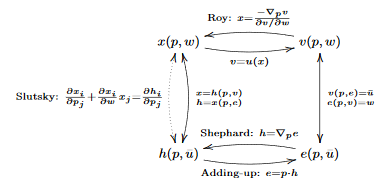
For graduate students, Luke Stein has put together a 64 page “cheat sheet” (pdf) for basically the first 2 years of micro and macro theory. It’s not for everyone but would be great for studying for prelims at many top programs. This diagram summarizing key results in consumer theory was excellent.
People, the streets are empty here, in and around D.C.
…sales have slowed, with one exception: Happy hour. People are coming in earlier and staying longer, but often not having dinner.
“It’s increasing happy hour and decreasing dinner,” he said.
He said he had moved happy hour earlier to 3 p.m. from 4 p.m. for anyone showing government identification, and that people were coming in as early as 2 p.m.
And this:
On Tuesday, the City Council gave the mayor emergency authority to issue marriage licenses, because the Marriage Bureau, funded by the federal government, is closed.
That is all from Sabrina Tabernise in the NYT, the article has other interesting points.
My *Stubborn Attachments* essay for Cato Unbound
Here it is, here is one excerpt:
The classics of political philosophy deal with wealth and economic growth awkwardly at best. John Rawls, in his Theory of Justice and elsewhere, was suspicious of economic growth outright. Rawls feared that the savings rate of the first generation would lead to deprivation, and a diminishment of the well-being of the worst-off group (that first generation), and so he toyed with John Stuart Mill’s idea of the stationary state. Robert Nozick evinced a good understanding of markets in his Anarchy, State, and Utopia, but still he focused on individual libertarian rights as an underpinning for a free society. Like Nozick, I believe in individual rights, but I don’t think they settle most questions, and I don’t find modest levels of taxation under democratic conditions to be morally problematic.
In part I wrote Stubborn Attachments to respond to Derek Parfit’s Reasons and Persons, first published in 1984. In that wonderful book, Parfit wondered whether consequentialist reasoning could in fact produce coherent recommendations, for either individuals or societies. Yet there is no talk in Reasons and Persons of economic growth, or how a much better future might help resolve aggregation problems. Nonetheless Parfit did produce an important appendix on why the social discount rate should be zero, and you can think of Stubborn Attachments as trying to think through the broader implications of that argument.
And:
You should always ask what are the weakest points of any book, including this one. For me, it is the fear that progress has a mean-reverting character and that improvements end up as temporary rather than sustainable. In that case, the idea of enduring benefits would be an illusion, and even if pursuing such benefits were a good recommendation we might end up with the empty set in terms of policy recommendations. Historical pessimism would trump my recommendations, and we would be devoting our energies to the proverbial rearranging of the deck chairs on the Titanic.
Furthermore, Stubborn Attachments gives little guidance on how to offset the claims of humans versus the claims of nature. The benefits of economic growth are specified for human beings, and it is less clear that such economic growth is good for the animal kingdom as a whole, given the encroachments of humans and also the tortures of factory farming. If it is any consolation, however, I don’t think other philosophers have solved that problem either. Utilitarians, for instance, offer no plausible guidelines for weighting the well-being of non-human animals versus the well-being of humans, nor have they shown how it might be feasible to follow such guidelines.
Philosophical critiques will be forthcoming, so stay tuned!