The sixth and final volume of Knausgaard’s *My Struggle*
Remember when Ortega y Gasset wrote: “Within the novel almost anything fits…”? Well, Karl Ove Knausgaard has proven him right in this improbably wonderful conclusion to his ongoing semi-fictionalized autobiographical series My Struggle, the first two volumes of which stand as literary masterworks. It’s not every day that a 1153 pp. rant, outside the author’s main fields of expertise, turns out to be so compelling. But wait…I guess those are his main fields of expertise.
Maybe a third of this book is an intellectual biography of Hitler and an analysis of how the proper readings of Mein Kampf change over the years and decades. “Mein Kampf received terrible reviews,” writes K., and then we learn why they matter. I found that segment to be a masterful take on liberalism and its potential for decline, as Knausgaard tries harder than most to make us understand how Hitler got anywhere at all. Underneath it all is a Vico-esque message of all eras converging, and the past not being so far away from the present as it might seem.
Another third of the book covers various writers, including Dostoyevsky, Handke, Celan, Joyce, Hamsun, and Olav Duun, and why they matter to Knausgaard, and is interesting throughout. There are detailed brilliant takes on Herman Broch’s The Death of Virgil and Rene Girard on Hamlet and then desultory remarks on William Petty’s Political Arithmetick. For those sufficiently familiar with the underlying sources, it absolutely comes off.
The other third of the book, most prominent at the beginning, is a mostly failed and meandering fictional narrative of the author’s own life, unsatisfying if read “straight up” but in context a reminder that all thought processes degenerate, and an account of how and why they do so, and in that regard an ideal introduction to the rest of the work and a meta-move which ties together all six volumes of the series, including the often-unsatisfying volumes 3-5. But it will try your patience.
As for what went wrong with liberalism, here is one relevant bit:
Charisma is one of the two great transcendental forces in the social world: beauty is the other. They are forces seldom talked about, since both issue from the individual, neither may be learned or acquired, and in a democracy, where everyone is meant to be considered equal and where all relationships are meant to be just, such properties cannot be accorded value, though all of us are aware of them and of how much they mean…beauty eclipses everything, bedims all else, it is what we see first and what we consciously or unconsciously seek. Yet this phenomenon is shrouded in silence…driving it out instead by our social mechanisms of expulsion, calling it stupid, immature, or unsophisticated, perhaps even primitive, at the same time as we allow it to flourish in the commercial domain, where it quietly surrounds us whichever way we turn…
I do “get” why the reviews have been so mixed, but I think someone has to have the stones to stand up and call this a masterpiece and that someone is me. With it, Karl Ove Knausgaard has cemented his claim to have produced something truly creative and new, and now instructive as well.
You can pre-order it here, or if you were in a rush as I was, order from the UK.
The rise of the Swedish Democrats
There is a new research paper on this topic, from Ernesto Dal Bo, Frederico Finan, Olle Folke, Torsten Persson, and Johanna Rickne:
We study the rise of the Sweden Democrats, a radical-right party that rose from negligible size in 2002 to Sweden’s third largest party in 2014…We take a starting point in two key economic events: (i) a series of policy reforms in 2006-2011 that significantly widened the disposable-income gap between “insiders” and “outsiders” in the labor market, and (ii) the financial-crisis recession that doubled the job-loss risk for “vulnerable” vs “secure” insiders. On the supply side, the Sweden Democrats over-represent both losing groups relative to the population, whereas all other parties under-represent them, results which also hold when we disaggregate across time, subgroups, and municipalities. On the demand side, the local increase in the insider-outsider income gap, as well as the share of vulnerable insiders, are systematically associated with larger electoral gains for the Sweden Democrats. These findings can be given a citizen-candidate interpretation: economic losers (as we demonstrate) decrease their trust in established parties and institutions.
Is it being an economic loser that makes you support the Sweden Democrats, or simply observing a lot of economic losers around you, the latter having been the case for Donald Trump’s support? This Twitter thread gives some key pictures from the paper and summary of results.
Friday assorted links
1. “We found that delay discounting is more predictive of income than age, ethnicity, or height.”
2. What happened to the push for school choice?
3. When is perfect meritocracy optimal? Hardly ever?
4. What viewers would mute from films if they could.
5. Me on deathbed regret, with a hat tip to an earlier conversation with Robin Hanson.
How dangerous was the Mexican-American War for American soldiers?
The Mexican War of 1846-1848, largely forgotten today, was the second costliest war in American history in terms of the p ercentage of soldiers who died. Of the 78, 718 American soldiers who served, 13, 283 died, constituting a casualty rate of 16.87 percent. By comparison, the casualty rate was 2.5 percent in World War I and World War II, 0.1 percent in Korea and Vietnam [TC: you’ll find better but still lower estimates here], and 21 percent for the Civil War.
That is from American Ulysses: A Life of Ulysses S. Grant, by Ronald C. White, a good book by the way. I had not known that a possible U.S. takeover of “Santo Domingo” (today’s D.R.) was such a big issue during Grant’s administration.
Can you describe a person’s politics in terms of hopes?
That is the topic of my recent Bloomberg column. Excerpt:
I am reminded of these points by the recent death of the economist James Mirrlees, a Nobel laureate. His most famous contribution to the field was a model suggesting that the marginal rate of tax on the most skilled workers should be zero.
To illustrate the rationale for this view, imagine that Jerry Seinfeld is no longer doing comedy. His non-existent output, correspondingly, results in no government revenue. What if the government taxed his additional comedy work at a rate of zero? Theoretically, such a policy would encourage Seinfeld to produce more comedy shows without harming government revenue. Both Seinfeld and his audience would benefit.
Mirrlees did not think this was a practical guide to policy, if only because the tax authorities will never be able to tell at exactly what level a zero marginal tax rate will have the desired effect of inducing talented people to continue working. Instead, the model is a guide to thinking about the relevant trade-offs behind tax policy — namely, that foregone output from the talented is a major consideration.
Now, do I wish the world was arranged in such a way that zero tax rates could be handed out, at the proper margins, to these highly talented individuals? Absolutely. I don’t think you would find the same aspirational enthusiasm from the progressive left on this issue.
Do read the whole thing.
That was then, this is now
Four decades ago Venezuelans could fly in and out of Caracas’s Maiquetía airport on Concorde. These days they are leaving the country on foot — walking over the border into Colombia, traipsing down the Andes to Ecuador and Peru or trudging through the Amazon basin to Brazil. As the economy collapses, the Venezuelan exodus “is building to a crisis moment”, the UN has warned. Drawing comparisons with the desperate journeys of Syrians and Africans through the Mediterranean in recent years, it says 2.3m people — 7 per cent of the population — have left Venezuela since 2015. On Monday, President Nicolás Maduro put the figure at just 600,000, and his vice-president Delcy Rodríguez said the outflow was “normal”. Outcry over the exodus, she said, was “designed by the Pentagon to justify intervention in Venezuela”.
That is from Gideon Long in the FT.
Thursday assorted links
Death, Trauma and God: The Effect of Military Deployments on Religiosity
Learning to cope with man’s mortality is central to the teachings of the world’s major religions. However, very little is known about the impact of life-and-death trauma on religiosity. This study exploits a natural experiment in military deployments to estimate the causal effect of traumatic shocks on religiosity. We find that combat assignment is associated with a substantial increase in the probability that a serviceman subsequently attends religious services regularly and engages in private prayer. Combat-induced increases in religiosity are largest for enlisted servicemen, those under age 25, and servicemen wounded in combat. The physical and psychological burdens of war, as well as the presence of military chaplains in combat zones, emerge as possible mechanisms.
That is from Resul Cesur, Travis Freidman, and Joseph J. Sabia.
Angered, Sweden
I wish to visit Angered, Sweden (sometimes called Angered Centrum), yes that is the name of the place:
When I entered this mysterious end station. I didn’t expect to find a shopping center that had so many Halal restaurants, Turkish delights stores and Kebab places. I love to eat Kebabs here in Norway with Halal meat, so for me its not a problem eating this. I rather found this place interesting, because it had all of the world foods in one place.
At the end of this shopping center, I found ICA store and here I found some Swedish people. But mostly everywhere I went there was foreigners…Why is Angered Centrum almost empty of Swedish people? Have the government in Sweden made this to a place so that foreigners and Swedish people should live so far apart from each other that it would reduce conflicts?
Here is more. The Wikipedia page of Angered is unusual, it serves up tidbits such as:
The hilly terrain forced the planners to build the different parts of Angered at some distance from each other.
It turns out that Angered was modeled after Brasilia, and it was a major center for public housing investment.
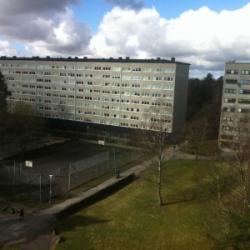
The locale can be subdivided further yet:
Of those born in Hjallbo, a district of Angered, three-quarters have a foreign background. This compared with a half two decades ago and just 6.5 per cent in all of Sweden.
Added to this sense of cultural and social isolation is the suburb’s reputation for criminality and violence. Nawol and Hamdi, two Somali teenagers in hijabs, voice their concerns about living in a neighbourhood that has long been characterised as a ghetto. “I don’t like living in Angered. A lot of people do bad things,” said Nawol, 19. Hamdi added: “There are a lot of gangsters.”
There is a Swedish election on Sunday, and to counter the Sweden Democrats many of the other Swedish parties are moving to the right on immigration, the median voter theorem in slow motion, so to speak.
Exactly what kind of institutional failure is this? Political? Intellectual? Democratic? The absence of real democracy? I should stress that I am happy to live near Somali and Yemeni women in hijab (and not) in northern Virginia, and I believe American assimilation continues to work reasonably well, including for Muslims and in fact especially for Muslims overall. But the formula seems to work less well in Sweden, with its tighter social structures and more generous welfare benefits. What exactly went wrong? What is the final equilibrium? Will anyone ever be able to say again “if only they had a Nordic-style social welfare state”?
Indonesia fact of the day
Even though Indonesia boasts the largest Muslim population of any nation, it witnessed, in marked contrast to Egypt, a steady growth in the size of the Christian community in the course of the twentieth century. The Roman Catholic community grew from only 26,000 in 1900 to 500,000 in 1940, and to 6 million in 2003. The number of indigenous Protestants rose from 285,000 in 1900 to 1.7 million in 1940, and to perhaps 16 million in 2003. What is more, it is estimated that 1 million of the new Christians converted in the course of the century were of a Muslim rather than a traditional religious background.
That is all from the new and interesting Brian Stanley, Christianity in the Twentieth Century: A World History, published by Princeton University Press.
Wednesday assorted links
2. Kipling’s “If” is the favorite poem of Serena Williams.
3. International Journal for Re-Views in Empirical Economics.
4. Those new service sector jobs: Seoul to check public toilets daily for hidden cameras.
Don’t blame the fake news, it’s the truth that is the problem
That is the topic of my latest Bloomberg column, here is one bit:
The world of the internet – fundamentally a world of information – is reporting on the failures of the elites 24/7. And while pretty much every opinion is available, some have more resonance than others. Is it not the case that, post-2008, most people really are skeptical of the ability of American elites to prevent the next financial crisis? Going even further back, I recall the optimism surrounding the Mideast peace talks of the 1970s or the Oslo accords of the 1990s. Hardly anyone honest has the same positive feelings about today’s efforts at peace talks.
Again, these impressions are based on actual information. An informed populace, however, can also be a cynical populace, and a cynical populace is willing to tolerate or maybe even support cynical leaders. The world might be better off with more of that naïve “moonshot” optimism of the 1960s.
…Instead of today’s swamp of negativism, do you not instead long for a few rousing hymns, a teary rom-com happy ending, a non-ironic exhibit of wonderful American landscape paintings? Yet all these cultural forms are largely on the wane. It’s no accident that the hugely successful romantic comedy “Crazy Rich Asians” is set in Singapore.
Homer > Socrates!
Weight stigma and race: an empirical application of intersectionality
America’s obsession with obesity has spawned increasing amounts of research examining how body size shapes social outcomes. Generally, body size negatively correlates with these outcomes, with larger people suffering lower self-esteem, marriage rates, and wages. However, these outcomes are unevenly distributed among racial groups, as black people counterintuitively seem robust to many of the ravages of weight discrimination. Understanding why black people do not suffer a “double burden” where weight is concerned has baffled social scientists using basic models of intersectionality to explain outcomes. The author attempts to deepen understanding of intersectionality and the structure of race in the United States by examining the combined effect of body size and skin tone or color on individual income for black Americans. The author finds that light-skinned black Americans suffer an obesity income penalty similar to white Americans, whereas medium- and dark-skinned black Americans seem to suffer no obesity income penalty.
That is by Robert L. Reece, via the excellent Kevin Lewis.
The Economic Effects of Social Networks: Evidence from the Housing Market
That is by Michael Bailey, Ruiqing Cao, Theresa Kuchler, and Johannes Stroebel¶, there is a demonstration effect in consumption, namely you are more likely to buy a house if your friends did well buying homes. Here is from the working paper version:
We show how data from online social networking services can help researchers better understand the effects of social interactions on economic decision making. We use anonymized data from Facebook, the world’s largest online social network, to first explore heterogeneity in the structure of individuals’ social networks. We then exploit the rich variation in the data to analyze the effects of social interactions on housing market investments. To do this, we combine the social network information with housing transaction data. Variation in the geographic dispersion of social networks, combined with time-varying regional house price changes, induces heterogeneity in the house price experiences of different individuals’ friends. We show that individuals whose geographically distant friends experienced larger recent house price increases are more likely to transition from renting to owning. They also buy larger houses and pay more for a given house. Similarly, when homeowners’ friends experience less positive house price changes, these homeowners are more likely to become renters, and more likely to sell their property at a lower price. We find that these relationships are driven by the effects of social interactions on individuals’ housing market expectations. Survey data show that individuals whose geographically distant friends experienced larger recent house price increases consider local property a more attractive investment, with bigger effects for individuals who regularly discuss such investments with their friends.
Tuesday assorted links
1. Another null hypothesis confirmed.
2. Sending a tiny spacecraft to Mars.
3. How Addis Ababa came to look like a Chinese city (somewhat misleading, but still has interesting information and pictures).
4. Robin Hanson on discrimination and transparency.