Wednesday assorted links
1. What should you infer from the cheapness of Costco Single Malt Scotch Whiskey?
3. “The Swiss town of Albinen, located in the scenic canton of Valais, wants to pay people 25,000 Swiss francs (£18,900) each to move there.” Link here.
4. Rebecca Traister and Ross Douthat on the post-Weinstein moment, many of the best parts are toward the end don’t neglect to catch Ross on Andrea Dworkin.
5. Websites that record all of your keystrokes. The list includes some famous companies.
6. How scalable are blockchains?
7. Geoffrey Manne has a very good WSJ-gated piece on why the AT&T antitrust lawsuit is not a good idea. Here is a good Puzzanghera and James piece on the case.
Game of Theories: Real Business Cycle Theory
Here’s the third chapter of our mini-series on business cycle theories: The Real Business Cycle.
There is no great lung stagnation
In 2013, the Post-Polio Health International (PPHI) organizations estimated that there were six to eight iron lung users in the United States. Now, PPHI executive director Brian Tiburzi says he doesn’t know anyone alive still using the negative-pressure ventilators. This fall, I met three polio survivors who depend on iron lungs. They are among the last few, possibly the last three.”
…In the 1940s and 1950s, hospitals across the country were filled with rows of iron lungs that kept victims alive. Lillard recalls being in rooms packed with metal tubes—especially when there were storms and all the men, women, adults, and children would be moved to the same room so nurses could manually operate the iron lungs if the power went out. “The period of time that it took the nurse to get out of the chair, it seemed like forever because you weren’t breathing,” Lillard said. “You just laid there and you could feel your heart beating and it was just terrifying. The only noise that you can make when you can’t breathe is clicking your tongue. And that whole dark room just sounded like a big room full of chickens just cluck-cluck-clucking. All the nurses were saying, ‘Just a second, you’ll be breathing in just a second.’”
…Mia Farrow only had to spend eight months in an iron lung when she was nine, before going on to become a famous actress and polio advocate.
Here is the full story, via the excellent Samir Varma.
What I’ve been reading
1. John Wyndham, The Day of the Triffids. A remarkably readable and indeed prescient British work from 1951, you’ll find so much of the science and speculative fiction of the last few twenty years in here, a bit of Saramago too. What if most (but not all) of the world goes blind but then has to fight-off plant-like invaders which turn out to be more intelligent than we had thought? Underrated.
2. The Acts of the Lateran Synod of 649, translated with notes by Richard Price. I hadn’t realized how many of these early Church debates were kept and passed down to the current day. The participants really do seem to know they are debating the intellectual framework for everything else to follow, and yet people hardly talk about these books. They are among the most significant remaining traces of the ancient world, Rome and Constantinople in particular. How can you beat this?: “If anyone says that God the Word who worked miracles was someone other than the Christ who suffered, or says that God the Word was with the Christ born from Woman, or was in him as in someone other than himself…let him be anathema.” Down with monoenergism!
3. Helen Dale, Kingdom of the Wicked. Here is Helen on her book:
Kingdom of the Wicked asks what would have happened had Jesus emerged in a Roman Empire that has gone through an industrial revolution. How, I wondered, would we react to him if he turned up in a society more (or less) like the present? The answer was not one I liked much. I thought we’d mistake him for a terrorist. The novel is informed – even overshadowed – by the destruction of civil liberties and gross expansion of executive power occasioned by the War on Terror, a war now in the process of becoming war without end.
I find it works both as fiction and as thought experiment; see the related essay by Mark Koyama.
4. Alexander Thurston, Boko Haram: The History of an African Jihadist Movement. Makes a murky history relatively easy to follow, by the way: “Put all these ideas together, and “Boko Haram” means something like “Western culture is forbidden by Islam” or “the Westernized elites and their ways of doing things contradict Islam” — not just in schools but also in politics and society.”
Beyond Austerity: Reforming the Greek Economy, edited by Costas Meghir, Christopher A. Pissarides, Dimitri Vayanos, and Nikolaus Vettas, is an intelligent and useful look at where Greece goes next.
The end of net neutrality isn’t the end of the world
That is the title and topic of my latest Bloomberg column.
Tuesday assorted links
1. Self-driving cars will be better for wheelchairs.
2. “U.S. House of Representatives Financial Services Committee considered many important banking reforms in 2009-2010 including the Dodd-Frank Act. We show that during this period, the foreclosure starts on delinquent mortgages were delayed in the districts of committee members even though there was no difference in delinquency rates between committee and non-committee districts.” Link here.
3. Reexamining the economics of NFL draft picks.
4. Bershidsky on Merkel and Germany.
5. Is George Orwell overrated? I claimed this to Cardiff Garcia just yesterday, at least relative to Huxley.
6. What is up with Northern Ireland? (NYT) A good and important piece.
What should I ask Ross Douthat?
I will be having a Conversation with him December 4th, by the way, you can register here. His forthcoming book is spectacular, but we will talk about everything under (and above) the sun, what should I ask him?
Off Label Prescribing as Good as On Label
Once a drug has been approved for some use it may be legally prescribed for any use. New uses for old drugs are discovered quite often so off-label uses can be very different from FDA approved uses. Mitomycin, for example, was approved to treat stomach and pancreatic cancer but is used off-label in laser-eye surgery. Drugs prescribed off-label have not been through FDA-approved efficacy trials for the off-label use. In Assessing the FDA via the Anomaly of Off-Label Drug Prescribing I pointed out that off-label prescribing, therefore, gives us a window onto a world with much less FDA regulation.
Since off-label prescribing is common and in rapidly progressing areas of medicine often the gold-standard, I argued that the behavior of physicians validated off-label prescribing and demonstrated that physicians were willing and able to draw upon non-FDA sources of information to make rational prescribing decisions. Dan Klein and I also showed that physicians are supportive of off-label prescribing saying, for example, that it would be “crazy” to require FDA approval for off-label uses.
The support of physicians for off-label prescribing is telling but not dispositive. Perhaps physicians make hubristic mistakes in prescribing off-label. A new paper by Ladanie et al. (including John Ioannidis) provides important information. The authors search the literature for all the RCTs when an off-label drug was pitted against an on-label drug. They conclude:
Our meta-epidemiological analysis of 25 different treatment indications for off-label drug use provides no empirical evidence supporting any assumption of generally inferior treatment
effects associated with off-label use. On the contrary, the summary effect estimates across all indications would even be compatible with more favorable effects, on average, of the off-label
treatment. However, the heterogeneity is substantial and the on-label comparators are not necessarily the best approved treatment option in all 25 topics. While some off-label
treatments are clearly better, others are clearly not.
The finding is especially impressive because although off-label treatments are sometimes the gold standard they are also often used when standard treatments have failed. Thus, in an RCT, off-label treatments could be worse on average and yet still provide a very useful weapon in the medical armory.
One might argue that if off-label treatments are as good as FDA-approved treatments then the FDA should have higher standards. FDA required clinical trials, however, already cost hundreds of millions of dollars and years of effort, creating drug lag and drug loss. Rather than condemning the FDA, what these results indicate is that the medical system–physicians, hospitals, insurers, scientists–does a good job at evaluating new uses for old drugs. As Dan Klein and I noted in our precis on off-label prescribing:
The off-label experience testifies to the fact that much knowledge about efficacy and safety is produced outside the FDA regulatory apparatus. The Pharmacopoeia’s recognition of off-label
indications years ahead of the FDA demonstrates that physicians and scientists have certified thousands of drug indications quite independently of the FDA, even when those indications are not
very closely related to the original indications. In addition to the Pharmacopoeia, there are several other forms of professional certification, including the American Hospital Formulary Service Drug Information, HMO formularies, and a wide array of specialist professional periodicals and information services. NIH studies, clinical results and determinations from other countries, and other professional, science-based judgments are examples of nongovernmental, non-mandatory certification.
Hat tip: Michelle Dawson.
Books that had hidden influence on me
Way back when, I considered the ten books that influenced me most, a list I still stand by. In response, someone asked me to name the books that influenced me, but whose influence I probably was not aware of. Let’s ignore the semi-contradiction in that request and plow straight ahead! Here goes, noting that if memory serves I read most of these between the ages of 10 to 12:
1. Alexander Kotov, Think Like a Grandmaster. From this book I realized you could think you understood a chess position, but then later learn you didn’t really understand it at all. A huge lesson, one I learned again and to a higher degree when high-quality chess computers came along. Most of the commentariat on economic and social affairs could use a reminder on this one. This book also taught me that you learn by doing — trying to solve actual problems — not so much from pure reading. Or the two in close conjunction. It may be the distortions of memory, but still I feel this is one of the best books I ever have read. Hail the Soviet training system!
2. Bobby Fischer, My Sixty Memorable Games of Chess. Reflects a certain kind of classicism in thinking and method. Later, it was revealed much of the analysis was faulty and in part was from Larry Evans and not Fischer himself.
3. Reuben Fine, Basic Chess Endings. I wasn’t influenced so much by this book itself as by a long series of articles in Chess Life and Review, showing the analysis was full of holes. See my remarks on Kotov.
4. David Kahn, The Code-Breakers, The Story of Secret Writing. I read this one quite young, and learned that problems are to be solved! I also developed some sense of what a history could look like and what a history should report. I recall my uncle thinking it deeply strange that a boy my age should be reading a book of such length.
5. Rudolf McShane and Jakow Trachtenberg, The Trachtenberg System of Basic Mathematics. From this I learned how powerful the individual human mind could be, and also how much school wasn’t teaching me. It began to occur to me that the mainstream doesn’t necessarily have the best or only methods. That said, non-mainstream approaches still have the responsibility of coming up with the right answer. Query: does it these days ever make sense to actually use this stuff?
6. The Baseball Encyclopedia, or something like that. From this book I began to figure out statistics and how they fit into broader patterns of historical explanation. I spent a lot of time with this one even before the age of ten. It helped me understand my baseball cards in terms of a much longer perspective and also, if I recall correctly, it explained the underlying meaning of many of the statistics, albeit in what would today count as a very naive, non-Moneyball manner. I still know that Chief Wilson hit 36 triples in 1912.
Honorable mentions: Jonathan Livingston Seagull, Zen and the Art of Motorcycle Maintenance, and The Joy of Sex, all given to me by my mother. I believe they helped inculcate some of the 1960s-70s ethos of individual freedom into my thinking. I also consumed numerous sports memoirs, such as Jerry Kramer’s Instant Replay: The Green Bay Diary of Jerry Kramer and also the war memoir Guadalcanal Diary. From those I began to think about the relationships between character, work habits, teamwork, and success. The Making of Star Trek helped me master the details of what was then my favorite TV series, and also to think about cosmopolitanism across different kinds of intelligent beings. In addition to chess I also was influenced by playing paper and dice war games, most of all Barbossa (the exact title may differ slightly), a really scary game where you have to consider the possibility the Nazis could have won and thus think about the contingency of history. I began to understand that violence could be a reality that stood above all else and how important it was to avoid such a scenario.
Then there is youthful science fiction, though perhaps that someday gets a post of its own. I read a lot of books about music too, many about jazz solos and chord composition, including in American popular music. Much earlier, maybe ages 5-8, it was maps and books full of facts about the world (ahem) and animals, most of all the taxonomic arrangement of the animal kingdom.
Finally, at the time I was fully aware that I wasn’t getting a single one of these titles through my formal school system.
Monday assorted links
1. America is still a suburban nation.
2. “Evidence from applying this framework to these data indicates that between and 45 and 75 percent of the
burden of corporate taxes is borne by labor with the balance borne by capital.” That estimate seems high to me, but this paper is a serious effort.
3. Germany bans children’s smart watches.
4. “One of the friends who helped her through that period was Ivanka Trump, though their relationship has grown more complicated.” This article is really quite something. NYT, you have to keep on reading to grasp the narrative.
5. 100 cryptocurrencies in four words or less. You can play this game in your car with the children.
6. Most popular names for girls, state-by-state, year-by-year What is it with Nebraska and “Addison”?
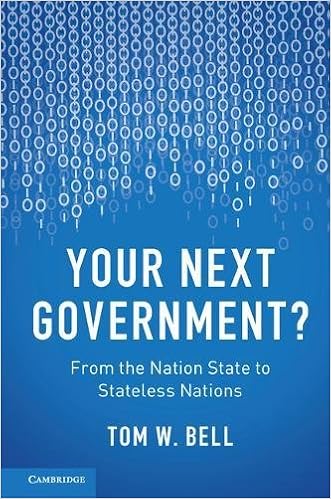
Your Next Government
 Google is building a small city within Toronto:
Toronto has about 800 acres of waterfront property awaiting redevelopment, a huge and prime stretch of land that amounts to one of the best opportunities in North America to rethink at scale how housing, streets and infrastructure are built. On Tuesday the government and the group overseeing the land announced that they were partnering with an Alphabet subsidiary, Sidewalk Labs, to develop the site.
Not to be outdone, Bill Gates is thinking even bigger, a 25,000 acre site for a new city near Phoenix that might take advantage of Arizona’s forward thinking rules on self-driving cars.
All over the world, we can see the beginnings of a move from nation-states to smaller, more decentralized and agile communities such as common interest developments, special economic zones and proprietary cities. Your Next Govenment is Tom W. Bell’s primer on this coming revolution. If you want to find out the latest on the Honduran Zede or the Polynesian seasteading project, both of which Bell has been involved with, YNG is your first stop. Bell also covers the history of these movements from Henry Ford’s failed Brazilian city, Fordlandia, to the use of special economic zones and foreign trade zones in the United States.
For anyone starting such a community, Bell has up-to-date recommendations on the principles of governance including how to adopt an appropriate legal code.
Recommended.
The show so far, a continuing series
1. The situation with North Korea has moved to one of open confrontation. That said, there are stronger commercial sanctions on North Korea than before, and the attitude of the Chinese does seem to have shifted toward recognizing North Korea as a problem needing to be solved. For the time being, both the missile tests and the jawboning have stopped, for unknown reasons. Note that the South Korean and Japanese markets remain high, of course the U.S. market is strong too.
2. Trump has spent a great deal of time with Prime Minister Abe, the real “pivot toward Asia.” Abe is being treated like the most important leader of the free world — is that crazy? Merkel is now teetering.
3. The Trump administration has recognized and encouraged a much more explicit semi-military alliance between America and India, also part of the pivot. China-India relations could be the world’s number one issue moving forward.
4. The apparent “green light” from the Trump administration probably raised the likelihood and extremity of the Saudi purge/coup. I give this a 20% chance of working out well, though with a big upside if it does. Whether you like it or not, so far it appears to me this is Trump’s most important initiative.
Just to interject, much of your assessment of the Trump administration should depend on #1-4, and I am worried that is hardly ever the case for those I see around me. While I do not view the current administration as “good executors” on foreign policy, the remaining variance on #1-4 is still very high and it is not all on the down side.
5. The Trump administration seems to think that keeping production clusters within this nation’s borders is of higher value than shaping the next generation of the world’s trade architecture. I don’t think they will get much in return for this supposed trade-off, but there you go.
6. I am seeing deeply biased assessments of tax reform, from both sides. I don’t favor raising the deficit by $1.5 trillion (or possibly more), I do favor cutting corporate rates and targeting some of the most egregious deductions. I am disappointed that there is not more celebration of the very good features of the plan on the table, that said big changes in the proposed legislation still are needed.
7. In terms of regulatory reform (WSJ), the administration has done better than my most optimistic scenario. In their worst area, carbon, progress on solar and electric cars is bigger good news than the bad policy news. And for all practical purposes, the carbon policy of Trump is not much different from that of say Angela Merkel.
8. The suburbs are rebelling against the Republican Party. There is a decent chance the Republicans will lose the House in 2018, as well as numerous governorships. Soon we may get a window of a very different Trump, plus more investigations.
9. Various people connected to Trump will be nabbed for crimes and perjuries.
10. Trump has personally “gone after” many political and social norms, but it is not yet clear if they will end up weaker or stronger as a result. His “grab them…” tape for instance seems, in the final analysis, to have empowered a major rebellion in the opposite direction. #10 is a major reason why many commentators hate Trump as a person and president, and I can understand that response, but I am myself more focused on what the final outcomes will be and there we do not know.
11. The cultural and intellectual force of liberalism — broadly defined — has been greatly weakened by a mix of Trump and Trump-related forces. I find this tragic and a major source of despair.
12. I do not favor “a decline in the dignity of the presidency” in the manner we are seeing, but I find many of these criticisms are stand-ins for not liking the substance of what is happening. I don’t think we know what are the costs (or benefits) are from this transformation of the presidential image. I could readily imagine those costs are high, but as a sociological matter I am seeing “the dignity of the office of the president has been insulted” as a stand-in for “my dignity has been insulted.”
13. The quality of discourse continues to decline.
Sunday assorted links
1. On-line dating in China (NYT).
2. In economics, time demands are endogenous.
4. TLS books of the year, always one of the best lists.
5. Claims about hypersonic weapons, speculative. And micro assassination drones. The State of the Union.
6. David Brooks on the siege mentality (NYT). And Ross Douthat on Kenneth Starr (NYT). They’re both right.
Thrasher and Gaus on the Calculus of Consent
Writing for the The Oxford Handbook of Classics in Contemporary Political Theory, political philosophers John Thrasher and Gerald Gaus review Buchanan and Tullock’s The Calculus of Consent:
Calculus advances new methods in an attempt to solve an old problem: the problem of
democratic justification. While democracy claims to be the “rule of the people” in any
actual democratic system we actually find the rule of some people over others. More
formally, the winning coalition in any election is able to impose its authority on the losers.
This is true however large the majority happens to be, and however small the minority is,
unless the vote is unanimous; and even then, there may be an excluded minority of those
who did not or could not vote. Yet at the heart of the democratic ideal is the principle that
all are inherently free and equal, with no natural authority to rule over one another. How
odd then to start from freedom and equality and end with majority coalitions imposing
their policies on minorities merely because they have the numbers to do so. Once we see
this oddity we are confronted with the question: how could the authority of democratic
assemblies over free and equal persons be justified? This is the problem of democratic
justification, a problem that animates Calculus.…A feature of Calculus typically missed is its optimism. Public choice theory is commonly
characterized as anti-democratic, or as undermining faith in the democratic process
(Barry 1989; Christiano 1996, 2004). Rightly understood though, Calculus is an almost
giddy endorsement of democracy (of a specific form) in the face of what looked like dire
prospects for democratic theory.
How to fix racial bias in policing
We estimate the degree to which individual police officers practice racial discrimination. Traffic police regularly discount the charged speed on drivers’ tickets to avoid a discrete jump in the fine schedule. This behavior leads to an excess mass in the distribution of charged speeds just below the jump. Using a bunching estimation design and data from the Florida Highway Patrol, we show that minorities are less likely to receive this break than white drivers. We disaggregate to the individual police officer level and find significant heterogeneity across officers in their degree of discrimination, with 40% of officers explaining the entirety of the aggregate discrimination. Our measure of discrimination is easy to calculate and can be used by police departments as part of an early warning system. Using a simple personnel policy that reassigns officers across locations based on their lenience, departments can effectively reduce the aggregate disparity in treatment.
While 40% is a high number, overall I find that reassuring. That is from the job market paper of Felipe Goncalves, of Princeton University.