Chongqing travel notes
1. Especially outside the immediate center of town, it feels as if something wacky is always happening. Someone is screaming, backslapping, bumping fists, or screaming while backslapping and bumping fists. Interactions appear to be random, highly intense, and short in duration. The following interaction is more intense yet. It reminds me of that old Humphrey Bogart movie “Beat the Devil.”
2. Every cabbie seems to know a random person standing on a street corner, who somehow mysteriously signals to that cab to be picked up, even if said cab already is delivering a Western passenger to some other location. Shouting ensues, the random person is moved along in the cab only a short distance, always along the Westerner’s route, and then the person is let off again. With a shout. Rinse and repeat.
3. It is a better city for street food and stall food than is Chengdu. The tastes are stronger and spicier, though I believe the peaks of Chengdu are higher and more subtle.
4. Don’t just stick to “the peninsula,” also travel to the alternate sides of the city’s two rivers, the Jialing and the Yangtze.
5. Haagen-Dazs is much more popular in China than in the United States, at least at the retail level.
6. “Sun Zhengcai, the former Communist Party chief of the Chinese city of Chongqing, is under investigation by authorities, the Wall Street Journal reported Saturday, citing people it didn’t identify.” He had been considered a possible successor to Uncle Xi.
7. On my flight from Kunming to Chongqing, I witnessed my first “facial surveillance” arrest. Just as they were about to let us off the plane, two policemen appeared at the entrance, with a copy of a facial surveillance photograph. (Before you board any plane in China, they photograph your face plenty, and match it to various databases.) They walked down the aisle, turning left and right, looking for the passenger who matched the photo. They found him and escorted him off the plane, with the crowd watching nervously. He showed neither surprise nor did he protest his innocence.
8. An excellent room in a five-star luxury Chongqing hotel, with view and upgrade to a larger suite, costs $70 a night.
9. Nearby is “the world’s longest cantilevered glass skywalk.”
The city’s “mind-blowing overpass has five layers, 20 ramps and eight directions,” good photos at that link.

Here is Wikipedia on Chongqing, by one measure it is China’s most populous metropolitan area. “Its population is already bigger than that of Peru or Iraq, with half a million more arriving every year in search of a better life,” and that was written eleven years ago.
Edna O’Brien sentences to ponder
“A male artist in the room is — for women and men — cultural Viagra,” she says. “As for a woman, there may be one or two who are glad you are there but you don’t make the same impact.” None of this is said with bitterness. If anything, she values being left alone to concentrate on her writing. “For all my affability, I am also cold.”
That is from her Lunch with the FT, by Janan Ganesh, interesting throughout.
Saturday assorted links
1. The economic impact of China’s anti-corruption campaign.
2. You can play this musical instrument with just your thoughts.
3. Why we didn’t kill Kim Jong Un.
4. Are max and rookie contracts the most efficient NBA deals? Less winner’s curse.
5. Now a Yunnanese nooodle restaurant in the East Village (NYT).
What does the puffin tell us about the Atlantic?
The widths of the Pacific continued unaltered for millions of years. Temperatures scarcely dropped there in the Ice Ages. Generation after generation of Pacific birds were able to evolve in an almost completely stable world. Birds which somehow or other had arrived on remote islands branched into different species. In the Atlantic, there was hardly time to do that between the Ice Ages…in the Atlantic endemics — species confined to particular places — only rarely evolved.
What you see when the puffins arrive in the spring is a product of this history. The Atlantic, for the past 2.74 million years has been a place of coming and going, unsettled at the deepest of levels, a system always ready to flip from relatively beneficent to deeply unaccommodating. Life does not have the time here to develop the mass of differentiated variety it has within the security of the Pacific.
…The result is that now in the North Atlantic there is relatively little local variation. Species have evolved to cope with the variability and have wide ranges across the latitudes. The Pacific is a mosaic of local land-based varieties; the Atlantic the exclusive realm of the ocean travellers, birds which have distance embedded in their way of being.
That is from the new and excellent The Seabird’s Cry: The Lives and Loves of Puffins, Gannets and Other Ocean Voyagers, by Adam Nicholson. Whether it is covering the sex lives of guillemots or how gannets abuse their children, this book is first-rate.
The puffin chapter closes with this:
Next time you sit among the puffins on a summer evening, looking at their elegance and anxiety, that is what to hold in mind: not clowns but beauties, Ice Age survivors, scholar-gypsies of the Atlantic, their minds on an everlasting swing between island and sea, burrow and voyage, parent and child, the oscillating nomad masters of an unpacific ocean.
By the way, that is a UK Amazon link above, so they had to ship my copy across the Atlantic.
Arrived in my pile and pawed on my sofa
And what a pile it is, after a while in China. I l have started pawing through:
Francis Spufford, True Stories & Other Essays. I have browsed this only selectively, but the essay on C.S. Lewis and the dangers of apologetics is superb. He quotes Lewis:
…nothing is more dangerous to one’s own faith than the work of an apologist. No doctrine of the Faith seems to me as spectral, so unreal as the one that I have just described in a public debate. For a moment, you see it, it has seemed to rest on oneself; as a result, when you go away from that debate, it seems no stronger than that weak pillar…
I also can recommend Spufford’s essay on what science fiction call tell us about God, and on Francis Bacon and the idolatry of the market. I look forward to the rest.
Fall Down 7 Times Get Up 8: A Young Man’s Voice from the Silence of Autism, by Naoki Higashida, is a good autism memoir from Japan.
Scott E. Page, The Diversity Bonus: How Great Teams Pay Off in the Knowledge Economy.
Peter Brannen, The Ends of the World: Volcanic Apocalypses, Lethal Oceans, and Our Quest to Understand Earth’s Past Mass Extinctions.
Friday assorted links
1. Is there such a thing as “the Dirtbag Left”?
2. Is China making the right trade-offs between short- and long-term growth? Was French Revolution land redistribution good for ag productivity? Or is it too soon to tell?
3. Pseudoerasmus on how you get to Denmark.
4. J.M. Coetzee wrote early poetry in 1965 computer code.
5. Claims about grid batteries.
6. Julia Galef on YIMBY vs. NIMBY.
7. Michael Cannon is not enthusiastic about the Cruz amendment.
They can watch your heart now, too
An Ohio judge has ruled that data from a pacemaker can be used in court.
Defendant Ross Compton, who faces aggravated arson charges, claims he was woken by a fire at home, packed a case, broke a window and threw out the bag.
A cardiologist told police his explanation was “highly improbable” based on his heart rate and cardiac rhythms at the time.
Mr Compton’s lawyer said allowing pacemaker evidence expanded government snooping into private data.
Here is the full story, and here is an appalling add-on:
According to local paper Journal News, Judge Charles Pater said: “There is a lot of other information about things that may characterise the inside of my body that I would much prefer to keep private rather than how my heart is beating. It is just not that big of a deal.”
Via Michelle Dawson. And here is an article about retail interference with brain implants.
A short interview with me about writing
It is with Writing Routines, here is the interview, here is one bit:
When you first sit down to write, how do you start?
The keyboard is the most useful part, though I will check my email and maybe Twitter first, so I don’t miss something big.
What’s your process for editing your own work?
I repeatedly edit it many times, at least ten. I just keep on doing it, until I can’t think of further improvements. I can’t say that is a process in any formal sense, simply a recognition that the “process” to date hasn’t worked very well and so it must continue. I don’t pretend this is efficient.
And this:
For better or worse, I just don’t have that many modes.
The hidden inequality of mosquito bites
Now, a team of public health researchers studying neighborhoods in Baltimore has added one more indignity to that list: poorer neighborhoods also have to deal with more serious mosquito infestations.
The researchers, led by Eliza Little of Columbia University, surveyed Asian tiger mosquito populations in five West Baltimore neighborhoods, spanning the gamut from the impoverished (Harlem Park) to the well-heeled (Bolton Hill).
For three years, they surveyed a number of factors known to influence mosquito populations: abandoned buildings, accumulating trash, sources of standing water and surface vegetation among them. They tallied mosquito larvae and pupae where they found them, and put up periodic traps to catch and count adult female mosquitoes (the ones that do the biting).
It turned out, unsurprisingly, that poor neighborhoods have more abandoned buildings and also have more accumulated trash and more standing pools of water, all conducive to mosquitoes.
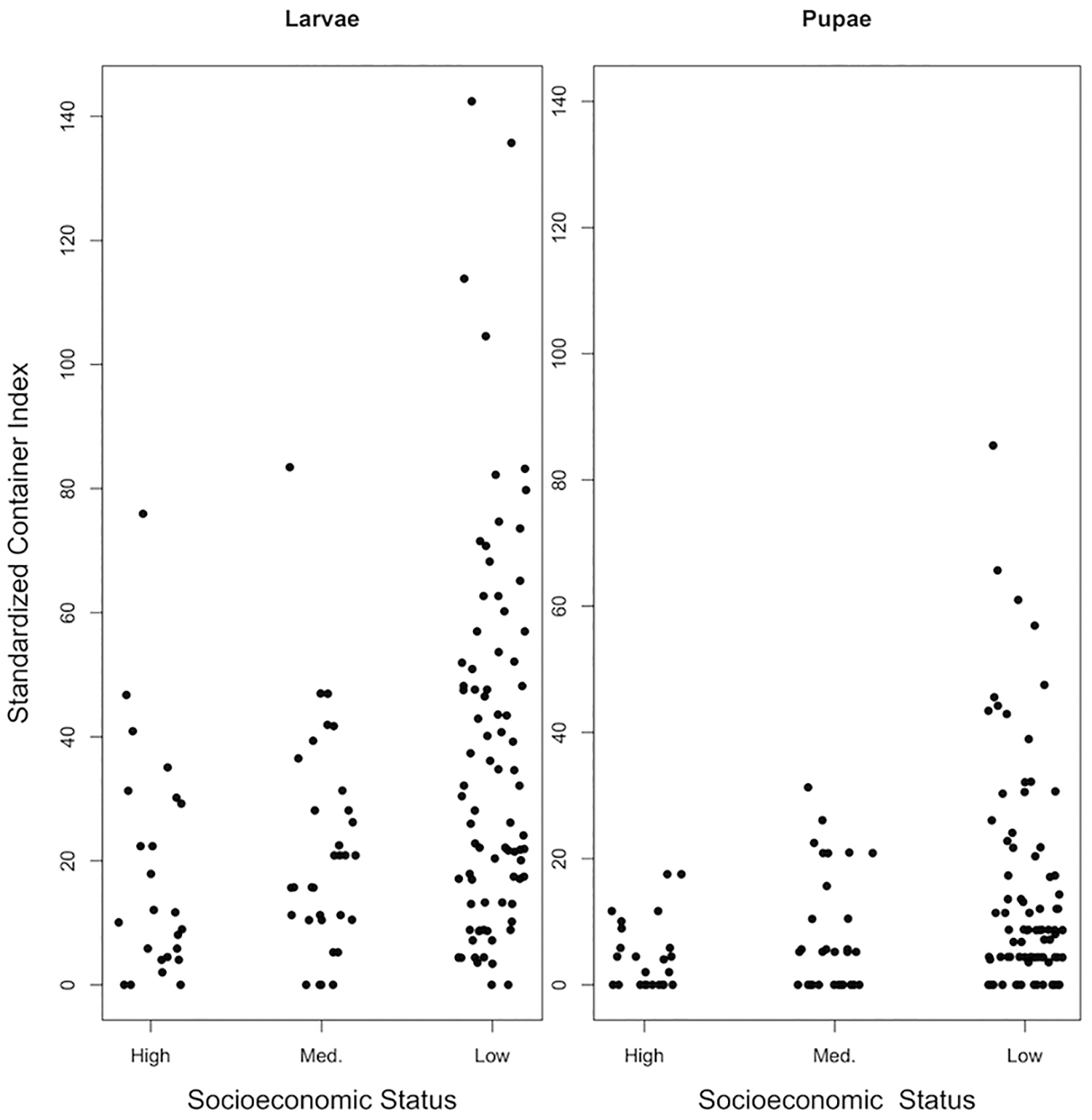
Here is the Wonkblog piece by Christopher Ingraham, here is the paper itself, in the Journal of Medical Entomology.
United States v. Nixon
A quick history lesson for those of you not familiar with that landmark decision:
United States v. Nixon, 418 U.S. 683 (1974), was a landmark United States Supreme Court decision which resulted in a unanimous 8–0 ruling against President Richard Nixon, ordering him to deliver presidential tape recordings and other subpoenaed materials to the District Court. Issued on July 24, 1974, the ruling was important to the late stages of the Watergate scandal, when there was an ongoing impeachment process against Richard Nixon. United States v. Nixon is considered a crucial precedent limiting the power of any U.S. president to claim executive privilege.
Here is the rest of the Wikipedia entry.
Thursday assorted links
2. A new metric of sympathy and affection: “do you listen to me at 1.7x or 1.3x?”
3. Gangnam Style is no longer the most played video.
4. Eels.
5. “The consensus in Iqaluit seems to be that everyone with a credit card has an Amazon Prime membership. That’s because people can often find groceries cheaper online than in local stores, despite government food subsidy programs.
“Amazon Prime has done more toward elevating the standard of living of my family than any territorial or federal program. Full stop. Period,” a local principal, who declined to speak further, said on Facebook.” Link here, however they fear a cut-off.
6. “Economists are 37x more likely to have an economist father than a random dad draw would predict. For med doctors it’s 24x. Plumbers 14x.” From Susan Dynarski.
Not From The Onion: The Stress of Summer Vacation
“We have this mythical belief that everyone will come out of it at the other end OK,” she said. “You don’t end up as a faculty member unless you did survive it. That doesn’t mean that there weren’t people in my generation who got so stressed out that they left. They did leave. We just never talked about them.”
So what is this terrible, stressful problem that not all faculty survive? Summer vacation. No really.
For nine months a year at research universities, instructors and students build communities from a transient group of academics unified by one thing: classes. Professors invest time in students, committees, and teaching; students invest time in their assignments.
…That changes in the summer. The fixed schedule disappears, the community disperses, and the work that has been building up over the school year can loom dangerously close to deadline.
…It’s in that solitude that professors and students say they experience what some call a “summer slump,” a period of isolation that can heighten symptoms of depression or anxiety for those susceptible to such disorders.
To cope with that slump, Ms. Hagen read personal testimonies and learned that the separation she feels is widespread, even normal. But her university never addressed it. “As wonderful as my adviser is, that’s not a conversation that was ever shared,” Ms. Hagen said. “We never talked about what’s important to your mental health.”
I think the conservative critique of higher education is overblown. But with articles like this in the Chronicle of Higher Education it’s no wonder that much of America is angry and dismissive of a coddled intellectual class that is utterly divorced from their own, normal life experiences. (I too am a coddled member of that class but I know how fortunate and privileged I am to have a job in academia.)
The correction only widens the gap:
Corrections (6/16/2017, 10:43 a.m.): A previous version of this article mistakenly referred to Dafina-Lazarus Stewart as “she.” Mx. Stewart uses the pronouns ze, zim, and zir.
The Golden Age of Conservative Intellectuals
When was the Golden Age of Conservative Intellectuals? It is easy to say when the Golden Age began; April 1947 at the first meeting of the Mont Pelerin society. Among those in attendance were:
- Maurice Allais, Paris
- Aaron Director, Chicago
- Walter Eucken, Freiburg
- Milton Friedman, Chicago
- F. A. Harper, Irvington-on-Hudson, New York
- F. A. Hayek, London
- Henry Hazlitt, New York
- Bertrand de Jouvenel, Chexbres, Vaud
- F. H. Knight, Chicago
- Fritz Machlup, Buffalo
- Ludwig von Mises, New York
- Felix Morley, Washington, D.C.
- Michael Polanyi, Manchester]
- Karl R. Popper, London
- William E. Rappard, Geneva
- Leonard E. Read, Irvington-on-Hudson, New York
- Lionel Robbins, London
- Wilhelm Ropke, Geneva
- George J. Stigler, Providence, Rhode Island
- C. V. Wedgwood, London
(Full list here). It’s more difficult to say when the Golden Age ended. If I had to pick a date I’d say at a moment of triumph, November 9, 1989.
Is Dali, Yunnan the very best place in the world to visit right now?
It has just that right mix of exotic and comfort, and is mostly unfrequented by Western tourists. You can spend a day in the center of town and not see ten of them. Here are a few points:
1. Except for the rainy season, the weather is perfect pretty much every day, all year round. Unlike much of China, there is virtually no air pollution.
2. The town is set on a gorgeous lake, backed by lovely green mountains. Dali has about one million people, and so it feels very manageable. Yet it offers virtually every amenity and convenience.

3. Driving to the local villages around the lake is highly worthwhile. Track down the local ceremonies and rituals.
4. The town and the surrounding region is full of ethnic minority groups, most prominently the Bai. You can eat their food and buy their crafts. There are other minority groups too, including various kinds of Muslims. This is where Han Chinese and southeast Asian and Tibetan influences intersect.
5. The local cuisine features fish soups, cured ham, flowers, lotus root, and mushrooms mushrooms mushrooms. For breakfast, bread is served with honey. You can’t get these dishes anywhere else, not even in other parts of China, and yet none of this food is expensive.
6. You can stay at a luxurious five-star Hilton for $130 a night, or spend less and still do well.
7. The old town has crafts and curios and clothes shopping at very good prices.
8. The level of crime and other mishaps is extremely low.
For a good treatment of all of Yunnan, I recommend Jim Goodman, The Exploration of Yunnan. Here is Wikitravel on Dali.
Malcolm Gladwell at Behavioral Scientist on race and the courts
Here is a new interview with Gladwell, much of it focusing on the Brown vs. Board of Education decision. Here is one excerpt:
I was more than interested to discover how much of the work on these effects—which in education they call “same race effects”—has been done by economists. If I’m a social psychologist, the economists are eating my lunch. They’re doing very persuasive, very elegant studies using these data sets that come out of the education reform movement. The economists are the first to jump on it. I feel like that is rich hunting ground for social psychologists as well, and they can bring a perspective to the analysis of that data that the economist can’t.
I’m not criticizing the work that’s been done by economists, but if you read it, you will notice that there is a beat that’s missing—they’re economists, so they come at it from a different perspective. I would love to see social psychologists go over that same data and interpret it their way. And that again would be something that would be insanely useful to the conversation we have in this country about how to make schools better.
And here is Malcom on his next book:
MG: Yes. I’ve started a new book, and it very explicitly comes out of the world of psychology. There was a paper that Lee Ross wrote 50 years ago, maybe 45 years ago, called “Shortcomings of the Intuitive Psychologist.” It’s a famous paper, and I’m tearing off a little, tiny piece of that argument and having fun with it.
DN: And what piece is that?
MG: I’m interested in how we deal with strangers. How good are our intuitive ideas about dealing with strangers? I haven’t thought it through entirely, but I’m fascinated by what it means to deal with someone who you don’t know and, most importantly, whose credibility you cannot assess easily. Strikes me as a very contemporary problem, and from a psychological perspective, super interesting. There’s just so much fantastic psychology on that question.
The brief discussion on rock and roll vs. country music was interesting as well.
Here is the Behavioral Scientist web site, it looks interesting. Here are their most popular articles.