Results for “age of em” 17236 found
Nigeria fact of the day
In Nigeria debt service, mostly domestic, took up a staggering 96% of government revenues last year.
That is from The Economist, in an article focused on Africa’s resurgent fiscal troubles. Here is a bit more:
Part of the problem is that the government has collected little money from oil recently due to rampant oil theft, low production and the cost of fuel subsidies, which are deducted before oil proceeds reach the treasury. Bola Tinubu, Nigeria’s incoming president, promises to fix the oily mess, but so have many past presidents of his country. Even in better-run places, debt service is chewing up government revenue. In Ivory Coast and Senegal it accounts for about one-quarter of revenue.
And this:
Ideally, economic growth would allow Africa to escape the squeeze. But the outlook is gloomy. In April the imf cut its growth forecast for sub-Saharan Africa in 2023 to 3.6%, only about one percentage point higher than population growth.
I wonder what the de-growthers think of this.
The Student-Loan Payment Pause Led Borrowers to Take on More Debt
In 2020 payments on student loans were paused, initially for 3 months but then extended via executive action until June 30, 2023. This was a big program, at the time there were approximately 45 million student loan borrowers, with an outstanding balance of over $1.7 trillion. The main results of the program were that borrowers used the pause to take on more debt. From a new paper by Dinerstein, Yannelis and Chen:
We evaluate the effects of the 2020 student debt moratorium that paused payments for student loan borrowers. Using administrative credit panel data, we show that the payment pause led to a sharp drop in student loan payments and delinquencies for borrowers subject to the debt moratorium, as well as an increase in credit scores. We find a large stimulus effect, as borrowers substitute increased private debt for paused public debt. Comparing borrowers whose loans were frozen with borrowers whose loans were not frozen due to differences in whether the government owned the loans, we show that borrowers used the new liquidity to increase borrowing on credit cards, mortgages, and auto loans rather than avoid delinquencies. The effects are concentrated among borrowers without prior delinquencies, who saw no change in credit scores, and we see little effects following student loan forgiveness announcements. The results highlight an important complementarity between liquidity and credit, as liquidity increases the demand for credit even as the supply of credit is fixed.
This is good news for debt pauses as stimulus payments but it’s bad news if you think that debt pauses are just the nudge some people need to get their financial house in order. Although the COVID scenario makes generalization somewhat difficult, the story is consistent with borrowers who have difficulty restraining spending regardless of wealth, the so-called wealthy hand to mouth consumers (see here for a now classic example). For this group, a debt pause is just a debt pause.
Ho hum
MMS: Massively Multilingual Speech.
– Can do speech2text and text speech in 1100 languages.
– Can recognize 4000 spoken languages.
– Code and models available under the CC-BY-NC 4.0 license.
– half the word error rate of Whisper.Code+Models: https://t.co/zQ9lWms5TQ
Paper:…— Yann LeCun (@ylecun) May 22, 2023
And trained on The New Testament, I might add, a text which exists in a great number of languages.
How effective was the IAEA?
Here is the Open AI call for international regulation, most of all along the lines of the International Atomic Energy Agency. I am not in general opposed to this approach, but I think it requires very strong bilateral supplements, from the United States of course. Which in turn requires U.S. supremacy in the area, as was the case with nuclear weapons. From a 564 pp. official work on the topic:
For nearly forty years after its birth in 1957 the IAEA remained essentially irrelevant to the nuclear arms race. (p.22)
There is also this:
However, in the late 1950s and early 1960s it was not the failure of the IAEA’s functions as a ‘pool’ or ‘bank’ or supplier of nuclear material that inflicted the most serious blow on the organization, on its safeguards operation and eventually on Cole himself. For a variety of reasons, the Agency’s chief patron, the USA, chose to arrange nuclear supplies bilaterally rather than through the IAEA. One reason was that the IAEA had been unable to develop an effective safeguards system. Another was that in a bilateral arrangement it was the US Administration, under the watchful eyes of Congress, that chose the bilateral partner rather than leaving the choice to an international organization that would have to respond to the needs of any Member State whatever its political system, persuasion or alliance. But the most serious setback came in 1958 when, for overriding political reasons, the USA chose the bilateral route in accepting the safeguards of EURATOM as equivalent to — in other words as an acceptable substitute for — those of the IAEA.
It is frequently suggested that the IAEA has been partially captured by the nuclear sector itself. I do not consider that bad news, but it is a sobering thought for those expecting too much from this approach. Do note that it took years to set up the agency, and furthermore when North Korea wanted to acquire nuclear weapons the country simply left the agency and broke its earlier agreement. Perhaps the greatest gain from this approach is that the non-crazy nations have a systematic multilateral framework to work within, should they decide to defer to the external, bilateral pressure from the United States?
On the other side, my fear is that the international agreement will lead to excess regulation at the domestic level.
There is also this:
The fact that Iraq’s nuclear weapon programme had been under way for several years, perhaps a decade, without being detected by the IAEA, led to sharp criticism of the Agency and posed the most serious threat to the credibility of its safeguards since they had first been applied some 30 years earlier.
All of these issues could use much more intelligent discussion.
Monday assorted links
1. Why do many people find slow motion appealing?
2. Canine markets in everything, Austin edition. And the hotel version (NYT).
3. News stripped of all hype and emotion, by AI. And new tool for co-authoring long form articles with AI.
5. Everleigh? Nova? Good to see that “Tyler” is dropping in popularity. Rising and falling baby names.
6. Why you should visit Ravenna.
7. The Straussian that is Magnus Carlsen (WSJ). Thanos!
Islam and human capital in historical Spain
We use a unique dataset on Muslim domination between 711-1492 and literacy in 1860 for about 7500 municipalities to study the long-run impact of Islam on human-capital in historical Spain. Reduced-form estimates show a large and robust negative relationship between length of Muslim rule and literacy. We argue that, contrary to local arrangements set up by Christians, Islamic institutions discouraged the rise of the merchant class, blocking local forms of self-government and thereby persistently hindering demand for education. Indeed, results show that a longer Muslim domination in Spain is negatively related to the share of merchants, whereas neither later episodes of trade nor differences in jurisdictions and different stages of the Reconquista affect our main results. Consistent with our interpretation, panel estimates show that cities under Muslim rule missed-out on the critical juncture to establish self-government institutions.
That is from a new paper by Francesco Cinnirella, Alieza Naghavi, and Giovanni Prarolo, via a loyal MR reader.
Jonathan Swift/Gulliver/Laputa optimal taxation
I heard a very warm debate between two professors, about the most commodious and effectual ways and means of raising money, without grieving the subject. The first affirmed, “the justest method would be, to lay a certain tax upon vices and folly; and the sum fixed upon every man to be rated, after the fairest manner, by a jury of his neighbours.” The second was of an opinion directly contrary; “to tax those qualities of body and mind, for which men chiefly value themselves; the rate to be more or less, according to the degrees of excelling; the decision whereof should be left entirely to their own breast.” The highest tax was upon men who are the greatest favourites of the other sex, and the assessments, according to the number and nature of the favours they have received; for which, they are allowed to be their own vouchers. Wit, valour, and politeness, were likewise proposed to be largely taxed, and collected in the same manner, by every person’s giving his own word for the quantum of what he possessed. But as to honour, justice, wisdom, and learning, they should not be taxed at all; because they are qualifications of so singular a kind, that no man will either allow them in his neighbour or value them in himself.
The women were proposed to be taxed according to their beauty and skill in dressing, wherein they had the same privilege with the men, to be determined by their own judgment. But constancy, chastity, good sense, and good nature, were not rated, because they would not bear the charge of collecting.
First Pigou taxes on vice, then taxes on inherited rents, and finally no tax on ideas, knowledge, or wisdom. That is from part III, chapter six.
Mississippi Learning
In 2002, Florida adopted a phonics based reading strategy due to Charlie Crist. Scores started to rise. Other southern states started to following suit, including Mississippi long deried as the worst in the nation.
APNews: Mississippi went from being ranked the second-worst state in 2013 for fourth-grade reading to 21st in 2022. Louisiana and Alabama, meanwhile, were among only three states to see modest gains in fourth-grade reading during the pandemic, which saw massive learning setbacks in most other states.
The turnaround in these three states has grabbed the attention of educators nationally, showing rapid progress is possible anywhere, even in areas that have struggled for decades with poverty and dismal literacy rates. The states have passed laws adopting similar reforms that emphasize phonics and early screenings for struggling kids.
“In this region, we have decided to go big,” said Burk, now a senior policy fellow at ExcelinEd, a national advocacy group.
These Deep South states were not the first to pass major literacy laws; in fact, much of Mississippi’s legislation was based on a 2002 law in Florida that saw the Sunshine State achieve some of the country’s highest reading scores. The states also still have far to go to make sure every child can read.
But the country has taken notice of what some have called the Mississippi miracle.

Addendum: See my previous posts on the closely related issue of Direct Instruction.
Population and Welfare: The Greatest Good for the Greatest Number
That is a new paper by Peter J. Klenow, Charles I. Jones, Mark Bils, and Mohamad Adhami, reject its implications at your peril:
Economic growth is typically measured in per capita terms. But social welfare should arguably include the number of people as well as their standard of living. We decompose social welfare growth — measured in consumptionequivalent units — into contributions from rising population and rising per capita consumption. Because of diminishing marginal utility of consumption, population growth is scaled up by a value-of-life factor that substantially exceeds one and empirically averages around 2.7 across countries and over time. Population increases are therefore consistently the dominant contributor, and consumption-equivalent welfare growth around the world averages more than 6% per year since 1960, as opposed to 2% per year for consumption growth. Countries such as Mexico and South Africa rise sharply in the growth rankings once population growth is incorporated, whereas China, Germany and Japan plummet. We show the robustness of these results to incorporating parental time use and fertility decisions using data from the U.S., the Netherlands, Japan, and South Korea. The effects of falling parental utility from having fewer kids are roughly offset by increases in the “quality” of kids associated with rising time investment per child.
If you worry about fertility rates, do you not have to accept something like this framework? Mexico — underrated!
In general, I think people should visit the high population countries more. For the pointer I thank Oliver Wang.
Attack monopoly power with deregulation
One recent study shows just how important regulation is in contributing to monopoly. Since 1970, increased regulation can explain 31% to 37% of the subsequent increase in market power.
Upon reflection, it is obvious that larger firms are better able to deal with regulatory burdens. They have more employees, bigger legal departments and are better suited to deal with governments. Startups are generally leaner and more nimble, but these aren’t necessarily advantages in dealing with Washington or state and local agencies. As regulatory costs rise, the comparative advantage shifts to the larger firms — exacerbating market power problems…
According to researcher Shikhar Singla, regulation costs an average of $9,093 per employee for a typical small firm, compared to $5,246 for a large firm. It is no surprise that, according to the data, smaller firms invest relatively less in more highly regulated areas.
Based on a study of regulatory comments, Singla also found that large firms oppose regulation in general, but push for regulation when such rules and laws damage the interests of smaller firms. Singla also finds that regulatory costs have increased significantly since the late 1990s.
Here is the full Bloomberg column.
Yes, automated tipping is out of control
Consumers already contending with a squeeze on their bank accounts due to inflation are now facing more pressure as businesses introduce new tipping features at self-checkout machines.
Companies, including airports, bakeries, coffee shops and sports stadiums, have now introduced the self-serve tipping option, where customers can leave tips including the typical 20%, despite facing minimal to no interaction with any employee, according to a recent report by The Wall Street Journal…
William Michael Lynn, a consumer behavior and tip culture professor at Cornell University’s Nolan School of Hotel Administration, told the newspaper that businesses “are taking advantage of an opportunity,” and “who wouldn’t want to get extra money at very little cost if you could?”
Here is the story, here is my earlier Bloomberg column on tipping. Just hand cash directly to individual humans who have helped you! Via Anecdotal.
Claims about atheists
The group that is most likely to contact a public official? Atheists.
The group that puts up political signs at the highest rates? Atheists.
HALF of atheists report giving to a candidate or campaign in the 2020 presidential election cycle.
And while they don’t lead the pack when it comes to attending a local political meeting, they only trail Hindus by four percentage points.
…atheists take part in plenty of political actions – 1.52 to be exact. The overall average in the entire sample was .91 activities. The average atheist is about 65% more politically engaged than the average American.
And this:
The results here are clear and unambiguous – atheists are more likely to engage in political activities at every level of education compared to Protestants, Catholics or Jews. For instance, an atheist with a high school diploma reports .7 activities, that’s at least .2 higher than any other religious group.
Political engagement is clearly related to education, though. The more educated one is, the more likely they are to be politically active. But at every step of the education scale, atheists lead the way. Sometimes those gaps are incredibly large. A college educated atheist engages in 1.7 activities, it’s only 1.05 activities for a college educated evangelical.
From Ryan Burge, here is the full data analysis.
My Conversation with Simon Johnson
Here is the audio, video, and transcript. Here is part of the episode description:
What’s more intense than leading the IMF during a financial crisis? For Simon Johnson, it was co-authoring a book with fellow economist (and past guest) Daron Acemoglu. Written in six months, their book Power and Progress: Our Thousand-Year Struggle Over Technology and Prosperity, argues that widespread prosperity is not the natural consequence of technological progress, but instead only happens when there is a conscious effort to bend the direction and gains from technological advances away from the elite.
Tyler and Simon discuss the ideas in the book and on Simon’s earlier work on finance and banking, including at what size a US bank is small enough to fail, the future of deposit insurance, when we’ll see a central bank digital currency, his top proposal for reforming the IMF, how quickly the Industrial Revolution led to widespread prosperity, whether AI will boost wages, how he changed his mind on the Middle Ages, the key difference in outlook between him and Daron, how he thinks institutions affect growth, how to fix northern England’s economic climate, whether the UK should join NAFTA, improving science policy, the Simon Johnson production function, whether MBAs are overrated, the importance of communication, and more.
And here is one excerpt:
COWEN: If institutions are the key to economic growth, as many people have argued — Daron and yourself to varying degrees — why, then, is prospective economic growth so hard to predict?
In 1960, few people thought South Korea would be the big winner. It looked like their institutions were not that good. It was a common view: oh, Philippines, Sri Lanka — then Ceylon — would do quite well. They had English language to some extent. They seemed to have okay education. And those two nations have more or less flopped. South Korea took off. It’s now, per capita income roughly equal to France or Japan. Doesn’t that mean it’s not about institutions? Because institutions are pretty sticky.
JOHNSON: Yes, I think of institutions as being part of the hysteresis effect, if you can get it in a positive way, that if you grow and you strengthen institutions, which South Korea has done, it makes it much harder to relapse. There are plenty of countries that had spurts of growth without strong institutions and found it hard to sustain that.
You make a very good point about the early 1960s, Tyler. There wasn’t that much discussion that I’ve seen about institutions per se, but education — yes, absolutely. Culture — people made the same comparisons. They said, “Confucian culture is no good or won’t lead to growth. That’s a problem, for example, for South Korea.” That turned out to be wrong.
I think institutions are sticky. I think history matters a lot for them. They’re not predestination, though. You could absolutely carve your own way, but the carve-your-own way is harder when you start with institutions that are more problematic, less democratic, more autocratic control, less protection of property rights.
All of these things can go massively wrong, but building better institutions and making them sustainable, like Eastern Europe — the parts of the former Soviet Empire that managed to escape the Soviet influence after 1989, 1991 — I think those countries have worked long and hard, with very mixed results in some places, to build better institutions. And the EU has helped them in that regard, unquestionably.
I enjoyed this session with Simon.
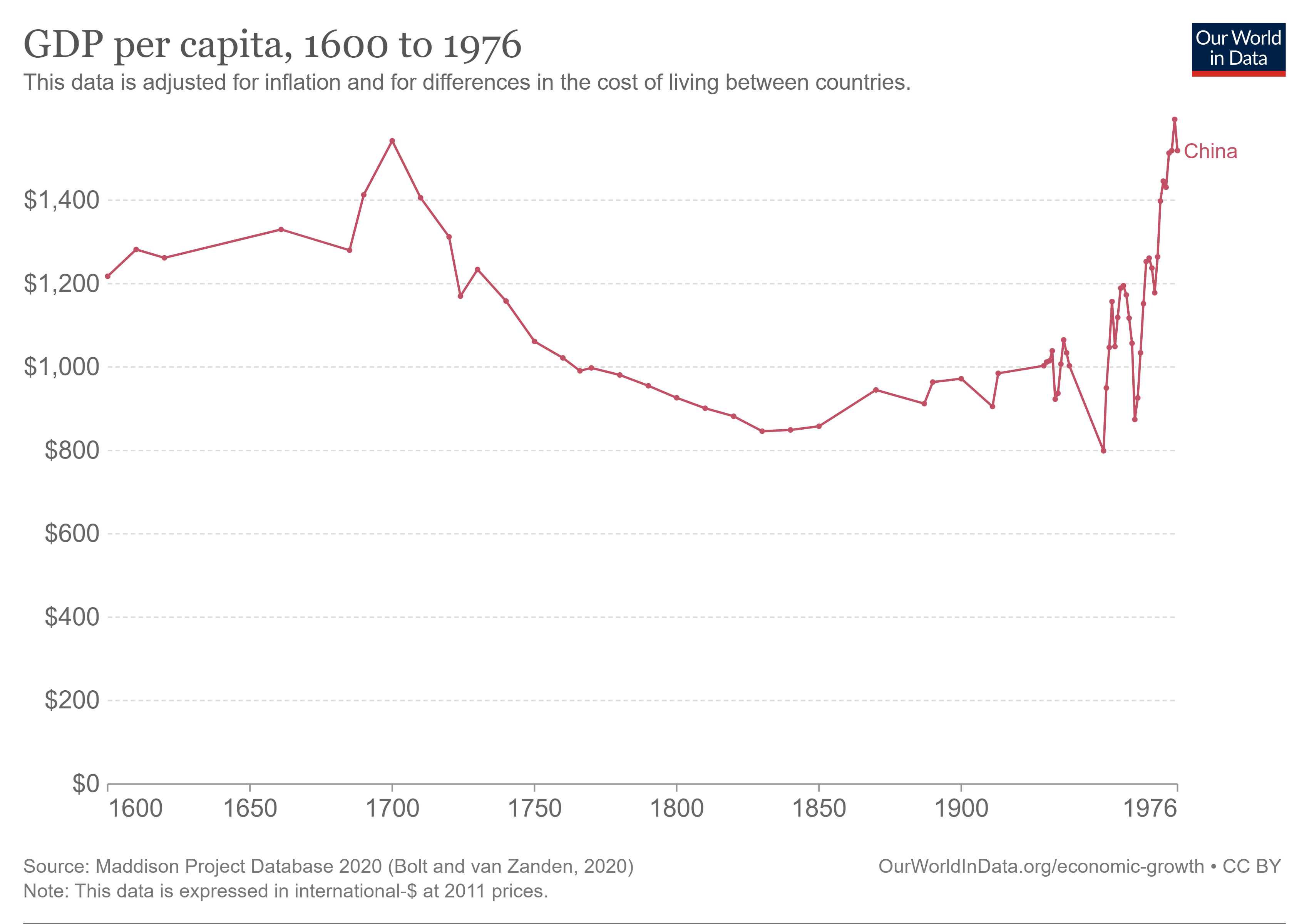
Graph of the Day
A remarkable graph pointed to by Phil Magness who writes:
China’s GDP per capita hit its lowest point in the past 300 years under Maoism. Twice.
The first time was during the civil war and the second was the Great Leap Forward. Wojtek Kopczuk comments:
Even taking into account that these historical measurements are notoriously problematic and difficult to make comparable, the fact that it is even in the ballpark is shocking.
Tuesday assorted links
1. To what extent can they pull your DNA from thin air? (NYT)
2. Accounting for chores, Americans have as much leisure time as do Swedes.
3. John Cochrane on Bob Lucas. And David Henderson on Bob Lucas (WSJ).
5. Daron Acemoglu on Turkey and the election.
6. Ezra Klein and Veronique de Rugy podcast, covering the debt ceiling (NYT).
7. Soon your iPhone will be able to speak in your own voice.