Results for “best book” 2009 found
The Great Walter Williams, Radical Troublemaker
Our colleague, the great Walter Williams, died on Tuesday shortly after teaching his last class–which is exactly how he would have wanted to go. He was 84 and had been teaching at George Mason since 1980. As Don Boudreaux writes in the WSJ:
For 40 years Walter was the heart and soul of George Mason’s unique Department of Economics. Our department unapologetically resists the trend of teaching economics as if it’s a guide for social engineers. This resistance reflects Walter’s commitment to liberal individualism and his belief that ordinary men and women deserve, as his friend Thomas Sowell puts it, “elbow room for themselves and a refuge from the rampaging presumptions of their ‘betters.’ ”
Walter taught UCLA-Chicago price theory to multiple generations of George Mason students. His students loved him. He secured funding for me when I was a student, for which I have always been grateful. You can find many of his graduate exam questions here. They are tough!
Walter led a remarkable life recounted in his autobiography, Up From the Projects. He was arrested for disorderly conduct several times and drafted into the army. He was later court-martialed but, acting as his own attorney, he wins his case. He’s sent to Korea and when asked to fill in a form stating his race he writes Caucasian because the Negros got all the worst jobs. He tells his commanding officer that he has pledged to defend the constitution against all enemies foreign and domestic and that he, the commanding officer, is a domestic enemy of the constitution. He writes to complain to President John F. Kennedy. The army gives him an honorable discharge. His wife, Connie, helps him to become more mannerly. It was only when he discovered economics, however, that he learned to combine trouble-making with discipline. He was interviewed a few years ago on these themes by Jason Riley for the WSJ:
“I was more than anything a radical,” says Mr. Williams. “I was more sympathetic to Malcolm X than Martin Luther King because Malcolm X was more of a radical who was willing to confront discrimination in ways that I thought it should be confronted, including perhaps the use of violence.
“But I really just wanted to be left alone. I thought some laws, like minimum-wage laws, helped poor people and poor black people and protected workers from exploitation. I thought they were a good thing until I was pressed by professors to look at the evidence.”
During his junior year at California State College in Los Angeles, Mr. Williams switched his major from sociology to economics after reading W.E.B. Du Bois’s “Black Reconstruction in America,” a Marxist take on the South’s transformation after the Civil War that will never be confused with “The Wealth of Nations.” Even so, the book taught him that “black people cannot make great progress until they understand the economic system, until they know something about economics.”
He earned his doctorate in 1972 from UCLA, which had one of the top economics departments in the country, and he says he “probably became a libertarian through exposure to tough-mined professors” — James Buchanan, Armen Alchian, Milton Friedman — “who encouraged me to think with my brain instead of my heart. I learned that you have to evaluate the effects of public policy as opposed to intentions.”
Walter was never politically correct. He once demanded that our Dean do something about the lack of representation of Asian-Americans on the GMU basketball team. He enjoyed his iconoclasm but his provocations were designed to get people to stop and think not to offend. It’s not clear that this is possible anymore.
Walter was a brilliant communicator. GMU Econ Chair Daniel Houser noted:
That Walter is so beloved by legions of non-economists speaks not to his dumbing down of economics in order to attain popularity. Instead, it speaks to his unusual mastery of economics to make it accessible and relevant to ordinary men and women.”
Walter was always his own person, perhaps best reflected in this interview with Nick Gillespie.
Gillespie: Let’s talk a little bit about the broad-based libertarian movement. Do you feel that you are part of a libertarian movement?
Williams: No, I don’t.
Gillespie: So, what are you then?
Williams: I am not a part of a movement. I have never been part of a movement, I just do my own thing.
I miss him already. There is no replacement. Here is Suffer No Fools, an excellent video-biography of the great Walter Williams.
My excellent Conversation with Zach Carter
Zach is author of the recent book The Price of Peace: Money, Democracy, and the Life of John Maynard Keynes, which has been on many year-end “best of” lists. Here is the audio, transcript, and video. Here is part of the CWT summary:
Zach joined Tyler to discuss what Keynes got right — and wrong — about the Treaty of Versailles, how working in the India Office influenced his economic thinking, the seemingly strange paradox of his “liberal imperialism,” the elusive central message of The General Theory, the true extent of Keynes’ interest in eugenics, why he had a conservative streak, why Zach loves Samuel Delaney’s novel Nova, whether Bretton Woods was doomed to fail, the Enlightenment intuitions behind early defenses of the gold standard, what’s changed since Zach became a father, his next project, and more.
Here is one excerpt:
COWEN: [Keynes is] sympathetic to his own ideas and wants to promote them. But to me, there’s a discord. Milton Friedman spends, what, 45 minutes talking to Pinochet, has a very long record of insisting economic and political freedom come together — maybe even too simplistically — writes against the system of apartheid in South Africa and Rhodesia, calls for free markets there. And people give Friedman hell over that.
Keynes writes the preface for the Nazis and favors eugenics his whole life, and that’s hardly ever mentioned.
CARTER: I don’t know that the way that Keynes talks about eugenics is as salient as you suggest. The best article that I came across on Keynes and eugenics is by this guy — I think David Singerman. It’s in the Journal of British Studies. It’s a pretty in-depth look at the way Keynes came to eugenics and what he did and did not support. It’s very clear that Keynes didn’t support eugenics in the way that Americans sterilizing poor Black workers in the South were interested in eugenics.
Keynes was broadly interested in it from the perspective of birth control. This is a time when eugenics and genetics are not as clearly defined as they are today, so he’s thinking about heritability of eye colors — how he gets involved in this stuff. He never really supports anything other than birth control.
When he actually has power as a policymaker, he just doesn’t do any of this stuff. He is working on the Beveridge plan. He is working on financial stuff that is much more egalitarian than what we think of him when we think about eugenics.
COWEN: But he is chair of the British Eugenics Society for eight years late in his career.
CARTER: He doesn’t do much there. There are big debates that are happening within that society, and he’s mostly sitting them out. Singerman goes into this in much more detail. It’s been a while since I read the article, but Singerman seems to think that this is a useful way of understanding Keynes’s worldview, but not that Keynes is some guy who’s going around wanting to sterilize people and do the things that we think of with the eugenics movement in the United States.
COWEN: I don’t think he wants to sterilize people, but he has those essays on population, which are not put into the collected works. They’re not mentioned by Roy Harrod. He is greatly worried that the people from some countries — I think including India — will outbreed the people from Britain, and this will wreak havoc on prices and wages, and it’s a big crisis. He even says, “We need to worry not only about the quantity of people, but the quality of people in the world.”
A very good episode, definitely recommended. And here is Zach on Twitter.
Why you should use *Modern Principles* for your class
Alex has had numerous posts on Modern Principles, but here is my two cents. A textbook, as the name indicates, is a book. It has to be conceived of as a book, and thought of as a book, and written as a book, and ideally it should be read as a book. There are many other textbooks out there, and I do not wish to name names, but consider the following question. Which are the authors who really love books? Who spend their lives reading books? And indeed writing books. And who spend their lives studying what makes books good or bad? Who view books as truly essential to their overall output?
An ancillary question to ask is who are the authors who are truly dedicated to video, and to on-line communication more generally, as an independent outlet for their efforts and creativity?
Here is information on our new fifth edition, better than ever. Because we love books.
Teaching Modern Principles Online
I’ve been teaching hundreds of students the principles of economics using Modern Principles of Economics and its online course management system and the response has been excellent. Most students like the class but what always surprises me is that some students like the online class better than any other class they have ever taken. A good lesson about different learning styles. Some reviews:

- I wanted to say thank you for the way you teach your class. I just started it and it is way better than I expected. The videos you made are why I’m thanking you. In high school I would always have to go home and watch videos explaining what the teacher taught us….your class is already the best class I have taken in my life because it fits the way I learn. I’ve never really written an email like this so forgive me if it breaks the usual business casual email approach. Thank you again!
- I am a student a George Mason…I would like to say that these classes are the best online classes I have taken and wish all my classes would be like this! Especially with Mason being mostly online and all of my classes being online this semester, I think that this class’s design should be an outline for other online classes. The videos themselves are very well edited and can be fun to watch! Instead of just watching a PowerPoint online and taking notes, being able to see the professor speak, while incorporating graphs, and even animations makes the class much more enjoyable, and in my case easier to absorb. Another aspect I wish all online classes did is giving quizzes along with the videos to check information learned. Speaking from my experience in your previous class the “Learning Curve” and other pre-test activities did wonders for me when preparing for chapter tests and exams. Overall, these classes are a great experience and I look forward to this semester in Econ 104! As a little side note, my favorite videos/lessons from last semester where the ones where you and Professor Cowen would debate over subjects learned in class. It gave useful insight and thinking to both sides of the argument.
- I really liked how it was set up with the videos. As someone who has diagnosed ADHD, this type of online class, and class in general has made it so much easier for me to constantly go back on videos to hear what the professors were saying and trying to teach us. Honestly best class experience I’ve ever had, and I wish more were like it.
- Prof. Tabarrok’s videos that accompanied our course material were of high quality. Even though this was a distance learning course, I felt that I got an in depth lecture for each section of the course. I did not feel that I was left to read the book myself; it was like I had great in-person lecture that I could re watch again and again.
- Since this is an online course, I expected it to be very short cut and not interactive. This course was the total opposite. Being able to watch videos about professors genuinely teaching economics and answering questions while following the video was so helpful.The aspects of the course allowed me to connect with different imperative issues & solutions across the world.
Saturday assorted links
1. Greenstone and Nath on cost-effective carbon abatement.
2. William Bolcom remembers Boulez.
3. Robin Hanson on pandemic spending and prevention; see also my comment #2 in the list.
4. Can the British turn moon dust into oxygen?
5. NHS to trial blood test to detect more than 50 forms of cancer. You know the scientific resurgence of the British (or should I say the English?) is a remarkable and much underreported story. Start with the Anglosphere and mix in a few top universities and the revenue-rich creative cluster of southeast England… There is much we can learn from this episode, and it is more important than say continuing to debate Brexit.
6. The Novavax vaccine. Nita Patel (guess where she is from? Try for the state) gets special praise and “Her all-female crew is an essential part of Novavax’s lab team.”
Modern Principles, New Edition!
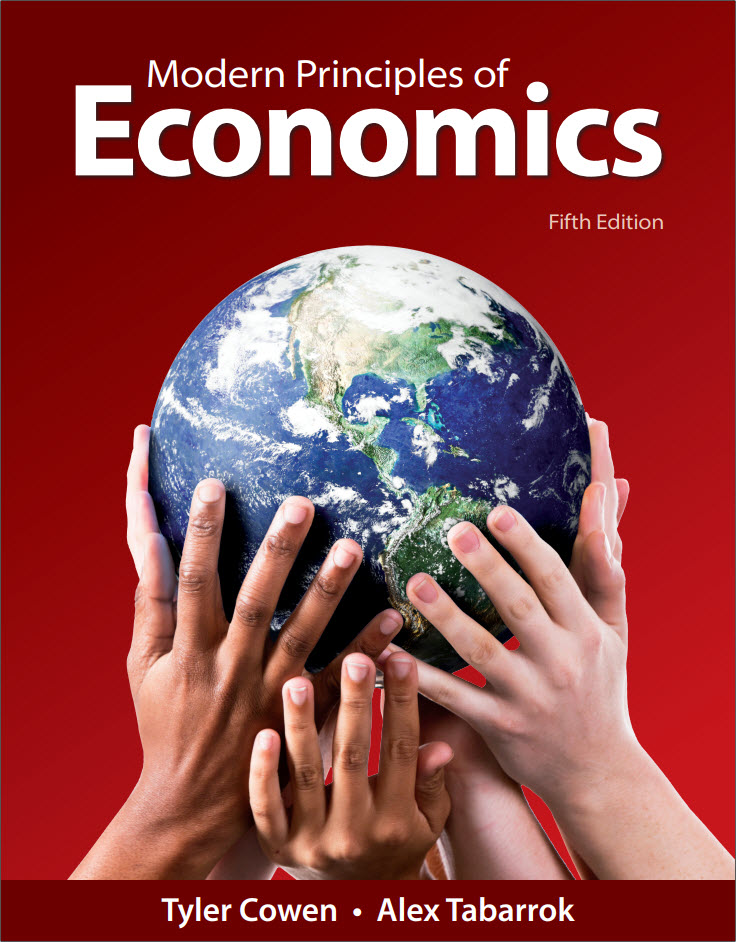
The new edition of Modern Principles is here! We take our title, Modern Principles of Economics, seriously. Other textbooks stick with the market for ice cream year after year but when it comes to new editions we don’t just add a box or two–we rewrite entire chapters with new examples and applications and we cut older material to make way for the new.
In the new edition we introduce platform economics and we use it to explain why Facebook is free; we have new material applying the elasticity of supply to understand why housing is so expensive in some cities; we have rewritten the chapter on trade to take into account the China shock and the China trade-war shock including the implications for politics; we have new material on pollution and a carbon tax; new material on the declining labor force participation rate of men and new material on supply chains and bottlenecks. Of course, there is also new material on pandemics although we had material on pandemics in the very first edition!
Modern Principles of Economics is by far the best textbook for teaching online (or offline!). Not only do you get over a hundred professionally produced videos, like this one on price ceilings and price coordination, you also get Achieve, the excellent new course management system that integrates e-book, tutorials, quizzes, exams, assessment and much more so that you can get up and running online overnight.
I’ll be covering some of the new material in Modern Principles this week.
The very good vaccine news
Very good news from Pfizer on the vaccine front. And Zoom shares have been crashing. Disney is soaring. Book that wedding venue now!
Here is the woman who led the effort. And:
If you want to tell positive stories about immigration, look no further than the BioNTech vaccine: company co-founders Uğur Şahin and Özlem Türeci are both children of Turkish Gastarbeiter who came to Germany in the late 1960s.
This also means a lot of the other vaccine candidates are quite likely to work. Finally, please do note this:
In seriousness, the expected value of delaying getting sick just went way, way, way up.
Bravo to all those involved. And from one reader:
What do you think of proposing a new holiday to your readers?
Most of them are going to celebrate Christmas and Thanksgiving with their families during the peak of the pandemic, when immunity is available just around the corner. Perhaps “Vaccinalia” a two day celebration two weeks after your entire family is vaccinated, with presents AND turkey…
My Conversation with Edwidge Danticat
Here is the audio, video, and transcript. Here is the CWT summary:
She joined Tyler to discuss the reasons Haitian identity and culture will likely persist in America, the vibrant Haitian art scenes, why Haiti has the best food in the Caribbean, how radio is remaining central to Haitian politics, why teaching in Creole would improve Haitian schools, what’s special about the painted tap-taps, how tourism influenced Haitian art, working with Jonathan Demme, how the CDC destroyed the Haitian tourism industry, her perspective on the Black Lives Matter movement, why she writes better at night, the hard lessons of Haiti’s political history, and more.
Here is one excerpt:
COWEN: Now, in all of these conversations, there’s a segment where I present to the guest my favorite Haitian proverbs, and he or she reacts. Are you ready for a few?
DANTICAT: All right. You’ve been sharing Haitian proverbs with your guests?
COWEN: Here’s one. “After the dance, the drum is heavy.”
DANTICAT: Oh my god.
COWEN: What does that mean to you?
DANTICAT: Aprè dans, tanbou lou. I actually have a book called After the Dance. It’s on Carnival. Yes, for me, it means that there are consequences to everything, even the most joyful thing. You have to be prepared for the consequences of things that you’ve done.
It’s something that my mom used to say quite a bit, too. If you have just had a really big celebration, or if you waited too late to do your homework because you’re having a good time watching a program you like, she was like, “Aprè dans, tanbou lou.” After the dance, the drum is heavy. It’s like the morning-after, hangover situation and the most joyful outcome, but really, that there are consequences to everything.
COWEN: Here’s another one. “It is the owner of the body who looks out for the body.”
DANTICAT: Oh, this one. You will not believe how much we hear that these days. Se mèt kò ki veye kò. It’s something that we say a lot now in the coronavirus era. You hear it on the radio. You hear people say it when they talk to their neighbors. Se mèt kò ki veye kò. That means that, really, you are the best person to take care of yourself.
If you’re saying, “Wear your mask when you go out during the coronavirus era.” “Wash your hands.” It’s like the best, the most qualified person to take care of you is you. It’s not the doctor. It’s not your loved one. Se mèt kò ki veye kò. It’s the owner of the body who takes care of the body. It’s like, “Watch out for yourself.” It’s very good advice these days.
COWEN: “When they want to kill a dog, they say it’s crazy.”
DANTICAT: Yes, that’s the dehumanization. I guess that’s fake news. [laughs] It’s connected to the fake news. If you want to diminish or slight someone, you call them names. So that’s also a timely one, I think.
COWEN: How about this one? “The constitution is paper; the bayonet is steel.”
DANTICAT: Yes. Again, back to our conversation about dictatorship, in a way. I believe that one was often cited by one of the generals, actually, during the ’90s, during the coup d’état, or it might have been even before. I think it speaks to the fragility of documents like the constitution. Yesterday was Constitution Day in the US, so that might also apply here.
It’s that whole thing with freedom. Freedom is something that we have to always keep watching out it doesn’t slip away because, sometimes, we think these documents or these rules are set in stone. I think this general who kept saying this was saying, “Well, I have the weapons.” It’s kind of paper, rock scissors. Which is stronger?
COWEN: “When the mapou tree dies, goats would eat its leaves.”
DANTICAT: Yes. This one, I think, is about humility because we have this expression that we say when someone has died who has contributed a great deal to our culture: we say that a mapou has fallen. A mapou is a soft cotton tree, it’s a kind of sacred tree, and it’s also a big tree that lasts forever. It’s a regal institution, a mapou.
What this one is saying, actually, the goat is a meager creature compared to a mapou, and there’s no way a goat would actually be able to access the leaves of a mapou, but when it dies, it falls. I’ve always heard that proverb as a way of encouraging humility, that all our leaves are vulnerable to the goat, if you will. [laughs]
COWEN: One more proverb, “Beyond the mountain is another mountain.”
DANTICAT: Yes. Dèyè mòn gen mòn.
COWEN: That’s a very famous one.
DANTICAT: Yes. I actually use that a lot myself. One of my neighbors just passed away, and she used to use that proverb a lot. I think it means that no matter what, we can see there is more. I think it’s about there’s more to everything than what we see.
It also speaks to the physical layout of Haiti because it’s a very mountainous place. Ayiti. The Arawak called it Ayiti. It actually means land of the mountains, and it’s physically true. If you’re traveling across Haiti, literally, there’s always a mountain physically behind a mountain, but in a spiritual sense, it also means that there’s always more.
Recommended. And I thank Carl-Henri Prophète for assistance with the transcription.
My favorite fiction of 2020
Emily St. John Mandel, The Glass Hotel.
Anne Enright, Actress: A Novel.
Susannah Clarke, Piranesi.
Maggie O’Farrell, Hamnet.
Elena Ferrante, The Lying Life of Adults.
Of those Hamnet was my clear favorite, then the Enright. Here is my non-fiction list, which also explains why the lists have come earlier this year.
Blog and Substack contest winners
To date there are three:
1. Anton Howes for his Substack Age of Invention. He is a historian of invention, often but not exclusively focusing on the eighteenth century, here is Anton on Twitter. As a separate matter, don’t forget Anton’s excellent recent book Arts & Minds: How the Royal Society of Arts Changed a Nation.
2. Works in Progress. Here is their About page: “Works in Progress is a new online magazine dedicated to sharing novel ideas and stories of progress, and features original writing from some of the most interesting thinkers in the world.” The major individuals behind Works in Progress are Sam Bowman, Saloni Dattani, Ben Southwood, and Nick Whitaker, all with bios at the previous link, all strong intellectual forces.
Note also: “Works in Progress is always looking for new writers for upcoming issues and our blog. Reach out if you want to talk about writing for us, with a short summary or abstract of your piece.”
3. Alice Evans, lecturer at King’s College London. Here is Alice on Twitter. She is working on “”THE GREAT GENDER DIVERGENCE” What explains global variation in gender relations?” and here is her related blog on that same topic. Here is her famous post on gender relations in north vs. south India. Her home page also links to her podcast.
I do expect there will be further awards, and I will keep you posted (here is the original announcement). If you just started writing a blog and submitted, you may still be in the running for the future. In the meantime, congratulations to these winners!
*The Fabric of Civilization: How Textiles Made the World*
The author is Virginia Postrel, and yes studying the history of textiles is one of the very best ways to better understand markets. This book does that.
 You can pre-order here. Here is Virginia’s adapted WSJ essay.
Clubhouse
I’ve tried it a few times, and I think it will become “a thing.” You can read about it here, though it is time someone did a more current article. It is the best forum invented to date for mid-size, friendly, intellectual chats. Broadly speaking imagine a Zoom call, with competing topic-named rooms, the video turned off, and better queuing and calling upon people procedures. It doesn’t seem to induce fatigue the way Zoom calls do. The software has a fluidity and ease of use that I hardly ever see, as usually I hate new apps that people tell me to try.
I don’t know that it will ever be “my thing,” mostly because I can read so quickly, which raises my opportunity cost of consumption. (Though you can read with it on in the background — is it ever the case that no one in the audience is listening? Would that even matter?) In any case, I suspect it will take some real mind-share away from Twitter and Facebook, and now is the time for you to start learning about it.
So far it is invite-only, though I assume it will be opening up more broadly. Furthermore, an invitation is not so difficult to get. Arguably there is a problem with who gets invited or deplatformed, though so far this seems to bother the (non-participating) people on Twitter more than it disturbs anyone performing on Clubhouse itself.
It is much more Tiebout-like than Zoom, so someday this also may be an incredible data source on what leads to useful conversations, which are the best governance rules, and so on.
*Poet of Revolution: The Making of John Milton*
That is the new book by Nicholas McDowell, and it is one of my favorite non-fiction works this year. Milton is today more relevant than he has been in a long time, excerpt:
Milton’s political development is shaped by his evolving understanding of the ways in which ‘tyranny’ — defined initially in ecclesiastical and clerical terms but which grows to encompass political organization — retards the intellectual and cultural progress of a nation. This understanding was shaped not only by historical experience of the unprecedented political turbulence of mid-seventeenth-century Britain, but by the interaction between that experience and his intellectula life. Milton’s period of intensive and almost entirely orthodox reading in political and religious history in the mid-1630s, the record of some of which survives in the notebook that was rediscovered in 1874, revealed to him how clerical censorship and heresy-hunting had suppressed intellectual and literary life in other countries. Milton regarded the cultural decline of Italy under the Counter-Reformation and Inquisition from the glory days of Dante and Petrarch, two of his pre-eminent post-classical models of the poetic career, as the starkest instance of this process. His tour of Italy in 1638-9 confirmed the lessons of his reading: that in nations where ‘this kind of inquisition tyrannizes,’ as he put it in Areopagitica, learning is brought into a ‘servil condition’ and the ‘glory ‘ of ‘wits’ is ‘dampt.’
Recommended! Every page is enjoyable, and you can profit from this book no matter your prior knowledge of Milton may be. A sure thing for the year end’s “best of” list.
You can pre-order here.
*Editing Humanity*
That is the new book by Kevin Davies, and the subtitle is The CRISPR Revolution and the New Era of Genome Editing. So far I am on p.74, but it is one of the best science books I have read in some while, maybe the best this year. Excerpt:
…Cas9 normally takes about six hours to search through every PAM sequence in the bacterial genome, pausing at each prospective site for a mere twenty milliseconds to peer into the double helix to see if it has found the correct target. But the packaging of DNA in a eukaryotic cell nucleus is far more complex than bacteria. During lectures to his students at the University of Edinburgh, Andrew Wood shows a diagram of a bacterial cell alongside a winding, looping mammalian DNA fiber. “Cas9 didn’t evolve to work in the environment in which we now put it,” he says. “It’s mind-boggling that it is possible to interrogate hundreds of millions of nucleotides in a matter of hours.”
Recommended. Emmanuelle Charpentier and Jennifer Doudna, the two Nobel winners from last week, are so far the central characters of the story.
Paul Milgrom, Nobel Laureate
Most of all this is a game theory prize and an economics of information prize, including game theory and asymmetric information. Much of the work has had applications to auctions and finance. Basically Milgrom was the most important theorist of the 1980s, during the high point of economic theory and its influence.
Here is Milgrom’s (very useful and detailed) Wikipedia page. Most of his career he has been associated with Stanford University, with one stint at Yale for a few years. Here is Milgrom on scholar.google.com. A very good choice and widely anticipated, in the best sense of that term. Here is his YouTube presence. Here is his home page.
Milgrom, working with Nancy Stokey, developed what is called the “no trade” theorem, namely the conditions under which market participants will not wish to trade with each other. Obviously if someone wants to trade with you, you have to wonder — what does he/she know that I do not? Under most reasonable assumptions, it is hard to generate a high level of trading volume, and that has remained a puzzle in theories of finance and asset pricing. People are still working on this problem, and of course it relates to work by Nobel Laureate Robert Aumann on when people should rationally disagree with each other.
Building on this no-trade result, Milgrom wrote a seminal piece with Lawrence Glosten on bid-ask spread. What determines bid-ask spread in securities markets? It is the risk that the person you are trading with might know more than you do. You will trade with them only when the price is somewhat more advantageous to you, so markets with higher degrees of asymmetric information will have higher bid-ask spreads. This is Milgrom’s most widely cited paper and it is personally my favorite piece of his, it had a real impact on me when I read it. You can see that the themes of common knowledge and asymmetric information, so important for the auctions work, already are rampant.
Alex will tell you more about auctions, but Milgrom working with Wilson has designed some auctions in a significant way, see Wikipedia:
Milgrom and his thesis advisor Robert B. Wilson designed the auction protocol the FCC uses to determine which phone company gets what cellular frequencies. Milgrom also led the team that designed the 2016-17 incentive auction, which was a two-sided auction to reallocate radio frequencies from TV broadcast to wireless broadband uses.
Here is Milgrom’s 277-page book on putting auction theory to practical use. Here is his highly readable JEP survey article on auctions and bidding, for an introduction to Milgrom’s prize maybe start there?
Here is Milgrom’s main theoretical piece on auctions, dating from Econometrica 1982 and co-authored with Robert J. Weber. it compared the revenue properties of different auctions and showed that under risk-neutrality a second-price auction would yield the highest price. Also returning to the theme of imperfect information and bid-ask spread, it showed that an expert appraisal would make bidders more eager to bid and thus raise the expected price. I think of Milgrom’s work as having very consistent strands.
With Bengt Holmstrom, also a Nobel winner, Milgrom wrote on principal-agent theory with multiple tasks, basically trying to explain why explicit workplace incentives and bonuses are not used more widely. Simple linear incentives can be optimal because they do not distort the allocation of effort across tasks so much, and it turned out that the multi-task principal agent problem was quite different from the single-task problem.
People used to think that John Roberts would be a co-winner, based on the famous Milgrom and Roberts paper on entry deterrence. Basically incumbent monopolists can signal their cost advantage by making costly choices and thereby scare away potential entrants. And the incumbent wishes to be tough with early entrants to signal to later entrants that they better had stay away. In essence, this paper was viewed as a major rebuttal to the Chicago School economists, who had argued that predatory behavior from incumbents typically was costly, irratoinal, and would not persist.
The absence of Roberts’s name on this award indicates a nudge in the direction of auction design and away from game theory a bit — the Nobel Committee just loves mechanism design!
That said, it is worth noting that the work of Milgrom and co-authors intellectually dominated the 1980s and can be identified with the peak of influence of game theory at that period of time. (Since then empirical economics has become more prominent in relative terms.)
Milgrom and Roberts also published a once-famous paper on supermodular games in 1990. I’ve never read it, but I think it has something to do with the possible bounding of strategies in complex settings, but based on general principles. This was in turn an attempt to make game theory more general. I am not sure it succeeded.
Milgrom and Roberts also produced a well-known paper finding the possible equilibria in a signaling model of advertising.
Milgrom and Roberts also wrote a series of papers on rent-seeking and “influence activities” within firms. It always seemed to me this was his underrated work and it deserved more attention. Among other things, this work shows how hard it is to limit internal rent-seeking by financial incentives (which in fact can make the problem worse), and you will see this relates to Milgrom’s broader work on multi-task principal-agent problems.
Milgrom also has a famous paper with Kreps, Wilson, and Roberts, so maybe Kreps isn’t going to win either. They show how a multi-period prisoner’s dilemma might sustain cooperating rather than “Finking” if there is asymmetric information about types and behavior. This paper increased estimates of the stability of tit-for-tat strategies, if only because with uncertainty you might end up in a highly rewarding loop of ongoing cooperation. This combination of authors is referred to as the “Gang of Four,” given their common interests at the time and some common ties to Stanford. You will note it is really Milgrom (and co-authors) who put Stanford economics on the map, following on the Kenneth Arrow era (when Stanford was not quite yet a truly top department).
Not what he is famous for, but here is Milgrom’s paper with Roberts trying to rationalize some of the key features of modern manufacturing. If nothing else, this shows the breadth of his interests and how he tries to apply game theory generally. One question they consider is why modern manufacturing has moved so strongly in the direction of greater flexibility.
Milgrom also has a 1990 piece with North and Weingast on the medieval merchant guilds and the economics of reputation, showing his more applied side. In essence the Law Merchant served as a multilateral reputation mechanism and enforced cooperation. Here is a 1994 follow-up. This work paved the way for later work by Avner Greif on related themes.
Another undervalued Milgrom piece is with Sharon Oster (mother of Emily Oster), or try this link for it. Here is the abstract:
The Invisibility Hypothesis holds that the job skills of disadvantaged workers are not easily discovered by potential new employers, but that promotion enhances visibility and alleviates this problem. Then, at a competitive labor market equilibrium, firms profit by hiding talented disadvantaged workers in low-level jobs.Consequently, those workers are paid less on average and promoted less often than others with the same education and ability. As a result of the inefficient and discriminatory wage and promotion policies, disadvantaged workers experience lower returns to investments in human capital than other workers.
With multiple, prestigious co-authors he has written in favor of prediction markets.
He was the doctoral advisor of Susan Athey, and in Alex’s post you can read about his auction advising and the companies he has started.
His wife, Eva Meyersson Milgrom, is herself a renowned social scientist and sociologist, and he met her in 1996 while seated next to her at a Nobel Prize dinner in Stockholm. Here is one of his papers with her (and Ravi Singh), on whether firms should share control with outsiders. Here is the story of their courtship.