Results for “best book” 2009 found
The man who wants to read everything
The New Yorker has done a profile of Michael A. Orthofer, here is one excerpt:
I first contacted him in 2004, asking him if I could write for the the Complete Review; I was an undergraduate at Stanford at the time, and thought that the site was an institution, like The New York Review of Books. I was politely rebuffed. Years later, I e-mailed to ask if I could send him a galley of my first novel. He already had it, he replied—he had picked up an advance review copy for sale at the Strand, for $1.49. He went on to review the book, giving it a B, and later e-mailed to soften the blow. “Bs always have something going for them,” he explained, while a C grade indicates “steer-clear territory.” All books on the site get a rating from A+ to F, part of the site’s endearing, Robert-Christgau-like fustiness.
Michael runs Literary Saloon, one of the very best and most important blogs, focusing on foreign literature in translation.
Oddly, he spent the first six years of his life not reading, and thus he is somewhat behind. Yet he is working at it:
“I can’t imagine not doing it,” Orthofer told me. “A day in which I don’t read or write, I have trouble falling asleep.” His goal is to read a book a day, though he confesses that this is “unrealistic.” He works on weekends, too, and has written four novels that are in the drawer. His main interests, according to the site, are inline roller-skating in Central Park and building snow sculptures, some of which are big enough that he carves staircases inside them to get to the top. When he tires of working, he steps out to a library or bookstore, “to see, be around books.” Last year, and this year, he worked through Christmas.
I will continue to read him until I can no longer. The profile is interesting and humorous throughout, and it is so far my favorite magazine piece of the year.
For the pointer I thank Michael Rosenwald.
Defer to the Algorithm
A BuzzFeed article predicts that Twitter will soon move from a time-ordered feed to an algorithmic feed, one that shows you tweets that it predicts you will like before it show you lesser-ranked tweets. Naturally, twitter exploded with outrage that this is the end of twitter.
My own tweet expresses my view ala Marc Andreessen style:
https://twitter.com/ATabarrok/status/695960895906779136
It is peculiar that people are more willing trust their physical lives to an algorithm than their twitter feed. Is the outrage real, however, or will people soon take the algorithm for granted? How many people complaining about algorithmic twitter don’t use junk-email filters? I want ALL my emails! Only I can decide what is junk! Did junk email filters ruin email or make it better?
Facebook moved to an algorithm years ago. At the time, the move caused complaints but I think algorithmic feed has made Facebook more relevant, especially in recent years when the algorithm has gotten quite good. The profits agree with my assessment. Many people don’t understand that there is no serious alternative to an algorithmic feed because most people’s uncurated feeds contain well over a thousand posts every day. It’s curate or throw material out at random.
Think of the algorithm as an administrative assistant that sorts your letters, sending bills to your accountant, throwing out junk mail, and keeping personal letters for your perusal. The assistant also reads half a dozen newspapers before you wake to find the articles he thinks that you will most want to read that morning. Who wouldn’t want such an assistant? Moreover, Facebook has billions of dollars riding on the quality of its assistant algorithms and it invests commensurate resources in making its algorithm more and more attuned to our wants and needs.
It’s not simply that the algorithms are good and getting better it’s that the highest productivity people will use their human intelligence to complement machine intelligence. That means trusting the machine to curate millions of items, bringing only the most important to your attention, and then using human intelligence to take action on the most important items. By trusting the machine intelligence to filter, you can open yourself up to a much wider space of information. I have many more friends on Facebook than I have IRL because I trust the algorithm to bring me only the best of my friends on any given day. A twitter algorithm will mean that I can follow more people without being overwhelmed. Even when the filter is imperfect, you are more likely to discover something of importance from 100,000 items imperfectly filtered to 100 than from 1000 items perfectly filtered to 100.
As Tyler argued in Average is Over, the future belongs to people who can defer to the algorithm.
The Importance of Institutions
So far, in our Principles of Macroeconomics class at MRUniversity we’ve covered GDP (how it is calculated, nominal versus real, GDP as a measure of the standard of living etc.). We have also covered the basic facts about differences in income both across countries and over time, the importance of growth rates, and the presence of growth miracles and growth disasters, among other topics.
In our latest video, Tyler covers the Importance of Institutions. Next up geography and growth and shortly after that on to the Solow model!
As always, these videos are freely available for non-commercial use. They can be used with any textbook but why would you want any but the best?
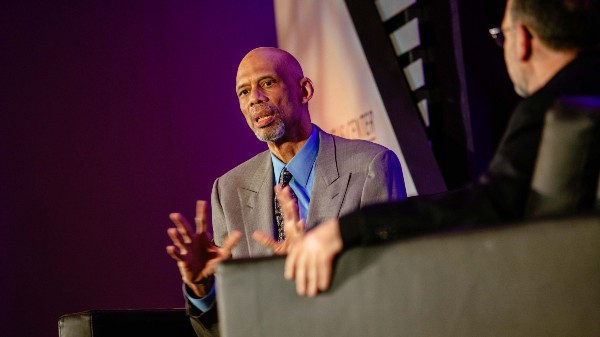
My conversation with Kareem Abdul-Jabbar
Here is the video, the podcast, and the transcript. Kareem really opened up. Here is the summary:
Kareem Abdul-Jabbar joins Tyler Cowen for a conversation on segregation, Islam, Harlem vs. LA, Earl Manigault, jazz, fighting Bruce Lee, Kareem’s conservatism, dancing with Thelonious Monk, and why no one today can shoot a skyhook.
Maybe you think of Kareem as a basketball player, but here is my introduction:
Kareem Abdul-Jabbar is one of America’s leading public intellectuals. I would describe him as an offshoot of the Harlem Renaissance, and what he and I share in common is a fascination with the character of Mycroft Holmes, the subject of Kareem’s latest book — and that of course, is Sherlock Holmes’s brother.
Here is Kareem:
I did know Amiri [Baraka]. I think the difference is I believe in what happened in Europe during what they call the Enlightenment. That needs to happen to black Americans, absolutely a type of enlightenment where they get a grasp of what is afflicting them and what the cures are.
I think that the American model is the best in the world but in order to get everybody involved in it we have to have it open to everyone. That hasn’t always been the case.
The most under-appreciated Miles Davis album?
For me [Kareem], the most under-appreciated one is Seven Steps to Heaven. And that shows, I think, Miles’ best group. There’s a big argument, what was Miles’ best group, the one that had Cannonball Adderley, Coltrane, Bill Evans, and Philly Joe Jones and Red Garland or Herbie Hancock, Ron Carter, Tony Williams, and Wayne Shorter?…number two is Porgy and Bess.
He cites Chester Himes as the underappreciated figure of the Harlem Renaissance. And Kareem thinks like an economist:
It [my instruction] was going well with Andrew Bynum, but Andrew finally got to sign his contract for $50 million, and then at that point Andrew thought that I didn’t know anything and that he didn’t have to listen to me, and we don’t know where Andrew is right now.
Read or hear also his very interesting remarks on Islam, and where its next Enlightenment is likely to come from, not to mention Kareem on the resource curse and of course his new book (and my Straussian read of it). And Kareem on his favorite movies, starting with The Maltese Falcon. Self-recommending!
A question about deep reading
Brad asks:
Prof. Cowen – I’m a longtime MR reader, but just came across an old post on your prolific reading. In the post, you mention:
“But it is not like the old days when I would set aside two months to work through The Inferno, Aeneid, and the like, with multiple secondary sources and multiple translations at hand. I no longer have the time or the mood, and I miss this.”
I am intrigued by this process of deep reading the canonical classics – have you detailed your method/routine for this anytime on MR?
Thanks!
Here is my preferred method:
1. Read a classic work straight through, noting key problems and ambiguities, but not letting them hold you back. Plow through as needed, and make finishing a priority.
1b. Mark up the book with bars and questions marks, but don’t bother writing out your still-crummy thoughts. That will slow you down.
2. After finishing the classic, read a good deal of the secondary literature, keeping in mind that you now are looking for answers to some particular questions. That will structure and improve your investigation. But do not read the secondary literature first. You won’t know what questions will be guiding you, plus it may spoil or bias your impressions of the classic, which is likely richer and deeper than the commentaries on it.
3. Go back and reread said classic, taking as much time as you may need. If you don’t finish this part of the program, at least you have read the book once and grappled with some of its problems, and taken in some of its commentators. If you can get through the reread, you’ll then have achieved something.
4. I am an advocate of the “close in time” reread, not the “several years later” reread. The several years later reread works best when it has been preceded by a close in time reread, otherwise you tend to forget lots, or never to have learned it to begin with, and the later reread may be more akin to starting a new book altogether.
5. If you want to find new things in books you already know and love, opt for new editions, new translations, and new typesettings where you will encounter it as a very different visual and conceptual field.
*Congress and the Shaping of the Middle East*
That is the new Kirk J. Beattie book, and I find it one of the very best studies on how Washington actually works; I am less interested in the determinants of Middle East policy per se. Here is one bit:
On the Senate side, I got the distinct impression that the constituents are not, in general, as important to senators as they are to House members. One gets the distinct impression that individuals with financial clout are far more likely to get senators’ attention than others. As one staffer put it, “If you’re talking to me, you’re talking about money. People are not coming to these issues for the first time. But for us, where our constituents are is very marginal.” That said, a small number of well-heeled individuals can get senators’ attention in many but certainly not all cases. The bias here runs distinctly in favor of putative supporters of Israel. While other religious or ethno-religious factors are in play, like the size and strength of a senator’s evangelical community, senators appear to be less concerned about these voices, unless of course the senator either shares or sees utility in that perspective. This parallels views held by House staffers, leaving one to think that evangelical senators’ commitment to Israel exceeds the level of pro-Israel concern by the evangelical masses.
Among other virtues, the book offers a new (to me) channel for how money might affect politics. Even if donors cannot “buy positions” from politicians, the need to stay competitive in a more or less zero-sum fundraising game means that Congressional staff do not have enough time to study or learn issues very well, and thus depend all the more on outside sources of information.
Definitely recommended, you can buy it here.
The Top Ten MR Posts of 2015
Here are the top ten MR posts from 2015, mostly as measured by page views. The number one viewed post was:
- Apple Should Buy a University. People really like to talk about Apple and this post was picked up all over the web, most notably at Reddit where it received over 2500 comments.
Next most highly viewed were my post(s) on the California water shortage.
2. The Economics of California’s Water Shortage followed closely 4) by The Misallocation of Water.
3. Our guest blogger Ramez Naam earned the number 3 spot with his excellent post on Crispr, Genetically Engineering Humans Isn’t So Scary.
5. My post explaining why Martin Shkreli was able to jack up the price of Daraprim and how this argued in favor of drug reciprocity was timely and got attention: Daraprim Generic Drug Regulation and Pharmaceutical Price-Jacking
6. What was Gary Becker’s Biggest Mistake? generated lots of views and discussion.
7. Tyler’s post Bully for Ben Carson provided plenty of fodder for argument.
8. The Effect of Police Body Cameras–they work and should be mandatory.
9. Do workers benefit when laws require that employers provide them with benefits? I discussed the economics in The Happy Meal Fallacy.
10. Finally, Tyler discussed What Economic Theories are Especially Misunderstood.
Posts on immigration tend to get the most comments. The Case for Getting Rid of Borders generated over 700 comments here and over 1700 comments and 57 thousand likes at The Atlantic where the longer article appeared.
Other highly viewed posts included two questions, Is it Worse if foreigners kill us? from Tyler and Should we Care if the Human Race Goes Extinct? from myself.
The Ferguson Kleptocracy and Tyler’s posts, Greece and Syriza lost the public relations battle and a Simple Primer for Understanding China’s downturn (see also Tyler’s excellent video on this topic) were also highly viewed.
I would also point to Tyler’s best of lists as worthy of review including Best Fiction of 2015, Best Non-Fiction of 2015 and Best Movies of 2015. You can also see Tyler’s book recommendations from previous years here.
What caught my attention in 2015
This was the year when it became clear that much of Eastern Europe probably won’t end up as free societies. It’s not just semi-fascism in Hungary. Poland and Slovakia, arguably the two most successful economies and societies in Eastern Europe, took big steps backward toward illiberal governance. How can one be optimistic about the Balkans? I imagine a future where African and North African refugees are bottled up there, and Balkan politics becomes slowly worse. As for Ukraine, a mix of Russia and an “own goal” has made the place ungovernable. Where is the bright spot in this part of the world?
Nothing good happened in China’s economy, although more fingers have been inserted into more dikes. I am not hopeful on the cyclical side, though longer term I remain optimistic, due to their investments in human capital and the growing importance of scale.
I have grown accustomed to the idea that Asian mega-cities represent the future of the world — have you?
Syria won’t recover.
This was the year of the rise of Ted Cruz.
It was an awful year for movies, decent but unpredictable for books. The idea that Facebook and social media rob the rest of our culture of its centrality, or its ability to find traction, is the default status quo. Not even that idea has gained much traction. Cable TV started to receive its financial comeuppance. Yet on the aesthetic side, television is at an all-time peak, with lots of experimentation and independent content provision, all for the better. I suspect this is one reason why movies are worse, namely brain drain, but I am hoping for longer-run elasticities of adjustment into the broader talent pool.
Against all odds, Homeland was excellent in its fifth season.
I became even more afraid to move my cursor around a web page, and in terms of content, more MSM sites became worse than better. Banning photos would solve twenty percent of this problem.
Stephen Curry and Magnus Carlsen were the two (public) individuals I thought about the most and followed the most closely. Each has a unique talent which no one had come close to before. For Curry it is three point shooting at great range and with little warning; for Carlsen it is a deep understanding of the endgame as the true tactical phase of chess, and how to use the middlegame as prep to get there. It wasn’t long ago Curry’s weapons were “trick” shots, perhaps suitable for the Harlem Globetrotters; similarly, players such as Aronian thought Carlsen’s “grind ’em down” style could not succeed at a top five level. Everyone was wrong.
But here’s what I am wondering. Standard theory claims that with a thicker market, the #2 talents, or for that matter the #5s, will move ever closer to the #1s. That is not what we are seeing in basketball or chess. So what feature of the problem is the standard model missing? And how general is this phenomenon of a truly special #1 who breaks some of the old rules? Does Mark Zuckerberg count too?
I realized Western China is the best part of the world to visit right now. The food trends where I live were Filipino and Yemeni, which I found welcome. Virginia now has a Uighur restaurant in Crystal City, and the aging San Antonio Spurs continue to defy all expectations. Kobe Bryant, who “ranks among the league’s top 5 percent of shot-takers and its bottom 5 percent of shot-makers,” has redefined the retirement announcement, among other things.
Top curling teams say they won’t use high-tech brooms. Just wait.

Sunday assorted links
1. How bad are things? Arguably this post needs a broader sense of what makes a life valuable, still one of the more interesting blog posts of the last year.
2. Rubber’s reach.
4. Used bookstores are making a big comeback.
5. In Austin, Gary Leff and I enjoyed Papalote Taco House, thanks for your earlier suggestions. Pipian was best.
6. Affluent white people are the most likely to refuse vaccination for their children.
Saturday assorted links
1. Unreliable genetic information.
2. Elmendorf Unleashed, twelve videos.
3. I agree with this short, no plot spoilers review of the new Star Wars. And pre-order the Cass Sunstein Star Wars book.
4. Facts from books, good ones.
5. Facts about bananas, and banana ships. Good ones. Facts that is, not bananas. I prefer the bananas grown and eaten in Brazil.
6. Predictions for 2016 health care. And Atul Gawande on health care’s price conundrum.
Thursday assorted links
1. Swap your airline seat? (speculative)
2. Economists aren’t even consistent in their monetary policy mistakes.
4. Tibet’s Potemkin economy. And what happened this year in the real Washington, D.C., if there is such a thing.
5. Do heads of government age more quickly?
6. And from another segment of our world, “Hotz plans to best the Mobileye technology with off-the-shelf electronics.”
7. The new NYT column on academic press books, this time on inequality.
How to visit Singapore
Two different people have asked me this question this week, so I thought I would write out my answer. My approach is slightly unorthodox, but here goes:
1. Go to the top of Marina Bay Sands hotel and get a view of the skyline, the harbor, and the Straits. Watch the ships queuing. This is one of my favorite views in the whole world. Most of all I am struck by the contrast between what Singapore has achieved so quickly and also its continuing ultimate vulnerability; the view captures both of those. If you can afford it, stay in the hotel and swim in the Infinity Pool. That alone justifies dragging your body all the way to Singapore.
2. Organize the rest of your trip around food. For Malay food, visit the hawker centre at Geylang Serai Night Market. For Indian food, go to the hawker centre at the entrance to Little India, and walk around the adjacent shopping bazaar as well. For Singaporean food, there are many good choices, depending on your location. The optimal time to arrive is by 10:30, before most of the queues start. Ask cabbies for the best chili and pepper crab.
3. Eat at David Thompson’s Thai restaurant, in the mall next to Marina Bay Sands.
4. Once it is dark, and edging toward 9 p.m., walk around the Merlion area and the bridge, where the city comes to life.
5. Spend the rest of your time seeking out “retro Singapore” as much as possible. Haw Par Villa is one place to start, but there are multiple substitutes, including the hawker centres away from downtown and their special dishes.
6. The Asian Civilizations Museum is by far the best museum in town. The zoo and the bird park are first-rate.
7. Much as Singapore calls itself a “city-state” I think of it as a “suburb-state,” unlike Hong Kong which is a true city. I consider this high praise, but Singaporeans often are slightly insulted when I put it this way. Your mileage may vary, but I say enjoy it as you would a suburb.
8. Talk to as many Singaporean civil servants as you can.
9. Take a day trip by cab or bus into Johor Bahru, in neighboring Malaysia, a thirty minute trip if there are no delays. The food there is even better and you will learn some political science. Read this book for background on both countries. Read Lee Kuan Yew.
Here is my earlier post “Why Singapore is special.” In a nutshell, it’s one of the world’s greatest trips, safe and easy to deal with too.
Friday assorted links
1. Mark Koyama’s favorite books of the year. And Bryan Caplan on the fallacy of mood affiliation.
2. The Quietus best music of 2015 list. Not just the usual stuff, yet oriented toward smart listeners.
3. How to make nuclear weapons harder to use. And a new installment from the drone wars.
4. Raising the alcohol tax lowers gonorrhea rates.
5. The linguistics of YouTube voice.
6. New evidence that the number of independent contractors actually is up, though pre-Uber.
What is the main question in American monetary policy today?
It is not “given that U.S. inflation is so low, how can anyone sane oppose further monetary expansion?”
It is instead a blurred mix of “is Hélène Rey right about the global reach of the Fed?“, “would further U.S. monetary expansion make that global reach better or worse?”, “are the rate hike fears in the corporate bond market a reason to continue or postpone rate hikes?“, and “how strong will the dollar get, and how much of a problem will that be, if the U.S. and EU continue to diverge in their recoveries and monetary policies?“.
If you consider those issues, all of a sudden we have a fruitful debate, and I would say a debate with few clear answers.
The ECB, I agree, should simply be pushing for a looser monetary policy. How can anyone sane oppose monetary expansion there?
My apologies that many of those above links are FT or NYT-gated, but those are often the best sources…
What I’ve been reading, and not reading
1. Michael Denning, Noise Uprising: The Audiopolitics of a World Musical Revolution. How recording began to revolutionize “world music” in the 1920s, a bit scattershot but still an interesting conceptual book about the history of music.
2. Mary Beard, SPQR: A History of Ancient Rome. I have only browsed this one, but it does appear to be one of the best and most readable overall histories of Rome. I’m keeping it in the basement and someday I’ll go back to it.
3. Peter Turchin, Ultra Society: how 10,000 years of war made humans the greatest cooperators on earth: “The central idea of this book is that it was competition between groups, usually taking the form of warfare, that transformed humanity from small-scale foraging bands and farming villages into huge societies with elaborate governance institutions and complex and highly productive economic life.” Basically true, in my view,and this book argues for that position persuasively.
4. Karthik Ramanna, Political Standards: Corporate Interest, Ideology, and Leadership in the Shaping of Accounting Rules for the Market Economy. Here is one opening summary bit: “With the financialization of the U.S. economy, particularly since the 1990s, we see a growing impact of investment banks and asset-management firms in accounting rule-making. These groups are more likely to propose rules that accelerate financial-statement recognition of anticipated economic gains — that is, fair-value accounting rules. Under certain circumstances, this can result in higher compensation to executives in these firms.” Most generally, the amount of lobbying over accounting rules seems to be increasing. Here is an NYT Op-Ed by Ramanna. Underdiscussed topics, I have only pawed through this one but it appears to be wel-informed.