Results for “department why not” 207 found
Michigan markets in everything department of why not?
Oakley, Mi. is barely a town at 300 people, only one streetlight and, until recently, one police officer. The one cop was good at his job, reports Vocativ’s M.L. Nestel, until he was forced to step down after getting caught stalking a teenage girl.
In 2008, new chief Robert Reznick made some changes: he hired 12 full-time officers and started an enormous volunteer officer program which allowed lawyers, doctors and football players (from other towns) to work toward upholding the law.
One qualifies for this prestigious program simply by paying $1,200 to the police department. In return, you’ll get a uniform, bullet-proof vest and gun. For an additional donation, you’ll get a police badge and the right to carry your gun basically anywhere in the state, including stadiums, bars and daycares.
There is more here, via Larry Rothfield.
Markets in everything, or Department of Why Not?
Bouncers, ex-soldiers and former police officers are being brought into schools to provide "crowd control" and cover absent teachers' lessons, a teacher has revealed.
One
school, thought to be in London, employed two permanent cover teachers
through an agency for professional doormen, the National Union of
Teachers annual conference in Cardiff heard today.
Bouncers, who
more usually work nights keeping order in pubs and clubs, are being
employed in schools because they are "stern and loud", said Andrew
Baisley, a teacher at Haverstock school in Camden, north London.
Here is the story.
Department of Why Not
In England, this new cognitive approach to psychosis and the efforts of Hearing Voices Network are independent of each other, and are sometimes at odds. H.V.N.’s leading members, for instance, frequently criticize even sympathetic academic researchers for being insufficiently political. Yet both approaches share a similar purpose in seeking to place voice-hearing within the continuum of normal human experience – one, in order to better treat patients, the other, out of a firm conviction that hearing voices need not interfere with leading an otherwise “normal” life. [emphasis added]
Of course that refers to hearing voices that aren’t actually there. Here is the full and fascinating story. It advises people who wish to talk back to the voices to carry around cell phones.
How extreme must a single weirdness be, before a person can’t much function in the real world or be counted as "normal"?
Department of Why Not?
This reminds me of one of my favorite books, encountered during research for Last Best Gifts: Ed Brassard’s Body For Sale: An Inside Look At Medical Research, Drug Testing, And Organ Transplants And How You Can Profit From Them.
This is a how-to guide for selling the renewable and non-renewable bits
of yourself and also for getting accepted into paying clinical trials
of all kinds.
Why is the USDA Involved in Housing?!
In yesterday’s post, The 21st Century ROAD to Housing Act, I wrote that Trump’s Executive Order “cuts off institutional home investors from FHA insurance, VA guarantees and USDA backing…”. The USDA is of course the United States Department of Agriculture. In the comments, Hazel Meade writes:
USDA? Wait, what????
Why is the USDA in any way involved in housing financing?
Are we humanly capable of organizing anything in a rational way?
It’s a good question. The answer is a great illustration of the March of Dimes syndrome. The USDA got involved with housing in the late 1940s with the Farmers Home Administration. The original rationale was to support farmers, farm workers and agricultural communities with housing assistance on the theory that housing was needed for farming and the purpose of the USDA was to improve farming. Not great economic reasoning but I’ll let it pass.
Well U.S. farm productivity roughly tripled between 1948 and the 1990s as family farms became technologically sophisticated big businesses. So was the program ended? Of course not. Over time the program subtly shifted from farmers to “rural communities”–the shift happened over decades although it was officially recognized in 1994 when the Farmers Home Administration was renamed the Rural Housing Service. Today rural essentially means low population density which no longer has any strong connection to agriculture.
So that’s the story of how the US Department of Agriculture came to run a roughly $10 billion annual housing program for non-farmers in non-agricultural communities. And how does it do this? By supporting no-money-down direct lending and a 90 percent guarantee to approved private lenders. Lovely.
It’s a small program in the national totals, but an amusing example of the US government robbing Peter to pay Paul and then forgetting why Paul needed the money in the first place.
Why Don’t We Have Flying Cars?
 In the 1970s the general aviation aircraft industry was selling 15,000 or more aircraft a year but that number fell by a factor of about 10 in the early 1980s. What happened? One factor was a massive increase in tort liability as discussed in my paper with Eric Helland, Product Liability and Moral Hazard: Evidence from General Aviation. Another factor was ever-increasing FAA regulation.
But Max Tabarrok raises an interesting puzzle. It’s not at all obvious that the regulation of personal aircraft has been more strict than that of automobiles. So why the big difference in outcomes? There is, however, one small but potentially very important difference between the regulation of cars and aircraft.
By far the costliest part of the FAA’s regulation is not any particular standard imposed on pilot training, liability, or aircraft safety, but a slight shift in the grammatical tense of all these rules. The Department of Transportation (DOT) sets strict safety requirements for cars, but manufacturers are allowed to release new designs without first getting the DOT to sign off that all the requirements have been satisfied. The law is enforced ex post, and the government will impose recalls and fines when manufacturers fail to follow the law.
The FAA, by contrast, enforces all of its safety rules ex ante. Before aircraft manufacturers can do anything with a design, they have to get the FAA’s signoff, which can take more than a decade. This regulatory approach also makes the FAA far more risk-averse, since any problems with an aircraft after release are blamed on the FAA’s failure to catch them. With ex post enforcement, the companies that failed to follow the law would be blamed, and the FAA rewarded, for enforcing recall.
This subtle difference in the ordering of legal enforcement is the major cause of the stagnation of aircraft design and manufacturing.
In some ways, this is an optimistic message, since it illuminates an attractive political compromise: keep all of the safety standards on airplanes exactly as they are, but enforce these standards like they’re enforced with cars—i.e., through post-market surveillance, recall, and punishment. This small change would reinvigorate the general aviation industry, putting it back on the exponential trend upwards that it lost 50 years ago.
Why massive deregulation is very difficult
That is the topic of my latest Bloomberg column, just to clarify context for the newbies I think more than half of all current regulations are a net negative. Anywhere, here are some of the problems:
Consider the relatively straightforward idea, popular in some Republican circles, of firing large numbers of federal bureaucrats. There would be immediate objections, not only from the employees themselves but also from US businesses.
Businesses need to make plans, and they frequently consult with regulatory agencies as to what might be permissible. The Food and Drug Administration needs to approve new drug offerings. The Federal Aviation Administration needs to approve new airline routes. The Federal Communications Commission needs to approve new versions of mobile phones. The Federal Trade Commission and Department of Justice need to give green lights for significant mergers. The Federal Deposit Insurance Corp. needs to approve plans for winding down failed banks. And so on.
If those and other agencies were stripped of their staffs, a lot of US businesses would be paralyzed. You might argue that this fact is itself proof that there is too much regulation, but the fact remains. Shutting down a large chunk of the federal regulatory apparatus would make it harder, not easier, for the private sector. Furthermore, regulation would give way to litigation, and the judiciary is not obviously more efficient than the bureaucracy.
And this:
The basic paradox is this: Government regulations are embedded in a large, unwieldy and complex set of institutions. Dismantling it, or paring it back significantly, would require a lot of state capacity — that is, state competence. Yet deregulators are suspicious of greater state capacity, as it carries the potential for more state regulatory action. Think of it this way: If someone told a libertarian-leaning government efficiency expert that, in order to pare back the state, it first must be granted more power, he would probably run away screaming.
Recommended, the piece has numerous good points of interest.
Why isn’t there an economics of animal welfare field?
On Friday I was keynote speaker at a quite good Brown University conference on this topic. I, like some of the other people there, wondered why animal welfare does not have its own economics journal, own association, own JEL code, and own mini-field, much as cultural economics or defense economics developed several decades ago. How about its own blog or Twitter feed? You might even say there is a theorem of sorts: if an economics subfield can exist, it will. And so I think this subfield is indeed on the way. Perhaps it needs one or two name-recognized economists to publish a paper on the topic in a top five journal? Whoever writes such a breakthrough piece will be cited for a long time to come, even if many of those citations will not be in top-tier journals. Will that person be you?
I do understand there is plenty about animal welfare in ag econ journals and departments, but somehow the way the world is tiered that just doesn’t count. Yes that is unfair, but the point remains that this subfield remains an underexploited intellectual profit opportunity.
Addendum: Here is a new piece by Cass Sunstein.
Why is the Biden Administration Against Fee Transparency in Education?
President Biden has made a big deal of simplifying fees:
The FTC is proposing a rule that…would ban businesses from charging hidden and misleading fees and require them to show the full price up front. The rule would also require companies disclose up front whether fees are refundable. This would mean no more surprise resort fees at check out or unexpected service fees to buy a live event ticket.
Like everyone, I dislike these kinds of fees, although I don’t think they are a good subject for legislation. But I would certainly not prevent firms from offering a simple, up-front fee. And yet that is exactly what the Biden administration is doing in higher education.
So called Inclusive Access programs let colleges package textbooks with tuition and other fees. Students get one bill and access to textbooks on the first day of college. It’s convenient, no more hunting for textbooks or sticker shock. In addition, inclusive access programs give colleges bargaining power when negotiating prices.
Strangely, the Biden administration’s Department of Education wants to ban colleges from offering inclusive access programs. Thus, the Dept. of Education is arguing that simplified pricing is bad for consumers at the same time as the FTC is arguing that simplified pricing is good for consumers. What makes this contradiction even more baffling is that Inclusive Access was a program promoted in 2015 by the Obama-Biden Administration!
Proponents of the ban argue that letting students negotiate their own purchases lets them better tailor the outcome. Maybe, but that’s the same argument for letting airlines unbundle seat choice and baggage allowances. Hard to have it both ways. Pricing is complex.
Tyler and I are textbook authors so you might wonder where our interests lie. I actually have no idea. It’s complicated. I suspect inclusive access leads to a more winner-take-all market on textbooks. Modern Principles is a winner, thus on those grounds I would favor. More generally, however, I would get the FTC and the Dept. of Education out of pricing decisions and let colleges and firms negotiate. Pricing decisions are more complicated and contextual than simplified bans or regulations.
SpaceX Versus the Department of Justice
The DOJ is suing SpaceX for focusing its hiring on US citizens and permanent residents. Yes, you read that right.
Semafor: The DOJ alleges that SpaceX discouraged refugees and asylum seekers from applying to open positions and refused to hire those that did, according to the complaint.
According to the complaint, SpaceX job postings wrongly stated that only U.S. citizens and lawful permanent residents could apply for openings, and that “SpaceX’s hiring practices were routine, widespread, and longstanding, and harmed asylees and refugees.”
Under U.S. law, both asylum seekers and refugees are protected from hiring discrimination regardless of citizen status.
The lawsuit is bizarre. I am sure Elon would be happy to hire some refugees from the Russian space program. So why does SpaceX advertise that only US citizens and lawful permanent residents can apply for some jobs? Because that’s what they understand the law requires:
People “don’t understand the chilling effect of the federal export control laws” that SpaceX allegedly cited in its job listings as a reason for excluding refugees and asylees as candidates, writes Abhi Tripathi, the director of mission operations at UC Berkeley’s Space Sciences Laboratory. The International Traffic in Arms Regulations (ITAR) only allows U.S. citizens and green card holders to access information in companies that make spacecraft and rockets for national security reasons. “Employees are PERSONALLY liable with huge fines and imprisonment if the wrong info gets out,” Tripathi says. It’s unclear which positions SpaceX allegedly refused refugee and asylum applicants for.
Now SpaceX may be wrong about the technicalities of the law, the distinction, as I understand it, rests on the difference between US Persons and US Citizens, but they are 100% correct that the DoD frowns on non-citizens working for military related ventures. As a result, jobs restricted to US citizens are common in industries that interact with the military or that involve technologies which are potentially dual-use, such as jobs at SpaceX. Jobs that require security clearances are, of course, typically restricted to US citizens but so are many jobs not requiring clearances. Here, for example, is an ad for an engineer at Northrup Grumman in aerospace structures that does not require security clearance but advertises US Citizen only. The U.S. military, of course, mandates citizenship or a green card for enlistment, a policy that is shared by another federal employer—can you guess? Surprise. The Department of Justice.
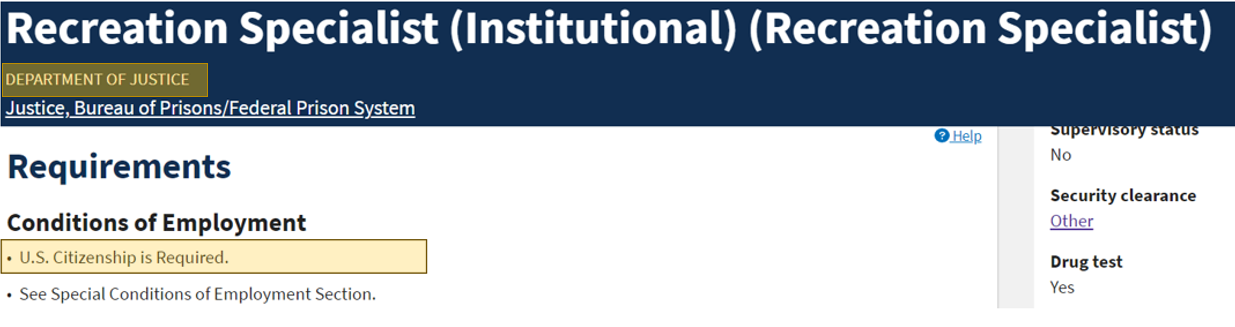
Below, for example, is an ad for a recreational specialist to work for the DOJ’s Bureau of Prisons–this is not a job involving national security!–but the ad states clearly that U.S. Citizenship is Required. Most federal government jobs, in fact, are restricted to US citizens. The Federal Reserve even requires US citizenship to get an internship.
In short, it seems that SpaceX is being singled out for punishment for a practice that is widespread in the industry and often encouraged by, sometimes required by, and usually practiced by the Federal government.
Why The United States Should Open New Consulates in India
A good piece by Michael Rubin in the National Interest:
India will likely become the most populous country on Earth this year, and, yet, outside of the U.S. Embassy in New Delhi, there are only four State Department consulates in the country of 1.4 billion. That is fewer consulates than the State Department operates in France and fewer offices than the U.S. Embassy services in Spain. The Canadian province of Quebec, whose population totals less than nine million, merits two consulates in the State Department’s view.
…The United States computer and tech industry rests disproportionately on the labor and intellectual contributions of America’s vast Indian-American community. If Silicon Valley is the center of America’s computer industry, then Bangalore is its equivalent in India. The interaction between the two is significant. And yet, while India maintains a consulate in San Francisco, the United States has no equivalent in Bangalore; the closest American post is more than 200 miles away in Chennai. It need not be an either/or decision, but at the very least the State Department should explain why maintaining an investment in Winnipeg, Canada is more important than nurturing the relationship between two of the largest tech hubs in the world.
… if U.S. diplomacy is to be effective, it needs to adjust to twenty-first-century realities rather than nineteenth-century ones.
With more consulates might we not also cut the ridiculous and embarrassing time it takes to get a US visitor or business visa? When I was last in Delhi I met with one of the economic officers at the American Embassy. His job was to drum up business between India and the US–how can anyone do that when business visas are so difficult to acquire? Talk about the land of red tape!
Hat tip: Ben.
Why Britain?
Here is a new paper by Carl Hallmann, W. Walker Hanlon, and Lukas Rosenberger, of great interest:
Why did Britain attain economic leadership during the Industrial Revolution? We argue that Britain possessed an important but underappreciated innovation advantage: British inventors worked in technologies that were more central within the innovation network. We offer a new approach for measuring the innovation network using patent data from Britain and France in the 18th and early 19th century. We show that the network influenced innovation outcomes and then demonstrate that British inventors worked in more central technologies within the innovation network than inventors from France. Then, drawing on recently-developed theoretical tools, we quantify the implications for technology growth rates in Britain compared to France. Our results indicate that the shape of the innovation network, and the location of British inventors within it, can help explain the more rapid technological growth in Britain during the Industrial Revolution.
Hallmann is on the job market from Northwestern, noting that his main paper is on labor, short-term work, and employment scarring.
Why don’t elite colleges expand supply?
Peter Q. Blair (Harvard) and Kent Smetters (U. Penn) have a new paper based on that question, here is the abstract:
While college enrollment has more-than doubled since 1970, elite colleges have barely increased supply, instead reducing admit rates. This study shows that straightforward reasons cannot explain this behavior. The authors propose a model where colleges compete on prestige, measured using relative selectivity or relative admit rates. A key comparative static of the model is that higher demand decreases [increases] the admit rate when the weight on prestige is above [below] a critical value, consistent with experience in elite [non-elite] colleges. A calibrated version of the model closely replicates the pattern in the data of declining admit rates at elite colleges while counter-factual simulations without prestige fail. Prestige competition is inefficient. Allowing elite colleges to collude on admissions strategy internalizes the non-pecuniary prestige externality and is Pareto improving.
My answer is slightly different. I do not doubt that the postulated enrollment selectivity constraint binds in the short run. Nonetheless, I think if most of the top schools really wanted to take in more students, they could do a mix of “recalibrating” the data and lobbying the college raters in such a way that would allow larger classes to happen with little or no reputational penalty.
The true constraint is the faculty. Let’s say Harvard tried to grow by 3x. They would have to hire many new professors, and those are people who could not currently obtain tenure at Harvard. (Harvard could lure those people in, and afford them, right now, but they don’t.) So Harvard tenure standards would have to fall. In addition to tolerating these “lower standards,” the current interest groups controlling Harvard departments would find their power greatly diluted by all these newcomers. And so it doesn’t happen. When “self-interest” and “high standards” coincide in the academic world, it is very difficult to defeat that. At least on academic matters, faculty governance really is the order of the day at top universities.
And so the classes at most top universities stay small. By the way, a potential faculty expansion wouldn’t even have to be with tenure and voting rights. Say Harvard econ would invite in 15 dissident economists, of varying sorts, on “long enough to carry them to retirement” sorts of “no voting rights” contracts. Those people would teach, go to seminars, and in general liven up the environment and bring greater intellectual diversity. They would over time become a force and influence of their own. And so it ain’t gonna’ happen. Harvard has to stay relatively small.
So don’t believe them the next time faculty at top schools tell you they are egalitarian. They are not with their own resources at least, though they are happy to play the game with the resources of others.
Why the quality of the police is not higher
According to the Fairfax County Fraternal Order of Police, the average starting salary for a Fairfax County cop is $52,000. The median household income in the county was $124,831 in 2019.
And:
Fairfax County Police Department is down 188 officers, according to Sean Corcoran, president of the Fairfax County Coalition of Police. Officers eligible for retirement are leaving, others are getting out to join higher paying federal agencies like the Capitol Police.
It is thus very difficult to exercise quality control. Here is the full story.
Why don’t NYPD police officers wear more masks?
While police officers may forgo mask-wearing for any number of reasons, from peer pressure within ranks that are loath to change to a desire to more easily communicate, the images have fueled a perception of the police as arrogant and dismissive of protesters’ health — perhaps even at the peril of their own.
And while several officers have conspicuously knelt down with or hugged people at rallies, the widespread failure to use masks is creating a more standoffish look, one that protesters say suggests that the police operate above the rules — one of the very beliefs motivating the nationwide movement.
“If you’re out here to protect the public, it starts with you,” said Chaka McKell, 46, a carpenter from Bedford-Stuyvesant who attended a protest in Downtown Brooklyn on Monday. “The head sets the example for the tail.”
The official New York Police Department policy is that officers should wear masks when interacting with the public. But in a statement on Wednesday, the department dismissed the criticism about the lack of masks as petty.
“Perhaps it was the heat,” Sgt. Jessica McRorie of the department’s press office said in a statement. “Perhaps it was the 15 hour tours, wearing bullet resistant vests in the sun. Perhaps it was the helmets. With everything New York City has been through in the past two weeks and everything we are working toward together, we can put our energy to a better use.”
“In a nutshell,” as they say, and here is the full NYT piece. This short vignette reflects two basic truths: first, there is a tendency to see oneself above at least some of the laws, and to follow defined procedures only selectively. Second, given the resources and constraints put on the table, such attitudes should not be entirely surprising.