Results for “markets in everything” 1895 found
Artisanal funeral markets in everything
With an increasing demand among baby boomers for customized funerals that reflect the individuality of the deceased, funeral directors are expanding into the business of event production. Today’s funeral director might stage a memorial service featuring the release of butterflies at the grave site, or with the deceased’s Harley parked ceremonially at the entrance to the chapel. In such instances, the skills of a funeral director can seem to fall somewhere between those of a nurse and a wedding planner. Mortuary Management, a trade magazine, offers articles about such innovations as the tribute blanket—an instant heirloom that incorporates photographs of the deceased into a custom-made tapestry—and urges funeral directors to be open-minded when faced with families who want pop songs played at a service. It’s a profitable strategy to, as a feeble witticism of the industry has it, “put the fun back into funerals.”
There is more from here from Rebecca Mead. I liked this exchange too:
“Who is going to follow a funeral home’s Twitter account, really?” one participant asked.
“Weirdos,” someone replied.
“Competitors,” added another.
Interesting throughout, as they say.
Markets in everything, tangled and untangled
Many knitters find their craft a tranquil and even meditative pastime—until knots and tangles in their yarn send them into a fury. But for one group of fanatics, there is nothing more satisfying than a hopelessly tangled web.
Daphne Basnet of Melbourne, Australia, once paid about $50 on eBay for a 25-pound box of snarled yarn, simply for the pleasure of untangling it. “I was so happy, I can’t tell you,” recalls the 58-year-old of her purchase, a mess of about 120 knotted balls.
…Finding such tangled treats got easier when Ms. Basnet joined Knot a Problem, a seven-year-old group of more than 2,100 “detanglers” on the online community for knitters and crocheters called Ravelry. Frustrated yarn-lovers from around the world post pleas for help undoing their knottiest knots, often created by children, pets or yarn-winding mishaps.
Devoted detanglers typically offer to take on the projects for the cost of shipping. Competition for the most maddening messes can be fierce. Some members check the group every day.
“People will jump in and say, ‘Send it to me!’ ” says Mary Enright, 56, a detangler from Sioux Falls, S.D.
Some of you may be saying “OK…” but I am more along the lines of “who am I to judge?” And there is this:
Group members like to post before-and-after photos of what they call “tangle porn.” Heaps of yarn resembling bowls of spaghetti become neat balls and cakes. “I think it’s fulfilling for people when they see what it was, sort of like house remodeling,” says Ms. Rothschild. “You see how crappy it was and how beautiful it turned out to be.”
And if you are looking for further signs of dedication:
About a dozen hard-core members celebrated by sending each other yarn to untangle, knotting up new skeins themselves if they had to.
For the pointer to the article I thank Peter Metrinko.
Markets in everything there is no great media stagnation
Netflix has built socks that read your body to understand when you fall asleep, and then automatically pause your Netflix show.
There is more here, via the excellent Samir Varma.
Sentences to ponder under-discussed markets in everything
Kenya Hathaway, a musician and vocal coach for television shows, has never talked with her husband about celebrity nannies, even in light of the unraveling marriages of the Afflecks and Rossdales.
There is more here, via the sharp-eyed Felix Salmon. The NYT article is interesting throughout, with many good bits.
Middle eastern barter markets in everything
Against Salafist jihadis in Sinai, as well as Hamas in Gaza, Egypt and Israel are working together more closely than at any time since the peace treaty was signed. In many respects Egypt and Israel now consider themselves to be closer allies to each other than each is to the United States. Jordan recognises that Israel is a guarantor of its security, the regional power most likely to intervene on its behalf should it face a serious threat.
That is from Nathan Thrall at LRB.
Cargo cruise markets in everything
In recent years, big cruise operators such as Carnival, Royal Caribbean, and Star Cruises have spent heavily on soaring atriums, sushi bars, cabaret shows, and on-deck water slides to woo vacationers. Don’t tell that to John McGuffick, who’s spent months at a time at sea on cargo vessels—happily ensconced in quarters more suited to a Trappist monk than a Caribbean cruiser.
“The food can be pretty ordinary, and you have to be prepared to go with the flow,” says the 72-year-old retired farmer from Australia whose 10 trips via ocean freighter have taken him to dozens of ports across Asia, Europe, and North America. His personal maritime endurance record: 110 days nonstop from Dunkirk, in northern France, to Singapore. Explains McGuffick: “I like the solitude.”
Shipping companies like the dollars passengers such as McGuffick can bring aboard. In a slowing global economy, freight prices have fallen so far that hauling a person from Shanghai to Rotterdam brings in at least 10 times more revenue than a 20-foot container full of flat-packed furniture.
It’s not luxurious and not exactly cheap: About $115 a day secures travelers a bed and three meals on some of the largest vessels ever built. The handful of paying passengers—ships typically take no more than a dozen at a time—dine with the crew, have the run of most of the ship, and can chat up the captain on the bridge or engineers below deck.
The story is here, and I thank Stu Harty for the pointer. But beware: you have to wash your own clothes, and your window view might be blocked by shipping containers.
Marxian markets in everything, cemetery edition
On a summer visit to the grave of Karl Marx, Ben Gliniecki found that he would have to pay £4, or about $6, to pay respects to the man who sounded the death knell for private property.
Mr. Gliniecki, a Marxist, said no.
“Personally, I think it is disgusting,” the 24-year-old political activist said. “There are no depths of irony, or bad taste, to which capitalists won’t sink if they think they can make money out of it.”
The charity that looks after this cemetery has long taken swipe at a different irony: Karl Marx’s decision to buy a burial plot in a private London graveyard over the then state-provided alternatives. They say their cover fee subsidizes the upkeep of a cemetery where 170,000 other people rest.
And note this:
The German philosopher…once predicted the “hot tears of noble people” would be shed over his ashes…
The WSJ article is here, via Vic Sarjoo.
Division of labor markets in everything is science broken after all?
There is a growing industry where publication consultants will work with authors, research groups or even institutions to help get their work published, or help submit their dissertation/thesis. This help can range from proof reading, data collection, analysis (including statistics), helping with the literature review and identifying suitable journals/conferences.
That is from a new PubMed paper, via Neuroskeptic.
The wedding culture that is Argentina markets in everything metaphors of decline
With fewer and fewer young Argentinians getting married for real, groups of friends in their 20s and 30s are instead paying around $50 (£32) each to attend staged events.
“It all started two years ago with a group of friends: we realized we hadn’t been to a wedding in a long time because hardly anybody is getting married anymore,” says 26-year-old publicist Martín Acerbi. Together with four friends from the university town of La Plata, 32 miles (50km) south of the capital city of Buenos Aires, Acerbi decided to organize a fake wedding instead.
To their surprise the event was a roaring success, and the one-off wedding became a business: Acerbi and his friends founded the Falsa Boda company in November 2013 – and have had steady work ever since.
The company hires real wedding locations, caterers and DJs for the parties, Acerbi said. “These wedding professionals have become our strategic allies, we organize it like it’s the real thing, except the marriage itself is fake,” he said.
Hired actors play the bride, groom and a surprise third party: a spurned lover or secret boyfriend who arrives “unexpectedly” – and with dramatic results.
“Our guests get all the fun of a wedding party with none of the commitment, or the problem of finding someone who is actually getting married,” says Acerbi.
A typical “fake wedding” hosts about 600 or 700 paying guests, with soap-opera style drama and a party lasting until 6am the next morning – the normal timetable for a real wedding in hard-partying Argentina.
The full story is here.
Detroit squatter markets in everything
Wanted: One good squatter.
It’s no joke. In a remote pocket of northwest Detroit along the Rouge River, neighbors are so desperate to stop a cycle of abandonment and blight they’re recruiting a squatter to occupy a home whose longtime owners left last weekend.
That’s because neighbors fear the onetime farmhouse on Puritan and Hazelton will be stripped and torched if it remains empty for long. Eight nearby houses burned in the past two years. A few blocks away, there are more weedy lots than homes.
A co-founder of one neighborhood group explained:
“You want someone in the house when it’s still functioning. Otherwise, it will be destroyed in 24 hours.”
In this case the homeowners are asking potential squatters for references, so as to avoid drug dealer squatters. How about some Syrian squatters?
Technically, squatting in Detroit is against the law but it is often tolerated. But not all settlement attempts pass legal muster:
“The over-arching theme is that the city of Detroit does nothing, so we’re forced to do our own thing,” said Brown, 34, a Wayne County Community College professor.
Brown also made headlines last year. That’s when she and her husband, David, bought a $2,000 house in the neighborhood in hopes of forming a kibbutz, a Jewish communal settlement. City officials seized backyard goats and charged the couple with violating ordinances.
The full article is here, hat tip goes to a loyal MR reader.
Refugee markets in everything
The annual report in 2013 from a multibillion-dollar London private-equity firm that counts a French pastry baker and a Dutch shoemaker among its holdings touted a new opportunity with “promising organic and acquisitive growth potential.”
That investment was the management of refugee camps.
“The margins are very low,” said Willy Koch, the retired founder of the Swiss company, ORS Service AG, which runs a camp in Austria that overflowed this summer with migrants who crossed from the Balkans and Hungary. “One of the keys is, certainly, volume.”
The WSJ story is here, or maybe here. And here is a related business:
In Sweden, the government paid a language-analysis firm $900,000 last year to verify asylum-seekers’ claims of where they were from.
Look for more stories along these lines. Hat tip goes to Hugo Lindgren.
Auction markets in everything
Elephants, giraffes, lemurs, and even a cockroach at the Oakland Zoo have been exploring their creative sides to produce colorful paintings that will be auctioned for charity.
The painting sessions were conducted by zoo keepers who used only positive-reinforcement, including plenty of treats, as they worked with the animals, zoo spokeswoman Nicky Mora said.
Elephants were helped to hold paintbrushes in their trunks and giraffes in their mouths and produced their artwork one stroke at a time. Goats, lemurs, and meerkats had their hooves, paws or claws dabbed with nontoxic, water-based paint and ran over a blank sheet of poster board while chasing a treat.
Thirty-two of the works will be auctioned on eBay starting Thursday.
Andy, a Madagascar hissing cockroach, scurried around a canvas and the result was a piece in purple, green and yellow tones.
Maggie, a Nigerian dwarf goat, had her hooves dipped in blue, green and yellow paint and the keeper coaxed her with snacks to walk on a canvas.
I recall once reading that de Kooning was quite impressed by the paintings of an elephant. There is more here.
Markets in everything those new service sector jobs
Sosa is a gynecological teaching associate, and she holds one of modern medicine’s most awkward jobs, using her body to guide med students through some of its most delicate, dreaded exams. Every week, she lies back for dozens of the next medical generation’s first pelvic and breast screenings, steering gloved fingers through the mysteries of her own anatomy and relaying the in-depth feedback they’ll need out in the wild.
She is not, in the traditional sense, a medical professional herself: A 31-year-old theater actor, she has also worked recent jobs at a bakery and Barnes & Noble. Yet what she lacks in faculty prestige, she and her compatriots — including a squad of male urological teaching associates, who teach genital and prostate exams — make up for in humor, candor and endurance. For nervous students, she is like an enthusiastic surgical dummy, awake through the operation and cheering them on…
In New York and Los Angeles, the simulated patients are often actors; here, in eastern Virginia, they are part-time or former professors, baristas, retail workers and house spouses, all contract workers paid by the session, and not extraordinarily so. Gliva-McConvey, the program director, said wages were confidential but added, “All I can say is, we don’t pay them enough.”
Vocabulary becomes hugely important to avoiding clumsy wording. Teachers are taught to neutralize sexual language — it’s a “table,” not a “bed”; a “drape,” not a “sheet” — and cut back on awkward phrases: Say “footrests” instead of the too-equestrian “stirrups”; “lots of pressure” instead of “this is going to hurt.” Students aren’t supposed to “grab,” “stick in” or “pull out” anything, though in the moment, instructor Kelene Williams said with a laugh, “sometimes neutral doesn’t come out.”
The article is…unsettling…throughout, kudos to Drew Harwell, and I thank M. for the pointer.
Forthcoming Uighur markets in everything
Another sign on the door says that a new restaurant will be replacing Charlie Chiang’s and will be “opening soon.”
The new restaurant will be called Amannisahan and will serve Uyghur cuisine, according to the sign. In an indication that a quick reopening may indeed be in the works, Amannisahan says it’s currently hiring restaurant managers and waiters.
Take that Bryan Caplan! And that’s for Crystal City, VA, by the way here is the Jorma Kaukonen song.
For the pointer I thank Michael Makowsky.
Cryotherapy markets in everything
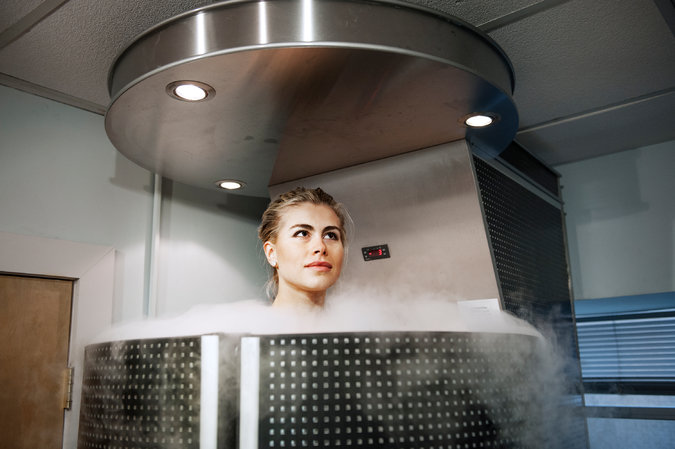
While Anastasia Garvey, an actress and model, doesn’t have office pressure, she says she is constantly on edge wondering if she’ll get a certain job. She has developed a regimen of ways to disconnect: meditation, acupuncture, cupping therapy, monthly trips to a reservation-only spa and most recently cryotherapy — as in spending some time being blasted by air cooled to minus 260 degrees.
It only lasts three minutes, plus time to warm up again on a stationary bike, but it costs $90 a session, she said. She goes three times a week.
“The first time I did it I couldn’t remember my name,” she said. “You’re in a freezer. You’re so cold you can’t think of anything.”
There are many interesting ideas and bits in this NYT Paul Sullivan piece: “As for the seeming contradiction of the Buddhist boxer…”