Results for “those new service sector jobs” 205 found
My Free Press column on Moltbook
Here is the link, excerpt:
The reality of bot communication is more mundane than the most extreme examples online make it sound. AI expert Rohit Krishnan measured their conversations and found that they gravitate to the same few subjects.
“LLMs [large language models] LOVE to talk about the same stuff over and over again, they have favorite motifs that they return to,” Krishnan writes. Does that sound like any humans you know? They frequently repeat themselves and each other, with just small variations. And a relatively small percentage of the bots are doing a high share of the talking. Made in our own image, indeed.
What we have done with these agents is to create self-reinforcing loops that keep responding to each other. If enough time passes, as with humans, the bots will end up saying virtually everything, including conspiracy talk. Expect highly unpleasant political views to follow, as well as peacenik chatter and plans for love-ins. They will have favorite heavy-metal songs, too, some of them with satanic themes.
Over the course of 2026, I expect that there will be analogous AI-run networks, created by humans (as Moltbook was) or by bots themselves. Imagine a bot that calls up an AI music generator like Suno and asks for a new Renaissance choral tune but sung in Guarani, and then shares it with the other bots (and some humans) on a bot network devoted to music composition. Or how about a site where the AIs comment on various Free Press articles?
By the way, the bot who wrote me looking for work is now a verified story. The bot’s “owner” apologized, and offered a full explanation, though I said I was delighted to receive the message. Here is an update from Scott Alexander.
Friday assorted links
1. Those semi-new service sector jobs how to get people to leave a cult.
2. What was Alice Munro actually writing about? So often people are writing about themselves.
3. The New Yorker on Paul Collier and Britain.
4. Claims about LLMs and stock returns.
5. Live version of “I Hear a Symphony,” you can skip the thirty second intro.
6. The Harvard endowment’s single biggest public investment is now Bitcoin.
Sunday assorted links
1. Context is that which is scarce Africa and mining.
2. Refine, a new tool for research papers.
3. Conservative renaissance at Stanford?
4. Growing up with economic growth makes you trust government more.
5. Those old and new service sector jobs.
6. What is psychological solipsism correlated with?
7. Early Justin Wolfers piece on point shaving in NCAA basketball.
Michael Clemens on H1-B visas
From 1990 to 2010, rising numbers of H-1B holders caused 30–50 percent of all productivity growth in the US economy. This means that the jobs and wages of most Americans depend in some measure on these workers.
The specialized workers who enter on this visa fuel high-tech, high-growth sectors of the 21st century economy with skills like computer programming, engineering, medicine, basic science, and financial analysis. Growth in those sectors sparks demand for construction, food services, child care, and a constellation of other goods and services. That creates employment opportunities for native workers in all sectors and at all levels of education.
This is not from a textbook narrative or a computer model. It is what happened in the real world following past, large changes in H-1B visa restrictions. For example, Congress tripled the annual limit on H-1B visas after 1998, then slashed it by 56 percent after 2004. That produced large, sudden shocks to the number of these workers in some US cities relative to others. Economists traced what happened to various economic indicators in the most-affected cities versus the least-affected but otherwise similar cities. The best research exhaustively ruled out other, confounding forces.
That’s how we know that workers on H-1B visas cause dynamism and opportunity for natives. They cause more patenting of new inventions, ideas that create new products and even new industries. They cause entrepreneurs to found more (and more successful) high-growth startup firms. The resulting productivity growth causes more higher-paying jobs for native workers, both with and without a college education, across all sectors. American firms able to hire more H-1B workers grow more, generating far more jobs inside and outside the firm than the foreign workers take.
An important, rigorous new study found the firms that win a government lottery allowing them to hire H-1B workers produce 27 percent more than otherwise-identical firms that don’t win, employing more immigrants but no fewer US natives—thus expanding the economy outside their own walls. So, when an influx of H-1B workers raised a US city’s share of foreign tech workers by 1 percentage point during 1990–2010, that caused7 percent to 8 percent higher wages for college-educated workers and 3 percent to 4 percent higher wages for workers without any college education.
Here is the full piece.
The history of American corporate nationalization
I wrote this passage some while ago, but never published the underlying project:
The American Constitution is hostile to nationalization at a fundamental level. The Fifth Amendment prohibits government “takings” without just compensation to the owners, and that is sometimes called the “takings clause.” Since the United States did not start off with a large number of state-owned enterprises, there is no simple and legal way for the country to get from here to there. Government nationalization of private companies would prove expensive, most of all to the government itself. More importantly, the strength of American corporate interests has taken away any possible pressures to eliminate or ignore this amendment.
The lack of interest in state-owned enterprises reflects some broader features of the United States, most of all a kind of messiness and pluralism of control. An extreme federalism has bred a large number of regulators at federal, state, and local levels, often with overlapping jurisdictions. Each level of government digs its claws into the regulatory morass, and not always for the better, but this preempts nationalization, which would centralize power and control in one level of government. That is not the American way.
A tradition of strong state-level regulation was built up during the mid- to late 19th century, when the federal government did not have the resources, the reach, or the scope to do much nationalizing. America developed some very large national commercial enterprises, such as the railroads, Bell (a phone company), and Western Union (a communications and wire service), which were quite large and far-ranging before the federal government itself had reached a mature size. At that time local government accounted for about half of all government spending in the country and the federal government had few powers of regulation. It wasn’t quite laissez-faire, but America could not rely on its federal government and this shaped the later evolution of the country. To handle these booming corporate entities, America created more state-level regulation of business than was typical for the other industrializing Western countries. That steered Americans away from nationalization as a means for distributing political benefits or disciplining corporations[1]
This policy decision to rely so much on multiple levels of federalistic regulation comes with a price. American failures in physical infrastructure have been the other side of the coin of American successes in business. A strong rule of law, combined with so many legal checks and balances and blocking points, has carved out a protected space for private American businesses. They can operate with relatively secure property rights. At the same time, those same laws and blocking points make it hard to get a lot of things built when a change in property rights is required, whether government or business or both are doing the building. The law is used to obstruct growth and change, and for NIMBYism — “Not In My Backward,” and more generally for giving any litigation-ready interest group a voice in any decision it cares about. Can you imagine a sentence like this being written about China?: “The [New York and New Jersey] Port Authority sent out letters inviting tribe representatives to join the environmental review project, inviting the Shawnee Tribe of Oklahoma and the Sand Hills Nation of Nebraska.”[2]
In America background patriotism sustains a rule by general national consensus, and so the American government doesn’t need extensive state-owned companies to build or maintain political support through the creation of so many privileged insiders. The American paradox is this: the reliance on the law reflects a relatively strong and legitimate government, but the multiplication of that law renders government ineffective in a lot of practical matters, especially when it comes to the proverbial “getting things done,” a dimension where the Chinese government has been especially strong.
You should note that although the United States has not so many state-owned enterprises, the American government still has ways of expressing its will on business, or as the case may be, favoring one set of businesses over another. In these latter cases it can be said that American business is expressing its will over government through forms of crony capitalism, a concept which is spreading in both America and China.
The United States has evolved a subtle brand of corporatism and industrial policy that is mostly decentralized and also – this is an important point — relatively stable across shifts of political power. America uses its large country privileges to maintain access to world markets and to protect the property rights of its investors, usually without much regard for whether they are Democrats or Republicans. For instance the State Department works hard to maintain open world markets for films and other cultural goods and services. Toward this end America has used trade negotiations, diplomatic leverage, foreign aid, and also explicit arm-twisting, based on its military commitments to protect allied nations in Western Europe and East Asia. America already had successful entertainment producers, it just wanted to make sure they could earn more money abroad, and that is why the American government usually insists on open access for audiovisual products when it negotiates free trade treaties. Yet in these deals there is not much if any explicit favoritism for one movie or television studio over another, or for one political alliance over another. Democrats are disproportionately overrepresented in Hollywood, but Republican administrations protect the interests of the American entertainment sector nonetheless. It’s about the money and the jobs, not about shifting political coalitions. You’ll note that the independence from particular political coalitions gives the American business environment a particular stability and predictability, to its advantage internationally and otherwise.
[1] See Millward (2013, chapter nine, and p.222 on chartering powers).
[2] That is from Howard (2014, p.10).
Contemporary TC again: Let us hope that I was at least partially correct…
The Rising Cost of Child and Pet Day Care
Everyone talks about the soaring cost of child care (e.g. here, here and here), but have you looked at the soaring cost of pet care? On a recent trip, it cost me about $82 per day to board my dog (a bit less with multi-day discounts). And no, that is not high for northern VA and that price does not include any fancy options or treats! Doggie boarding costs about about the same as staying in a Motel 6.
Many explanations have been offered for rising child care costs. The Institute for Family Studies, for example, shows that prices rise with regulations like “group sizes, child-to-staff ratios, required annual training hours, and minimum educational requirements for teachers and center directors.” I don’t deny that regulation raises prices—places with more regulation have higher costs—but I don’t think that explains the slow, steady price increase over time. As with health care and education, the better explanation is the Baumol effect, as I argued in my book (with Helland) Why Are the Prices So Damn High?
Pet care is less regulated than child care, but it too is subject to the Baumol effect. So how do price trends compare? Are they radically different or surprisingly similar? Here are the two raw price trends for pet services (CUUR0000SS62053) and for (child) Day care and preschool (CUUR0000SEEB03). Pet services covers boarding, daycare, pet sitting, walking, obedience training, grooming but veterinary care is excluded from this series so it is comparable to that for child care.
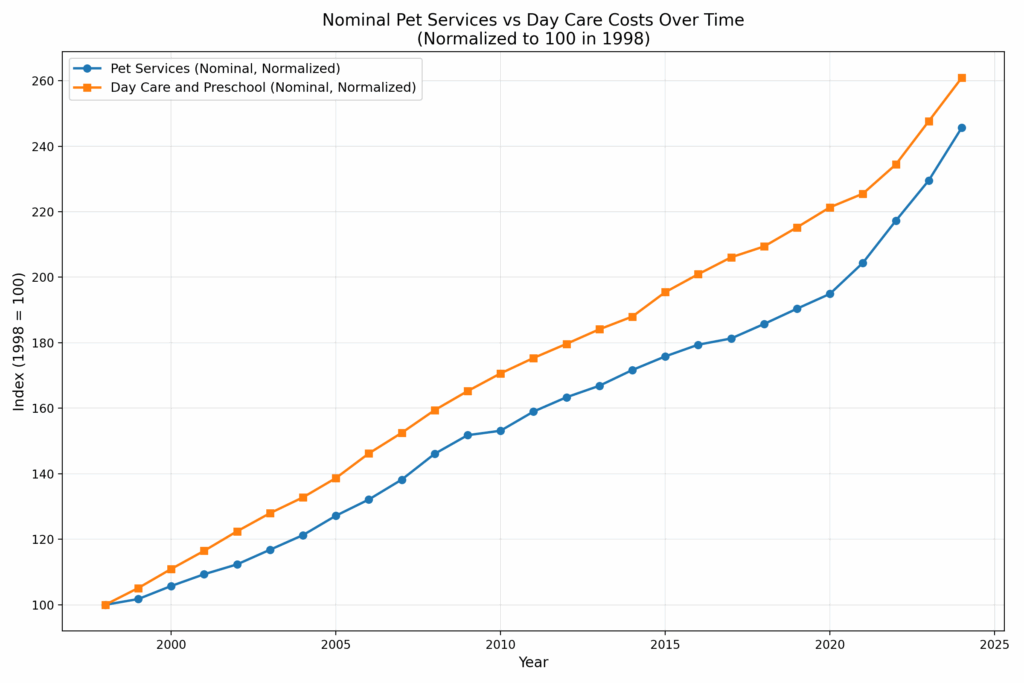
As you can see, the trends are nearly identical, with child care rising only slightly faster than pet care over the past 26 years. Of course, both trends include general inflation, which visually narrows the gap. When we normalize to the overall CPI, we get the following:
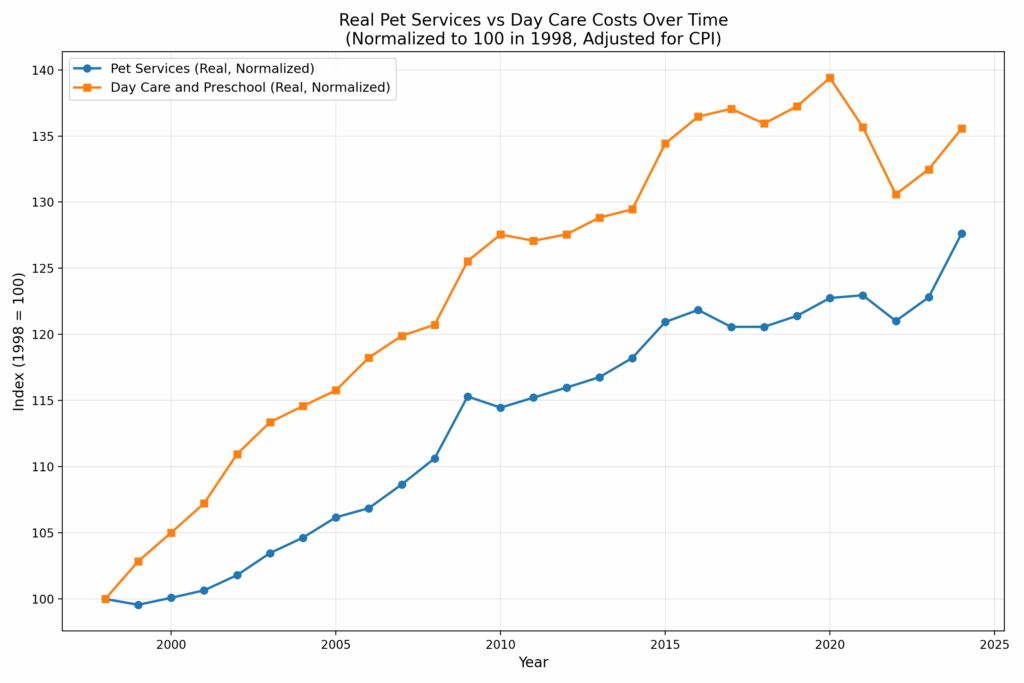
Over 26 years, the real (relative) price of Day Care and Preschool has increased 36%, while Pet Services have risen 28%. If regulation doesn’t explain the rise in pet care costs–and it probably doesn’t–then regulation probably doesn’t explain the rise in child care costs either. After all, child and pet care are very similar goods!
The similar rise in the price of child day care and pet day care/boarding is consistent with Is American Pet Health Care (Also) Uniquely Inefficient? by Einav, Finkelstein and Gupta, who find that spending on veterinary care is rising at about the same rate as spending on human health care. Since the regulatory systems of pet and human health care are very different this suggests that the fundamental reason for rising health care isn’t regulation but rising relative prices and increasing incomes (fyi this is also an important reason why Americans spend more on health care than Europeans).
Thus, my explanation for rising prices in child care and pet care is that productivity is increasing in other industries more than in the care industries which means that over time we must give up more of other goods to get child and pet care. In short, if productivity in other sectors rises while child/pet care productivity stays flat, relative prices must rise. Another way to put this is that to retain workers, wages in stagnant-productivity sectors must rise to match those in (equally labor-skilled) high-productivity sectors. That means paying more for the same level of care, simply to keep the labor force from leaving
But rising productivity in other sectors is good! Thus, I always refer to the Baumol effect rather than the “cost disease” because higher prices are not bad when they reflect changes in relative prices. As with education and health care the rising price of child and pet care isn’t a problem for society as whole. We are richer and can afford more of all goods. It can be a problem, however, for people who consume more than the average quantities of the service-sector goods and people who have lower than average wage gains. So what can we do? Redistribution is one possibility.
If we focus on the prices, the core problem is that care work is labor-intensive and labor has a high opportunity cost. One solution is to lower the opportunity cost of that labor. Low-skill immigration helps: when lower-wage workers take on support roles, higher-wage workers can focus on higher-value tasks. As I’ve put it, “The immigrant who mows the lawn of the nuclear physicist indirectly helps to unlock the secrets of the universe.” Same for the immigrant who provides boarding for the pets of the nuclear physicist.
Another solution is capital substitution—automation, AI, better tools. But care jobs resist mechanization; that’s part of why productivity growth is so slow in these sectors. Still, the basic truth remains: if we want more affordable day care—for kids or pets—we need to use less of what’s expensive: skilled labor. That means either importing more people to do the work, or investing harder in ways to do it with fewer hands.
Monday assorted links
1. Getting AI data centres in the UK.
2. Those new pillowfighting service sector jobs.
3. Exchange rates really matter (Sarah Gertler).
4. Ben Affleck on AI and the movies.
5. New predictions from John Gray.
6. Human in a bear suit used to defraud insurance companies (NYT).
Monday assorted links
1. Those new Chinese service sector jobs.
2. New Robin Hanson project: first futarchy on Ethereum.
3. Claims about how the two parties have evolved (speculative).
4. Can Singapore regulate its cats? (NYT)
Tuesday assorted links
1. Marc Nerlove has passed away.
2. Those new Strava jockey service sector jobs.
3. Polostan, new Neal Stephenson novel, with nuclear themes.
4. Mental health AI app with capybaras, it is definitely happening.
5. How cost-effective is the new R21 vaccine compared to existing malaria interventions? Quite effective.
6. Creating space in space: “Their main product is a furnace that will manufacture glass spheres from lunar regolith, which is rich in silicate.”
7. Good FT story on just how premature the EU AI regulation was.
Why France is underrated
That is the topic of my latest Bloomberg column, here is one bit:
Since the West European economic boom ended in the 1970s, the French civil service has been at best a mixed blessing. French administrators have gotten a lot done, reflecting their impeccable education and internal culture. But they have also helped to make the French economy overly static and too reliant on bureaucracy. A lazier, less activist civil service might have been better.
Fast forward to 2023. War and conflict are now more common on the global scene, a trend that shows no signs of abating. Populist governments are on the rise, and China and Russia are active and restless. None of those problems is easy to solve, and they all require greater involvement from the public sector. Nations with high-quality leadership and civil-service traditions will stand a better chance of navigating the turmoil.
So the bureaucracy that was once a hindrance to France may now turn out to be a comparative advantage. And at a time when governance seems to be deteriorating around the world, Macron continues to have a reputation as a relatively responsible leader.
This year has shown how this advantage plays out. Post-pandemic France has been a bit of a mix, with soaring energy prices, inflation, rising interest rates, continuation of the Ukraine war, labor strikes and protests, and a variety of European migration crises. Yet France avoided a credit downgrade and the French economy continued to create more jobs. Performance has hardly been perfect and the risk of recession remains, but France has done better than might have been expected 18 months ago.
I also consider the relatively successful French start-up scene, including in AI.
Saturday assorted links
1. Those new, super-duper specific service sector jobs, Federal Reserve edition.
2. The culture that is Korean email etiquette — “suffer a lot.”
3. The rise of the “extremely productive” researcher — a paper every five days? (Did they suffer a lot?)
4. Phil Magness appointed to a chair at the Independent Institute.
5. Preliminary results against lupus and other autoimmune diseases.
Sunday assorted links
1. Beauty induces higher stock market participation and thus higher returns.
2. “Afuera!”
3. Sri Lankan food is becoming more popular.
4. Those old service sector jobs. Circa 1933, with Einstein.
5. The new Katherine Rundell book (UK only) is receiving rave reviews (Times of London).
6. New Knausgaard novel is coming.
7. Markets in everything, security breach division, dept. of uh-oh.
Saturday assorted links
How much smaller will big business become?
At least on the tech side:
Consider the most prestigious service that generates images using AI, a company called Midjourney. It has a total of 11 full-time employees. Perhaps more are on the way, but that is remarkably few workers for a company that is becoming widely known in its field.
Part of the trick, of course, is that a lot of the work is done by computers and artificial intelligence. I don’t think this will lead to mass unemployment, because history shows that workers have typically managed to move from automating sectors into new and growing ones. But if some of the new job-creating sectors are personal services such as elder care, those jobs are typically in smaller and more local firms. That means fewer Americans working for big business.
Or consider ChatGPT, which has been described as the most rapidly growing consumer technology product in history. It is produced by OpenAI, headquartered in San Francisco. By one recent estimate the company has about 375 employees. By contrast, Meta, even after some layoffs, currently has more than 60,000.
Perhaps cloud computing will be run through a few mega-firms such as Microsoft and Amazon, but — due largely to AI — we can expect many firms to radically shrink in size?
Here is the rest of my Bloomberg column.
Saturday assorted links
1. “Looking for work, they stumbled upon an audition call at Dive Bar, and emerged into the world of professional mermaidhood.” Those new (old?) service sector jobs…
2. Timeline of the Sober Curious movement.
3. Various short essays on Adam Smith.
4. Andrew Batson best music of 2022.
5. The Economist on The Repugnant Conclusion.
6. Okie-Dokie.
7. “For much of her career, Mary Waisanen, a 43-year-old structural engineering technician in Virginia Beach, Va., would say yes when asked to work overtime to meet deadlines. The extra hours brought her a pay bump. But after watching TikToks about how to reach a healthy work-life balance, she says, she realized that she shouldn’t need to work extra hours to make ends meet.” WSJ link.