Year: 2016
Tuesday assorted links
1. “Streaming, brought to you by jets.”
2. The Welfare Trait: “Over the past five years, he has accumulated a mass of evidence about the personalities of welfare claimants and concluded that individuals with aggressive, rule-breaking and anti-social tendencies — what he calls the ‘employment–resistant personality profile’ — are over-represented among benefit recipients.”
3. The Animal Soul project (photos).
4. Those new service sector jobs: “Yukigassen is professional snowball fighting…”
6. “Can Wisconsin make a sex offender who’s completed his sentence wear a GPS monitor on his ankle for the rest of his life?” Posner says yes.
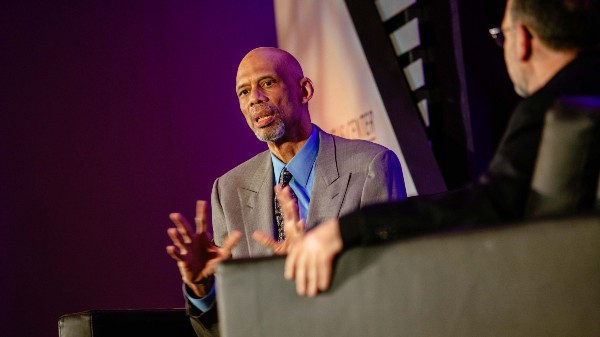
My conversation with Kareem Abdul-Jabbar
Here is the video, the podcast, and the transcript. Kareem really opened up. Here is the summary:
Kareem Abdul-Jabbar joins Tyler Cowen for a conversation on segregation, Islam, Harlem vs. LA, Earl Manigault, jazz, fighting Bruce Lee, Kareem’s conservatism, dancing with Thelonious Monk, and why no one today can shoot a skyhook.
Maybe you think of Kareem as a basketball player, but here is my introduction:
Kareem Abdul-Jabbar is one of America’s leading public intellectuals. I would describe him as an offshoot of the Harlem Renaissance, and what he and I share in common is a fascination with the character of Mycroft Holmes, the subject of Kareem’s latest book — and that of course, is Sherlock Holmes’s brother.
Here is Kareem:
I did know Amiri [Baraka]. I think the difference is I believe in what happened in Europe during what they call the Enlightenment. That needs to happen to black Americans, absolutely a type of enlightenment where they get a grasp of what is afflicting them and what the cures are.
I think that the American model is the best in the world but in order to get everybody involved in it we have to have it open to everyone. That hasn’t always been the case.
The most under-appreciated Miles Davis album?
For me [Kareem], the most under-appreciated one is Seven Steps to Heaven. And that shows, I think, Miles’ best group. There’s a big argument, what was Miles’ best group, the one that had Cannonball Adderley, Coltrane, Bill Evans, and Philly Joe Jones and Red Garland or Herbie Hancock, Ron Carter, Tony Williams, and Wayne Shorter?…number two is Porgy and Bess.
He cites Chester Himes as the underappreciated figure of the Harlem Renaissance. And Kareem thinks like an economist:
It [my instruction] was going well with Andrew Bynum, but Andrew finally got to sign his contract for $50 million, and then at that point Andrew thought that I didn’t know anything and that he didn’t have to listen to me, and we don’t know where Andrew is right now.
Read or hear also his very interesting remarks on Islam, and where its next Enlightenment is likely to come from, not to mention Kareem on the resource curse and of course his new book (and my Straussian read of it). And Kareem on his favorite movies, starting with The Maltese Falcon. Self-recommending!
Singapore fact of the day
A majority of the top dividend-paying stocks on the Straits Times Index are government-linked…
This Andy Mukherjee piece makes numerous good points about the current problems faced by Singapore, more than just the usual and focusing on the internal, and the difficulties of maintaining an adequate level of competition in the economy.
As I’ve said before, when you examine flows — such as government spending as a percentage of gdp — Singapore looks and indeed is quite free market. When you consider stocks and wealth…well, that is a very different story. Singapore has a strong market-oriented component, but it is not a free market miracle.
Time inconsistent, semi-fraudulent locksmiths and their enemies
I found this David Segal NYT article difficult to summarize, and surely it was difficult to title, but I found it one of the most interesting pieces I have read in weeks. Allow me to start in the middle:
To fight lead gens, Google deploys a little-known army of volunteers, called Mappers, many of whom are engaged in a contest that takes wit and stamina. These are people around the world who propose and approve edits to Google Maps, with an assist from Google employees, all in the interest of refining the product and fighting spam — a term that in this context means anything fake and misleading.
It may seem bizarre that people would work gratis for one of the world’s richest companies. But many Mappers turn the job into a calling. For Dan Austin, who lives in Olympia, Wash., it was more like an addiction.
A former truck driver for DHL, he became a Mapper after he was laid off from his job and started fixing mistakes he had noticed on Maps while on the road. By the fall of 2011, Mr. Austin had discovered locksmith spam and was soon spending 10 hours a day, seven days a week, deleting it from Maps.
The premise is this:
The goal of lead gens is to wrest as much money as possible from every customer, according to lawsuits. The typical approach is for a phone representative to offer an estimate [for locksmith work] in the range of $35 to $90. On site, the subcontractor demands three or four times that sum, often claiming that the work was more complicated than expected. Most consumers simply blanch and pay up, in part because they are eager to get into their homes or cars.
Here is another bit from the middle:
Mr. Alverado said those fake buildings were necessary because getting to the first page in Google results now took ingenuity and cunning.
“You have no idea,” he said, sounding a little weary when asked about competition. Israelis were his toughest rivals, he said, and they had instilled a kind of awe in him. “I can tell you point-blank, they are freaking smart,” he said. “I really admire them.”
Every single paragraph is interesting in a different and substantive way, an almost impossible achievement for a piece.
For the pointer I thank the excellent Samir Varma.
Monday assorted links
1. Diane Coyle: which books should the well-educated student read?
2. MIE: Conbody.com.
3. There is no great stagnation what would Macbeth say levitating bonsai trees.
4. ““THOUGH TACOS ARE EXPLICITLY NAMED IN THE COURSE, THEY NEED NOT BE THE FOCUS FOR YOUR RESEARCH.” Link here.
5. Blanchard and Gagnon: “…in terms of their expected value, stocks are not overpriced today.” The second link, however, is mine.
In the drone wars, the eagles swing the balance of power back toward the Dutch
As tech firms and law enforcement experiment with radio jammers and net-wielding interceptor drones to take down rogue quadcopters, police in the Netherlands are trialling a simpler solution: eagles. The country’s law enforcement has teamed up with a raptor training company named Guard From Above to see if birds of prey can be used to safely intercept quadcopters.
In the video demonstration above, an eagle is seen easily plucking what looks like a DJI Phantom out of the air. However, it’s not clear how dangerous this is for the bird.
File under “But at a price.”
The article is here, with an excellent video, and for the pointer I thank @alsoyourbrother.
Economics on Buying vs Renting a House
I was asked on Quora What do economists think about buying vs renting a house? Here’s my answer:
Housing is overrated as a financial investment. First, it’s not good to have a significant share of your wealth locked into a single asset. Diversification is better and it’s easier to diversify with stocks. Second, unless you are renting the basement, houses don’t pay dividends. Stocks do. You can hope that your house will accumulate in value but don’t count on it. Indeed, you should expect that as an investment your house will appreciate less than does the stock market. You didn’t expect to get a great investment and a place to live in the meantime did you? TANSTAAFL.
Another problem with houses is that home ownership locks people to location making it harder to move for jobs. The problem is especially severe because no one likes to sell at a “loss” even when it is rational to do so. So when jobs disappear and home prices fall instead of moving, people hold on for too long just hoping that things will get better. It’s troubling that both across states in the United States and across countries higher home ownership predicts higher unemployment rates. See Does High Home-Ownership Impair the Labor Market?
So why do so many people buy houses? Houses are lovely if you enjoy interior decorating, backyard barbecues and talking to your neighbors. Houses today also come bundled with a significant side asset – access to so-called public schools. One argument for school vouchers, by the way, which isn’t emphasized as much as it should be, is that vouchers would break the strong connection between where you live and what schools you attend. Poor people would have a better chance at attending good schools if schools and housing weren’t bundled together so closely
Owning a house is also a part of the “American Dream” and perhaps as a result the US tax code subsidizes houses, especially for the rich. Most economists, however, think that the United States tax code is inefficiently biased toward housing. There is no good reason to bias people away from renting and towards buying. Germany is a wealthy country and a majority of Germans get by just fine by renting. See Most Germans don’t buy their homes, they rent. Here’s why.
One final point: behavioral economics tells us that we quickly get used to big houses but we never get used to commuting. So when you have a choice, go for the smaller house closer to work.
What should I ask Nate Silver?
Nate will be doing a Conversations with Tyler, this February 16, 3:30 Arlington campus of GMU.
What should I ask him? Please leave your answer in the comments, and the day of the event you also can use Twitter hashtag #cowensilver.
Here is the YouTube teaser for the event. Here is the RSVP for the event. By the way, the Kareem video and podcast will be ready tomorrow (Tuesday) morning.
My favorite things Iowa
No, I’m not in Iowa, but I’ve never covered it before, and today seems like as good a day as any. Here goes:
1. Painter: Grant Wood. Here is an interpretative take on American Gothic. It’s not by the way man and wife in the picture, but rather Wood’s sister standing next to the local dentist.
2. Novelist: I draw a blank, sorry people…Does it count that Joe Haldeman (The Forever War) was a product of the Iowa Writer’s Workshop? There must be other examples as well.
3. Hero: Norman Borlaug.
4. Actor: John Wayne is from Iowa, but I can’t call him a favorite. I guess he is my favorite version of…John Wayne. If that. Can one call Johnny Carson an actor? I never took to him either.
5. Jazz musician: Yes there is one, Bix Beiderbecke. Art Farmer too, and also Charlie Haden. Yet how rarely one hears of the “Iowa jazz tradition.”
6. Guitarist: Dick Dale, don’t by the way forget his Lebanese background, which you can hear in his riffs.
7. Movie, set in: What’s Eating Gilbert Grape? Honorable mention to the more obvious Field of Dreams, an OK but not great film in my view.
The bottom line: Who would have thought “jazz musician” would be the strongest category here? Those Iowans are so busy with their jazz, it is amazing they have time to lobby for their ethanol subsidies.

Uncertainty increases the reliance on affect in decisions
That is a new paper by Ali Faraji-Rad and Michel Tuan Pham, here is the abstract:
Uncertainty is an unavoidable part of human life. How do states of uncertainty influence the way people make decisions? We advance the proposition that states of uncertainty increase the reliance on affective inputs in judgments and decisions. In accord with this proposition, results from six studies show that the priming of uncertainty (vs. certainty) consistently increases the effects of a variety of affective inputs on consumers’ judgments and decisions. Primed uncertainty is shown to amplify the effects of the pleasantness of a musical soundtrack (study 1), the attractiveness of a picture (study 2), the appeal of affective attributes (studies 3 and 4), incidental mood states (study 6), and even incidental states of disgust (study 5). Moreover, both negative and positive uncertainty increase the influence of affect in decisions (study 4). The results additionally show that the increased reliance on affective inputs under uncertainty does not necessarily come at the expense of a reliance on descriptive attribute information (studies 2 and 5), and that the increased reliance on affect under uncertainty is distinct from a general reliance on heuristic or peripheral cues (study 6).
The pointer is from Cass Sunstein on Twitter. File under “The culture that is Iowa”?
Sunday assorted links
1. Sologamy: the new wedding trend is marrying yourself.
2. A look inside Venezuela’s El sistema.
3. Sweden fact [estimate] of the day: “Here’s calculation that there are now 123 male 16-17 years olds in Sweden for every 100 females”
4. The multiple voices of Jacob Collier sing Stevie Wonder (music video). And 39 other intriguing musicians. And Bill Gates on desert island discs.
The End of History in reverse
Every year since 2006 more democracies have experienced erosion in political rights and civil liberties than have registered gains, as we find in our annual Freedom in the World report. In all, 110 countries, more than half the world’s total, have suffered some loss in freedom during the past 10 years.
That is from Mark P. Lagon and Arch Puddington at the WSJ. I would like to see a good theory of how liberty, democracy, and liberalism — or however we wish to characterize that bundle — comove across the globe, in both positive and negative times.
Hysteresis for legally protected ZMP elephants in Myanmar
“Unemployment is really hard to handle,” said U Saw Tha Pyae, whose six elephants have been jobless for the past two years. “There is no logging because there are no more trees.”
Myanmar’s leading elephant expert, Daw Khyne U Mar, estimates that there are now 2,500 jobless elephants, many of them here in the jungles of eastern Myanmar, about two and a half hours from the Thai border. That number would put the elephant unemployment rate at around 40 percent, compared with about 4 percent for Myanmar’s people.
“Most of these elephants don’t know what to do,” Ms. Khyne U Mar said. “The owners have a great burden. It’s expensive to keep them.”
Adult elephants, which each weigh about 10,000 pounds, eat 400 pounds of food a day and, other than circuses and logging, have limited job opportunities.
Logging is arduous. But elephant experts say hard work is one reason Myanmar’s elephants have remained relatively healthy. A 2008 study calculated that Myanmar’s logging elephants, which have a strict regimen of work and play, live twice as long as elephants kept in European zoos, a median age of 42 years compared with 19 for zoo animals.
Here is the full NYT story, via Michelle Dawson and Otis Reid. The story is interesting throughout, you will note the elephants had strong labor law protections:
The military governments adhered to a strict labor code for elephants drawn up in British colonial times: eight-hour work days and five-day weeks, retirement at 55, mandatory maternity leave, summer vacations and good medical care. There are still elephant maternity camps and retirement communities run by the government. In a country where the most basic social protections were absent during the years of dictatorship, elephant labor laws were largely respected.
Interesting throughout — I wonder what is the natural rate of unemployment for elephants in a freer labor market…?
Agriculture matters, the past matters
We match individual-level survey data with information on the historical lifeways of ancestors, focusing on Africa, where the transition away from such modes of production began only recently. Within enumeration areas and occupational groups, we find that individuals from ethnicities that derived a larger share of subsistence from agriculture in the pre-colonial era are today more educated and wealthy. A tentative exploration of channels suggests that differences in attitudes and beliefs as well as differential treatment by others, including less political power, may contribute to these divergent outcomes.
That is from a recent paper by Michalopoulos, Putterman, and Weil. Here are video and ungated versions.