Year: 2016
Resistance to anesthesia in the 19th century
That is the topic of a new paper by Meyer R and Desai SP, here is the abstract:
News of the successful use of ether anesthesia on October 16, 1846, spread rapidly through the world. Considered one of the greatest medical discoveries, this triumph over man’s cardinal symptom, the symptom most likely to persuade patients to seek medical attention, was praised by physicians and patients alike. Incredibly, this option was not accepted by all, and opposition to the use of anesthesia persisted among some sections of society decades after its introduction. We examine the social and medical factors underlying this resistance. At least seven major objections to the newly introduced anesthetic agents were raised by physicians and patients. Complications of anesthesia, including death, were reported in the press, and many avoided anesthesia to minimize the considerable risk associated with surgery. Modesty prevented female patients from seeking unconsciousness during surgery, where many men would be present. Biblical passages stating that women would bear children in pain were used to discourage them from seeking analgesia during labor. Some medical practitioners believed that pain was beneficial to satisfactory progression of labor and recovery from surgery. Others felt that patient advocacy and participation in decision making during surgery would be lost under the influence of anesthesia. Early recreational use of nitrous oxide and ether, commercialization with patenting of Letheon, and the fighting for credit for the discovery of anesthesia suggested unprofessional behavior and smacked of quackery. Lastly, in certain geographical areas, notably Philadelphia, physicians resisted this Boston-based medical advance, citing unprofessional behavior and profit seeking. Although it appears inconceivable that such a major medical advance would face opposition, a historical examination reveals several logical grounds for the initial societal and medical skepticism.
File under “@pmarca bait.”
Hat tip goes to Neuroskeptic.
*Democracy for Realists*
The authors are Christopher H. Achen and Larry M. Bartels, and the subtitle is Why Elections Do Not Produce Representative Government. This book is brutally depressing, not to mention very well presented, though I cannot say the core message is surprising at this point. Voters choose on the basis of partisan loyalties, and these days party voting has a much bigger influence on state and local elections than it used to. So where is the accountability? Some voters engage in “retrospective voting,” but on the basis of super-short time horizons, and often the voters hold politicians accountable for matters those politicians cannot control, even storms and other natural disasters. The authors really do demonstrate these points with lots of rigorous analysis.
OK, now a segue. Given all this, the natural and appropriate policy response should be to a) expand the responsibilities of democratic government, or b) consider limiting the responsibilities of democratic government?
You are allowed only two guesses…
Markets in everything
From my email Inbox:
Greetings T. Cowen,
I’m L. Ron Gardner and I’ve just published a mind-blowing novel/libertarian manifesto — Kill Jesus: The Shocking Return of the Chosen One — that you might want to review at your site. It is about Jesus reincarnating and attempting to end the Fed, which his father controls. The book, which has been described as “Atlas Shrugged on ‘roids,” is available at Amazon in paperback and Kindle.
Thursday assorted links
1. Why they get naked at LSU: simple economics.
2. Should your tech firm have an economist?
3. “One of my favorite emails said something like “once you create a body of data, it’s subpoenable.””
4. Livestream for my Chicago chat with Randall Kroszner on the future of money, 6 p.m. CST.
5. “Now, Amazon Japan lists a company that offers budget-friendly monk delivery service.”
6. Substantive update on Amazon America’s retail plans.
7. What are the differences in Ivy League reading lists? And terror plans often leak.
The New College Degrees: The Good News and the Bad News
In Launching the Innovation Renaissance I argued that students were not graduating with the degrees that pay (see also my piece in the Chronicle of Higher Education).
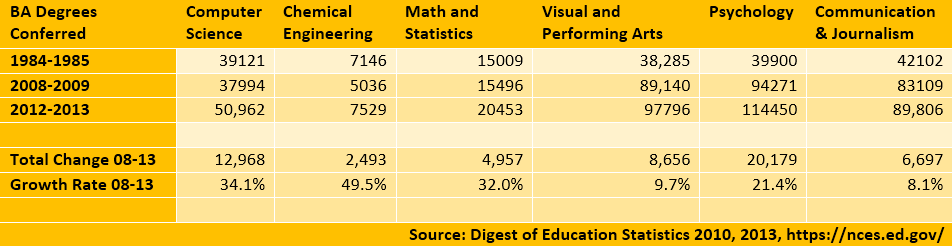
In 2009 the U.S. graduated 37,994 students with bachelor’s degrees in computer and information science. This is not bad, but we graduated more students with computer science degrees 25 years ago! The story is the same in other technology fields such as chemical engineering and math and statistics.
If students aren’t studying science, technology, engineering and math, what are they studying?
In 2009 the U.S. graduated 89,140 students in the visual and performing arts, more than in computer science, math and chemical engineering combined and more than double the number of visual and performing arts graduates in 1985.
So what has happened since 2009? The good news is that enrollment in STEM fields has increased dramatically. The number of graduates with computer science degrees, for example, has increased by 34%, chemical engineering degrees are up by a whopping 49.5% and math and statistics degrees have increased by 32%.
The bad news is that we are still graduating more students in the visual and performing arts than in computer science, math and chemical engineering combined. As I said in Launching nothing wrong with the visual and performing arts but those are degrees which are unlikely to generate spillovers to society.
We are also graduating more students in communications and journalism than in computer science, math and chemical engineering combined and more students in psychology than in computer science, math and chemical engineering combined. Here’s what I said about psychology:
In 2009 we graduated 94,271 students with psychology degrees at a time when there were just 98,330 jobs in clinical, counseling and school psychology in the entire nation. The latter figure isn’t new jobs — it’s total jobs!
Despite these problems, the number of psychology degrees conferred annually has increased since 2008-2009 by an astounding 21.4%! Visual and performing arts degrees have increased by 9.7% and communication and journalism degrees are up 8.1%. Do you think that jobs in these fields have gone up by equal percentages?
Stated differently, in 2012-2013 we graduated 20,418 more students in computer science, chemical engineering and math and statistics than we did in 2008-2009 but we also graduated 20,179 more students in psychology alone! We have a long way to go.
Here is the data:
The Importance of Institutions
So far, in our Principles of Macroeconomics class at MRUniversity we’ve covered GDP (how it is calculated, nominal versus real, GDP as a measure of the standard of living etc.). We have also covered the basic facts about differences in income both across countries and over time, the importance of growth rates, and the presence of growth miracles and growth disasters, among other topics.
In our latest video, Tyler covers the Importance of Institutions. Next up geography and growth and shortly after that on to the Solow model!
As always, these videos are freely available for non-commercial use. They can be used with any textbook but why would you want any but the best?
Jose Canseco is tweeting BOJ negative interest rates
Bank of Japan should call them willie wonka bonds “YOU GET NOTHING. yOU LOSE!”
Who is advising Japan? Forcing banks to lend all ¥ will not get 2% inflation. It creates loanees market with even lower rates. Dumb move
Negative interest rates in Japan is blowing my mind
Here is his Twitter account, here is the Bloomberg story. They promised us flying cars, and all we got was…

The men who collect dinosaurs
‘I’m just starting out as a collector,’ Sebastian begins. ‘I only own prehistoric shark teeth and I have a fossil of a prehistoric squid from way before the dinosaurs, and I got a Utahraptor bone shard I think from my kindergarten teacher, she’s an amateur palaeontologist who first got me into dinosaurs, and I have dinosaur poop but I think you should put in the word “coprolite”. That’s the technical term.’ He thinks some more. ‘Oh, I have mosasaur teeth, that’s a very cool prehistoric aquatic reptile. Imagine owning a T rex though! I would like to own any complete dinosaur, I don’t care which one.’
To my surprise, Sebastian doesn’t see an emotional difference between owning dinosaur toys and owning real dinosaurs, and he hints at a dimensionless state he enters using imagination. ‘If I look at a toy giganotosaurus, it feels the same as looking at a real giganotosaurus, which I have only seen once in a museum. I really see the same thing when I’m looking at my toy. I forget that the real dinosaur is way bigger. My toy is just as big in my mind.’
That is from an interesting Laurie Gwen Shapiro Aeon article, hat tip goes to Anecdotal.
Larry Summers reviews Robert Gordon
Many rightly wonder about mis-measurement of productivity as new products become available and quality improves. Gordon is compelling in arguing that productivity growth is indeed significantly underestimated. He is also more persuasive than I expected in arguing that, if anything, this understatement was greater decades ago than it has been recently. In part this is because there were more of these transformational changes that are inherently hard to assimilate in standard frameworks. In part it is because the statisticians do a much better job than they once did of taking account of quality change.
And:
The question of how to square developments that are large enough to have a major impact on wage and employment patterns with the paucity of measured productivity growth looms for future research.
Do read the whole thing, again my review of Gordon is here.
*There IS Life After College*
That is the new book by Jeffrey J. Selingo, and the subtitle is the highly practical What Parents and Students Should Know About Navigating School to Prepare for the Jobs of Tomorrow.
If you want one book which delivers what this subtitle promises, this is it.
The latest and probably best estimate for TPP
From Peter A. Petri and Michael G. Plummer (pdf):
This Working Paper estimates the effects of the Trans-Pacific Partnership (TPP) using a comprehensive, quantitative trade model, updating results reported in Petri, Plummer, and Zhai (2012) with recent data and information from the agreement. The new estimates suggest that the TPP will increase annual real incomes in the United States by $131 billion, or 0.5 percent of GDP, and annual exports by $357 billion, or 9.1 percent of exports, over baseline projections by 2030, when the agreement is nearly fully implemented. Annual income gains by 2030 will be $492 billion for the world. While the United States will be the largest beneficiary of the TPP in absolute terms, the agreement will generate substantial gains for Japan, Malaysia, and Vietnam as well, and solid benefits for other members. The agreement will raise US wages but is not projected to change US employment levels; it will slightly increase “job churn” (movements of jobs between firms) and mpose adjustment costs on some workers.
I know plenty of people who don’t like parts of this deal, but not any who have produced a better net estimate of what it will do.
Hat tip goes to the ever-energetic Brad DeLong.
*Unequal Gains*
That is the forthcoming book by Peter H. Lindert and Jeffrey G. Williamson, and the subtitle is American Growth and Inequality since 1700. The sections on recent America, while unobjectionable, are ordinary, but the early coverage of American history is very interesting indeed. Here is one excerpt:
Why the Old South reversal of fortune? A benign part of the story seems to have been that the colonial South was still a labor-scarce frontier region with high returns to coastal land producing export crops, like indigo, rice, and tobacco. Its decline after 1774 was echoed in two other frontier cases many decades later. One was the dramatic relative decline of the West South Central income per capita between 1840 and 1860 — from 60 percent of the U.S. average to just 9.5 percent above it…The other was the loss of the Pacific region’s gold-discovery-generated super-incomes after the 1850s and early 1860s (the Pacific states were 213.3 percent above the US average in 1860, and the mountain states were 30.5 percent above).
I hope to report on other interesting sections of the book soon; it is due out in April. Again, most business cycles in history have been real business cycles.
Wednesday assorted links
1. Should we have laxer conviction standards for tougher punishments? No, but a good brain twister.
2. “Does this mean inflation isn’t transitive?” Correct, inflation measures are not transitive. Larry Temkin should be happy.
3. Musk personally made sure the guy’s order was cancelled.
4. “Ravens do spy on each other, it turns out, and they can infer when other birds are snooping on them.”
5. “Between 1993 and 2015, cattle killed 13 people who were out for walks in the United Kingdom. Dozens more walkers received broken bones or other injuries from the animals…Murderous cattle are an understudied phenomenon…” Link here.
Working as a model for stock photography — what’s it like?
I very much liked this Jonathan Kay piece, which has so many good, interesting, and separate points, here is one of them:
“One of the most important elements of the Shutterstock quality-control process is to ensure there are no logos or other brand identifiers,” she told me. “Nor can the photos contain identifiable people or locations which haven’t released their legal rights.” The blackouts here can be extremely broad, and include some of the most famous landmarks on the planet. You can’t include the Eiffel Tower in most forms of stock photography, for instance. Nor can you include anyone wearing the iconic beige-and-blue Burberry pattern. Even a tiny patch of it in the background renders an image completely unusable.
And this:
Click through the Shutterstock database, and you find that professionally shot and curated stock photos invariably exhibit what might be called calculated soullessness. The subjects project human emotions—happy, sad, confused, angry—but in a simple, one-dimensional way. There should be nothing bespeaking a complex inner life. Real human interest always will distract the audience from the intended product or idea.
In closing:
How does a photographer achieve authenticity in an age where authentic culture increasingly is built around irony? More broadly: Is the project of organizing human experience into databases of generic happy faces and sad faces still relevant to us in 2016?
Alas, I can no longer remember to whom I owe the pointer, my apologies.
File under Those New Service Sector Jobs. And if that doesn’t suit you, here is “Calling all ‘bulky’ Alec Baldwin lookalikes”.
Amazon plans hundreds of brick and mortar stores
The Seattle company plans as many as 400 bookstores, Sandeep Mathrani, chief executive of large mall operator General Growth Properties Inc., said on an earnings call with analysts Tuesday.
“You’ve got Amazon opening brick-and-mortar bookstores and their goal is to open, as I understand, 300 to 400,” said Mr. Mathrani in response to a question about mall traffic.
That compares to the 640 stores Barnes & Noble Inc. operates and the 255 locations Books-A-Million Inc. said it had as of last summer.
The WSJ story is here, here are others. What is the underlying business plan? To make these iconic locations like Apple stores? To treat all future business, in all sectors, as depending on the focality of the company behind it? To start with books, move on to other items, and eventually steal middle-class and upper-middle class consumers away from Walmart? Somehow use these stores to lock people in Amazon Prime? Do you have other hypotheses? Is this overconfident folly, or is it the “for good” return of brick and mortar bookstores to our lives?