Month: December 2022
(Dutch) *Pioneers of Capitalism*
The subtitle is The Netherlands 1000-1800, and the authors are Maarten Prak and Jan Luiten van Zanden. An excellent book, here is one excerpt:
…between 1454 and 1500 the Netherlands appears to have printed more than double the European average number of books, with the Hanseatic town of Deventer as the most important center of this new industry. In the sixteenth century, book printing in the Low Countries was originally concentrated in Antwerp, but after 1585 production in the northern Netherlands skyrocketed, reaching an average per capita output that was consistently three to more than four times that of Europe as a whole. During the seventeenth century, Holland became the “bookshop of the world.” Exports of books were important, but the domestic demand for print was equally large.
You can buy it here.
Sunday assorted links
Liberal Democracy Strong
Bravo to Richard Hanania for revisiting some beliefs:
In February, I argued that Russia’s imminent successful invasion of Ukraine was a sign heralding in a new era of multipolarity. By October, I declared every challenge to liberal democracy dead and Fukuyama the prophet of our time. It’s embarrassing to have two contradictory pieces written seven months apart. But it would’ve been more embarrassing to persist in believing false things. If there’s any time to change one’s mind, it’s in the aftermath of large, historical events that went in ways you didn’t expect. Russia’s failure in Ukraine and China’s Zero Covid insanity provided extremely clear and vivid demonstrations of what democratic triumphalists have been saying about the flaws of autocracy. Nothing that the US or Europe have done – from the Iraq War to our own overly hysterical response to the coronavirus – have been in the same ballpark as these Chinese and Russian mistakes. Perhaps the war on terror comes close in terms of total destruction and lives lost, but we could afford to be stupid and it didn’t end up hurting Americans all that much.
In the land of the blind, the one-eyed man is king but still it’s good to see liberal democracy put some points on the scoreboard.
Popular music recommendations for 2022
I said I wasn’t going to give these, because they were too ordinary, but a few of you asked, so here goes, in no particular order:
2. The new Beyonce, Renaissance.
3. Rosalia, Motomami.
4. Bad Bunny, Un Verano Sin Ti.
5. Cecile McLorin Salvant, Ghost Song.
Nothing so unusual or surprising on that list…
Should the United States ban TikTok?
A bipartisan coalition is currently considering such an action and a bill has been introduced to the Senate (FT summary here). I don’t see why we should do this. I am all for keeping TikTok off the smart phones of people in the military and in national intelligence and perhaps a few other roles as well. But beyond that point?
What is the actual evidence that it is serving up slanted, pro-Chinese content, or otherwise swaying public opinion in a negative manner?
On top of that, perhaps many Americans should be more exposed to pro-Chinese views! As part of a broader menu of choice, of course. If only TikTok would teach them the theory of comparative advantage.
If TikTok did turn out to be an insidious and highly effective agent of foreign propaganda, we can always ban it later on. That won’t be hard to do, politically speaking.
You are losing your privacy to the Chinese? The Chinese, for better or worse, already can buy lots of data on you from private data brokers, just as other parties can. Few people seem super worried about that. Nor do we ban trips to China, which often result in a “stripping” of all the available information accessible through that person’s devices (people who matter and who know better often just bring burner phones and laptops, etc.).
What exactly would be the legal basis for such a ban? “I don’t like your company so we are getting rid of it?” We can do better than that.
Saturday assorted links
1. How about sending your *neural nets* to school?
3. “More than half of investors under 35 get investing advice from YouTube” Link here. And more lectures on Rene Girard.
5. Infovores on winners and losers from AI.
6. Center for Election Science, new group for approval voting, here is their FAQs page. And approval voting vs. some alternatives.
7. My Coindesk podcast with Simon Johnson (and two hosts) on the future of crypto after FTX.
The Great Barrington Plan: Would Focused Protection Have Worked?
A key part of The Great Barrington Declaration was the idea of focused protection, “allow those who are at minimal risk of death to live their lives normally to build up immunity to the virus through natural infection, while better protecting those who are at highest risk.” This was a reasonable idea and consistent with past practices as recommended by epidemiologists. In a new paper, COVID in the Nursing Homes: The US Experience, my co-author Markus Bjoerkheim and I ask whether focused protection could have worked.
Nursing homes were the epicenter of the pandemic. Even though only about 1.3 million people live in nursing homes at a point in time, the death toll in nursing homes accounted for almost 30 per cent of total Covid-19 deaths in the US during 2020. Thus we asked whether focusing protection on the nursing homes was possible. One way of evaluating focused protection is to see whether any type of nursing homes were better than others. In other words, what can we learn from best practices?
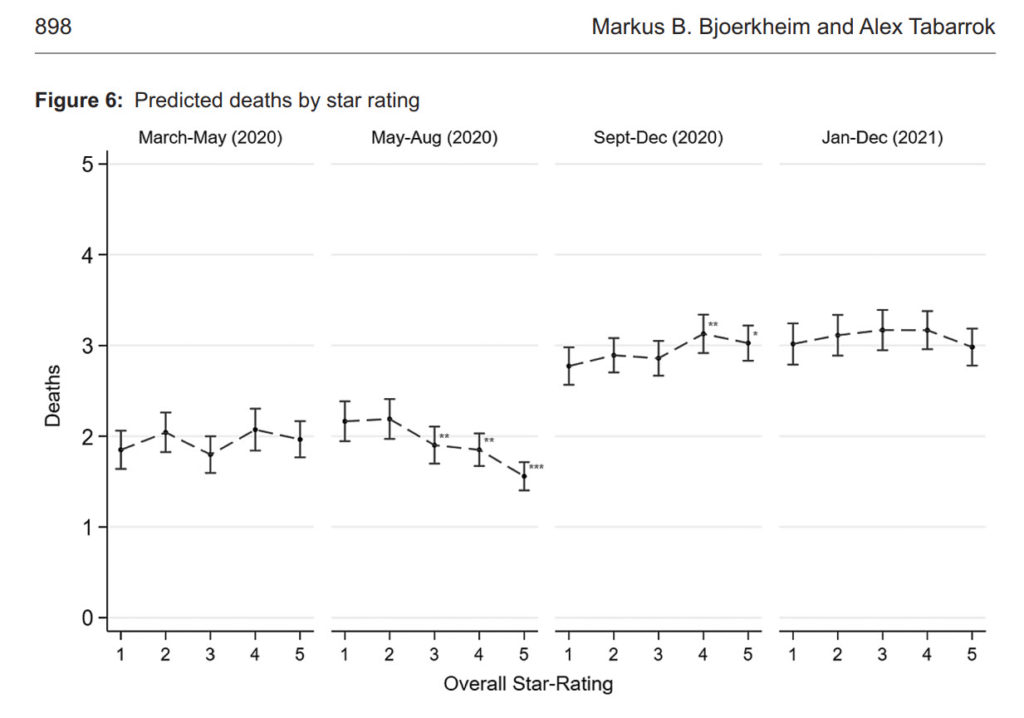
The Centers for Medicaire and Medicaid Services (CMS) has a Five-Star Rating system for nursing homes. The rating system is based on comprehensive data from annual health inspections, staff payrolls, and clinical quality measures from quarterly Minimum Data Set assessments. The rating system has been validated against other measures of quality, such as mortality and hospital readmissions. The ratings are pre-pandemic ratings. Thus, the question to ask is whether higher-quality homes had better Covid-19 outcomes? The answer? No.
The following figure shows predicted deaths by 5-star rating. There is no systematic relationship between nursing homes rating and COVID deaths. (In the figure, we control for factors outside of a nursing homes control, such as case prevalence in the local community. But even if you don’t control for other factors there is little to no relationship. See the paper for more.) Case prevalence in the community not nursing home quality determined death rates.
More generally, we do some exploratory data analysis to see whether there were any “islands of protection” in the sea of COVID and the answer is basically no. Some facilities did more rapid tests and that was good but surprisingly (to us) the numbers of rapid tests needed to scale nationally and make a substantial difference in nursing home deaths was far out of sample and below realistic levels.
Finally, keep in mind that the United States did focused protection. Visits to nursing homes were stopped and residents and staff were tested to a high degree. What the US did was focused protection and lockdowns and masking and we still we had a tremendous death toll in the nursing homes. Focused protection without community controls would have led to more deaths, both in the nursing homes and in the larger community. Whether that would have been a reasonable tradeoff is another question but there is no evidence that we could have lifted community controls and also better protected the nursing homes. Indeed, as I pointed out at the time, lifting community controls would have made it much more difficult to protect the nursing homes.
What Do Think Tanks Think?
From Richard Hanania and Max Abrahms:
Through the use of survey methods, the study presents the first systematic comparison of America-based international relations professors to think tank employees (TTEs) in terms of their preferred conduct of the United States in international affairs. The difference between the two groups in their support for military intervention is stark. TTEs are 0.47 standard deviations more hawkish than professors based on a standard measure of militant internationalism (MI). Controlling for self-described ideology mitigates this effect although it remains statistically significant. Beyond quantifying their relative foreign policy preferences, this study helps to resolve why TTEs tend to assume more hawkish policies. The authors find evidence that hawkishness is associated with proximity to power. Professors who have worked for the federal government score higher on MI, as do TTEs based at institutions located closer to Capitol Hill. In general, the results point to a self-selection mechanism whereby those who favor interventionist policies are more likely to pursue positions to increase their policy influence, perhaps because they know that powerful institutions are more likely to hire hawks. Alternative explanations for differences, such as levels or kinds of foreign policy expertise, have weaker empirical support.
It remains remarkable to me how few people even ask such questions. Both think tanks and foreign policy opinion remain critically understudied, at least in the appropriate serious ways and involving considerations of “public choice” (there is of course a massive dull literature on foreign policy opinion…if you think I am missing some massive literature that you know all about I suspect you do not grok what I actually am asking for).
And here is the Richard Hanania 2022 update.
*Avatar: The Way of Water*
Eh. The sequence of the last hour is quite good, but there is not enough “movie” packed into what came before. The villains are cartoonish, and the protagonists feel like “generic aliens.” Dramatic tension is weak throughout. Cinematic references include to The Poseidon Adventure, Titanic, Frankenstein vs. the Wolf Man, Waterworld, Return of the Jedi, Whale Rider (do the Maori feel ripped off at all?), and other films.
Did I mention that the main plot line concerns doxxing? You can sit around and debate which of the characters would have been suspended from Twitter or not.
The theater was perhaps one-third full on a Friday evening, and most of the tickets seem to have been sold two days earlier when I first booked and reserved the seats.
How many more of these are coming down the pike?
*Babel: An Arcane History*
So far a spectacularly good book, call it speculative fiction broadly in the vein of Susanna Clarke. Plus she has written many other books. Plus she is only 26 years old. Plus she is getting a Ph.D from Yale in Asian Languages and Literatures. I am far from finished, but so far this is one of my favorites of the year.
Friday assorted links
Why The United States Should Open New Consulates in India
A good piece by Michael Rubin in the National Interest:
India will likely become the most populous country on Earth this year, and, yet, outside of the U.S. Embassy in New Delhi, there are only four State Department consulates in the country of 1.4 billion. That is fewer consulates than the State Department operates in France and fewer offices than the U.S. Embassy services in Spain. The Canadian province of Quebec, whose population totals less than nine million, merits two consulates in the State Department’s view.
…The United States computer and tech industry rests disproportionately on the labor and intellectual contributions of America’s vast Indian-American community. If Silicon Valley is the center of America’s computer industry, then Bangalore is its equivalent in India. The interaction between the two is significant. And yet, while India maintains a consulate in San Francisco, the United States has no equivalent in Bangalore; the closest American post is more than 200 miles away in Chennai. It need not be an either/or decision, but at the very least the State Department should explain why maintaining an investment in Winnipeg, Canada is more important than nurturing the relationship between two of the largest tech hubs in the world.
… if U.S. diplomacy is to be effective, it needs to adjust to twenty-first-century realities rather than nineteenth-century ones.
With more consulates might we not also cut the ridiculous and embarrassing time it takes to get a US visitor or business visa? When I was last in Delhi I met with one of the economic officers at the American Embassy. His job was to drum up business between India and the US–how can anyone do that when business visas are so difficult to acquire? Talk about the land of red tape!
Hat tip: Ben.
Who gains and loses from the new AI?
With so many spectacular AI developments coming out this year, it is worth asking who benefits and who loses.
Specific technologies usually help some personality types and hurt others. For instance, the rise of computers, programming, and the internet helped analytical nerds. Today, you might be in high demand as a programmer or run your own start-up and earn riches. But back in the 1960s, you might have been lucky to get a job at NASA and pull in a middle-class income. Earlier, the rise of manufacturing and factory employment helped able-bodied male laborers who had an enthusiasm for physical labor.
One striking feature of the new AI systems is that you have to sit down to use them. Think of ChatGPT, Stable Diffusion, and related services as individualized tutors, among their other functions. They can teach you mathematics, history, how to write better and much more. But none of this knowledge is imparted automatically. There is a relative gain for people who are good at sitting down in the chair and staying focused on something. Initiative will become more important as a quality behind success.
The returns to durability of effort are rising as well. If you quit in the middle of executing your AI-aided concrete project, the new AI services will, for you, end up as playthings rather than investments in your future.
The returns to factual knowledge are falling, continuing a trend that started with databases, search engines and Wikipedia. It is no longer so profitable to be a lawyer who knows a large amount of accumulated case law. Instead, the skills of synthesis and persuasion are more critical for success.
ChatGPT excels at producing ordinary, bureaucratic prose, written in an acceptable but non-descript style. In turn, we are likely to better understand how much of our society is organized around that basis, from corporate brochures to regulations to second-tier journalism. The rewards and status will go down for those who produce such writing today, and the rewards for exceptional originality are likely to rise. What exactly can you do to stand out from the froth of the chat bots?
Our underlying views may become more elitist. If you are a programmer who is only slightly better than the bots, you may lose respect and income. The exceptional programmers and writers, who cannot readily be copied, will command more attention and status. And as successive generations of the GPTs improve, these rewards will be doled out to a smaller and smaller percentage of humans.
It is charged that the new bots do not have originality. However true that may be, the observation eventually focuses your attention on the question of how many humans have that same originality.
Most writers are likely to lose some of their audience, if only because would-be readers will be busy playing around with the bots. A deeper danger, not yet upon us but perhaps not far away, is that the bots will be able to effectively copy our best-known writers and creators.
One current common strategy is to give away a lot of writing, or images, for free on the web, and use the resulting publicity to build an audience for more commercial outputs, such as books and lectures and artworks. In the future, that may be asking for trouble, as the bots will copy you and in essence you will be training your competitors for free. It will work only if you can produce charisma and celebrity, two traits that will rise in importance.
The “old school” strategy of releasing limited editions, not available on the internet and not fully defined by their digital qualities, may increase in importance, as it will be harder for AI to copy such outputs.
The prior generation of information technology favored the introverts, whereas the new AI bots are more likely to favor the extroverts. You will need to be showing off all the time that you are more than “one of them.” Originality, including “in your face” originality, will be at a premium. If you are afraid to be such a “show off,” how is the world to know you are anything other than a bot with a human face?
Alternatively, many humans will run away from such competitive struggles altogether. Currently the bots are much better at writing than say becoming a master gardener, which also requires skills of physical execution and moving in open space. We might thus see a great blossoming of talent in the area of gardening, and other hard to copy inputs, if only to protect one’s reputation and IP from the bots.
Athletes, in the broad sense of that term, may thus rise in status. Sculpture and dance might gain on writing in cultural import and creativity. Counterintuitively, if you wanted our culture to become more real and visceral in terms of what commands audience attention and inspiration, perhaps the bots are exactly what you’ve been looking for.
The Monitoring Role of Social Media
In this study, we examine whether social media activity can reduce corporate misconduct. We use the staggered introduction of 3G mobile broadband access across the United States to identify exogenous increases in social media activity and test whether access to 3G reduces misconduct. We find that facilities reduce violations by 1.8% and penalties by 13% following the introduction of 3G in a local area. To validate social media activity as the underlying mechanism, we show that 3G access results in sharp increases in Tweet volume and that facilities located in areas with high Tweet volume engage in less misconduct. The effect of 3G access on misconduct is stronger for facilities of more visible firms and concentrated in non-financial violations, such as those involving unsafe workplace conditions and inappropriate treatment of employees and customers. Overall, our results demonstrate that social media plays an important role in monitoring corporate misconduct.
Here is the full paper, from Jonas Heese and Joseph Pacelli at HBS, via the excellent Kevin Lewis.
Thursday assorted links
1. Philip Tetlock is co-founder of The Forecasting Research Institute. And they are hiring.
3. Kirzner in the courtroom (2019).
4. Redux of my 2020 Bloomberg column about progress on the way and the end of the great stagnation.
5. Striking Pew findings from 2022.
6. Which nationalities cry most, and least, when they win the Olympics?