Thomas Schelling on Adapting to Climate Change
Yesterday, Thomas Schelling gave a seminar on climate change here at the Center for Study of Public Choice. Schelling’s main argument was that lots of resources are going into predicting and understanding climate change but very little thought or resources are going into planning for adaptation.
If Washington, DC, Boston and Manhattan are to remain dry, for example, we are almost certainly going to need flood control efforts on the level of the Netherlands. It takes twenty years just to come up with a plan and figure out how to pay for these kinds of projects let alone to actually implement them so it’s not too early to beginning planning for adaptation even if we don’t expect to need these adaptations for another forty or fifty years. So far, however, nothing is being done. Climate deniers think planning for adaptation is a waste and many climate change proponents think planning for adaptation is giving up.
Schelling mentioned a few bold ideas. We can protect every city on the Mediterranean from Marseilles to Alexandria to Tel Aviv or we could dam the Strait of Gibraltar. Damming the strait would be the world’s largest construction project–by far–yet by letting the Mediterranean evaporate somewhat it could also generate enough hydro-electric power to replace perhaps all of the fossil fuel stations in Europe and Africa.
Schelling didn’t mention it but in the 1920s German engineer Herman Sörgel proposed such a project calling it Atlantropa (more here). In addition to power, damming the strait would open up a huge swath of valuable land. Gene Roddenberry and Phillip K. Dick were fans but needless to say the idea never got very far. A cost-benefit analysis, however, might show that despite the difficulty, damming the strait would be cheaper than trying to save Mediterranean cities one by one. But, as Schelling argued, no one is thinking seriously about these issues.
I argued that capital depreciates so even many of our buildings, the longest-lived capital, will need to be replaced anyway. Here, for example, is a map showing the age of every building in New York City. A large fraction, though by no means all, are less than one hundred years old. If we let the areas most under threat slowly deteriorate the cost of moving inland won’t be as high as one might imagine–at least if the water rises slowly (not guaranteed!). Schelling agreed that this was the case for private structures but he doubted that we would be willing to let the White House go.
If we are going to save cities, especially buildings not yet built, should we not start taxing land today that is under threat of future flood? Act now to mitigate future moral hazard problems. John Nye and Robin Hanson raised this issue. See Robin’s post for more.
It was an enjoyable seminar. At 94, Schelling remains sharp, provocative, and in command of the facts.
A Dual-Track Drug Approval Process
In a post earlier this year I noted that Japan has significantly liberalized its approval process for regenerative medicine. Writing in Forbes, Bart Madden and Nobelist Vernon Smith outline a similar proposal for the United States.
Recently, Japanese legislation has implemented the core Free To Choose Medicine (FTCM) principles of allowing not-yet-approved drugs to be sold after safety and early efficacy has been demonstrated; in addition, observational data gathered for up to seven years from initial launch will be used to determine if formal drug approval is granted.
…FTCM legislation in the U.S. would create a dual track system (see figure below) that preserves the existing FDA clinical trial process while offering patients an alternative. Patients, advised by their doctors, would be able to contract with a drug developer to use not-yet-approved drugs after Phase I safety trials are successfully completed and one or more Phase II trials have demonstrated continued safety and initial efficacy. The resulting early access could make FTCM drugs available up to seven years before conventional FDA approval, which entails Phase III randomized control trials and a lengthy FDA review before the FDA makes an approval decision.
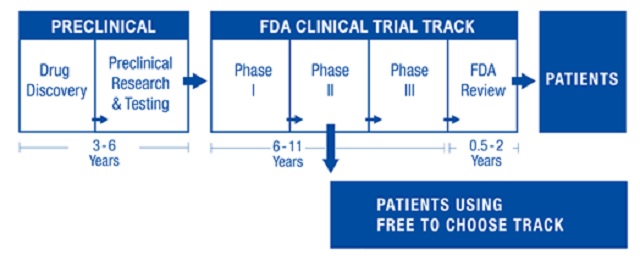
…The heart of the dual track system is the Tradeoff Evaluation Drug Database (TEDD) which would be available to the public through a government-supervised web portal. TEDD would contain all treatment results of FTCM drugs including patients’ health characteristics and relevant biomarkers, but no personal identification. This open access database would be a treasure-trove of information to aid drug developers in making better R&D decisions consistent with fast-paced learning and innovation.
…Today’s world of accelerating medical advancements is ushering in an age of personalized medicine in which patients’ unique genetic makeup and biomarkers will increasingly lead to customized therapies in which samples are inherently small. This calls for a fast-learning, adaptable FTCM environment for generating new data. In sharp contrast, the status quo FDA environment provides a yes/no approval decision based on statistical tests for an average patient, i.e., a one-size-fits-all drug approval process.
I hold the Bartley J. Madden Chair in Economics at the Mercatus Center so I am biased but this is an important proposal. Japan is leading the way and similar ideas are being discussed in Great Britain but as the most important pharmaceutical market in the world, the United States has an outsize influence on world drug development. We need to lower costs and speed new drugs to market.
The coffee-machine bacteriome
 From a new paper in Nature, Scientific Reports:
Microbial communities are ubiquitous in both natural and artificial environments. However, microbial diversity is usually reduced under strong selection pressures, such as those present in habitats rich in recalcitrant or toxic compounds displaying antimicrobial properties. Caffeine is a natural alkaloid present in coffee, tea and soft drinks with well-known antibacterial properties. Here we present the first systematic analysis of coffee machine-associated bacteria. We sampled the coffee waste reservoir of ten different Nespresso machines and conducted a dynamic monitoring of the colonization process in a new machine. Our results reveal the existence of a varied bacterial community in all the machines sampled, and a rapid colonisation process of the coffee leach. The community developed from a pioneering pool of enterobacteria and other opportunistic taxa to a mature but still highly variable microbiome rich in coffee-adapted bacteria. The bacterial communities described here, for the first time, are potential drivers of biotechnologically relevant processes including decaffeination and bioremediation.
The authors note:
The presence of bacterial genera with pathogenic properties and the fast recovery of the communities after rinsing the capsule container, strongly suggest the need for frequent maintenance of the capsule container of these machines.
In related news from a few years ago, scientists in the US have genetically modified an E.coli strain so that it is ‘addicted’ to caffeine. Yes, but will E. coli prove theorems?
Hat tip: Paul Kedrosky.
Which Group has Committed the Most Terrorist Acts on US Soil?
The RAND Database of Worldwide Terrorism Incidents (RDWTI) contains data on terrorist incidents worldwide from 1968 through 2009. Terrorism is defined as the deliberate creation and exploitation of fear through violence or the threat of violence in the pursuit of political change.
According to the Rand database, there were 567 terrorist incidents in the United States between 1968 and 2009. The most terrorist incidents, 140 out of 567 or 25% of the total during this period, were due to one group or cause, anti-Castro Cubans. The anti-Castro terrorist groups have killed 6 people, mostly advocates of dialogue with Cuba such as Eulalio Jose Negrin who was gunned down in 1979. Numerous bombings have also been traced to these groups including hotel bombings in Miami, bombings in New York of consulates (also Madison Square Gardens) and near-miss airplane bombings. Connections between anti-Castro groups, the CIA and the Bush dynasty remain controversial.
The group responsible for the second highest number of terrorist incidents on US soil, 62 incidents or 10% of the total (1968-2009), is the Jewish Defense League. Mostly these have been bombings in New York City of places or people attached to the Soviets. Perhaps the best known is the 1986 tear-gassing of the Metropolitan Opera House on the visit of the Moiseyev Dance Company. Rand tallies 2 deaths in total to the JDL.
Although these groups committed many terrorist acts on US soil neither had much interest in terrorizing US citizens per se, perhaps explaining the relatively low body counts in the United States.
Venture Capital to Buy Equity in Purdue Students
Danielle Douglas-Gabriel at the WashPost writes that Purdue is going to run an experiment with income contingent loans.
This week, Purdue University [partnered]…with Vemo Education, a Reston-based financial services firm, to explore the use of income-share agreements, or ISAs, to help students pay for college.
Through its research foundation, the school plans to create ISA funds that its students can tap to pay for tuition, room and board. In return, students would pay a percentage of their earnings after graduation for a set number of years, replenishing the fund for future investments.
The Federal government already offers an income based repayment program for student loans but private plans would likely be more flexible and generate more useful information.
Douglas-Gabriel makes a useful point:
Say a student agrees to pay five percent of her income for five years on a $10,000 agreement. If that student lands a $60,000 job after graduation, she could pay $15,000 by the time the contract is up, more if she gets raises along the way. Yet if that same graduate loses her job during that time, she wouldn’t be forced to find the money to pay.
But then concludes with an odd criticism:
Either way students would have to be pretty informed about the earning potential in their field before signing up.
What the example illustrates, however, is that being unlucky or uninformed is less damaging with an income share agreement than with a traditional loan. Loans have the greatest burden when a student overestimates their potential earnings and is poorer than expected. Thus, the loan offers no relief when relief is most needed. In contrast, payments under an income share agreement fall when income falls. An ISA does cost more than a loan when a student underestimates their potential earnings but in this case the student is richer than expected and can easily bear the extra burden. Thus, ISAs offer income insurance.
Douglas-Gabriel also writes:
Some observers worry that students pursuing profitable degrees in engineering or business would get better repayment terms than those studying to become nurses or teachers.
Actually, that is part of the point. An ISA is about improving idiosyncratic risk sharing. To the extent that engineers are reliably expected to earn more than nurses, they should pay a smaller share of their income so the total payment for an education is about the same for both engineers and nurses (fyi, business is not a profitable degree).
Indeed, one of the prospective benefits of ISAs is that differences in prices will better reveal which are the degrees, programs and schools that most generate value-added.
Hat tip: Kevin James.
Addendum: See previous MR posts on this topic.
A Cost-Benefit Analysis of Government Compensation of Kidney Donors
 The latest issue of the American Journal of Transplantation has an excellent and comprehensive cost-benefit analysis of paying kidney donors by Held, McCormick, Ojo, and Roberts. Earlier, Becker and Elias estimated that a payment of $15,000 per living donor would be sufficient to eliminate the US waiting list. The authors adopt a larger figure of $45,000 for living donors and $10,000 for deceased donors and find that even at these rates paying donors generates benefits far in excess of costs.
In particular, a program of government compensation of kidney donors would provide the following benefits (quoting from the article):
- Transplant kidneys would be readily available to all patients who had a medical need for them, which would prevent 5000 to 10 000 premature deaths each year and significantly reduce the suffering of 100 000 more receiving dialysis.
- This would be particularly beneficial to patients who are poor and African American because they are considerably overrepresented on the transplant waiting list. Indeed, it would be a boon to poor kidney recipients because it would enable them to reap the great benefits of transplantation at very little expense to themselves.
- Because transplant candidates would no longer have to spend almost 5 years receiving dialysis while waiting for a transplant kidney, they would be younger and healthier when they receive their transplant, increasing the chances of a successful transplantation.
-
With a large number of transplant kidneys available, it would be much easier to ensure the medical compatibility of donors and recipients, which would increase the success rate of transplantation.
-
Taxpayers would save about $12 billion each year. Dialysis is not only an inferior therapy for end-stage renal disease (ESRD), it is also almost 4 times as expensive per quality-adjusted life-year (QALY) gained as a transplant.
America and the Refugees
My latest piece is on the Syrian refugees and I’m delighted that it’s in Playboy. Next step is to get invited to the Mansion. Here’s the opening:
Even 4-year-old Syrian orphans are too dangerous to welcome to the United States, says New Jersey Gov. Chris Christie. What sort of man turns away desperate orphans out of fear? Christie’s words and actions are shameful and unbecoming of a great nation—as are those of 25 other governors who said they will work to keep Syrian refugees from moving to their state. Is America no longer the home of the brave?
Since 9/11 we have been told many times that our nation is at war. Our troops understand, and they have fought bravely whenever and wherever they have been called upon. Not once have they backed down or refused the call. Yet, when faced with the risk of orphan refugees, some of our leaders protest that the risk is too great. How can we ask so much of our troops but so little of ourselves?
Do read the whole thing. The link is surprisingly safe for work, at least when I clicked, but use at your own risk.
New Course: Principles of Macroeconomics!
Principles of Macroeconomics, the new course by Tyler and myself, has just launched at MRUniversity. We will be covering unemployment, inflation, business cycles, growth and much more. The first section which is up now covers GDP including
- What is GDP?
- Nominal versus Real GDP
- Real GDP per capita and the Standard of Living
- and the many ways of Splitting GDP (such as the spending and factor income approaches).
As usual, all the videos are free and will work with any textbook although of course they go best with the best textbook, Modern Principles.
Here is the introduction to GDP:
Syrian Refugees, Jelly Beans, and Murderers
A meme going around compares Syrian refugees to jelly beans:
If i gave you a bag of 50000 jellybeans and told you 100 are poisonous, you wouldnt accept them right? Then why would we accept 50000 refugees if some of them are bad?
 I like jelly beans and numbers so I did a back of the envelope calculation. In the US there are about 15,000 murders per year. Most murderers kill only one person. Even serial killers kill only 2.8 people on average. Thus, 15,000 is also approximately the number of murderers in a year.
Let’s say that people live on average for 50 years–that’s a bit low but our figure for the number of murderers was a bit high–this means that in the current population there will be approximately 15000*50=750,000 murderers.
750,000 killers among us struck me as an awful lot when I first calculated the number but there are approximately 166,700 people in prison for murder right now and of the 750,000 some of them are not yet murderers and some of them won’t be caught. Thus, on reflection, 750,000 seems like a scary, yet reasonable estimate.
The current US population is 322 million so there are .0023 murderers per capita or 2.33 murderers per 1000 or 116 murderers per 50,000 people in the United States. Put differently, about 116 American babies out of every 50,000 will grow up to murder someone. (Perhaps the NYMag should rerun its poll?). In contrast, only 100 of the 50000 jelly beans were poisonous.
Thus, if anything, Syrian jelly beans look pretty good compared to American jelly beans.
Addendum: See Alex Nowrasteh for calculations going beyond jelly beans.
Whistleblowers for Innovation
We reward whistle blowers who help to prosecute people who are defrauding the government by giving them a share of the proceeds. Bradley Birkenfeld, for example, provided evidence to the US government that the Swiss bank UBS was illegally enabling US tax evaders. The case led to a $780 million dollar fine against UBS and Birkenfeld collected a sweet cut, $104 million.
Derek Khanna at the R Street Institute suggests a similar system to reward innovators (pdf).
Imagine a research team developed a cancer drug that could save the federal government $1 billion a year. Under the innovation savings program, a portion of those savings would flow back to the researchers themselves, in exchange for their not patenting the technology. In order to be eligible for a prize payout, the innovation would need to meet a minimum cost-savings threshold established by Congress (e.g., $100 million). Since the researchers would be paid out of funds already authorized by Congress, there would be no additional cost to taxpayers, who instead would expect to see still additional savings.
…This idea is directly inspired by the centuries-old concept of “qui tam” claims. Qui tam statutes allowed a private citizen to bring action on behalf of a government to recover a penalty….
But programs that seek only to stamp out waste, fraud and abuse do little to encourage the kinds of innovations that would reduce costs on the “front end.” That’s the goal of the innovation savings program: to provide a profit mechanism, separate and apart from patents and direct subsidies, to encourage innovations that could revolutionize such fields as medical technology, energy efficiency and payment processing
The benefits of such a system are not only that it avoids some of the costs of patents but that it would also work when patents are not available. It only works when the government is a big player but that’s a huge share of the economy.
Gambling Can Save Science!
Some 25 years ago, our colleague Robin Hanson published Could Gambling Save Science?, one of the first papers explaining and advocating prediction markets. Since that time prediction markets have been used to better predict political events, Hollywood movie revenues, and corporate sales but perhaps oddly little has been done in the field that Robin initially proposed, science.
That has now changed. As part of the reproducibility project economists at the Stockholm School of Economics set up a market to predict which psychology papers would fail to replicate. From Ed Yong at The Atlantic:
Dreber’s experiment was born in a bar. Over drinks with her husband Johan Almenberg and roommate Thomas Pfeiffer, she was talking about an attention-grabbing psychological study that she thought was “cute, but unlikely to be true.” When she wondered how good her instincts were, Pfeiffer brought up another paper by economist Robin Hanson at George Mason University. Titled Could Gambling Save Science?, it suggested that researchers could get a more honest consensus on scientific controversies by betting on their outcomes, in the way that traders bet on the future prices of goods.
“It blew us all away,” says Dreber. In 2012, she and her colleagues contacted Nosek, who agreed to add prediction markets to his big Reproducibility Project.
The markets worked well and, verifying the wisdom of the crowds, they worked far better than any individual in the market. The authors of the study argue that prediction markets could be used more extensively in science:
[P]rediction markets are a promising tool for assessing the reproducibility of published scientific results. The prediction markets also allow us to estimate probabilities for the hypotheses being true at different testing stages, which provides valuable information regarding the temporal dynamics of scientific discovery. We find that the hypotheses being tested in psychology typically have low prior probabilities of being true (median, 9%) and that a “statistically significant” finding needs to be confirmed in a well-powered replication to have a high probability of being true. We argue that prediction markets could be used to obtain speedy information about reproducibility at low cost and could potentially even be used to determine which studies to replicate to optimally allocate limited resources into replications.
Coming Apart: The State of White England?
Some surprising findings from researchers at the Institute for Fiscal Studies about education in England:
All ethnic minority groups in England are now, on average, more likely to go to university than their White British peers. This is the case even amongst groups who were previously under-represented in higher education, such as those of Black Caribbean ethnic origin, a relatively recent change.
These differences also vary by socio-economic background, and in some cases are very large indeed. For example, Chinese pupils in the lowest socio-economic quintile group are, on average, more than 10 percentage points more likely to go to university than White British pupils in the highest socio-economic quintile group. By contrast, White British pupils in the lowest socio-economic quintile group have participation rates that are more than 10 percentage points lower than those observed for any other ethnic group.
Combined with the Case-Deaton results about rising/not falling death rates among middle aged white Americans and the other measures of increasing social polarization among white Americans that Charles Murray discusses in Coming Apart this may be signs of a trend.
Hat tip: Tim Harford.
Satoshi Nakamoto Nominated for Nobel Prize
Bhagwan Chowdhry, a professor of finance at UCLA, has nominated Satoshi Nakamoto, the creator of Bitcoin, for a Nobel prize in economics. It’s an excellent choice. Nakamoto made a fundamental breakthrough that combined cryptography and a distributed database to create the first decentralized cryptocurrency. Moreover, Nakamoto implemented his theoretical breakthrough to create a working cryptocurrency with real benefits to potentially billions of consumers.
Chowdry writes:
The invention of bitcoin — a digital currency — is nothing short of revolutionary….It offers many advantages over both physical and paper currencies. It is secure, relying on almost unbreakable cryptographic code, can be divided into millions of smaller sub-units, and can be transferred securely and nearly instantaneously from one person to any other person in the world with access to internet bypassing governments, central banks and financial intermediaries such as Visa, Mastercard, Paypal or commercial banks eliminating time delays and transactions costs.
But beyond demonstrating the possibility of creating a reliable digital currency, Satoshi Nakamoto’s Bitcoin Protocol has spawned exciting innovations in the FinTech space by showing how many financial contracts — not just currencies — can be digitized, securely verified and stored, and transferred instantaneously from one party to another.
…Not only will Satoshi Nakamoto’s contribution change the way we think about money, it is likely to upend the role central banks play in conducting monetary policy, destroy high-cost money transfer services such as Western Union, eliminate the 2-4% transactions tax imposed by intermediaries such as Visa, MasterCard and Paypal, eliminate the time-consuming and expensive notary and escrow services and indeed transform the landscape of legal contracts completely. Many industries such as Banking, Finance, Law will see a big upheaval. The consumers will be big beneficiaries and indeed the poor and marginal sections of the society will reap the benefits of financial and social inclusion in the coming decades. I can barely think of another innovation in Economic and Finance in the last several decades whose influence surpasses the welfare increases that will be engendered by Satoshi Nakamoto’s brilliant, path-breaking invention. That is why I am nominating him for the Nobel Prize in Economics.
Since no one knows who Nakamoto is it might seem difficult to award him a prize but Chowdry notes that bitcoin itself provides a solution:
The Nobel committee can easily buy bitcoins for the award money from any reputed online Bitcoin exchange and transfer it to him instantaneously. A very early bitcoin transaction suggests that the bitcoin address 1HLoD9E4SDFFPDiYfNYnkBLQ85Y51J3Zb1 likely belongs to him. Of course, he could easily and verifiably let the committee know which address he wants the money to be transferred to.
Swiss Referendum on 100% Reserves
A Swiss group has collected the 100,000 signatures necessary to require a national referendum on requiring banks to hold 100% reserves.
In a nut shell, the proposal extends the Swiss Federation’s existing exclusive right to create coins and notes, to also include deposits. With the full power of new money creation exclusively in the hands of the Swiss National Bank, the commercial banks would no longer have the power to create money through lending. The Swiss National Bank’s primary role becomes the management of the money supply relative to the productive economy, while the decision concerning how new money is introduced debt free into the economy would reside with the government.
After interest in the 1930s Chicago plan of Fisher and Simons died off, Murray Rothbard and other libertarians were virtually the only people calling for 100% reserves. More recently, however, the idea has almost become mainstream. Consider Martin Wolf’s FT column:
Printing counterfeit banknotes is illegal, but creating private money is not. The interdependence between the state and the businesses that can do this is the source of much of the instability of our economies. It could – and should – be terminated.
…Banks create deposits as a byproduct of their lending. In the UK, such deposits make up about 97 per cent of the money supply. Some people object that deposits are not money but only transferable private debts. Yet the public views the banks’ imitation money as electronic cash: a safe source of purchasing power.
Banking is therefore not a normal market activity, because it provides two linked public goods: money and the payments network. On one side of banks’ balance sheets lie risky assets; on the other lie liabilities the public thinks safe. This is why central banks act as lenders of last resort and governments provide deposit insurance and equity injections. It is also why banking is heavily regulated. Yet credit cycles are still hugely destabilising.
What is to be done? A minimum response would leave this industry largely as it is but both tighten regulation and insist that a bigger proportion of the balance sheet be financed with equity or credibly loss-absorbing debt.
…A maximum response would be to give the state a monopoly on money creation. One of the most important such proposals was in the Chicago Plan, advanced in the 1930s by, among others, a great economist, Irving Fisher. Its core was the requirement for 100 per cent reserves against deposits. Fisher argued that this would greatly reduce business cycles, end bank runs and drastically reduce public debt. A 2012 study by International Monetary Fund staff suggests this plan could work well.
Similar ideas have come from Laurence Kotlikoff of Boston University in Jimmy Stewart is Dead, and Andrew Jackson and Ben Dyson in Modernising Money.
Hat tip on the Swiss proposal to Dirk Niepelt who offers further comment.
Minor Vapists
The Yale School of Medicine reports on some of the benefits of vaping and some of the costs of bans:
More than 40 states have banned the sale of electronic cigarettes to minors, but a new study out of the Yale School of Public Health indicates that these measures have an unintended and dangerous consequence: increasing adolescents’ use of conventional cigarettes.
Using data from the National Survey on Drug Use and Health, the research finds that state bans on e-cigarette sales to minors yield a 0.9 percentage point increase in rates of recent conventional cigarette use by 12 to 17 year olds, relative to states without these bans.
“Conventional cigarette use has been falling somewhat steadily among this age group since the start of the 21st century. This paper shows that bans on e-cigarette sales to minors appear to have slowed this decline by about 70 percent in the states that implemented them,” said Abigail Friedman, assistant professor of public health and the study’s author. “In other words, as a result of these bans, more teenagers are using conventional cigarettes than otherwise would have done so.”
The paper by Abigail Friedman is forthcoming in the Journal of Health Economics (working paper version).
Hat tip: Mitch Berkson.