Why it’s better to ask for forgiveness than permission
Transport for London is preparing to launch a crackdown on Uber, proposing a series of new rules that will hit the popular minicab-hailing app in one of its most popular cities.
…The proposals include a minimum five-minute wait time between ordering a private hire vehicle and it arriving, and banning operators from showing cars for hire within a smartphone app – a hallmark of the American company’s service.
No, this is not from an Ayn Rand novel.
These proposed rules so nakedly protect rent-seekers and make life worse for consumers that I don’t think they will succeed. Even if the rules fail, however, we shouldn’t be complacent about the dangers to innovation.
What made Uber different and controversial is that their Ayn Rand loving CEO followed the adage that it’s better to ask for forgiveness than permission. Uber skirted the law and went to consumers directly about whether they wanted transportation innovation. Consumers around the world responded with a resounding Yes to the Uber-referendum so regulators and rent-seekers who want to control Uber now must also fight Uber-consumers. That genie won’t go back into the bottle.
In the usual scenario, however, innovation can be quashed before consumers have a chance to know what they are missing. Had the taxi companies had an inkling of what was coming it would have been easy to to pass stricter laws in advance that would have made Uber impossible to get off the ground. Of course, in many industries today the old guard does have an inkling of what is coming and that should frighten anyone who wants to see greater innovation.
Asymmetric Information and Signaling
MRUniversity now has its own video production team! We are continuing to work with the artists at Tilapia films to produce outstanding videos for teaching economics–these videos work great with our textbook, Modern Principles. Our in-house production team will be working to polish our “regular” videos in a way that enhances the learning experience. You can see an example of the new style in the video below featuring Tyler on signaling.
Our Principles of Economics course is now complete. You can guess what is coming soon!
Generic Drug Regulation and Pharmaceutical Price-Jacking
The drug Daraprim was increased in price from $13.60 to $750 creating social outrage. I’ve been busy but a few points are worth mentioning. The drug is not under patent so this isn’t a case of IP protectionism. The story as I read it is that Martin Shkreli, the controversial CEO of Turing pharmaceuticals, noticed that there was only one producer of Daraprim in the United States and, knowing that it’s costly to obtain even an abbreviated FDA approval to sell a generic drug, saw that he could greatly increase the price.
It’s easy to see that this issue is almost entirely about the difficulty of obtaining generic drug approval in the United States because there are many suppliers in India and prices are incredibly cheap. The prices in this list are in India rupees. 7 rupees is about 10 cents so the list is telling us that a single pill costs about 5 cents in India compared to $750 in the United States!
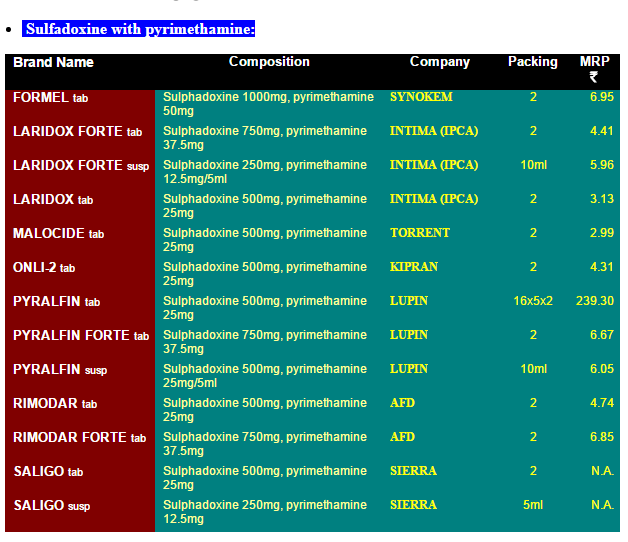
It is true that there are real issues with the quality of Indian generics. But Pyrimethamine is also widely available in Europe. I’ve long argued for reciprocity, if a drug is approved in Europe it ought to be approved here. In this case, the logic is absurdly strong. The drug is already approved here! All that we would be doing is allowing import of any generic approved as such in Europe to be sold in the United States.
Note that this is not a case of reimportation of a patented pharmaceutical for which there are real questions about the effect on innovation.
Allowing importation of any generic approved for sale in Europe would also solve the issue of so-called closed distribution.
There is no reason why the United States cannot have as vigorous a market in generic pharmaceuticals as does India.
Hat tip: Gordon Hanson.
Breaking Bad: Are Meth Labs Justified in Dry Counties?
A new paper from Fernandez, Gohmann and Pinkston shows that counties in Kentucky that forbid alcohol have more meth labs than otherwise similar counties. I like the research but in truth any paper with both Breaking Bad and Justified references is a winner in my book.
Abstract: This paper examines the influence of local alcohol prohibition on the prevalence of methamphetamine labs. Using multiple sources of data for counties in Kentucky, we compare various measures of meth manufacturing in wet, moist, and dry counties. Our preferred estimates address the endogeneity of local alcohol policies by using as instrumental variables data on religious affiliations in the 1930s, when most local-option votes took place. Alcohol prohibition status is influenced by the percentage of the population that is Baptist, consistent with the “bootleggers and Baptists” model. Our results suggest that the number of meth lab seizures in Kentucky would decrease by 24.4 percent if all counties became wet.
The authors suggest that alcohol users who buy alcohol in places where it is banned become acculturated and familiar with illegal networks making it easier for them to buy meth. In a reverse of the usual story, alcohol prohibition becomes the gateway to other illegal activities.
In my interpretation, however, the association of meth labs and alcohol prohibition is due more to supply side factors than demand side factors. In particular, a long history of moonshine production in dry Kentucky counties leads to an accumulation of knowledge about where to hide the labs, how to evade the law and who to bribe. In this version of the theory, lifting alcohol prohibition doesn’t necessarily reduce meth production because the knowledge and the networks remain in place.
A modified version of the theory can combine demand and supply factors. If there are economies of scope between alcohol production and meth production (such as bribes to local police) then a reduction in the demand for moonshine will raise the costs of producing meth.
Understanding which of these theories holds would make an important contribution to the industrial organization of illegal goods and would also have implications for how best to combat illegal good production.
Open Borders and the Welfare State
Milton Friedman famously said that you can’t have a welfare state and open borders. I disagree. In many respects (not all), you can have open borders and a welfare state.
What we think of as the welfare state encompasses many different programs, many of which are not handouts. Social Security for example is mostly a forced savings program. For these types of insurance programs there is no problem at all as, for the most part, a person has to work and pay into the program to get money out of the program. For programs like schooling there is also no problem–even if the schooling is provided free to immigrant children–because the schooling leads to higher wages later in life which are taxed. In these cases, the immigrant children are really just receiving a loan which they will have to pay back from their own earnings later in life. The story for basic health is similar. Thus, the only cases where there is a worry about excessive transfers from citizens to immigrants is in pure handouts or health benefits to say the elderly. In these cases, I would simply say that such benefits are not available to immigrants or only available after five years or some such time period.
Addendum: I gave this answer in an interview for a Brazilian newspaper. You can read the full interview here although it is in Portuguese.
A Phool and His Money
I was disappointed with Akelof and Shiller’s Phishing for Phools.
Cinnabon pastries are hard to resist. Advertising can be deceptive. Humans sometimes act in foolish ways. If these statements strike you as anodyne then there is no need to read George Akerlof and Robert Shiller’s new book Phishing for Phools, a disappointing foray into behavioral economics from two recent Nobel Prize winners. If these statements strike you as novel then I recommend instead Ariely’s Predictably Irrational, Sunstein and Thaler’s Nudge, Kahneman’s Thinking, Fast and Slow or Daniel Gilbert’s Stumbling on Happiness, to name just a few classics in the field
You can read my full review at The New Rambler.
What Was Gary Becker’s Biggest Mistake?
The econometrician Henri Theil once said “models are to be used but not to be believed.” I use the rational actor model for thinking about marginal changes but Gary Becker really believed the model. Once, at a dinner with Becker, I remarked that extreme punishment could lead to so much poverty and hatred that it could create blowback. Becker was having none of it. For every example that I raised of blowback, he responded with a demand for yet more punishment. We got into a heated argument. Jim Buchanan and Bryan Caplan approached from the other end of the table and joined in. 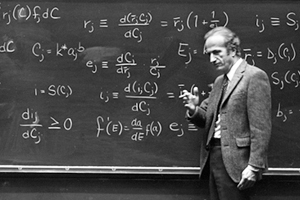 It was a memorable evening.
Becker isn’t here to defend himself on the particulars of that evening but you can see the idea in his great paper, Crime and Punishment: An Economic Approach. In a famous section he argues that an optimal punishment system would combine a low probability of being punished with a high level of punishment if caught:
If the supply of offenses depended only on pf—offenders were risk neutral — a reduction in p “compensated” by an equal percentage increase in f would leave unchanged pf…
..an increased probability of conviction obviously absorbs public and private resources in the form of more policemen, judges, juries, and so forth. Consequently, a “compensated” reduction in this probability obviously reduces expenditures on combating crime, and, since the expected punishment is unchanged, there is no “obvious” offsetting increase in either the amount of damages or the cost of punishments. The result can easily be continuous political pressure to keep police and other expenditures relatively low and to compensate by meting out strong punishments to those convicted.
We have now tried that experiment and it didn’t work. Beginning in the 1980s we dramatically increased the punishment for crime in the United States but we did so more by increasing sentence length than by increasing the probability of being punished. In theory, this should have reduced crime, reduced the costs of crime control and led to fewer people in prison. In practice, crime rose and then fell mostly for reasons other than imprisonment. Most spectacularly, the experiment with greater punishment led to more spending on crime control and many more people in prison.
Why did the experiment fail? Longer sentences didn’t reduce crime as much as expected because criminals aren’t good at thinking about the future; criminal types have problems forecasting and they have difficulty regulating their emotions and controlling their impulses. In the heat of the moment, the threat of future punishment vanishes from the calculus of decision. Thus, rather than deterring (much) crime, longer sentences simply filled the prisons. As if that weren’t bad enough, by exposing more people to criminal peers and by making it increasingly difficult for felons to reintegrate into civil society, longer sentences increased recidivism.
Instead of thinking about criminals as rational actors, we should think about criminals as children. In this light, consider the “Becker approach” to parenting. Punishing children is costly so to reduce that cost, ignore a child’s bad behavior most of the time but when it’s most convenient give the kid a really good spanking or put them in time out for a very long time. Of course, this approach leads to disaster–indeed, it’s precisely this approach that leads to criminality in later life.
So what is the recommended parenting approach? I don’t want to get into a debate over spanking, timeouts, and reasoning but one thing all recommendations have in common is that the consequences for inappropriate behavior should be be quick, clear, and consistent. Quick responses help not just because children have “high discount rates” (better thought of as difficulty integrating their future selves into a consistent whole but “high discount rates” will do as short hand) but even more importantly because a quick response helps children to understand the relationship between behavior and consequence. Prior to Becker there was Becaaria and in Beccarian theory, people must learn to associate crime with punishment. When responses aren’t quick, children, just like scientists, have difficulty learning cause and effect. Quick is thus one way of lowering cognitive demands and making consequences clear.
Animals can learn via conditioning but people can do much better. If you punish the child who steals cookies you get less cookie stealing but what about donuts or cake? The child who understands the why of punishment can forecast consequences in novel circumstances. Thus, consequences can also be made clear with explanation and reasoning. Finally, consistent punishment, like quick punishment, improves learning and understanding by reducing cognitive load.
Quick, clear and consistent also works in controlling crime. It’s not a coincidence that the same approach works for parenting and crime control because the problems are largely the same. Moreover, in both domains quick, clear and consistent punishment need not be severe.
In the economic theory, crime is in a criminal’s interest. Both conservatives and liberals accepted this premise. Conservatives argued that we needed more punishment to raise the cost so high that crime was no longer in a criminal’s interest. Liberals argued that we needed more jobs to raise the opportunity cost so high that crime was no longer in a criminal’s interest. But is crime always done out of interest? The rational actor model fits burglary, pick-pocketing and insider trading but lots of crime–including vandalism, arson, bar fights and many assaults–aren’t motivated by economic gain and perhaps not by any rational interest.
Here’s a simple test for whether crime is in a person’s rational interest. In the economic theory if you give people more time to think carefully about their actions you will on average get no change in crime (sometimes careful thinking will cause people to do less crime but sometimes it will cause them to do more). In the criminal as poorly-socialized-child theory, in contrast, crime is often not in a person’s interest but instead is a spur of the moment mistake. Thus, even a small opportunity to reflect and consider will result in less crime. As one counselor at a juvenile detention center put it:
20 percent of our residents are criminals, they just need to be locked up. But the other 80 percent, I always tell them – if I could give them back just ten minutes of their lives, most of them wouldn’t be here.
 Cognitive behavioral therapy teaches people how to act in those 10 minutes–CBT is not quite as simple as teaching people to count to ten before lashing out but it’s similar in spirit, basically teaching people to think before acting and to revise some of their assumptions to be more appropriate to the situation. Randomized controlled trials and meta-studies demonstrate that CBT can dramatically reduce crime.
Cognitive behavioral therapy runs the risk of being labeled a soft, liberal approach but it can also be thought of as remedial parenting which should improve understanding and appreciation among conservatives. More generally, it’s important that crime policy not be forced into a single dimension running from liberal to conservative, soft to tough. Policing and prisons, for example, are often lumped together and placed on this single, soft to tough dimension when in fact the two policies are different. I favor more police on the street to make punishment more quick, clear, and consistent. I would be much happier with more police on the street, however, if that policy was combined with an end to the “war on drugs”, shorter sentences, and an end to brutal post-prison policies that exclude millions of citizens from voting, housing, and jobs.
Let’s give Becker and the rational choice theory its due. When Becker first wrote many criminologists were flat out denying that punishment deterred. As late as 1994, for example, the noted criminologist David Bayley could write:
The police do not prevent crime. This is one of the best kept secrets of modern life. Experts know it, the police know it, but the public does not know it. Yet the police pretend that they are society’s best defense against crime. This is a myth
Inspired by Becker, a large, credible, empirical literature–including my own work on police (and prisons)–has demonstrated that this is no myth, the police deter. Score one for rational choice theory. It’s a far cry, however, from police deter to twenty years in prison deters twice as much as ten years in prison. The rational choice theory was pushed beyond its limits and in so doing not only was punishment pushed too far we also lost sight of alternative policies that could reduce crime without the social disruption and injustice caused by mass incarceration.
Japan Liberalizes Regenerative Medicine
Japan is liberalizing its approval process for regenerative medicine:
…Regenerative medicines in Japan can now get conditional marketing approval based on results from mid-stage, or Phase II, human trials that demonstrate safety and probable efficacy. Once lagging behind the United States and the European Union on approval times, there is now an approximately three-year trajectory for approvals, according to Frost’s Kumar. That compares with seven to 10 years before.
…Around the world, companies have also faced setbacks while pushing such treatments. In the U.S., Geron Corp., which started the first nation-approved trial of human embryonic stem cells, ended the program in 2011, citing research costs and regulatory complexities.
…While scientists globally have worked for years in this field, treatments have been slow to come to market. But there is hope in Japan that without the political red tape, promising therapies will emerge faster and there will be speedier rewards.
Japan is liberalizing because with their aging population treatments for diseases like Alzheimer’s and Parkinson’s disease are in high demand. Under the new system, a firm with a gene or regenerative therapy (e.g. stem cells) can get conditional approval with a small trial. Conditional approval means that the firm will be able to sell its procedure while continuing to gather data on efficacy for a period of up to seven years. At the end of the seven year period, the firm must either apply for final marketing approval or withdraw the product. The system is thus similar to what Bart Madden proposed for pharmaceuticals in Free to Choose Medicine.
Due to its size and lack of price controls, the US pharmaceutical market is the most lucrative pharmaceutical market in the world. Unfortunately, this also means that the US FDA has an outsize influence on total world investment. The Japanese market is large enough, however, that a liberalized approval process if combined with a liberalized payment model could increase total world R&D.
Breakthroughs made in Japan will be available for the entire world so we should all applaud this important liberalization.
Hat tip: Michael Mandel.
Drum Solo
Rush’s Neil Peart was recently voted the greatest drummer of all time. Here’s Neil demonstrating why:
To appreciate the artistry, I like this best on headphones without visuals but the video captures the amazing physicality of the performance. Some backstory here.
Gun Drop Boxes???
Reporters often call me for insight into various issues or just a quotable comment. Yesterday, however, I had a hard time believing the policy the reporter wanted to talk about was real.
Tacoma, Washington wants to install boxes around the city so people can drop off their guns, no questions asked. But, but, but…seriously?
After the reporter assured me this was real I offered the following:
George Mason University economics professor Alex Tabarrok said [gun buyback] programs have been proven ineffective, and he predicted the same result for a drop box scheme. Anyone in the port city who wants to get rid of a gun discreetly, Tabarrok said, has an easy option: toss it in Puget Sound.
Not really something you need a PhD for but when you are tossed a softball you may as well hit it.
There is something to be said for simply reducing the hassle of disposing a gun for those who don’t want to sell but as a crime control measure this is a bust. Regardless of your views on guns not much will change if you don’t do something nationally about the big boxes where people can buy guns (otherwise known as stores).
The Costs of Occupational Licensing
On Labor Day let’s all read the excellent White House report on occupational licensing:
…the current licensing regime in the United States also creates substantial costs, and often the requirements for obtaining a license are not in sync with the skills needed for the job. There is evidence that licensing requirements raise the price of goods and services, restrict employment opportunities, and make it more difficult for workers to take their skills across State lines. Too often, policymakers do not carefully weigh these costs and benefits when making decisions about whether or how to regulate a profession through licensing. In some cases, alternative forms of occupational regulation, such as State certification, may offer a better balance between consumer protections and flexibility for workers.
The Frechet Probability Bounds — Super Wonky!
I recently ran across a problem using the Frechet probability bounds. The bounds weren’t immediately obvious to me and Google didn’t enlighten so I wrote an intuitive explanation. Super wonkiness to follow. You have been warned.
Suppose that we have two events A and B which occur with probability P(A) and P(B). We are interested in saying something about the joint event P(A∩B), the probability that both events occur, but we don’t know anything about whether the events are correlated or independent. Can we nevertheless say something about the joint event P(A∩B)? We can. The Frechet bounds or inequalities tell us:
max[0,P(A)+P(B)-1] ≤ P(A∩B) ≤ min[P(A),P(B)]
In words, the probability of the joint event can’t be smaller than max[0,P(A)+P(B)-1] or bigger than min[P(A),P(B)]. Let’s give an intuitive explanation.
The events themselves are not important only the probabilities so let’s use an intuitive model for the events. Let x be a random number distributed between 0 and 1 with each number equally likely (i.e. a uniform distribution). Suppose that the event A occurs whenever x is in some region between a and b. For example, we might say that event A occurs if x is between .4 and .6 and event B occurs if x is between .1 and .7. Notice also that since any number between 0 and 1 is equally likely the probability that event A occurs is just the width of the A region, b-a. In this case, for example, P(A)=.6-.4=.2 and similarly P(B)=.7-.1=.6.
Now suppose that a demon arranges the events A and B to minimize the probability that both events occur. What is the smallest the demon could make P(A∩B)? To minimize the probability that both A and B occur we can think of the demon as placing the two events “as far apart” as possible. For example, the demon will begin one event at 0 and define it as the region moving right until the width is equal to P(A) and the other event the demon will begin at 1 and move left until the width is equal to P(B). If P(A)=.2 and P(B)=.4, for example, then the demon will define the events so that A∈[0,.2] and B∈[.6,1]. Here’s a picture. Notice that by beginning one event at 0 and the other at 1 the demon minimizes the overlap which is the probabiity that both events occur.
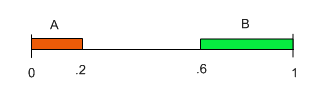 In this case, the events don’t overlap at all and so the demon has ensured that the probability of P(A∩B)=0.
But what if the two events must overlap? Suppose for example that P(A)=.5 and P(B)=.7 then the demon’s logic of minimization leads to the following picture:
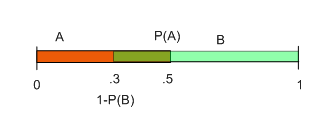 We can see from the picture that the overlap is the region between .3 and .5 which we know has probability .5-.3=0.2. Thus we have discovered that if P(A)=.5 and P(B)=.7 then the joint probability has to be at least .2, i.e. .2≤P(A∩B).
Now let’s generalize. The probability of any event occuring is the length of its region b-a but since the demon always begins the event A at 0 then the probability of P(A) is simply b the rightmost point of the A region. Thus, on the diagram the rightmost point of the A region is labelled P(A) (.5 in this case). Also since the demon always begins the B region at 1, P(B)=1-a′ where a′ is the leftmost point of the B region so rearranging we have that the leftmost point a′=1-P(B) as shown in the picture at .3. Thus, we can read immediately from the figure that the overlap region has length P(A)-(1-P(B)). Notice that if P(A)<1-P(B) then there is no overlap and the difference is a negative number. Rearranging slightly, the length of the overlap region is P(A)+P(B)-1. So now we have two cases, either there is no overlap at all in which case P(A∩B)=0 or there is overlap and P(A∩B)=P(A)+P(B)-1. So putting it all together we have proven that:
max[0,P(A)+P(B)-1] ≤ P(A∩B)
The Frechet bounds also say:
P(A∩B) ≤ min[P(A),P(B)]
This is much easier to show. If minimization is accomplished by minimizing the overlap then maximization is accomplished by maximizing the overlap. To maximize the joint probability the demon starts both regions at the same point, say at the 0 point, so the picture looks like this:
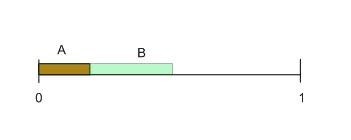 The joint probability is then the region of overlap. But the regions can’t overlap by more than the smallest of the two regions! In this case the A region is smaller than the B region and since the regions start at 0 we have P(A∩B)≤P(A). Generalizing we have that:
P(A∩B) ≤ min[P(A),P(B)]
Thus we have proven the Frechet bounds:
max[0,P(A)+P(B)-1] ≤ P(A∩B) ≤ min[P(A),P(B)]
Addendum: Here is Heckman on the theory of Frechet Bounds and Heckman and Smith and Heckman, Smith and Clements with applications.
The Tullock Memorial Conference
A conference on Gordon Tullock’s economic, political, and legal research is being held in Founders Hall of George Mason’s Arlington Campus on Friday October 2 and Saturday October 3, 2015.
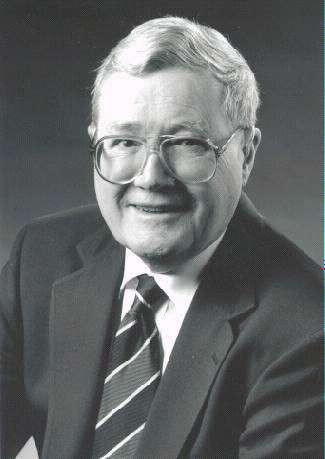 Gordon Tullock was one of the founders of the field of research that came to be called Public Choice. He was coauthor of one of the most important books in the field, the Calculus of Consent (with Nobel Prize winner James Buchanan) and the first to point out the losses associated with rent seeking. He was also among the first researchers to use economic tools to analyze the law, trial procedures, and judicial systems. His research includes theories of the origin of the state and constitutional governance, the impossibility of revolution, legal systems, government failure, and the economics of science itself. Beyond his own research he was an institution builder. He was the founding editor of the journal Public Choice, a premiere outlet for research on public choice. He helped to launch the Public Choice Society and the European Public Choice Society. He is among the most influential economists never to win the Nobel Prize.
Looks like an excellent conference and event. More information and RSVP here.
On the Bargaining Power of Workers
Over at Econlog Bryan Caplan responds to a Scott Alexander post on the bargaining power of workers. Bryan makes excellent points. I want to focus on two larger issues. Many people look at big firms and little workers and they see an imbalance and can’t imagine how the firms are not in control. Even framing the issue as the bargaining power of workers makes it seem like a David and Goliath battle.
The firm v. worker framing focuses attention on the threat to the worker of unemployment. From this perspective it seems as if the firm can “bargain” the worker down to the least the worker is willing to accept and, given the threat of unemployment, that isn’t much.
The firm versus worker framing, however, obscures a point that Tyler and I make in Modern Principles: Buyers don’t compete against sellers, buyers compete against other buyers (and sellers compete against other sellers). Firms buy labor and they are competing primarily not against workers but against other firms. Firms versus Firms! Now that is a real battle!
When firms are thinking about wages what they are thinking about is the threat from other firms. When a firm is hiring it knows it must pay the worker at least as much as other firms are willing to pay.
The other-firm threat is very real. In fact, more often that not when a worker-firm match breaks up, it’s the worker who leaves, usually for another firm (the hot, young startup?), rather than the firm who leaves the worker with a layoff. The figure below shows data on quits divided by layoffs. Most of the time quits exceed layoffs (even during some recessions) with only brief windows during severe recessions when quits are fewer than layoffs.

Using the firms versus firms frame it becomes clear that rather than a battle between firms and workers, firms are a worker’s best friend. To be sure, it’s the firms that the workers don’t work for who are their best friend not necessarily the firm they do work for! Indeed, another problem with the firm versus worker frame is that in their eagerness to win the “battle” with their firm workers sometimes support policies which harm all firms, including their friends. A case of cutting off the nose to spite the face. Remember, firms are buyers and sellers benefit when there are lots of rich, successful buyers.
Hat tip: Justin Merrill.
Addendum: Bargaining can be important when the hiring firm is willing to pay the worker considerably more than are other firms–this can happen for highly-skilled workers with specific talents and unique firm-complementarities. Note that in these cases it’s more a case of the worker “bargaining up” to grab surplus than the firm bargaining down. For workers as a group, this kind of surplus is gravy. But there’s nothing wrong with gravy so if this applies to you do read Getting to Yes and learn to bargain well.
Marketing Pork
Here is a great little story by Danny Vinik from Politico’s The Agenda on how so-called marketing boards are surreptitiously turned into lobbying boards.
Industries with a large number of producers find it difficult to organize collectively because of the free rider problem. Mostly, that’s a good thing because it prevents cartels. Collective action, however, could also be used to perform research or marketing that’s good for the industry as a whole but too expensive for any small subset of producers. In theory, therefore, some type of collective action could be beneficial and in agriculture governments have created checkoff programs which force producers to pay a tax to fund collective goods.
Checkoffs exist for dairy farmers, mushroom producers, and even popcorn processors. Critics say they violate economic freedom and distort the market; big corporate farmers, they allege, easily find ways to influence the boards and siphon the money off to push their own causes.
“In one sense, it’s a classic case of the larger producers are the more powerful political forces within these organizations,” said Dan Glickman, the Agriculture Secretary at the end of the Clinton administration who largely supports checkoff programs.
For the unhappy hog farmers, the current problem started with the 1985 Pork Law, when Congress set up the National Pork Board and required all farmers to contribute. Today, hog farmers must hand over 40 cents out of every $100 in revenue from pork sales. The board uses the money, totaling nearly $100 million a year, to conduct research and promote the pork industry, but is not allowed to lobby.
But as Adam Smith said “People of the same trade seldom meet together, even for merriment and diversion, but the conversation ends in a conspiracy against the public, or in some contrivance to raise prices.” Quite so. And in this case by creating a National Pork Board the government is providing the meeting hall and paying for the conversation. According to the law, the money from the checkoff program isn’t supposed to go for lobbying but here is where the story gets interesting.
You may recall the slogan, “Pork: The Other White Meat.” The slogan hasn’t been used for years but the National Pork Board still pays $3 million a year every year for the rights. Why would the Pork Board pay millions for an unused slogan? The key is who they are paying. The slogan is owned by National Pork Producers Council. The NPPC is a lobby group and you won’t be surprised to know that it is closely connected with the NPB (having once even shared offices).
…critics say the two groups have never been as separate as the law calls for, and now are essentially colluding through a deal that lets the Pork Board funnel money to the NPCC by assigning an absurdly inflated value to the “other white meat” slogan; the money then goes to promote the NPPC’s lobbying agenda.
A neat trick. The story is also a good object lesson in Mancur Olson’s thesis about how special interest groups grow in power over time, slowly choking off innovation as they cartelize the economy.