Patent Trolls are Only the Symptom
I was going to write a post on how trolls aren’t the fundamental problem with the patent system but Timothy Lee has it covered:
…trolls aren’t the primary problem with the patent system. They’re just the problem Congress is willing to fix. The primary problem with the patent system is, well, the patent system. The system makes it too easy to get broad, vague patents, and the litigation process is tilted too far toward plaintiffs. But because so many big companies make so much money off of this system, few in Congress are willing to consider broader reforms.
A modern example is Microsoft, which has more than 40,000 patents and reportedly earns billions of dollars per year in patent licensing revenues from companies selling Android phones. That’s not because Google was caught copying Microsoft’s Windows Phone software (which has never been very popular with consumers). Rather, it’s because low standards for patents — especially in software — have allowed Microsoft to amass a huge number of patents on routine characteristics of mobile operating systems. Microsoft’s patent arsenal has become so huge that it’s effectively impossible to create a mobile operating system without infringing some of them. And so Microsoft can demand that smaller, more innovative companies pay them off.
… In effect, the patent system is acting as an innovation tax, transferring wealth from companies that are creating successful technologies today to companies that acquired a lot of patents a decade ago.
A more fundamental change would be to offer patents of varying length, say 3, 7, and 20 years with the understanding that 3 year patents will be approved quickly but 20 year patents will be required to leap a high hurdle on non-obviousness, prior art and so forth. See my paper Patent Theory versus Patent Law.
My video on patents is a quick and fun introduction.
Prosperity Notes
ABC: The Treasury Department recently sold 44,000 one-dollar bills to one person — at a price of $5.95 apiece.
The bills weren’t even all that special — they weren’t very old, and they didn’t have any major flaws that made them valuable to collectors.
What they did have though, was four number eights in a row in their serial numbers — a sign of luck to many people of Asian descent.
And that’s made the bills popular. The Treasury’s Bureau of Engraving and Printing says it has sold over 70,000 such “prosperity notes” to thousands of people around the world — not including the huge sale to one individual.
Now that is a high rate of seigniorage. You can buy your own lucky bills from the Treasury. Westerners may prefer the 777 series. There is a discount for bulk orders, but you will still be paying more than a dollar for a dollar. That doesn’t feel lucky to me.
Hat tip: The Blacklist.
The False Prophets of Efficiency Wages
One of the least-convincing tropes of financial journalism is the article explaining how business firms can increase profits and at the same time engage in some conventional, culturally-approved, do-good activity such as improving the environment, saving energy, or helping the poor. The latest version is how to increase profits by increasing wages.
Here is James Surowiecki writing in the New Yorker:
A substantial body of research suggests that it can make sense to pay above-market wages—economists call them “efficiency wages.” If you pay people better, they are more likely to stay, which saves money; job turnover was costing Aetna a hundred and twenty million dollars a year. Better-paid employees tend to work harder, too. The most famous example in business history is Henry Ford’s decision, in 1914, to start paying his workers the then handsome sum of five dollars a day. Working on the Model T assembly line was an unpleasant job. Workers had been quitting in huge numbers or simply not showing up for work. Once Ford started paying better, job turnover and absenteeism plummeted, and productivity and profits rose.
Walter Frick writing in the Harvard Business Review agrees:
The theory of efficiency wages…suggests that firms sometimes have an incentive to pay workers more than the going rate because doing so attracts better candidates, motivates them to work harder, and encourages them to stay at the company longer.
(Similar kinds of stories are offered by Justin Wolfers and Jan Zilinksy and also Paul Krugman).
There are two problems with this story, one obvious and one not-so obvious. The not so-obvious problem is that the economists who developed the theory of efficiency wages (including Shapiro and Stiglitz, Akerlof and Yellen and Yellen) had no illusions that they were helping business firms to discover a new way to increase profits. The economists who developed efficiency wage theory were trying to explain persistent unemployment. Hence the title of Janet Yellen’s famous survey, Efficiency Wage Models of Unemployment.
The question that motivated efficiency wage theory was not why firms should raise wages but why firms don’t cut wages when they should. The answer they gave was that firms don’t cut wages despite unemployment because they fear that workers will respond to lower wages with reduced productivity. Thus, here is Akerlof and Yellen explaining that when workers demand “fair” wages they create unemployment.
…according to the fair wage-effort hypothesis, workers proportionately withdraw effort as their actual wage falls short of their fair wage. Such behavior causes unemployment…
In the original efficiency wage literature there is no wishful thinking–no idea that we can have more of everything that we want without tradeoffs. Instead of being desirable, the efficiency wage is a problem because lower wages would reduce unemployment and be better for the economy as a whole.
Instead of letting us bask in wishful thinking the real efficiency wage theory suggests unpleasant tradeoffs. Yellen, for example, suggests that if it were cheap, greater monitoring of workers would lower unemployment as would allowing workers to take low-pay or no-pay internships for trial periods. In our paper on asymmetric information, Tyler and I make such unpleasant tradeoffs clear:
When employers do not easily observe workers, for example, employers may pay workers unusually high wages, generating a rent. Workers will then work at high levels despite infrequent employer observation, to maintain their future rents (Shapiro and Stiglitz 1984). But those higher wages involved a cost, namely that fewer workers were hired, and the hires that were made often were directed to people who were already known to the firm. Better monitoring of workers will mean that employers will hire more people and furthermore they may be more willing to take chances on risky outsiders, rather than those applicants who come with impeccable pedigree. If the outsider does not work out and produce at an acceptable level, it is easy enough to figure this out and fire them later on.
Notice that the efficiency wage theorists took it for granted that to the extent that firms can increase profits by raising wages they have already done so (hence the persistent unemployment). Firms don’t typically leave $100 bills lying on the ground so the Stiglitz, Akerlof, Yellen assumption makes perfect sense. Thus the more obvious problem with the journalistic account of efficiency wages is that it makes it sound as if the idea that productivity might increase with wages is a revelation that firms have never considered. (See Frick for some implausible stories of why firms might not raise wages even when it is profitable to do so.) In fact, firms routinely track turnover and productivity and they are well aware that higher wages are a possible means to reduce turnover and increase productivity although, as it turns out, not necessarily the most effective means. Indeed, the whole field of workforce science deals with retention, turnover and job satisfaction and the relationship of these to productivity and it does so with more nuance than do most economists. Thus, it’s simply not plausible that large numbers of firms on the existing margin can increase wages, profits and productivity. TANSTAAFL.
In summary, the real theory of efficiency wages is an important and useful theory of persistent unemployment–one that helped earn Stiglitz and Aklerof Nobel prizes and Yellen a plum government job–but the journalistic proponents of “efficiency wages” are false prophets peddling false profits.
Vignettes of Famous Evolutionary Biologists, Large and Small
From Robert Trivers. Here is Trivers on William Hamilton:
Certainly one of the most creative minds I have ever met in biology. I still remember the day a graduate student came running down the hall saying “Have you heard Hamilton thinks that bacteria use clouds for dispersal? As quick as you can say “Bill Hamilton”, I asked “Has he shown how the bacteria get the rain to fall where they want it to?” And indeed his idea humbled me because ever since I had been coming to Jamaica I had heard rural people tell me “trees draw rain” as in, don’t cut them down, and I had thought to myself you poor benighted souls, you have the correlation right but causality wrong—naturally, where it rains more, trees are more apt to grow. Now Bill suggested they Jamaicans may well have had it right all along—lower temperatures over wooded areas could itself be a useful signal.
A Regulatory Balanced Budget in Canada
Financial Post: Canada is now the first country in the world to require that for every new regulation introduced one of equivalent burden must be removed.
C-21, has been operating as policy for several years already, which means that the costs of new rules must be quantified and equal or greater costs removed. It essentially caps the cost of rules coming directly from regulations.
This is not quite as radical as it sounds. As I understand it, the law applies only to new bureaucratic rules and regulations not to legislation. Nevertheless, it’s reasonable to force regulatory bureaucracies to operate within a budget so that new rules are promulgated only when the new rule is expected to be an improvement over existing rules taking into account all costs.
Heath Responds to Tabarrok
Joseph Heath has written an interesting and thoughtful comment on my review of his excellent book Enlightenment 2.0 (fyi, we have never communicated but it turns out that Heath is a long time reader of MR.). Samuel Hammond concisely summarized on twitter part of Heath’s response:
In reply to @ATabarrok, Joseph Heath shares the dire Straussian reading of his own book: The US is Rome burning
Quite accurate but I want to focus on a different point.
Finally, Tabarrok suggests that I am “too sanguine about the role of politics.” I thought I was being fairly pessimistic about politics. I think the nub of the disagreement between Tabarrok and myself on this point – and certainly the basis of our major differences of political ideology – is that I am much more sanguine about the role of the state than he is. This is not the same as being sanguine about democratic politics. For example, he points out that:
In a large electorate, no individual’s vote is likely to change the outcome of an election. As a result, it doesn’t pay to be informed about politics nor to think about politics in objective and rational terms. Consider an individual who spends time and effort to be informed about politics. What does this individual receive in return for their investment? The same thing as the uninformed individual. Since better information doesn’t lead to better consequences, it doesn’t pay an individual to be informed.
I couldn’t agree more….Indeed, the sort of considerations that motivate Tabarrok’s enthusiasm for making decisions through betting markets are, I would guess, quite similar to the ones that motivate my own enthusiasm for cost-benefit analysis. The key difference is that Tabarrok (and Bryan Caplan) tend to assume that democracy gives “the people” much greater control over the behaviour of the state than it actually does. In the background there is, I suspect, a somewhat public-choicy picture of legislation as a complex process of preference-aggregation. By contrast, I follow Ian Shapiro in thinking that we need to get past these sorts of “general will” theories of democracy.
There is one point in the last chapter where I say what I really think, but again, it might easily be overlooked. So let me just say, for the record, that I was also dead serious when I wrote the following paragraph (and that it comes closest to summarizing my considered view):
It is important to recognize that modern democratic political systems involve a delicate compromise between, on the one hand, the desire for public control of decision-making and, on the other hand, the need for rational, coherent policy. Democracies need to be democratic, but they also need to work, in the sense that they need to produce a state that effectively discharges its responsibilities. Thus they have a variety of institutional features that allow them to function even when the democratic public sphere is completely degraded. They do so largely by shifting power and control away from elected representatives toward experts. Even in the United States, where this is difficult to do, one can find examples all over. The most obvious example is the enormous role that the Supreme Court has played in making decisions that, in most other democracies, would be left to the legislature. But one can see it in other areas as well, such as the amount of autonomy that government agencies have or the increased use of cost-benefit analysis in public decision-making (338).
So if you want to know what I really think, it’s that we are not going to be able to fix the problem of increased irrationalism in politics — at best we will be able to limit its most toxic effects. As a consequence, the legislature will increasingly become a sideshow, with the two other branches of the state assuming more and more of the responsibility for actually governing.
Heath has hit on an important similarity and difference in our views. We are both skeptical about democracy as a way of making rational, coherent policy. But in response to the defects of democracy I want to devolve more decisions to the individual and the market while Heath wants to centralize more decisions to the state and expert bureaucracies.
One of the reasons that I oppose the extension of democratic politics into every aspect of modern life is precisely that in trying to do too much, democracy delivers incoherence, gridlock and frustration, forces that eventually undermine its own legitimacy. I worry about democratic legitimacy because I see democracy as a check and balance on Leviathan (while Heath sees it as a check on government by experts).
The legislature has become a sideshow. But I worry, because the more Congress is held in contempt the greater the support for a bold executive that takes charge, makes decisions and gets things done. Under these pressures, executive power has grown not just in the United States but also in Canada and Great Britain (on this theme see F.H. Buckley’s The Once and Future King.) But for all its faults, the legislature and the rule of law are more conducive to liberty than the executive and the administrative state. Legislators are satisfied with reelection and a bit of pork but executives hunger for greatness and in so doing they promote the real dangers, idolatry, the centralization of power and war.
In short, I worry that the pathologies of democracy drive the demand not for rational, technocratic government but for Caesarism.
Asymmetric Information: Response
At Cato Unbound Tyler and I respond to comments on our End of Asymmetric Information piece. Here is one bit:
It is important to remember that the opposite of asymmetric information is symmetric information, not perfect information. That is a simple distinction, yet it’s one that many commentators, such as David Auerbach writing at Slate, fail to recognize. Information will always be imperfect. Uncertainty and risk will never be banished. Uncertainty and risk, however, do not in general create market failure (indeed in the case of insurance and gambling, uncertainty and risk create markets).
We don’t even have perfect information about our own tastes. In this setting, when one of us orders a product that does not meet our expectations, what do we do? Most of the time, we return it. Rather than living in a world dominated by moral hazard, we live in a world dominated by firms so eager to sell quality products that they will often guarantee our satisfaction or take the product back for any reason with full refund (sometimes less postage).
….As Hayek emphasized, the market does not require perfect knowledge to function, rather it is the means by which imperfect knowledge is made to function in the social interest.
We discuss some more implications of the leveling of information such as why renting durables will become more common, and we explain why price discrimination is consistent with and in some cases implied by the reduction of asymmetric information. We also discuss what types of regulation we need more of and what types less, and how the level of asymmetric information is consistent with Hayek’s emphasis on markets and dispersed knowledge.
Public Choice Weekend!
Don’t forget the Public Choice Outreach Seminar is June 12-14. Applications are invited!
What is the Public Choice Outreach Conference?
The Public Choice Outreach Conference is a compact lecture series designed as a “crash course” in Public Choice for students planning careers in academia, journalism, law, or public policy. Graduate students and advanced undergraduates are eligible to apply. Many past participants of the Outreach seminar have gone on to notable careers in academia, law and business.
When and where is the Conference?
The 2015 Conference will be held at the Hyatt Arlington in Rosslyn, Virginia during June 12-14, 2015.
What are the fees involved?
Outreach has no conference fee – it is free to attend. Room and meals are included for all participants. However, travel costs are the responsibility of the participants.
More information and application here:
What’s the Hardest Part of Being a PhD Student?
I was asked this this question on Quora. Here’s my answer:
Writing an original dissertation.
Anyone who makes it into graduate school has had at least 16 years of learning and, as a result, most graduate students are good learners. A dissertation, however, requires the creation or discovery of new knowledge. On the day you finish your dissertation you have to know something that no one else in the world knows. That is a tall order.
After their course work ends, many students find themselves at a loss. They have done a lot of learning and not much creating or discovering–skills that not only are different than learning but that may even be at cross purposes. A learner has to trust that what he or she is being taught is true and valuable. A learner with too much skepticism won’t pass the final. But a dissertation writer without enough skepticism will never advance beyond previous knowledge and never discover that something previously learned was false.
It’s an odd necessity that the more you know the more skeptical you must become to know more. Not every student navigates this evolution in attitude.
FYI, Quora seems to be growing very rapidly. I first noticed this when my followers on Quora started growing faster than and soon exceeded my followers on Twitter, a fact I found surprising. According to Alexa, Quora has leaped in the popularity rankings 42 places in just the last 3 months. It will be interesting to see how they handle the growth especially keeping the quality of the questions high.
Is Capitalism Making Us Stupid?
Joseph Heath’s Enlightenment 2.0 is one of the best books I have read in years. I offer an extensive review at the New Rambler. Here’s the opening:
Joseph Heath is a Canadian philosopher who is unusually conversant with economics and also unusually capable of writing sparkling prose for a popular audience. His earlier book Economics Without Illusions was split into 6 right-wing fallacies and 6 left-wing fallacies, and he did a commendable job on both sides. Heath has his own left-liberal point of view: the subtitle of Economics Without Illusions was Debunking the Myths of Modern Capitalism and in the original Canadian version, the book was subtitled Economics For People Who Hate Capitalism. However, I like capitalism and I still enjoyed it! Enlightenment 2.0 is Heath’s foray into political philosophy. Drawing on psychology, economics and political science, Enlightenment 2.0 is a brilliant defense of reason, an important call for a more rational politics, and a great read.
Heath is worried that the foundations of liberal society are being eroded by the cultural denigration of reason combined with ruthlessly competitive economic and political forces that exploit the biases and hooks of our unreasoning mind.
Although I admire Enlightenment 2.0, I answer the question of the post differently than does Heath and my review contains plenty of critical commentary. Ayn Rand, Idiocracy, mind viruses and other interesting characters make an appearance. Read the whole thing.
Is the Income Tax Legal? Voluntary?
Just in case you are tempted to go all Wesley Snipes and refuse to pay your taxes on “constitutional” grounds, the income tax is legal and mandatory. Sorry.
Jonathan Siegel, professor of law at GWU has carefully examined all the primary tax protester arguments. All are wrong. Some are quite interesting
Some tax protestors claim that [the 16th] amendment is not really part of the Constitution — it was never ratified! Therefore, they say, the income tax is unconstitutional. This argument was popularized by Bill Benson in a book called “The Law That Never Was.”
Surprisingly enough, this argument has a little something to it. When the Sixteenth Amendment was ratified by state legislatures in the early twentieth century, the versions that some states voted on contained minor textual errors. Some of them neglected to capitalize the word “States,” one had “income” in place of “incomes,” one said “remuneration” instead of “enumeration,” one said “levy” instead of “lay,” and so on.
If the states didn’t all vote on the same, identical text for the Sixteenth Amendment, can the amendment really be considered ratified? When Congress makes a law, the House and the Senate must vote on the same text. Similarly, if the states didn’t vote on the right text, one could argue that they didn’t ratify the amendment. No Sixteenth Amendment, no income tax, the argument goes.
However, it seems that the amendment really was ratified. The alleged defects in the ratification process were considered at the time of ratification in 1913. The Solicitor of the Department of State convincingly explained why the minor textual variations in the versions the states voted on should be disregarded.
First, it seems that the state legislatures intended to ratify the amendment as proposed by Congress. They understood themselves to be voting to approve the proposed Sixteenth Amendment. The text set forth in their instruments of ratification was for recitation purposes only. The errors in the text were not proposals to change the text being ratified; they were just inadvertent errors that do not detract from the intention of the state legislatures to ratify the amendment as proposed.
Benson denies this. He claims that states deliberately altered the text of the proposed amendment. But the evidence just isn’t there. In one of his court filings, Benson singles out Oklahoma as a particularly clear case. He says the facts “unequivocally show that Oklahoma intentionally amended what the United States Congress had proposed” (see page 2 of Benson’s filing). But looking at Benson’s own book (pp. 61-67), one can see that the Oklahoma legislature adopted what it called “A resolution ratifying an amendment proposed by the sixty-first Congress of the United States” (emphasis added). This resolution then begins its ratification by reciting that “Whereas . . . Congress . . . on Monday the fifteenth day of March, one thousand nine hundred and nine, by joint resolution proposed an amendment to the constitution of the United States, in words and figures as follows:” Then, it’s true, the resolution misstates the text of the amendment (and pretty badly too). But it sure looks as though the Oklahoma legislatorsthought they were ratifying the amendment that Congress had proposed on the specified date and just misstated it. So even in a case that Benson himself singles out, it seems quite clear that the state legislature thought it was ratifying the Sixteenth Amendment, not proposing to change it.
…For all these reasons, it seems clear that the Sixteenth Amendment really is part of the Constitution.
Certainly that has been the uniform holding of the courts in cases in which this argument has been raised. For some representative cases, see United States v. Benson, 941 F.2d 598 (7th Cir. 1991) (rejecting these arguments in a criminal case brought against the author of the “Law that Never Was” book); United States v. Foster, 789 F.2d 457 (7th Cir. 1986); Cook v. Spillman, 806 F.2d 948 (9th Cir. 1986) (calling the argument that the Sixteenth Amendment was never ratified “frivolous” and imposing sanctions of $1,500 on the party making it); United States v. House, 617 F.Supp. 237, 238-39 (W.D. Mich.1985).
So while this argument is not as utterly absurd as most tax protestor arguments, one can be confident that it would not succeed in any actual court proceeding.
Voice and Exit Festival
I will be speaking at the Voice and Exit Festival in Austin, Texas, June 20-21. Voice and Exit is like a TED conference on steroids, an edgier, more radical TED. It looks like a lot of fun. Hope to see you there.
Here is a bit from V&A:
 We assemble those who ask: What are the systems and ways of life that are holding us back? What can we create to make those old ways obsolete? What innovations enable us to find wellbeing, life meaning and stronger connection to others? How can we live intentionally today so as to create that better future? Voice & Exit is an environment of exploration where we “criticize by creating” a better world.
Tyler’s Conversation with Jeff Sachs
It’s a great conversation. Sachs really opened up when discussing how his pediatrician wife influenced his approach to economics. The anger he still feels from the US treatment of Russia during its reform period is evident. He is startling forthright, calling out Acemoglu and Robinson and Krugman for mistakes and errors.
The youtube link is here. The audio edition is here and this is the ITunes link. Finally, here is the elegantly presented transcript on Medium, also with lots of links and additional material.
Sachs’ work on many fronts has influenced both Tyler and I, most notably in the geography section of our MRU development course.
Moral Suasion vs. Price Incentives for Conservation
Given the water drought in California, Ito, Ido and Tanaka have a timely paper comparing two methods of electricity conservation. The authors assigned 691 households in Japan to one of three groups a) a moral suasion group, b) an economic incentive group or c) a control group. The moral suasion group were told that electricity conservation was important and necessary on peak demand days and then over a year when the peak times hit they were sent day-ahead and same-day messages to please reduce electricity consumption at the peak times. The economic incentive group were told that their electricity prices would be higher during certain peak periods and over the year when the peak times hit they were sent day-ahead and same-day messages telling then when the prices would be higher. Prices were approximately 2-4 times higher during the peak times. Control groups had smart meters installed but were not sent messages.
Moral suasion worked but not nearly as well as economic incentives (in the figure, lower use is better).
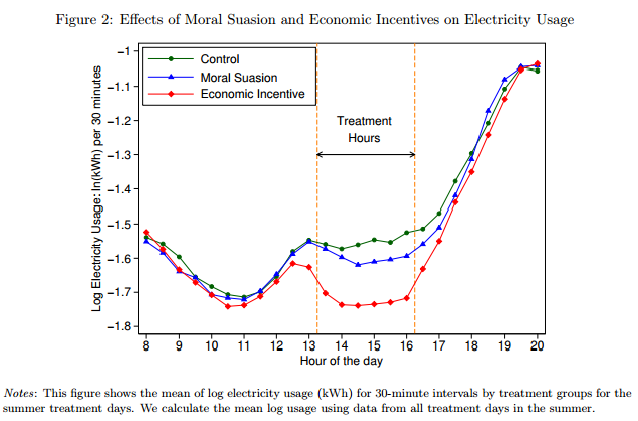
In fact, as the author’s discuss, the figure significantly underestimates the gains from the economic incentive because moral suasion worked only for the first few treatment periods and then faded away. The economic incentive continued to work throughout the treatment period. Moreover, precisely because people continued to respond to the incentive they developed a conservation habit so the group facing economic incentives actually conserved more during non-treatment periods and even after the experiment ended.
Hat tip: John Whitehead at Environmental Economics.
Addendum: Here are previous MR posts on water.
Compensating Differentials
The latest section of our Principles of Economics course at MRU is up today and it covers price discrimination and labor markets.
In this video, The Tradeoff Between Fun and Wages, we introduce the idea of compensating differentials in wages, an idea that goes back to Adam Smith.
Sharp readers will notice a homage near the beginning in what might otherwise appear to be an odd scene setting.