Roving Bandits
Yesterday, Tyler linked to an important report from the Washington Post showing how “aggressive police take hundreds of millions of dollars from motorists not charged with crimes.” The report and video are shocking.
The aggressive tactics documented by the Post have mostly been deployed against motorists who are unlucky enough to be stopped for a moving violation. An apparently leaked document, however, shows that these programs are likely to expand far beyond motorists.
More than Half of Workers Have New Jobs Since the End of the Recession
Many people continue to call for greater inflation to solve our current economic problems. A classic argument for why inflation can help is downward nominal wage rigidity. It is difficult to believe that nominal wage rigidity is important now, years after the end of the recession. The main reason nominal wages don’t fall is that wages are an anchor around which expectations and understandings are built and when wages are cut workers get angry and upset. But when a worker begins a new job with a new employer it’s anchors away! New job, new wage and no feelings of loss even if the wage is less than what some other person earned sometime in the past for doing something sort of similar.
Now here is an important fact: the median number of years that current wage and salary workers have been with their current employer is about four and a half. In other words, more than half of current workers have jobs that are new since the end of the recession. A majority of workers have new jobs, some workers have wages that are increasing (and thus a fortiori not downwardly rigid) and quite a few workers have flexible wages due to piece rates, commissions, bonuses and so forth. Not all of these categories perfectly overlap. Thus, the scope for nominal wage rigidity as an explanation for current problems appears to be small.
Moreover, here’s an interesting test. If nominal wage rigidity explains unemployment and if wages are more rigid at old jobs than at new jobs then we ought to see a positive correlation between unemployment rates and job tenure. Instead, we see the exact opposite, unemployment rates are lowest in the industries with the higher tenure. Of course, this is a raw correlation not a causal estimate. Nevertheless, some of the points are striking.
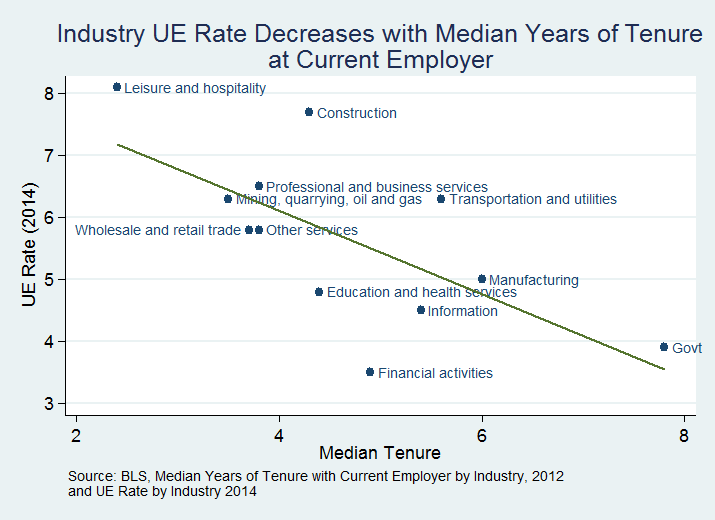
In the leisure and hospitality industry, for example, the median worker has been in their job only about 2.4 years–that means that well over the half of the jobs in this industry are new since the end of the recession–yet the unemployment rate in that industry is over 8%. With that kind of turnover in jobs its difficult to believe that wages have not adjusted. Or to put it differently, if one were to ask apriori which will have a greater influence on reducing nominal wage rigidity either a) turning over more than half the jobs in the industry or b) a few extra points in the inflation rate then I think most economists would, without hesitation, answer the former. Inflation is not magic.
College Admission Secrets
Most colleges are non-profits with unclear ownership status so their incentives do not lead to simple profit-maximization. Don’t be fooled, however, neither do colleges maximize student welfare or the public good. Instead colleges pursue some index of free cash flow, prestige, and administrative and faculty independence. The result is some peculiar outcomes. Most businesses, for example, don’t want to reject customers but colleges often encourage students to apply so that they can reject them. The Washington Monthly’s college issue has an excellent primer, Ten Ways Colleges Work You Over, that explains:
The aim of the game for colleges is to boost the number of students who apply and can be rejected. By doing this, the schools see their acceptance rates fall, making them appear to be more selective—which helps them rise up the U.S. News & World Report rankings.
Take Northeastern University in Boston… [which] sends nearly 200,000 personalized letters to high school students each year. The institution then follows up these letters with emails, making it seem that the school is wooing these individuals.
… Nearly 50,000 students applied to Northeastern this year for 2,800 spots in the fall 2014 class…
Lowering its acceptance rates is at least one factor in why Northeastern has catapulted up the U.S. News rankings, rising more than 100 spots since 2002.
Profit-maximization (or maximization of free cash flow) is also not absent from the process. Many schools, for example, say they are need blind but that just means that admission officers don’t know the student’s income. Admissions officers, however, do know lots of information that is highly correlated with income including where applicants live, what high school they attended and the occupations of the applicants parents–not exactly what I would call blind.
Schools even use seemingly arbitrary bits of information to increase their revenues. The Free Application for Federal Student Aid (FAFSA) form, for example, has students list the colleges that they are interested in applying to. Although the order is irrelevant, students often list in preferential order and the colleges see this information. As a result, colleges have an incentive to offer students who list their college first less financial aid simply because that is an indication that the student has a high demand for that college.
What has Economics Done for You Lately?
A very nice talk by Robert Litan on the contributions of economists and economic ideas to the internet economy:
Ikea’s Simulacrum
An amazing 75% of the images in an Ikea catalog are not photographs but CGI.
…the real turning point for us was when, in 2009, they called us and said, “You have to stop using CG. I’ve got 200 product images and they’re just terrible. You guys need to practise more.” So we looked at all the images they said weren’t good enough and the two or three they said were great, and the ones they didn’t like were photography and the good ones were all CG! Now, we only talk about a good or a bad image – not what technique created it.”

Big Sugar
From Bloomberg:
Because of a plunge in U.S. sugar prices amid a hefty crop of sugar beets and cane, the Agriculture Department estimates that it may have to buy 400,000 tons of sugar from processors who might default on $862 million in government loans. Sugar producers have the option of repaying the loans either with cash or with their harvests if prices fall below a certain level.
…The sugar, by law, would be sold to ethanol refiners, who would pay 10 cents a pound less than the government paid — an inducement needed to get the ethanol industry to use the sugar. Aside from the ridiculousness of piling one ill-advised subsidy atop another, this would produce a loss of $80 million for the U.S. Treasury. Some industry analysts estimate the government may have to buy as much as 800,000 tons of sugar to restore balance to U.S. stockpiles, potentially doubling the loss.
Police Killings
Richard Epstein writes:
Police officer deaths in the line of duty, year to date for 2014, were 67 of which 27 were by gunfire. For the full year of 2013, the numbers were 105 total deaths, with 30 by gunfire. It would be odd to say that police officer deaths (which are more common than deaths to citizens from police officers) should not count…
It would indeed be odd to say that police officer deaths should not count, which is perhaps why no one says this. Police officer deaths are counted but the literal truth is that we don’t count deaths to citizens. No one knows for sure exactly how many citizens are killed by police because the government doesn’t keep a count. Draw your own conclusions. What we do know, is that it is not true that police officer deaths are more common than deaths to citizens from police officers. Not even close.
105 officers were killed in the line of duty in 2013 but to be clear this includes heart attacks, falls, and automobile accidents. Deaths due to violent conflict include 30 deaths by gunfire, 5 vehicular assaults, 2 stabbings and a bomb. To be conservative, let’s say 50 deaths to police at the hands of citizens.
According to the FBI there are around 400 justifiable homicides by police every year, where justified is defined as the killing of a felon by a law enforcement officer in the line of duty. But note that if the killing of Michael Brown is found to be unjustified it won’t show up in these statistics.
The best information we have of citizens killed by the police, believe it or not, are private tabulations from newspaper accounts. On the basis of one such collection, DataLab at FiveThirtyEight estimates that police kill 1000 people a year.
Thus, killings by police seem to be on the order of 10 to 20 times higher than killings of police.
Ferguson and the Modern Debtor’s Prison
How does a stop for jaywalking turn into a homicide and how does that turn into an American town essentially coming under military control with snipers, tear gas, and a no-fly zone? We don’t yet know exactly what happened between the two individuals on the day in question but events like this don’t happen without a deeper context. Part of the context is the return of debtor’s prisons that I wrote about in 2012:
Debtor’s prisons are supposed to be illegal in the United States but today poor people who fail to pay even small criminal justice fees are routinely being imprisoned. The problem has gotten worse recently because strapped states have dramatically increased the number of criminal justice fees….Failure to pay criminal justice fees can result in revocation of an individual’s drivers license, arrest and imprisonment. Individuals with revoked licenses who drive (say to work to earn money to pay their fees) and are apprehended can be further fined and imprisoned. Unpaid criminal justice debt also results in damaged credit reports and reduced housing and employment prospects. Furthermore, failure to pay fees can mean a violation of probation and parole terms which makes an individual ineligible for Federal programs such as food stamps, Temporary Assistance to Needy Family funds and Social Security Income for the elderly and disabled.
 A new report from Arch City Defenders, a non-profit legal defense organization, shows that the Ferguson municipal courts are a stunning example of these problems:
Ferguson is a city located in northern St. Louis County with 21,203 residents living in 8,192 households. The majority (67%) of
residents are African-American…22% of residents live below the poverty level.…Despite Ferguson’s relative poverty, fines and court fees comprise the second largest source of revenue for the city, a total of $2,635,400. In 2013, the Ferguson Municipal Court disposed of 24,532 warrants and 12,018 cases, or about 3 warrants and 1.5 cases per household.
You don’t get $321 in fines and fees and 3 warrants per household from an about-average crime rate. You get numbers like this from bullshit arrests for jaywalking and constant “low level harassment involving traffic stops, court appearances, high fines, and the threat of jail for failure to pay.”
If you have money, for example, you can easily get a speeding ticket converted to a non-moving violation. But if you don’t have money it’s often the start of a downward spiral that is hard to pull out of:
For a simple speeding ticket, an attorney is paid $50-$100,
the municipality is paid $150-$200 in fines and court costs, and the
defendant avoids points on his or her license as well as a possible
increase in insurance costs. For simple cases, neither the attorney nor
the defendant must appear in court.However, if you do not have the ability to hire an attorney or pay
fines, you do not get the benefit of the amendment, you are assessed
points, your license risks suspension and you still owe the municipality
money you cannot afford….If you cannot pay the amount in full, you must appear in court on that night to explain why. If you miss court, a warrant will likely be
issued for your arrest.People who are arrested on a warrant for failure to appear in court
to pay the fines frequently sit in jail for an extended period. None of the
municipalities has court on a daily basis and some courts meet only
once per month. If you are arrested on a warrant in one of these
jurisdictions and are unable to pay the bond, you may spend as much as
three weeks in jail waiting to see a judge.
Of course, if you are arrested and jailed you will probably lose your job and perhaps also your apartment–all because of a speeding ticket.
As a final outrage, consider this story which ties together Ferguson, the courts, and the arrest of parents, often minority parents, for leaving their kids to play in parks (just as my parents did).
According to local judge Frank Vatterott, 37% of the courts responding to his survey unconstitutionally closed the courts to non-defendants. Defendants are then faced with
the choice of leaving their kids on the parking lot or going into court. As Antonio Morgan described after being denied entry to the court with his children, the decision to leave his kids with a friend resulted in a charge of child endangerment.
Should Only Winners Get Trophies?
A Reason-Rupee poll asked
Do you think all kids who play sports should receive a trophy for their participation, or should only the winning players be awarded trophies?
Overall, an estimated 57% Americans said that only the winning players should be awarded trophies but there were big differences according to gender, race, politics, education and income. 62% of men, for example, said that only the winning players should be awarded trophies compared to 52% of women. These results are consistent with experiments in which women tend to shy away from competition (perhaps with long-run consequences in the workforce). Whites opt for trophies to the winners-only at 63% compared to African Americans at just 44% and Hispanics at 39%. A whopping 80% of libertarians say that trophies should go only to the winners compared to conservatives at 63% and liberals and progressives both at 53%. More educated respondents were more likely to opt for trophies for only the winners. Trophies for the winners also increased strongly in income which could be because people with high income feel that they are winners or perhaps because people with high incomes are the types of people who enjoy competition.

Note that these are raw differences not betas from a statistical regression and since income, race, education etc. aren’t independent we don’t know which are the most controlling although the results point in directions consistent with other evidence. The data can be found here.
The Impact of Jury Race in Criminal Trials
In a great paper, The Impact of Jury Race in Criminal Trials, Shamena Anwar, Patrick Bayer and Randi Hjalmarsson exploit random variation in the jury pool to estimate the effect of race on criminal trials. The authors have data from nearly 800 trials in two Florida counties. On any given day, a jury pool is randomly drawn from a master list based on driver’s licenses. On some days, the pool of about 30 people contains some black members and on other days, purely for random reasons, it does not. The voir dire process– removals, excuses and challenges–whittles down the jury pool to 6 jury members with typically 1 alternate.
The authors have data on the race, gender, and age of each member of the jury pool as well as each member of the ultimate jury. The authors also know the race and gender of the defendant and the charges. What the authors discover is that all white juries are 16% more likely to convict black defendants than white defendants but the presence of just a single black person in the jury pool equalizes conviction rates by race. The effect is large and remarkably it occurs even when the black person is not picked for the jury. The latter may not seem possible but the authors develop an elegant model of voir dire that shows how using up a veto on a black member of the pool shifts the characteristics of remaining pool members from which the lawyers must pick; that is, a diverse jury pool can make for a more “ideologically” balanced jury even when the jury is not racially balanced.
The author’s results show not only that blacks and whites are treated differently depending on the composition of the jury pool but also that random variation in the jury pool adds to the variability of sentences holding race constant. Like is not treated as like. The results also suggest that we don’t need racial quotas to increase fairness. We can increase fairness and reduce variability in a racially neutrally way by expanding the size of juries. Six-person juries have become common because they are cheap(er) but a return to twelve person juries would reduce the variability of sentences and greatly equalize conviction rates across race.
A Job is an Exchange
I love Natasha Singer’s parenthetical in her excellent NYTimes article about job exchanges like Uber, Lyft and Task Rabbit.
“These are not jobs, jobs that have any future, jobs that have the possibility of upgrading; this is contingent, arbitrary work,” says Stanley Aronowitz, director of the Center for the Study of Culture, Technology and Work at the Graduate Center of the City University of New York. “It might as well be called wage slavery in which all the cards are held, mediated by technology, by the employer, whether it is the intermediary company or the customer.”
(Disclosure: For two weeks in the summer of 1988, I had a gig as the au pair for Professor Aronowitz’s daughter, then a toddler.)
FDA Device Regulation
In the interests of length I had to sacrifice a few points in my WSJ review of Innovation Breakdown by Joseph Gulfo (excerpted on MR yesterday). In the review, I argued that the FDA could speed the approval of medical devices and reduce uncertainty by not reviewing directly but becoming a certifier of certifiers as is done in Europe.
In fact, a US model is already in place. OSHA, the Occupational Safety and Health, requires that a range of electrical products and materials meet certain safety standards but it outsources certification to Underwriters Laboratories and other Nationally Recognized Testing Laboratories. We could and should do the same for medical devices and for drugs. Indeed, if a device or drug is permitted in a developed, advanced economy such as in Europe, Australia and Japan then I see no reason why it ought not to be provisionally approved in the United States (and vice-versa).
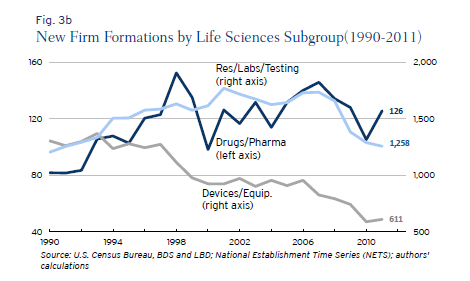
My paper with DiMasi and Milne showed that some FDA drug divisions appear to be much more productive than other divisions suggesting possibilities for substantial improvements if best practices were uniformly adopted. There also appear to be substantial differences between the regulation of drugs and devices especially in recent years. Ian Hathaway and Robert Litan have a new paper on Entrepreneurship and Job Creation in the U.S. Life Sciences Sector that shows that new firm creation in the medical device sector has fallen drastically since 1990 and far more than in the drug sector. Although there are likely many causes, the drop in the number of new firms is consistent with Gulfo’s experience of regulatory uncertainty and may suggest increases in regulatory cost for devices relative to drugs. Here is Hathaway and Litan:
The medical devices and equipment sector, on the other hand, saw new firm formations decline steadily and persistently between 1990 and 2011—falling by 695 firms or 53 percent during that period. Its share of new life sciences firms fell to 31 percent in 2011 from 50 percent in 1990. Unlike its life sciences sector counterparts, the decline in new firm formations in this segment appears to stretch beyond the cyclical effects of the Great Recession.
Innovation Breakdown
From my review today in the WSJ of Innovation Breakdown by Joseph Gulfo:
Yo is a smartphone app. MelaFind is a medical device. Yo sends one meaningless message: “Yo!” MelaFind tells you: “biopsy this and don’t biopsy that.” MelaFind saves lives. Yo does not. Guess which firm found it easier to put their product in consumers hands? Oy.
In “Innovation Breakdown: How the FDA and Wall Street Cripple Medical Advances,” Joseph Gulfo tells the tumultuous history of MELA Sciences, the company that invented MelaFind. When Dr. Gulfo joined the firm as president and CEO in 2004, the company’s brilliant team of scientists had spent many years and tens of millions of dollars to develop MelaFind, a “camera with a brain”—optical technology that would scan potential melanomas in multiple spectra and then, using sophisticated algorithms and large datasets, diagnose which were most likely to be cancerous.
MELA Sciences conducts an extensive clinical trial according to a protocol agreed on by the FDA and all looks good. After the clinical trial is completed, however, the FDA backs away from the protocol and comes out against MelaFind.
…The title of Dr. Gulfo’s book is “Innovation Breakdown” but “Innovator’s Breakdown” might have been more apt. The letter sent the author into survival mode. He battled the FDA, calmed investors, and defended against the lawsuit all while trying to keep the company afloat. Under stress, Dr. Gulfo’s health began to decline: He lost 29 pounds, his hair began to fall out, and the pain in his gut became so intense he needed an endoscopy. When his wife begged him to quit, he refused. They turned into roommates. “We were nothing more than cordial. I basically shut my wife out of my life,” he writes.
…The climax to this medical thriller comes when, in “the greatest 15 minutes of [his] life,” Dr. Gulfo delivers an impassioned speech, à la “Twelve Angry Men,” to the FDA’s advisory committee. The committee voted for approval, 8 to 7, and, perhaps with the congressional hearing in mind, the FDA approved MelaFind in September 2011.
It was a major triumph for the company, but Dr. Gulfo was beat. He retired from the company in June 2013—just in time to save his marriage.
Yet remarkably, given his experience, Mr. Gulfo writes that he still believes in a strong FDA. He argues in the book that better “leadership” and a few tweaks to existing rules can fix the problem. He’s wrong.
Compare MelaFind’s experience in the U.S. with its reception in Europe: MelaFind was submitted for marketing approval in Europe in May 2011. It was approved just five months later. One key reason for Europe’s efficient approval process is that European governments don’t review medical devices directly. Instead they certify independent “notified bodies” that specialize and compete to review new products. The European system works more quickly than the U.S. system, and there is no evidence that it results in reduced patient safety. Rather than tweak the current system, why doesn’t the U.S. just adopt the European model and call it a day? Our health and our economy would be better off for it.
Google’s Sergey Brin recently said that he didn’t want to be a health entrepreneur because “It’s just a painful business to be in . . . the regulatory burden in the U.S. is so high that I think it would dissuade a lot of entrepreneurs.” Mr. Brin won’t find anything in Dr. Gulfo’s book to persuade him otherwise. Until we get our regulatory system in order, expect a lot more Yo’s and not enough life-saving innovations.
Thinking Inside the Box
I like this library building in Nice, France.

In Defense of Johns
Jim Norton writing in Time:
…When I first began soliciting sex for money, it never occurred to me that some of them are possibly forced into prostitution or have abusive pimps. I must have known it deep down on an intellectual level, but hadn’t witnessed anything to confirm it.
Until I did.
The only experience I’ve had with an element of violence being present was driving on 48th Street in New York once and talking to a girl through my passenger window….As we were speaking, a van full of girls stopped and a guy who I assume was her pimp, bounced her across the hood of my car and threw her in the van.
This is why I’m a firm believer that prostitution should be legalized and pimps should be thrown down an elevator shaft.
Law enforcement stings designed to shame men who pay for sex are nothing more than the state blowing its own morality horn. Being a comedian who is single allows me a luxury most johns don’t have, which is the freedom to discuss the topic openly. And not from a ‘case study’ point of view, but from the honest point of view of someone who has spent the equivalent of a Harvard Law School education on purchasing sex.
By keeping prostitution illegal because we find it “morally objectionable,” we allow (or, more accurately, you allow) sex workers to constantly be put into dangerous situations. Studies have shown that rapes and STDs dropped drastically between 2003 and 2009 in Rhode Island after the state accidentally legalized it. The American Journal of Epidemiology showed that the homicide rate for prostitutes is 50 times higher than the next most dangerous job for a woman, working in a liquor store. You don’t need a Masters in sociology to understand it would be much safer for sex workers if they were permitted to work in places that provided adequate security. Legalizing prostitution would also alleviate the fear a sex worker may have about reporting the abusive behavior of a john out of fear of arrest.
…Give sex workers rights. Give johns a break.