The Paradox of India
Tyler often talks about cracking cultural codes. India is the hardest—and therefore the most fascinating—cultural code I’ve encountered. The superb post The Paradox of India by Samir Varma helps to unlock some of these codes. Varma is good at describing:
In 2004, something extraordinary happened that perfectly captured India’s unique nature: A Roman Catholic woman (Sonia Gandhi) voluntarily gave up the Prime Ministership to a Sikh (Manmohan Singh) in a ceremony presided over by a Muslim President (A.P.J. Abdul Kalam) in a Hindu-majority country.
And nobody commented on it.
Think about that. In how many countries could this happen without it being THE story? In India, the headlines focused on economic policy and coalition politics. The religious identities of the key players were barely mentioned because, well, what would be the point? This is how India works.
This wasn’t tolerance—it was something deeper. It was the lived experience of a civilization where your accountant might be Jain, your doctor Parsi, your mechanic Muslim, your teacher Christian, and your vegetable vendor Hindu. Where festival holidays meant everyone got days off for Diwali, Eid, Christmas, Guru Nanak Jayanti, and Good Friday. Where secularism isn’t the absence of religion but the presence of all religions.
But goes beyond that:
You might be thinking: “This is fascinating, but I’m not Indian. I can’t draw on 5,000 years of civilizational memory. How does any of this help me navigate my increasingly polarized world?”
Here’s what I’ve learned from watching India work its magic: The mental moves that make pluralism possible aren’t mystical—they’re learnable. Think of them as cognitive tools:
The And/And Instead of Either/Or: When faced with contradictions, resist the Western urge to resolve them. Can something be both sacred and commercial? Both ancient and modern? Both yours and mine? Indians instinctively answer yes.
Contextual Truth Over Universal Law: What’s right for a Jain isn’t right for a Bengali, and that’s okay. Truth can be plural without being relative. Multiple valid perspectives can coexist without canceling each other out.
Strategic Ambiguity as Wisdom: Not everything needs to be defined, categorized, and resolved. Sometimes the wisest response is a head waggle that means yes, no, and maybe all at once.
Code-Switching as a Life Skill: Indians don’t just switch languages—they switch entire worldviews depending on context. At work, modern. At home, traditional. With friends, fusion. This isn’t hypocrisy; it’s sophisticated social navigation.
The lesson isn’t “be more tolerant.” It’s “develop comfort with unresolved multiplicity.” In a world demanding you pick sides, the Indian model suggests a radical alternative: Don’t.
In our age of rising nationalism and cultural purism, when countries are building walls and communities are retreating into echo chambers, India stands as a glorious, maddening, inspiring mess—proof that diversity isn’t just manageable but might be the secret to civilizational immortality.
After all, it’s hard to kill something that contains multitudes. When one part struggles, another thrives. When one tradition calcifies, another innovates. When one community turns inward, another builds bridges.
It’s not a bug. It’s a feature.
And maybe, just maybe, it’s exactly what the world needs to remember right now.
Read the whole thing. Part 1 of 3.
Trump Accounts are a Big Deal
Trump’s One Big Beautiful Bill Act was signed into law on July 4, 2025. It’s so big that many significant features have been little discussed. Trump Accounts are one such feature under which every newborn citizen gets $1000 invested in the stock market. These accounts could radically change social welfare in the United States and be one important step on the way to a UBI or UBWealth. Here are some details:
- Government Contribution: A one-time $1,000 contribution per eligible child, invested in a low-cost, diversified U.S. stock index fund.
- Eligibility: U.S. citizen children born between January 1, 2025, and December 31, 2028 (with a valid Social Security number and at least one parent with a valid Social Security number).
- Employer Contributions: Employers can contribute up to $2,500 annually per employee’s child, and these contributions are excluded from the employee’s gross income for tax purposes. These are subject to the overall $5,000 annual contribution limit (indexed for inflation) per child (which includes parental contributions).
The employer contribution strikes me as important. Suppose that in addition to the initial $1000 government payment that on average $1000 is added per year for 18 years (by a combination of parent and parent employer contributions). Note that this is below the maximum allowed annual contribution of $5000. At a historically reasonable 7% real rate of return these accounts will be worth ~36k at age 18 (when the money can be fully withdrawn), $58k at age 25 and $875k at age 65 subject to uncertainty of course as indicated below.
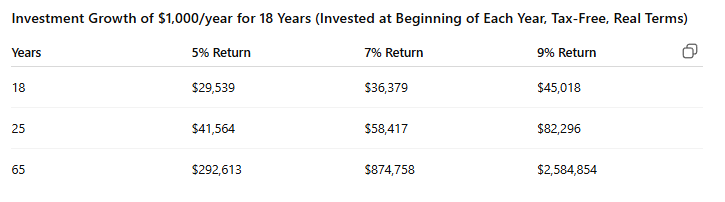
The $1000 initial payment is available only for newborns but, as I read the text, the parent and employer donations can be made for any child under the age of 18 so this is basically an IRA for children. It’s slightly complicated because if the child or parents put after-tax money into the account that is not taxed at withdrawal (you get your basis back) but everything else is taxed on withdrawal as ordinary income like an IRA. There are approximately 3.5 million citizen births a year so the program will have direct costs of $3.5 billion plus indirect costs from reduced taxes due to the tax-free yearly contribution allowance, which as noted could be quite large as it can go to any child. Thus the program could be quite expensive. On the other hand, it’s clear that the accounts could reduce reliance on social security if held for long periods of time. The $1000 initial contribution is limited to four years but once 14 million kids get them, the demand will be to make them permanent.
Genetic Counseling is Under Hyped
In an excellent interview (YouTube; Apple Podcasts, Spotify) Dwarkesh asked legendary bio-researcher George Church for the most under-hyped bio-technologies. His answer was both surprising and compelling:
What I would say is genetic counseling is underhyped.
What Church means is that gene editing is sexy but for rare diseases carrier screening is cheaper and more effective. In other words, collect data on the genes of two people and let them know if their progeny would have a high chance of having a genetic disease. Depending on when the information is made known, the prospective parents can either date someone else or take extra precautions. Genetic testing now costs on the order of a hundred dollars or less so the technology is cheap. Moreover, it’s proven.
Since the early 1980s the Jewish program Dor Yeshorim and similar efforts have screened prospective partners for Tay-Sachs and other mutations. Before screening, Tay-Sachs struck roughly 1 in 3,600 Jewish births; today births with Tay-Sachs have fallen by about 90 percent in countries that adopted screening programs. As more tests are developed they can be easily integrated into the process. In addition to Tay-Sachs, Dor Yeshorim, for example, currently tests for cystic fibrosis, Bloom syndrome, and spinal muscular atrophy among other diseases. A program in Israel reduced spinal muscular atrophy by 57%. A study for the United States found that a 176 panel test was cost-effective compared to a minimal 5 panel test as did a similar study on a 569 panel test for Australia.
A national program could offer testing for everyone at birth. The results would then be part of one’s medical record and could be optionally uploaded to dating websites. In a world where Match.com filters on hobbies and eye color, why not add genetic compatibility?
Do it for the kids.
Addendum: See also my paper on genetic insurance (blog post here).
Amazon’s Robotic Revolution
Amazon now employs almost as many robots as humans leading to huge productivity improvements. From the second graph, “end-to-end” packages handled by Amazon rose from 175 in 2015 to nearly 4000 in 2025. Incredible. Excellent piece in the WSJ.

Hat tip: Edward Conard.
Massive Rent-Seeking in India’s Government Job Examination System
In India, government jobs pay far more than equivalent jobs in the private sector–so much so that the entire labor market and educational system have become grossly distorted by rent seeking to obtain these jobs. Teachers in the public sector, for example, are paid at least five times more than in the private sector. It’s not just the salary. When accounting for lifetime tenure, generous perks, and potentially remunerative possibilities for corruption, a government job’s total value can be up to 10 times that of an equivalent private sector job. (See also here).
As a result, it’s not uncommon for thousands of people to apply for every government job–a ratio far higher than in the private sector. In one famous example, 2.3 million people submitted applications for 368 “office boy” positions in Uttar Pradesh.
The consequences of this intense competition for government jobs are severe. First, as Karthik Muralildharan argues, the Indian government can’t afford to pay for all the workers it needs. India has all the laws of say the United States but about 1/5 th the number of government workers per capita leading to low state capacity. But there is a second problem which may be even more serious. Competition to obtain government jobs wastes tremendous amounts of resources and distorts the labor and educational market.
If jobs were allocated randomly, applications would be like lottery tickets with few social costs. Government jobs, however, are often allocated by exam performance. Thus, obtaining a government job requires an “investment” in exam preparation. Many young people spend years out of the workforce studying for exams that, for nearly all of them, will yield nothing. In Tamil Nadu alone, between one to two million people apply annually for government jobs, but far less than 1% are hired. Despite the long odds, the rewards are so large that applicants leave the workforce to compete. Kunal Mangal estimates that around 80% of the unemployed in Tamil Nadu are studying for government exams.
Classical rent-seeking logic predicts full dissipation: if a prize is worth a certain amount, rational individuals will collectively spend resources up to that amount attempting to win it. When the prize is a government job, the ‘spending’ is not cash, but years of a young person’s productive life. Mangal calculates that the total opportunity cost (time out of the workforce) that job applicants “spend” in Tamil Nadu is worth more than the combined lifetime salaries of the available jobs (recall jobs are worth more than salaries so this is consistent with theory). Simply put, for every ₹100 the government spends on salaries, Indian society burns ₹168 in a collective effort of rent-seeking just to decide who gets them. The winners are happy but the loss to Indian society of unemployed young, educated workers who do nothing but study for government exams is in the billions. Indeed, India spends about 3.86% of GDP on state salaries (27% of state revenues times 14.3% of GDP). If we take Mangal’s numbers from Tamil Nadu, a conservative (multiplier of 1 instead of 1.68) back of the envelope number suggests that India could be wasting on the order of 1.4% of GDP annually on rent seeking. (Multiply 3.86% of GDP by 15 (30 years at 5% discount) to get lifetime value and take .025 as annual worker turnover.) Take this with a grain of salt but regardless the number is large.
India’s most educated young people—precisely those it needs in the workforce—are devoting years of their life cramming for government exams instead of working productively. These exams cultivate no real-world skills; they are pure sorting mechanisms, not tools of human capital development. But beyond the staggering economic waste, there is a deeper, more corrosive human cost. As Rajagopalan and I have argued, India suffers from premature imitation: In this case, India is producing Western-educated youth without the economic structure to employ them. In one survey, 88% of grade 12 students preferred a government job to a private sector job. But these jobs do not and cannot exist. The result is disillusioned cohorts trained to expect a middle-class, white-collar lifestyle, convinced that only a government job can deliver it. India is thus creating large numbers of educated young people who are inevitably disillusioned–that is not a sustainable equilibrium.
Mangal valiantly proposes redesigning the exams to reduce waste, but this skirts the core issue: India’s wildly skewed public wage structure. Government salaries far exceed what is justified by GDP per capita or job requirements, distorting education, employment, and unemployment throughout the entire economy in deeply wasteful ways. The only real solution is to bring public sector pay back in line with economic fundamentals.
Privatize Federal Land!
I’ve long advocated selling off some federal land—an idea that reliably causes mass fainting spells among the enlightened. How could we possibly part with our national patrimony, our land, our sacred wilderness? Calm down. Most of this “public land” is never used by the public. Selling some of it would actually make it more accessible and useful to real people.
Moreover, most of you wailing about selling some Federal land are probably very happy we sold the “public” airwaves for your private cell phone use. Privatizing the airwaves made them much more useful to the public. (Thank you Reed!).
AEI has an excellent map of the lands that could be sold and developed in the Mike Lee bill. Here’s their conclusion:
The data show a significant opportunity. Our analysis finds that developing just 135-180 square miles of the most suitable BLM land, a minuscule fraction of the total, could yield approximately 1 million new homes over ten years. This would substantially address the West’s housing shortage while generating an estimated $15 billion for the U.S. Treasury from land sales.
Here’s an example of the some of the land potentially developable around Las Vegas.

Here’s a Google satellite image of the bit around Mountain’s Edge. Enjoy your fishing on these public lands!

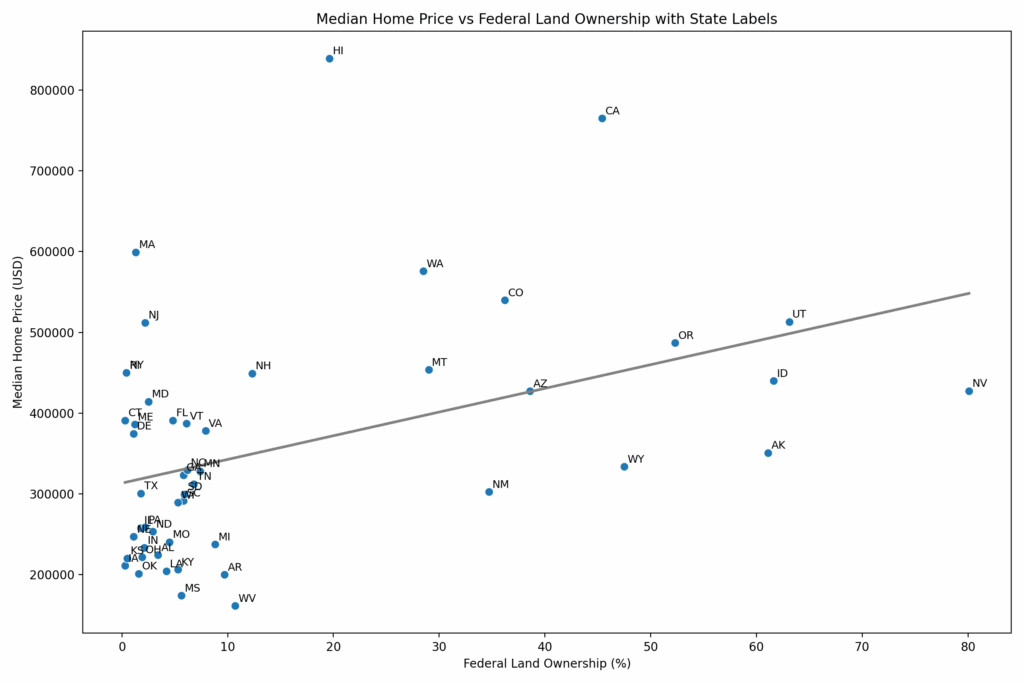
And here’s a very crude but useful scatter plot showing the correlation between median home prices in a state and Federal land ownership. Should home prices in Utah (63.1% Federally owned) really be 71% higher than in Texas (1.8% Federally owned)? Of course, Texas is famously an urban hellscape with no parks, no open space, and nowhere to hunt or fish.
Flying on Frying Oil
The ever-excellent Matt Levine points us to the amusing economic policies that connect the international jet-set to Malaysian street hawkers of fried noodles. The EU and the US have created strong economic incentives to create sustainable aviation fuel (SAF) and a good way to do this is to recycle used cooking oil (UCO). What could be better, right? Take a waste product and turn it into jet fuel! The EU and US policies, however, are so strong that all the EU and US used cooking oil cannot meet the demand. Here’s a great sentence, “Europe simply cannot collect enough used cooking oil to fly its planes.”
In the US, credits under the Inflation Reduction Act can account for up to $1.75 to $1.85 per gallon of SAF. Meanwhile cooking oil is subsidized in some  parts of the world. The result?
It turns out that restaurants, street food stalls and home cooks in Malaysia — which is “among the world’s leading suppliers of both UCO and virgin palm oil” — will pay less for fresh cooking oil than the international market will pay for used cooking oil. Fresh cooking oil is more useful to cooks than used cooking oil (it tastes better), but it is less useful to refiners and airlines than used cooking oil (it doesn’t reduce their carbon impact). Also fresh cooking oil is subsidized by the government in Malaysia: “Subsidised cooking oil sells for RM2.50 per kg versus the UCO trading price of up to RM4.50 per kg.” So if you run a restaurant, you can buy fresh cooking oil for about $0.60 (USD), use it to fry food a few times, and then sell it to a refiner for $1, which is a nice little subsidy for the difficult, risky, low-margin business of running a restaurant.
The noodle hawkers in Kuala Lumpur are getting a nice little bump in profit but who is going stall to stall to check that the oil is in fact used? And what counts as used? One fry or two? Clever entrepreneurs have cut out the middleman. Virgin palm oil can be substituted for used cooking oil and voila! Sustainable aviation fuel is contributing to deforestation in Malaysia. Malaysia exports far more “used” cooking oil than oil that it uses. No surprise.
All of this illustrates a broader point: externalities suggest policy interventions may improve outcomes but markets are complex and politics is blunt. It’s easy to make things worse. If intervention is necessary, a uniform carbon tax beats a patchwork of production-specific subsidies. A price is a signal wrapped up in an incentive. Send everyone the same signal and the same incentive to ensure that the cheapest emissions are cut first and total costs are minimized.
Crucially, a carbon tax rewards any effective solution, even ones a planner would never think of–lighter planes and cleaner fuels sure but also operational tweaks like jet washes. In contrast, subsidies tether policy to specific technologies, like used cooking oil. That invites rent-seeking and inefficiency.
Tax carbon, not inputs. Avoid games with paperwork. One verification point at the fuel supply point is simpler than tracing global waste-oil chains. Don’t subsidize the fry oil and audit the street hawkers. Tax the emissions.
Have Appliances Declined in Durability?
Many Americans believe that their appliances have become less durable and reliable over recent decades. Rachel Wharton at Wirecutter has an excellent piece pushing back. Her conclusions mirror what I found when looking at clothing quality: yes, there has been a modest decline in durability, but the main drivers are customer preferences, regulatory shifts, and Baumol effects—not corporate malfeasance or cultural decline.
“Everybody talks about the Maytag washing machine that lasts 50 years,” said Daniel Conrad, a former product engineer at Whirlpool Corporation who is now the director of design quality, reliability, and testing for a commercial-refrigeration company. “No one talks about the other 4.5 million that didn’t last that long.”
The available evidence suggests that appliance lifespans have decreased only modestly over the past few decades. Recent research from the Association of Home Appliance Manufacturers trade group shows that in 2010 most appliances lasted from 11 to 16 years. By 2019, those numbers had dropped, to a range of nine to 14 years. (In some cases, such as for gas ranges and dryers, the lifespans actually increased.)
The modest decline is partially explained by regulation:
Every appliance service technician I spoke to — each with decades of experience repairing machines from multiple brands — immediately blamed federal regulations for water and energy efficiency for most frustrations with modern appliances.
…The main culprit is the set of efficiency standards for water and energy use for all cooking, refrigeration, and cleaning appliances.
The regulations change often and push producers to make changes that consumers don’t necessarily want like switching to lighter plastic parts rather than metal or by adding sophisticated computer controls that increase efficiency but also introduce new break points. See my previous posts on these issues here and here.
But as with clothing, another reason for reduced durability is that many consumers don’t want durable appliances–instead consumers want the latest model with all the whizz-bang features. (Sure, I don’t want this and you don’t want it but heh, they sell!) In other words, appliances and their colors, features and styles have become items of fashion.
And people’s desire for new things only appears to be growing. Petrino Ball said her sales research at AJ Madison showed that today consumers are buying new appliances every eight years, even if what they had before hasn’t fully failed.
…Whitney Welch, a spokesperson for GE Appliances, told me that its research showed consumers are often replacing appliances for aesthetic reasons….
If many customers don’t want to keep appliances for more than 10 years then it doesn’t pay to make them last more than 10 years.
The big story isn’t declining durability but declining price:
In 1972, Sears sold a clothes washer for $220 and a dryer for $90, per 2022 research by AARP Magazine. That’s about $2,389 in 2025, adjusted for inflation. Today you can get a washer-and-dryer pair on sale from Sears for around $1,200.
The Baumol effect means that repair is rising in price relative to buying new which is another reason why we don’t keep products around as long as we did when we were poorer and it it made sense to fix broken goods:
….prices on most new models are so low, his first suggestion to customers is to just replace the appliance. “If the cost of repair is 50% of replacement, throw it cleanly away,” he said. “If it’s 40%, consider the option.”
“Labor is highly skilled,” he added. “It can’t compete with low prices.”
In many cases, it can’t compete with lost time, either. Repairs often require waiting a few days or weeks for parts, said Petrino Ball. “Even one day without a washer-dryer or fridge is really hard for many families,” she said, “but if you buy one, you can have it the next day.”
Moreover, as I argued with clothes, it is possible to find durable appliances if you shop carefully. Interestingly, Wharton notes that you can either go high or low. The top-of-the-line appliances from Sub-Zero and Wolf do last longer but they are very expensive and often do not include whizz-bang features. Alternatively, you can go low–buy a GE or Sears refrigerator and get it without frills–no ice or water dispenser, no electronics, no lux colors and chances are it will last a long time.
In short, appliance durability hasn’t collapsed—it’s evolved to meet consumer demand. We’re not being ripped off. We are getting better products at better prices. Rising incomes have simply redefined what “better” means.
The Eradication of Smallpox
Excellent, beautifully produced video on the eradication of smallpox. Interesting asides on the connection between the scientific and humanitarian revolutions.
Two Laws
In Italy, you need a doctor’s permission before joining a gym or running a marathon.
In Virginia and many other states, you need an annual auto safety inspection to legally drive.
Which of these laws is the most beneficial/costly? Show your work.
Of Course We Should Privatize Some Federal Land (but probably won’t)
The Federal government controls a ridiculous amount of land in the West including more than half of Oregon, Utah, Nevada, Idaho and Alaska and nearly half of California, Arizona, New Mexico and Wyoming. See the map (PDF). The vast majority of this land is NOT parks!!! It is time for a sale to raise some funds and improve the efficiency of land allocation.

 The conservative Mike Lee has a bill that would allow some sales. Great! The only problem with the bill is that it is loaded down with restrictions and qualifications. For example, there is a cap of 0.75% on total sales–that’s right, the land sales are capped at less than 1% of the total Federal land and that is a high cap because most of the rules prohibit any sale. The sales that are allowed have to be nominated by state or local governments, must be adjacent to developed areas and close to infrastructure. Moreover, the land can only be use for housing. Lyman Stone has a thread going into even more detail. The very modest goal–as you can see at right–is to rationalize some checkerboard land patterns.
Even so, the bill is probably doomed. Just mentioning federal land sales triggers a moral panic, as if someone proposed auctioning off Yellowstone. Supposed conservatives like Lomez are fueling this hysteria (e.g. here, here and here). It’s nonsense. Here and here is the type of land we are actually talking about—notice the difference?
As Matt Darling pointed out, this is Everything Bagel Liberalism from Conservatives—a bloated mess of proceduralism that empowers special interests and kneecaps supply.
If we can’t even sell Federal scraps then we’ve abandoned any pretense of governing in the public interest. We should be building entirely new cities–freedom cities!–not whining about fishing and hunting on scraps of scrub. This is exactly the same as urban NIMBYs who lobby to save “historic” parking lots. Pathetic. The federal land monopoly is not sacred. Let it go. This is where the rubber hits the road: if MAGA means anything beyond vibes and grievance, it should mean cutting red tape and unlocking land for Americans to own and build upon.
A Skeptical View of the NSF’s Role in Economic Research
Tyler and myself from 2016 but newly relevant on how to reform the National Science Foundation (NSF) especially as related to economics:
We can imagine a plausible case for government support of science based on traditional economic reasons of externalities and public goods. Yet when it comes to government support of grants from the National Science Foundation (NSF) for economic research, our sense is that many economists avoid critical questions, skimp on analysis, and move straight to advocacy. In this essay, we take a more skeptical attitude toward the efforts of the NSF to subsidize economic research. We offer two main sets of arguments. First, a key question is not whether NSF funding is justified relative to laissez-faire, but rather, what is the marginal value of NSF funding given already existing government and nongovernment support for economic research? Second, we consider whether NSF funding might more productively be shifted in various directions that remain within the legal and traditional purview of the NSF. Such alternative focuses might include data availability, prizes rather than grants, broader dissemination of economic insights, and more. Given these critiques, we suggest some possible ways in which the pattern of NSF funding, and the arguments for such funding, might be improved.
The Deadly Cost of Ideological Medicine
Excellent Megan McArdle column in the Washington Post tracing how we have swung from one form of insanity on vaccine policy to another with barely a pause in between:
In more than 20 years of covering policy, I have witnessed some crazy stuff. But one episode towers above the rest in sheer lunacy: the November 2020 meeting of the CDC’s Advisory Committee on Immunization Practices. Sounds boring? Usually, maybe.
But that meeting was when the committee’s eminent experts, having considered a range of vaccine rollout strategies, selected the plan that was projected to kill the most people and had the least public support.
In a survey conducted in August 2020, most Americans said that as soon as health-care workers were inoculated with the coronavirus vaccine, we should have started vaccinating the highest-risk groups in order of their vulnerability: seniors first, then immunocompromised people, then other essential workers. Instead of adopting this sensible plan, the Centers for Disease Control and Prevention advisory committee decided to inoculate essential workers ahead of seniors, even though its own modeling suggested this would increase deaths by up to 7 percent.
…Why did they do this? Social justice. The word “equity” came up over and over in the discussion — essential workers, you see, were more likely than seniors to come from “marginalized communities.” Only after a backlash did sanity prevail.
…That 2020 committee meeting was one of many widely publicized mistakes that turned conservatives against public health authorities. It wasn’t the worst such mistake — that honor belongs to the time public health experts issued a special lockdown exemption for George Floyd protesters. And of course, President Donald Trump deserves a “worst supporting actor” award for turning on his own public health experts. But if you were a conservative convinced that “public health” was a conspiracy of elites who cared more about progressive ideology than saving lives — well, there was our crack team of vaccine experts, proudly proclaiming that they cared more about progressive ideology than saving lives.
This is one of the reasons we now have a health and human services secretary who has devoted much of his life to pushing quack anti-vaccine theories.
I recall this episode well. Nate Silver and Matt Yglesias deserve credit for publicizing the insanity and stopping it–although similar policies continued at the state level.
Rebuild the Elites
Nature’s list of the top research universities in the world.
The U.S. seems intent on tearing down its own elites. Yes, they’ve been smug shits at times and deserve a rap on the knuckles—but our elites compete on the world stage. Gutting top universities rewards with a momentary dopamine hit, but unless we rebuild stronger institutions, we’re weakening ourselves globally. While we fight culture wars, China builds capacity. The goal shouldn’t be to destroy American elites, but to bring them back into the populist fold—to make Harvard and MIT feel like engines of American greatness again, not alien fortresses.
See yesterday’s post on the American Model for a case in point.
FYI, other sources do not rank Chinese universities quite so highly but they all acknowledge rising quality.
Hat tip: Matthew Yglesias.
The Return of the American Model
In talking about Operation Warp Speed I repeatedly placed it in the context of what I call the American Model of emergency response. The American model is the fusion of federal spending power with the speed, ingenuity, and innovation of the private sector. It aligns the visible hand of government with the invisible hand of the market. Operation Warp Speed was the most recent example, but the most important demonstration of the American Model was the shift to a wartime economy during World War II.
As Arthur Herman recounts in the excellent Freedom’s Forge, it wasn’t centralized command or sweeping nationalization that turned the United States into the “arsenal of democracy.” It was a partnership between government and business—figures like William Knudsen and Henry Kaiser mobilized private firms to outproduce the Axis through decentralized execution and rapid innovation funded by federal investment and aided by deregulation and the ending of New Deal attacks on markets and entrepreneurs. William Knudsen, the penniless Danish immigrant who worked his way to key positions in Ford and General Motors, being commissioned as a lieutenant general in the United States Army epitomizes the American Model.
In an incredible piece, Shyam Sankar the CTO of Palantir explains why he has accepted a commission as a lieutenant colonel in the Army Reserve’s newly formed Detachment 201: Executive Innovation Corps.
I decided to join the military for reasons both patriotic but also intensely personal.
My father grew up in a mud hut in Tamil Nadu, the southernmost state in India. He was the youngest of nine children and the first in his family to attend college—an education made possible only by his eight siblings pooling their wages. After graduation, he moved to Lagos, Nigeria, to build and run a pharmaceutical plant. Through ingenuity and an enterprising spirit, he became successful at a remarkably young age.
When I was 2, our life in Lagos ended violently. Five armed men broke into our home, killed our dog, pistol-whipped my father, and threatened my mother as they demanded money from the company safe. We fled Lagos with nothing, and started over in America.
My father took a job at a company that supplied souvenirs to theme parks in Orlando, Florida. My childhood memories are punctuated by Space Shuttle launches seen from my school courtyard, and by the bone-rattling double sonic booms of the Shuttles’ reentry. Lessons about the power of American technology were literally falling from the sky around me.
My father never again saw the material success of his youth, and he faced setback after setback in America. But he always reminded me of the counterfactual: “But for the grace of this nation, you would be dead in a ditch in Lagos.” America gave him life, liberty, and possibility.
Many lessons here about immigration, markets, universities, elites and more. Read the whole thing.