Plagues Upon the Earth
 Kyle Harper’s Plagues Upon the Earth is a remarkable accomplishment that weaves together microbiology, history, and economics to understand the role of diseases in shaping human history. Harper, an established historian known for his first three books on Rome and late antiquity, has an impressive command of virology, bacteriology, and parasitology as well as history and economics. In “Plagues Upon the Earth.” he explains all of these clearly and with many arresting turns of phrase and insights:
There are about seventy-three bacteria among major human pathogens–out of maybe a trillion bacterial species on earth. To imagine bacteria primarily as pathogens is about as fair as thinking of human beings as mostly serial killers.
Despite the tingling fear we still feel in the face of large animals, fire made predators a negligible factor in human population dynamics. The warmth, security and mystic peace you feel around the campfire has been instilled by almost two million years of evolutionary advantage given to us by the flames.
Mosquitos are vampires with wings….The blood heist itself is an amazing feat. Following contrails of carbon dioxide that lead to her mark, the female mosquito lands and starts probing. Once she reaches her target, she inserts her tube-like needle, as flexible as a plumber’s snake, into the skin. She pokes a dozen or more times until she hits her mark. The proboscis itself is moistened with compounds that anesthetize the victim’s skin and deter coagulation. For a tense minute or two, she pulls blood into her gut, taking on several times her own weight, as much as she can carry and still fly. She has stolen a valuable liquid full of energy and free metals. Engorged, she unsteadily makes her getaway, desperate for the nearest vertical plane to land and recuperate, as her body digests the meal and keeps only what is needful for her precious eggs.
What I like best about Plagues Upon the Earth is that Harper thinks like an economist. I mean this in two senses. First, his chapters on the Wealth and Health of Nations and Disease and Global Divergence are alone worth the price of admission. In these chapters, Harper brings disease to the fore to understand why some nations are rich and others poor but he is well aware of all the other explanations and weaves the story together with expertise.
The second sense in which Harper thinks like an economist is deeper and more important. He has a model of parasites and their interactions with human beings. That model, of course, is the evolutionary model. To a parasite, human beings are a desirable host:
Just as robbers steal from banks because that is where the money is, parasites exploit human bodies because there are high rewards for being able to do so…. for a parasite, there is now more incentive to exploit humans than ever…look at human energy consumption…in a developed society today, every individual consumer is the rough ecological equivalent to a herd of gazelles.
That parasites are driven by “incentives” would seem to be nearly self-evident but in the hands of a master simple models can lead to surprising hypothesis and conclusions. Harper is the Gary Becker of parasite modeling. Here’s a simple example: human beings have changed their environments tremendously in the past several hundred years but that change in human environment created new incentives and constraints on parasites. Thus, it’s not surprising that most human parasites are new parasites. Chimpanzee parasites today are about the same as those that exploited chimpanzees 100,000 years ago but human parasites are entirely different. Indeed, because the human-host environment has changed, our parasites are more novel, narrow, and nasty than parasites attacking other species.
It’s commonly suggested that one of the reasons we are encountering novel parasites is due to our disruptions of natural ecosystems, venturing into territories previously unexplored by humans, thereby releasing ancient parasites that have lain dormant for millennia. Like the alleged curse of Tutankhamun’s tomb we are unleashing ancient foes! Similarly, concerns are voiced that climate change, through its effect on permafrost melt, may liberate “zombie” parasites poised for retaliation. But ancient parasites are not fit for human hosts as they have not evolved within the context of the contemporary human environment. So, while I don’t trivialize the potential consequences of melting permafrost, I think we should fear much more relatively recent diseases such as measles, cholera, polio, Ebola, AIDS, Zika, and COVID-19. Not to mention whatever entirely new disease evolution is bound to throw in our path.
Indeed, one of the most interesting speculation’s in Plagues Upon the Earth is that “global divergences in health may have reached their maxima in the early twentieth century.” The reason is that urbanization and transportation turned the new diseases of the industrial era, like cholera, tuberculosis and the plague (the latter older diseases but ideally primed for the industrial era) into pandemics (also a relatively recent word) at a time when only a minority of the world had the tools to combat the new diseases.
Science, of course, is giving us greater understanding and control of nature but our very success increases the incentives of parasites to breach our defenses.
[Thus,] the narrative is not one of unbroken progress, but one of countervailing pressures between the negative health feedback of growth and humanity’s rapidly expanding but highly unequal capacities to control threats to our health.
Free Formatting For All on First Submission!
Many years ago I was incredulous when my wife told me she had to format a paper to meet a journal’s guidelines before it was accepted! Who could favor such a dumb policy? In economics, the rule is you make your paper look good but you don’t have to fulfill all the journal’s guidelines until after the paper is accepted. Sensible!
A paper just published in BMC Medicine estimates that this obtrusive norm costs researchers in biomedical journals alone some $230 million a year in wasted time. That’s consistent with an earlier study which estimated that over a billion dollars worth of time was wasted reformatting papers in all scientific fields. Quoting from that earlier study:
Our data show that nearly 91% of authors spend greater than four hours and 65% spend over eight hours on reformatting adjustments before publication…Among the time-consuming processes involved are adjusting manuscript structure (e.g. altering abstract formats), changing figure formats, and complying with word counts that vary significantly depending on the journal. Beyond revising the manuscript itself, authors often have to adjust to specific journal and publisher online requirements (such as re-inputting data for all authors’ email, office addresses, and disclosures). Most authors reported spending “a great deal” of time on this reformatting task. Reformatting for these types of requirements reportedly caused three month or more delay in the publication of nearly one fifth of articles and one to three month delays for over a third of articles.
It’s all very depressing. If we can’t get rid of unproductive paper reformatting standards–which benefit no one–how can we expect to tackle monumental tasks that require navigating complex tradeoffs such as resolving global climate change or making the tax code more just and efficient?
Yet perhaps there is hope. The BMC Medicine paper was covered in Nature and the authors have started a petition to change the reformatting norm. Do your part. Sign the petition! Free formatting for all on first submission!
Air Pollution Redux
New York City today has the worst air quality in the world, so now seems like a good time for a quick redux on air pollution. Essentially, everything we have learned in the last couple of decades points to the conclusion that air pollution is worse than we thought. Air pollution increases cancer and heart disease and those are just the more obvious effects. We now also now know that it reduces IQ and impedes physical and cognitive performance on a wide variety of tasks. Air pollution is especially bad for infants, who may have life-long impacts as well as the young and the elderly. I’m not especially worried about the wildfires but the orange skies ought to make the costs of pollution more salient. As Tyler noted, one reason air pollution doesn’t get the attention that it deserves is that it’s invisible and the costs are cumulative:
Air pollution causes many deaths. But it is rare to see or read about a person dying directly from air pollution. Lung cancer and cardiac disease are frequently cited as causes of death, even though they may stem from air pollution.
That’s the bad news. The good news, hidden inside the bad news, is that the costs of air pollution on productivity are so high that there are plausible ways of reducing some air pollution and increasing health and wealth, especially in high pollution countries but likely also in the United States with well-targeted policies.
For evidence on the above, you can see some of the posts below. Tyler and I have been posting about air pollution for a long time. Tyler first said air pollution was an underrated problem in 2005 and it was still underrated in 2021!
- Why the New Pollution Literature is Credible
- Air Pollution Reduces IQ, A Lot
- Air Pollution Kills
- David Wallace-Wells with a good overview.
- A good overview of the non-health impacts of pollution.
The Poop Detective
Wastewater surveillance is one of the few tools that we can use to prepare for a pandemic and I am pleased that it is expanding rapidly in the US and around the world. Every major sewage plant in the world should be doing wasterwater surveillance and presenting the results to the world on a dashboard.
I was surprised to learn that wastewater surveillance is now so good it can potentially lock-on to viral RNA from a single infected individual. An individual with an infection from a common SARS-COV-2 lineage like omicron won’t jump out of the data but there are rare, “cryptic lineages” which may be unique to a single individual.
Marc Johnson, a virologist at the University of Missouri and one of the authors of a recent paper on cryptic lineages in wastewater, believes he has evidence for a single infected individual who likely lives in Columbus, Ohio but works in the nearby town, Washington Court House. In other words, they poop mostly at home but sometimes at work.
Twitter: First, the signal is almost always present in the Columbus Southerly sewershed, but not always at Washington Court House. I assume this means the person lives in Columbus and travels to WCH, presumably for work. Second, the signal is increasing with time. Washington Court House had its highest SARS-CoV-2 wastewater levels ever in May, and the most recent sequencing indicates that this is entirely the cryptic lineage.
Moreover the person is likely quite sick:
Third, I’ve tried to calculate how much viral material this person is shedding. (Multiply the cryptic concentration by the total volume). I’ve done this several times and gotten pretty consistent results. They are shedding a few trillion (10^12) genomes/day. What does this tell us? How much tissue is infected? It’s impossible to know for sure. Chronically infected cells probably don’t release much, but acutely infected cells produce a lot more. I gather a typical output in the lab is around 1,000 virus per infected cell. If we assume we are getting 1,000 viral particles per infected cell, that would mean there are at least a billion infected cells. The density of monolayer epithelial cells is around 300k cells/sq cm. A billion cells would represent around 3.5 square feet of epithelial tissue! Don’t get me wrong. The intestines have a huge surface are and 3 square feet is a tiny fraction of the total. But it’s still a massive infection, no matter how you slice it….My point is that this patient is not well, even if they don’t know it, but they could probably be helped if they were identified.
…If you are the individual, let me know. There is a lab in the US that can do ‘official’ tests for COVID in stool, and there are doctors that I can put you in contact with that would like to try to help you.
So if you poop in Columbus Ohio and occasionally in Washington Court House and have been having some GI issues contact Marc!
Hat tip to Marc for using the twitter handle @SolidEvidence.
The Growing Market for Cancer Drugs
In my TED talk on growth and globalization I said:
If China and India were as rich as the United States is today, the market for cancer drugs would be eight times larger than it is now. Now we are not there yet, but it is happening. As other countries become richer the demand for these pharmaceuticals is going to increase tremendously. And that means an increase incentive to do research and development, which benefits everyone in the world. Larger markets increase the incentive to produce all kinds of ideas, whether it’s software, whether it’s a computer chip, whether it’s a new design.
…[T]oday, less than one-tenth of one percent of the world’s population are scientists and engineers. The United States has been an idea leader. A large fraction of those people are in the United States. But the U.S. is losing its idea leadership. And for that I am very grateful. That is a good thing. It is fortunate that we are becoming less of an idea leader because for too long the United States, and a handful of other developed countries, have shouldered the entire burden of research and development. But consider the following: if the world as a whole were as wealthy as the United States is now there would be more than five times as many scientists and engineers contributing to ideas which benefit everyone, which are shared by everyone….We all benefit when another country gets rich.
A recent piece in the FT illustrates:
AstraZeneca’s chief executive returned from a recent trip to China exuberant about an “explosion” of biotech companies in the country and the potential for his business to deliver drugs discovered there to the world….Many drugmakers are tempted by China’s large, ageing population, which is increasingly affected by chronic diseases partly caused by smoking, pollution and more westernised diets….the opportunity lies not just in Chinese patients, but also in the country’s scientists. “The innovation power has changed,” said Demaré. “It is no more ‘copy, paste’. They really have the power to innovate and put all the money in. There’s a lot of start-ups and we are a part of that.”

As I concluded my talk:
Ideas are meant to be shared, one idea can serve the world. One idea, one world, one market.
Orwell Against Progress
Orwell was deeply suspicious of technology and not simply because of the dangers of totalitarianism as expounded in 1984. In The Road to Wigan Pier, Orwell argues that technology saps vigor and will. He quotes disparagingly, World Without Faith, a pro-progress book written by John Beever, a proto Steven Pinker in this respect.
It is so damn silly to cry out about the civilizing effects of work in the fields and farmyards as against that done in a big locomotive works or an automobile factory. Work is a nuisance. We work because we have to and all work is done to provide us with leisure and the means of spending that leisure as enjoyably as possible.
Orwell’s response?
…an exhibition of machine-worship in its most completely vulgar, ignorant, and half-baked form….How often have we not heard it, that glutinously uplifting stuff about ’the machines, our new race of slaves, which will set humanity free’, etc., etc., etc. To these people, apparently, the only danger of the machine is its possible use for destructive purposes; as, for instance, aero-planes are used in war. Barring wars and unforeseen disasters, the future is envisaged as an ever more rapid march of mechanical progress; machines to save work, machines to save thought, machines to save pain, hygiene, efficiency, organization, more hygiene, more efficiency, more organization, more machines–until finally you land up in the by now familiar Wellsian Utopia, aptly caricatured by Huxley in Brave New World, the paradise of little fat men.
What’s Orwell’s problem with progress? He is a traditionalist. Orwell thinks that men need struggle, pain and opposition to be truly great.
…in a world from which physical danger had been banished–and obviously mechanical progress tends to eliminate danger–would physical courage be likely to survive? Could it survive? And why should physical strength survive in a world where there was never the need for physical labour? As for such qualities as loyalty, generosity, etc., in a world where nothing went wrong, they would be not only irrelevant but probably unimaginable. The truth is that many of the qualities we admire in human beings can only function in opposition to some kind of disaster, pain, or difficulty; but the tendency of mechanical progress is to eliminate disaster, pain, and difficulty.
..The tendency of mechanical progress is to make your environment safe and soft; and yet you are striving to keep yourself brave and hard.
I will give Orwell his due, he got this right:
Presumably, for instance, the inhabitants of Utopia would create artificial dangers in order to exercise their courage, and do dumb-bell exercises to harden muscles which they would never be obliged to use.
Orwell’s distaste for technology and love of the manly virtues of sacrifice and endurance to pain naturally push him towards zero-sum thinking. Wealth from machines is for softies but wealth from conquest, at least that makes you brave and hard! (See my earlier post, Orwell’s Falsified Prediction on Empire). Orwell didn’t favor conquest but it’s part of his pessimism that he sees the attraction.
Another of Orwell’s tragic dilemmas is that he doesn’t like progress but he does favor socialism and thus finds it unfortunate that socialism is perceived as being favorable to progress:
…the unfortunate thing is that Socialism, as usually presented, is bound up with the idea of mechanical progress…The kind of person who most readily accepts Socialism is also the kind of person who views mechanical progress, as such, with enthusiasm.
Orwell admired the tough and masculine miners he spent time with in the first part of Wigan Pier. In the second part he mostly decries the namby-pamby feminized socialists with their hippy-bourgeoise values, love of progress, and vegetarianism. I find it very amusing how much Orwell hated a lot of socialists for cultural reasons.
Socialism is too often coupled with a fat-bellied, godless conception of ’progress’ which revolts anyone with a feeling for tradition or the rudiments of
an aesthetic sense.…One sometimes gets the impression that the mere words ‘Socialism’ and ‘Communism’ draw towards them with magnetic force every fruit-juice drinker, nudist, sandal-wearer, sex-maniac, Quaker, ‘Nature Cure’ quack, pacifist, and feminist in England.
…If only the sandals and the pistachio coloured shirts could be put in a pile and burnt, and every vegetarian, teetotaller, and creeping Jesus sent home to Welwyn Garden City to do his yoga exercises quietly!
What Orwell wanted was to strip socialism from liberalism and to pair it instead with conservatism and traditionalism. (I am speaking here of the Orwell of The Road to Wigan Pier).
It’s still easy today to identify the sandal wearing, socialist hippies at the yoga studio but socialism no longer brings to mind visions of progress. Today, fans of progress are more likely to be capitalists than socialists. Indeed, socialism is more often allied with critiques of progress–progress destroys the environment, ruins indigenous ways of life and so forth. A traditionalist socialism along Orwell’s lines would add to this critique that progress destroys jobs, feminizes men, and saps vitality and courage. Thus, Orwell’s goal of pairing socialism with conservatism seems logically closer at hand than in his own time.
Wheeling and Dealing: How Auto Dealers Put The Brakes on Direct Sales
Alexander Sammon attends the the annual convention of the National Automobile Dealers Association:
Now car dealers are one of the most important secular forces in American conservatism, having taken a huge swath of the political system hostage. They spent a record $7 million on federal lobbying in 2022, far more than the National Rifle Association, and $25 million in 2020 just on federal elections, mostly to Republicans. The NADA PAC kicked in another $5 million. That’s a small percentage of the operation: Dealers mainline money to state- and local-level GOPs as well. They often play an outsize role in communities, buying up local ad space, sponsoring local sports teams, and strengthening a social network that can be very useful to political campaigns. “There’s a dealer in every district, which is why their power is so diffuse. They’re not concentrated in any one place; they’re spread out everywhere, all over the country,” Crane said. Although dealers are maligned as parasites, their relationship to the GOP is pure symbiosis: Republicans need their money and networks, and dealers need politicians to protect them from repealing the laws that keep the money coming in.
The political power of dealers is why many states still prohibit car manufacturers from selling direct to the public, an absurd restriction that I have been complaining about for years. Some progress has been made but also plenty of pushback:
After years of litigation, Michigan, the birthplace of the dealership, recently agreed to let Tesla sell and service cars in-state. Half of states have loosened dealer protections more (red states, ostensibly “pro-business,” tend to have the most binding restrictions), but dealers are still making record profits. Even Florida Gov. Ron DeSantis, despite launching his presidential bid with Tesla’s Elon Musk, has raised millions from dealers and given no indication he’d veto two restrictive, dealer-sponsored bills passing through the Florida Legislature. (These bills would make it illegal for car manufacturers to set transparent prices and allow buyers to order EVs from legacy manufacturers online.)
Even “pro-business” Texas, which Elon Musk now calls home, and where Tesla and SpaceX are major employers still doesn’t allow Tesla to sell its cars direct to consumers. As a result:
Teslas made in Texas have to be shipped out of the state and then reimported across state lines to any buyers in Texas who purchase them online, one of many ridiculous workarounds born of dealer-protection laws.
Absurd.
Hat tip: Market Power.
Orwell’s Falsified Prediction on Empire
In The Road to Wigan Pier, George Orwell argued:
…the high standard of life we enjoy in England depends upon our keeping a tight hold on the Empire, particularly the tropical portions of it such as India and Africa. Under the capitalist system, in order that England may live in comparative comfort, a hundred million Indians must live on the verge of starvation–an evil state of affairs, but you acquiesce in it every time you step into a taxi or eat a plate of strawberries and cream. The alternative is to throw the Empire overboard and reduce England to a cold and unimportant little island where we should all have to work very hard and live mainly on herrings and potatoes.
Wigan Pier was published in 1937 and a scant ten years later, India gained its independence. Thus, we have a clear prediction. Was England reduced to living mainly on herrings and potatoes after Indian Independence? No. In fact, not only did the UK continue to get rich after the end of empire, the growth rate of GDP increased.
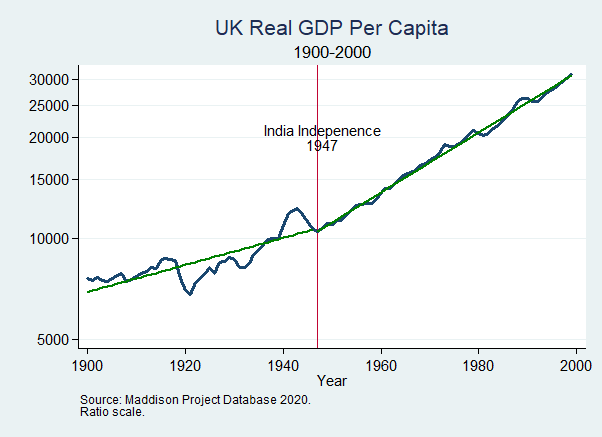
Orwell’s failed prediction stemmed from two reasons. First, he was imbued with zero-sum thinking. It should have been obvious that India was not necessary to the high standard of living enjoyed in England because most of that high standard of living came from increases in the productivity of labor brought about by capitalism and the industrial revolution and most of that was independent of empire (Most. Maybe all. Maybe more than all. Maybe not all. One can debate the finer details on financing but of that debate I have little interest.) The second, related reason was that Orwell had a deep suspicion and distaste for technology, a theme I will take up in a later post.
Orwell, who was born in India and learned something about despotism as a police officer in Burma, opposed empire. Thus, his argument that we had to be poor to be just was a tragic dilemma, one of many that made him pessimistic about the future of humanity.
Two Podcasts
Two podcasts I have enjoyed recently, First, The Social Radars, headed by Jessica Livingston and Carolynn Levy, co-founder and managing director of Y Combinator respectively. Jessica and Carolynn bring a lot of experience and trust with them so the entrepreneurs they interview open up about the realities of startups. Here is a great interview with David Lieb, creator of Google Photos and before that the highly successful failure, Bump.
I’ve also enjoyed the physician brothers Daniel and Mitch Belkin at The External Medicine Podcast. Here’s a superb primer on drug development from the great Derek Lowe.
Identify a Market Failure and Win Prizes!
The University of Chicago’s Market Shaping Accelerator, led by Rachel Glennerster, Michael Kremer, and Chris Snyder (Dartmouth), is offering up to two million dollars in prizes for new pull mechanisms and applications.
Our inaugural MSA Innovation Challenge 2023 will award up to $2,000,000 in total prizes for ideas that identify areas where a pull mechanism would help spur innovation in biosecurity, pandemic preparedness, and climate change, and for teams to design that incentive mechanism from ideation to contract signing.
Participating teams will have access to the world’s leading experts in market shaping and technical support from domain specialists to compete for their part of up to $2 million prize during multiple phases. Top ideas will also gain the MSA’s support in fundraising for the multi-millions or billions of dollars needed to back their pull mechanism.
…Pull mechanisms are policy tools that create incentives for private sector entities to invest in research and development (R&D) and bring solutions to market. Whereas “push” funding pays for inputs (e.g. research grants), “pull” funding pays for outputs and outcomes (i.e. prizes and milestone contracts). These mechanisms “pull” innovation by creating a demand for a specific product or service, which drives private sector investment and efforts towards developing and delivering that product or technological solution.
One example of a pull mechanism is an Advance Market Commitment (AMC), which is a type of contract where a buyer, such as a government or philanthropic organization, commits to purchasing (or subsidizing) a product or service at a certain price and quantity once it becomes available. This commitment creates a market for the product or service, providing a financial incentive for innovators to invest in R&D and develop solutions to meet that demand.
The first round of prizes are $4,000 for an idea!
The submission template asks applicants to identify a market failure where the social value exceeds private incentives and where we know the measurable outcome we want to encourage (e.g. the development of a vaccine, capturing carbon out of the air, etc.). Submissions are accepted from individuals 18 years and older and organizations around the globe whose participation and receipt of funding will not violate applicable law.
See here for more.
Can the Shingles Vaccine Prevent Dementia?
A new paper provides good evidence that the shingles vaccine can prevent dementia, which strongly suggests that some forms of dementia are caused by the varicella zoster virus (VZV), the virus that on initial infection causes chickenpox. The data come from Wales where the herpes zoster vaccine (Zostavax) first became available on September 1 2013 and was rolled out by age. At that time, however, it was decided that the vaccine would only be available to people born on or after September 2 1933. In other words, the vaccine was not made available to 80 year olds but it was made available to 79 year and 364-day olds. (I gather the reasoning was that the benefits of the vaccine decline with age and an arbitrary cut point was chosen.)
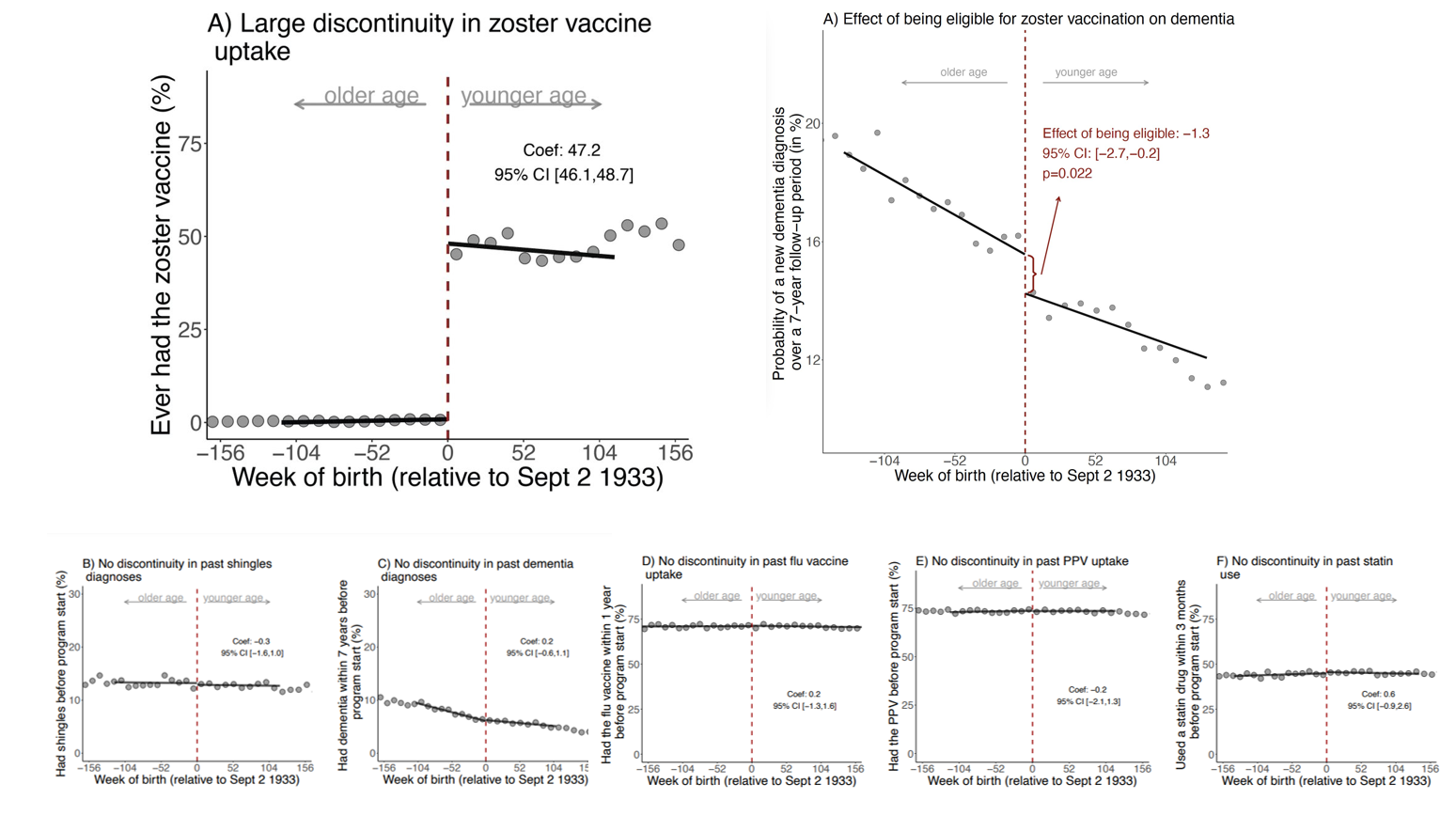
The cutoff date for vaccine eligibility means that people born within a week of one another have very different vaccine uptakes. Indeed, the authors show that only 0.01% of patients who were just one week too old to be eligible were vaccinated compared to 47.2% among those who were just one week younger. The two groups of otherwise similar individuals who were born around September 2 1933 are then tracked for up to seven years, 2013-2020. The individuals who were just “young” enough to be vaccinated are less likely to get shingles compared to the individuals who were slightly too old to be vaccinated (as one would expect if the vaccine is doing it’s job). But, the authors also show that the individuals who were just young enough to be vaccinated are less likely to get dementia compared to the individuals who were slightly too old to be vaccinated, especially among women. A number of robustness tests finds no other sharp discontinuities in treatments or outcomes around the Sept 2, 1933 cut point.
The following graph summarizes. The top left panel shows that the cutoff led to big differences in vaccine uptake, the top right panel shows that there was a smaller but sharp decline in dementia in the vaccinated group. The bottom panel shows that was no discontinuity in a variety of other factors.
Read the whole thing.
I have had my shingles vaccine. As I have said before, vaccination is the gift of a superpower.
The Student-Loan Payment Pause Led Borrowers to Take on More Debt
In 2020 payments on student loans were paused, initially for 3 months but then extended via executive action until June 30, 2023. This was a big program, at the time there were approximately 45 million student loan borrowers, with an outstanding balance of over $1.7 trillion. The main results of the program were that borrowers used the pause to take on more debt. From a new paper by Dinerstein, Yannelis and Chen:
We evaluate the effects of the 2020 student debt moratorium that paused payments for student loan borrowers. Using administrative credit panel data, we show that the payment pause led to a sharp drop in student loan payments and delinquencies for borrowers subject to the debt moratorium, as well as an increase in credit scores. We find a large stimulus effect, as borrowers substitute increased private debt for paused public debt. Comparing borrowers whose loans were frozen with borrowers whose loans were not frozen due to differences in whether the government owned the loans, we show that borrowers used the new liquidity to increase borrowing on credit cards, mortgages, and auto loans rather than avoid delinquencies. The effects are concentrated among borrowers without prior delinquencies, who saw no change in credit scores, and we see little effects following student loan forgiveness announcements. The results highlight an important complementarity between liquidity and credit, as liquidity increases the demand for credit even as the supply of credit is fixed.
This is good news for debt pauses as stimulus payments but it’s bad news if you think that debt pauses are just the nudge some people need to get their financial house in order. Although the COVID scenario makes generalization somewhat difficult, the story is consistent with borrowers who have difficulty restraining spending regardless of wealth, the so-called wealthy hand to mouth consumers (see here for a now classic example). For this group, a debt pause is just a debt pause.
The Promising Pathway Act
The evident failures of the FDA and CDC during COVID have opened up new opportunities for reform. One of the most interesting is the Promising Pathway Act, sponsored by Sens. Mike Braun (R-Ind.) and Kirsten Gillibrand (D-N.Y.). As Bart Madden and I write, the Act would create a new form of approval, provisional approval.
The Hill: Here’s how the current version of the bill works: A new drug could secure provisional approval for serious or life-threatening health conditions via early-stage clinical investigations indicating that the new drug’s safety and efficacy compare favorably to approved drugs.
Importantly, provisional approval requires establishing patient registries for all such treatments and is not simply a matter of faster approval. Third-party, independent entities would manage these registries, tracking safety and effectiveness.
In order to speed up the use of this new knowledge, the de-identified, disaggregated databases would be accessible to approved researchers, medical professionals for public health research and biopharmaceutical industry researchers. Drug sponsors or the government would fund the registries, and the FDA would submit an annual report to Congress on provisionally approved drugs.
Thus, provisional approval would allow earlier access to not yet approved drugs but would require the creation of a patient registry and database that could be used by anyone to evaluate the drug. An interesting and important idea.
Mississippi Learning
In 2002, Florida adopted a phonics based reading strategy due to Charlie Crist. Scores started to rise. Other southern states started to following suit, including Mississippi long deried as the worst in the nation.
APNews: Mississippi went from being ranked the second-worst state in 2013 for fourth-grade reading to 21st in 2022. Louisiana and Alabama, meanwhile, were among only three states to see modest gains in fourth-grade reading during the pandemic, which saw massive learning setbacks in most other states.
The turnaround in these three states has grabbed the attention of educators nationally, showing rapid progress is possible anywhere, even in areas that have struggled for decades with poverty and dismal literacy rates. The states have passed laws adopting similar reforms that emphasize phonics and early screenings for struggling kids.
“In this region, we have decided to go big,” said Burk, now a senior policy fellow at ExcelinEd, a national advocacy group.
These Deep South states were not the first to pass major literacy laws; in fact, much of Mississippi’s legislation was based on a 2002 law in Florida that saw the Sunshine State achieve some of the country’s highest reading scores. The states also still have far to go to make sure every child can read.
But the country has taken notice of what some have called the Mississippi miracle.

Addendum: See my previous posts on the closely related issue of Direct Instruction.
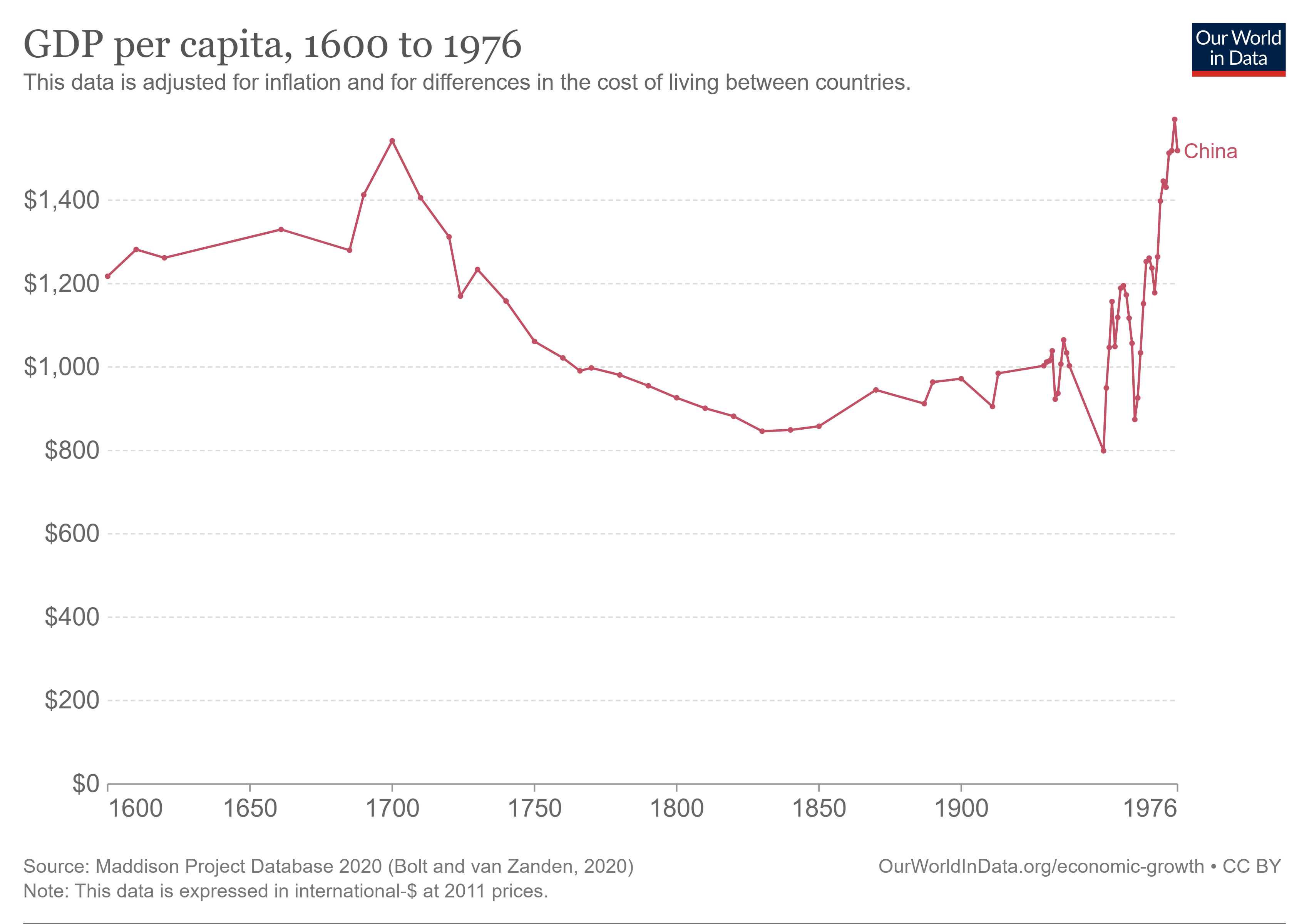
Graph of the Day
A remarkable graph pointed to by Phil Magness who writes:
China’s GDP per capita hit its lowest point in the past 300 years under Maoism. Twice.
The first time was during the civil war and the second was the Great Leap Forward. Wojtek Kopczuk comments:
Even taking into account that these historical measurements are notoriously problematic and difficult to make comparable, the fact that it is even in the ballpark is shocking.