Sentences of the Day
The Washington Post on the plan to refurbish Union Station in DC:
The federal environmental review of the project, which began in 2015, is at least three years behind schedule. Once the federal approval process is complete, a design phase is likely to take several years, project officials said, possibly followed by 13 years of construction.
A good example of the Ezra Klein point about the costs of everything bagel liberalism. By the way, the push to eliminate more than a thousand parking spots at the station seems counter-productive. I’m not a fan of parking minimums but in typical liberal fashion that has been turned into an anti-parking, anti-car crusade regardless of context. In fact, a railroad station is precisely where you do want parking to avoid the last mile(s) problem and encourage rail use.
Substitutes Are Everywhere: The Great German Gas Debate in Retrospect
In March of 2022 a group of top economists released a paper analyzing the economic effects on Germany of a stop in energy imports from Russia (Bachmann et al. 2022). Using a large multi-sector mathematical model the authors concluded that if prices were allowed to adjust, even a substantial shock would have relatively low costs. In contrast, the German chancellor warned that if the Russians stopped selling oil to Germany “entire branches of industry would have to shut down” and when asked about the economic models he argued that:
[the economists] get it wrong! And it’s honestly irresponsible to calculate around with some mathematical models that then don’t really work. I don’t know absolutely anyone in business who doesn’t know for sure that these would be the consequences.
The Chancellor was not alone in predicting big economic losses; some studies estimated reductions in output of 6-12% and millions of unemployed workers. The key distinction between the economists and the others was in their understanding of elasticities of substitution. When the Chancellor and the average person think about a 40% reduction in natural gas supplies, they implicitly assume that each natural gas-dependent industry must cut its usage by 40%. They then consider the resulting decline in output and the cascading effects on downstream industries. It’s easy to get very worried using this framework.
When the economists replied that there were opportunities for substitution they were typically met with disbelief and misunderstanding. The disbelief stemmed from a lack of appreciation of the many opportunities for substitution that permeate an economy. In our textbook, Modern Principles, Tyler and I explain how the OPEC oil shock in the 1970s led to an increase in brick driveways (replacing asphalt) and the expansion of sugar cane plantations in Brazil (for ethanol production). Amazingly, the oil shock also prompted flower growers to move production overseas, as the reduction in heating oil costs from growing in sunnier climates outweighed the increase in transportation fuel expenses. While these examples highlight long-term changes, short-term substitutions are also possible, though their precise details are usually hidden from central planners and economists.
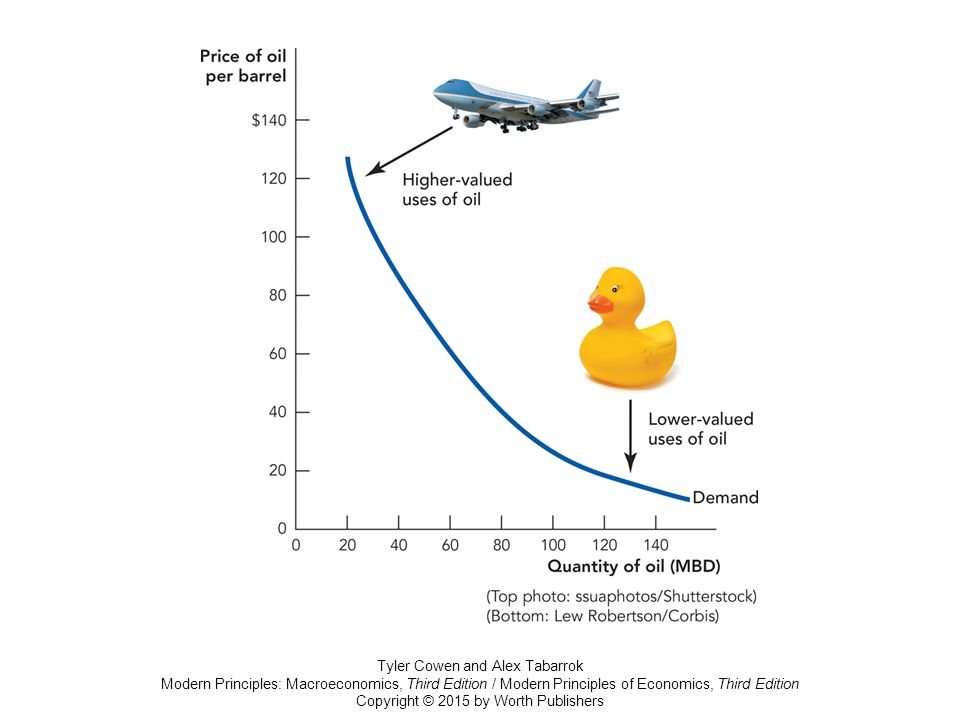 The misunderstanding came from thinking that we need every user of fuel to find substitutes. Not at all! In reality, as fuel prices rise, those with the lowest substitution costs will switch first, freeing up fuel for users who have more difficulty finding alternatives. Just one industry with favorable substitution possibilities, combined with a few moderately adaptable industries, can produce a significant overall effect. Moreover, there are nearly always some industries with viable substitution options. To see why reverse the usual story and ask, if fuel prices fell by 50% could your industry use more fuel? And if fuel prices fell by 50% are their industries that could switch into the now cheaper fuel?
People often find it easier to imagine new uses rather than ways to reduce existing consumption. However, it is typically the new uses that are scaled back first. Tyler and I illustrate this with our jet and rubber ducky graph. Although jet aircraft won’t shift away from oil even at high prices, rubber (actually plastic) duckies, which are made from oil, can find substitutes–wood, for example–when oil prices rise. And if plastic ducky manufacturers cannot find substitutes, they go out of business, freeing up more oil for other uses. In this way, the market identifies the least valuable goods to cease production, another kind of substitution.
Substitution is a more nuanced concept than many people imagine. Here’s another example. Imagine that an economy has an energy-intensive goods producing sector and that there are few substitutes for the fuel used in this sector. Disaster? Not at all. We don’t need a fuel substitute, if we can substitute imports of the energy-intensive goods for domestically produced versions. Storage is also a substitute and notice that the more you substitute away from a fuel in final uses the greater the effective storage. If you use 1 gallon a day a 10 gallon tank lasts 10 days. If you use a quarter gallon a day it lasts 40 days. Everything is connected.
All of these myriad changes happen under the guidance of the invisible hand, i.e. the price system. Remember, a price is a signal wrapped up in an incentive. Thus Bachmann et al. wisely recommended letting energy prices rise to convey the signal and not insuring energy users so the incentive effects were fully felt on the margin.
So what happened? Gas from Russia was indeed cut very substantially but the German economy did not collapse and instead proved as robust as predicted, perhaps even more so. (The Chancellor’s predictions were off the mark but, to be fair, the government also did do a good job in sourcing new supplies and building reserves.) Moll, Schularick, and Zachmann have revisited the analysis and conclude:
The economic outcomes confirm the core theoretical argument that macro elasticities are larger than micro elasticities and that “cascading effects” along the supply chain would be muted as opposed to destroying the economy’s entire industrial sector. As foreseen, producers partly switched to other fuels or fuel suppliers, imported products with high energy content, while households adjusted their consumption patterns….Market economies have a tremendous ability to adapt that was widely underestimated. In addition, the German economics ministry (BMWK) was very successful in quickly sourcing gas supplies from third countries and building LNG capacity. Finally, it probably helped that German policymakers refrained from imposing a price cap on natural gas (like in many other European countries) and instead opted for lumpsum transfers based on households’ and firms’ historical gas consumption.
Hat tip: Alex Wollman.
Free Insurance for Everyone!
President Biden says “We’re planning to make it mandatory for airlines to compensate travelers with meals, hotels, taxis, and cash, miles, or travel vouchers when your flight is delayed or cancelled because of their mistake.”
A classic example of the Happy Meal Fallacy:
Some restaurants offer burgers without fries and a drink. These restaurants cater to low-income people who enjoy fries and drinks but can’t always afford them. To rectify this sad situation a presidential candidate proposes The Happy Meal Act. Under the Act, burgers must be sold with fries and a drink. “Burgers by themselves are not a complete, nutritious meal,” the politician argues, concluding with the uplifting campaign slogan, “Everyone deserves a Happy Meal!”
But will the Happy Meal Act make people happy? If burgers must come with fries and a drink, restaurants will increase the price of a “burger.” Even though everyone likes fries and a drink they may not like the added benefits by as much as the increase in the price of the meal. Indeed, this must be the case since consumers could have bought the meal before the Act but chose not to. Requiring firms to sell benefits that customers value less than their cost makes both firms and customers worse off.
Almost everyone understands this when it comes to burgers and fries but make it burgers, fries and air miles and some people will think this is a good idea. To recap, requiring firms to sell benefits that customers value less than their cost makes both firms and customers worse off. And if customers value the benefits at more than the cost then that’s a profit opportunity and there is no need for a mandate.
The FDA Still Doesn’t Trust Women
The FDA has a long history of antipathy towards personal testing. The FDA has opposed personal pregnancy tests, HIV tests, genetic tests, and COVID tests, as I discussed in my article Testing Freedom. Well, the FDA is at it again:
NYTimes: At a hearing Tuesday to consider whether the Food and Drug Administration should authorize the country’s first over-the-counter birth control pill, a panel of independent medical experts advising the agency was left to reckon with two contradictory analyses of the medication called Opill.
During the eight-hour session, the manufacturer of the pill, HRA Pharma, which is owned by Perrigo, and representatives of many medical organizations and reproductive health specialists said that data strongly supported approval. They said that Opill, approved as a prescription drug 50 years ago, was safe, effective and easy for women of all ages to use appropriately — and that over-the-counter availability was sorely needed to lower the country’s high rate of unintended pregnancies.
In contrast, F.D.A. scientists questioned the reliability of company data that was intended to show that consumers would take the pill at roughly the same time every day and comply with directions to abstain from sex or temporarily use other birth control if they missed a dose. The agency seemed especially concerned about whether women with breast cancer or unexplained vaginal bleeding would correctly choose not to take Opill and whether adolescents and people with limited literacy would use it accurately.
Note carefully: The FDA isn’t worried that women won’t take the pill at the same time every day they are worried that women who get the pill without a prescription won’t take it at the same time every day. I guess in the FDA’s view women need some mansplaining to take birth control or at least some doctorplaining.
Dr. Westhoff suggested that for most women, there is no advantage to a doctor prescribing the pills because doctors don’t typically monitor patient adherence and often only see such patients once a year.
Similarly, I suspect that women with breast cancer will be concerned enough about their health to read the warning, Don’t Take This Pill if You Have Breast Cancer. Who knows, women with breast cancer might even ask their cancer physician or Google or their GP(T) about what foods and drugs to take and which to avoid.
If I didn’t know the FDA’s long history of opposing personal testing, I would think this simply bizarre but not trusting people with their own health decisions is practically in the FDA’s DNA.
Lessons from the COVID War
In preparation for a National Covid Commission a group of scholars directed by Philip Zelikow (director of the 9/11 Commission) began interviewing people and organizing task forces (I was an interviewee). The Covid Commission didn’t happen, a fact that illustrates part of the problem:
The policy agenda of both major American political parties appear mostly undisturbed by this pandemic. There is no momentum to fix the system….The Covid war revealed a collective national incompetence in governance….One common denominator stands out to us that spans the political spectrum. Leaders have drifted into treating this pandemic as if it were an unavoidable national catastrophe.
The results of this early investigation, however, are summarized in Lessons from the COVID WAR. Overall, a good book, not as pointed or data driven as I might have liked (see my talk for a more pointed overview), but I am in large agreement with the conclusions and it does contain some clarifying tidbits such as this one on the Obama playbook.
Innumerable speeches, books, and articles have stated that the Obama administration gave the incoming Trump administration a “playbook” on how to confront a pandemic and that this playbook was ignored. The Obama administration did indeed prepare and leave behind the “Playbook for Early Response to High-Consequence Emerging Infectious Disease Threats and Biological Incidents.”
But this playbook did not actually diagram any plays. There was no “how.” It did not explain what to do…when it came to the job of how to contain a pandemic that was headed for the United States in January 2020, the playbook was a blank page.
I also appreciated that Lessons has some some unheralded success stories from the state and local level. You may recall Tyler and I blogging repeatedly in 2020 about the advantages of pooled tests. Eventually pooled testing was approved but I haven’t seen data on how widely pooling was adopted or the effective increase in testing capacity that was produced. Lessons, however, offers an anecdote:
In San Antonio, a local charitable foundation paired with a blood bank to create a central Covid PCR testing lab (antigen tests were not yet readily available) that could combine samples (pooling) for efficiency and cost reduction, but also determine which individual in a pool was positive. Importantly, results were available within about twelve hours. That meant results were available before the start of school the new day.
The program helped San Antonio get kids back into the schools.
More generally, it’s striking that US schools were closed for far longer than French, German or Italian schools. See data at right on the number of weeks that “schools were closed, or party closed, to in-person instruction because of the pandemic (from Feb. 2020-March 2022)”. (South Korea, it should be noted, had some of the most advanced online education systems in the world.)
One general point made in Lessons that I wholeheartedly agree with this is that the school closures and many of the other controversial aspects of the pandemic response such as the lockdowns and mask mandates “were really symptoms of the deep problem. Without a more surgical toolkit, only blunt instruments were left.” With better testing, biomedical surveillance of the virus and honest communication we could have done better with much less intrusive and costly policies.
Addendum: See my previous reviews of Gottlieb’s Uncontrolled Spread, Michael Lewis’s The Premonition, Slavitt’s Preventable and Abutaleb and Paletta’s Nightmare Scenario.
Addendum 2: A typo in Lessons had France closing schools for 2 weeks instead of 12 weeks. Corrected.
The Public Choice Outreach Conference
There are just a few spots left! Tell your students. Apply now!

Polish Vending Machine for Contact Lenses

Here’s one in Lithuania. See my post The Optometry Racket for more on the context.
Hat tip: Tadeusz Giczan.
Buying a Coal Mine Gets Easier!
Long time readers will know that I have been advocating for buying a coal mine and shuttering it, especially a coal mine in India or China. The basic idea is that there are plenty of coal mines which are barely profitable so buying and shuttering these mines could be a relatively cheap way to reduce air pollution and climate change (much cheaper, for example, then letting the coal mine produce and then paying for carbon extraction). (I give an example of how this might work with an actual coal mine for sale here).
One objection, which I noted earlier, was BLM use it or lose it rules:
There are also some crazy “use it or lose it” laws that say that you can’t buy the right to extract a natural resource and not use it. When the high-bidder for an oil and gas lease near Arches National Park turned out to be an environmentalist the BLM cancelled the contract! That’s absurd. The high-bidder is the high-bidder and there should be no discrimination based on the reasons for the bid. See this Science piece.
Well some good news.
The Bureau of Land Management unveiled a draft rule late last month that would place conservation “on equal footing” with energy development and other traditional uses — a proposal that seeks to confront the agency’s long record of prioritizing extraction across the federal estate. A key provision of that rule would grant the BLM, which oversees one-tenth of all land in the United States, the authority to issue “conservation leases” to promote land protection and ecosystem restoration.
The article does a pretty good job of explaining conservation leases but it’s hilarious how the author reflexively labels PERC a right-wing think tank with deep ties to fossil fuels that supports “free market environmentalism” in scare quotes and never feels the need to resolve this with their support of conservation leases. Blank out, as Ayn Rand would say.
Few people have done more to advance the idea of conservation leases than Shawn Regan, vice president of research at the Property and Environment Research Center, or PERC, a right-wing, Montana-based think tank that promotes “free market environmentalism” and has deep ties to fossil fuels. Regan points to Williams’ and DeChristopher’s cases to highlight how legacy “use it or lose it” rules have biased public land management in favor of extraction.
“We have these ‘use it or lose it’ requirements that define ‘use’ in these really narrow ways that preclude conservation groups from participating in the leasing markets that affect the use of vast swaths of the American West,” he told HuffPost. “Conservation should be considered a valid use of public lands, and groups should be able to acquire those leases and decide to conserve them in some form or restore them.”
Regan argues the inability of conservationists to participate in federal land leasing, even when they are willing to pay more than a driller or rancher, has only helped fuel conflict in Western states.
…“Why don’t environmentalists just buy what they want to protect? Well, in many cases they can’t,” Regan said.
Hat tip: Robert Keller.
From the Comments
The context is that human challenge trials were “ethically fraught” but, Sure writes:
…I think we had more than a few instances in history where restricting movement, shuttering houses of worship, and stratifying the economy into favored and disfavored sectors was considered ethically fraught.
I mean we know that limiting visitation to old folks shortens their lives. We know that child abuse becomes harder to find the fewer the number of folks who lay eyes on them each day. We know that initimate partner violence increases when the housing market gets frozen. And we know that suicides crest when businesses go under.
Yet no such epistemic humility and wariness followed with public health recommendations to be tried on a scale reserved hitherto for literal wars and genocides. And we blindly went ahead full speed.
Or consider even the better defined but wildly more mundane issue: proof of vaccination. For decades health ethicists told us that merely revealing a patient’s name, let alone which medications they have taken, was an unconscionable ethical violation. One which we instituted balkanized medical systems to manage and where the cost has been literal lives lost as we have had untold numbers of patients fall through the cracks thanks to duplicate profiles, failure of providers to communicate, and of course scads and scads of useful data locked away from effective statistical analysis that could spot patterns of medical error.
Yet when the powers that be decided that we needed vaccine passports so we could enjoy dining again? Well, every waiter in the country becomes a safe repository of PHI.
No formal study. No deliberations. Precious little if any publications.
And even then, it went only for what was the most expedient option for the enlightened. No ability to get an antibody titer card for medical equivalence. No ability to substitute PCR results with a physician evaluation of recent disease recovery.
Professional medical ethics are bogus. There is no consistency and the entire profession serves to pander to the prejudices of the educated.
A Systematic Review of Human Challenge Trials, Designs, and Safety
One of the most bizarre aspects of the COVID era was the institutional unwillingness to perform human challenge trials, which likely would have sped up vaccines and other treatments and saved lives. We let people join the military, indeed we advertise to encourage people to join the military, but for some reason running a human challenge trial is considered ethically fraught.
A new review find that HCTs are quite safe–more evidence that we have too few of these trials.
Human challenge trials (HCTs) are a clinical research method in which volunteers are exposed to a pathogen to derive scientifically useful information about the pathogen and/or an intervention [1]. Such trials have been conducted with ethical oversight since the development of the modern institutional review system of clinical trials in the 1970s. More recently, there has been renewed discussion about the ethical and practical aspects of conducting HCTs, largely fueled by interest in conducting HCTs for severe acute respiratory syndrome coronavirus 2. Past reviews of HCTs focused on reporting methods [2] and safety for single pathogens [3–6], but these did not explicitly evaluate the safety of HCTs by assessing reported adverse events (AEs) and serious adverse events (SAEs) across a range of pathogens. Furthermore, many additional HCTs have been performed since the publication of these reviews. To better inform discussions about future uses of HCTs, including during pandemic response, this article presents a systematic review of challenge trials since 1980 and reports on their clinical outcomes, with particular focus on risk of AEs and risk mitigation strategies.
Hat tip: Alec Stapp.
In Defense of Merit
An excellent paper co-authored by many luminaries, including two Nobel prize winners:
Merit is a central pillar of liberal epistemology, humanism, and democracy. The scientific enterprise, built on merit, has proven effective in generating scientific and technological advances, reducing suffering, narrowing social gaps, and improving the quality of life globally. This perspective documents the ongoing attempts to undermine the core principles of liberal epistemology and to replace merit with non-scientific, politically motivated criteria. We explain the philosophical origins of this conflict, document the intrusion of ideology into our scientific institutions, discuss the perils of abandoning merit, and offer an alternative, human-centered approach to address existing social inequalities.
Great work! The only problem? See where the paper was published (after being rejected elsewhere).
Great News for Female Academics!
For decades female academics have been told that the deck is stacked against them by discrimination in hiring, funding, journal acceptances, recommendation letters and more. It’s dispiriting to be told that your career is not under your control and that, no matter what you do, you face an unfair, uphill battle. Why would any woman want to be a scientist when they are told things like this:
A vast literature….shows time after time, women in science are deemed to be inferior to men and are evaluated as less capable when performing similar or even identical work. This systemic devaluation of women women results in an array of real consequences: shorter, less praise-worth letters of recommendation, fewer research grants, awards and invitations to speak at conferences; and lower citation rates for their research…
The good news is that this depressing and dispiriting story isn’t true! In an extensive survey, meta-analysis, and new research, Ceci, Kahn and Williams show that the situation for women in academia is in many domains good to great. For example, in hiring for tenure the evidence is strong that women are advantaged. Moreover, women are advantaged especially in fields where they have relatively low representation (GEMP: geosciences, engineering, economics, mathematics/computer science, and physical science).
Among political scientists, Schröder et al. (2021) found that female political scientists had a 20% greater likelihood of obtaining a tenured position than comparably accomplished males in the same cohort after controlling for personal characteristics and accomplishments (publications, grants, children, etc.). Lutter and Schröder (2016) found that women needed 23% to 44% fewer publications than men to obtain a tenured job in German sociology departments.
…In summary, all of the seven administrative reports reveal substantial evidence that women applicants were at least as successful as and usually more successful than male applicants were—particularly in GEMP fields.
…In a natural experiment, French economists used national exam data for 11 fields, focusing on PhD holders who form the core of French academic hiring (Breda & Hillion, 2016). They compared blinded and nonblinded exam scores for the same men and women and discovered that women received higher scores when their gender was known than when it was not when a field was male dominant (math, physics, philosophy), indicating a positive bias, and that this difference strongly increased with a field’s male dominance. Specifically, women’s rank in male-dominated fields increased by up to 40% of a standard deviation. In contrast, male candidates in fields dominated by women (literature, foreign languages) were given a small boost over expectations based on blind ratings, but this difference was small and rarely significant.6
The situation is also very good in grant funding and journal acceptance rates which are either not biased or biased towards women. Similarly, “no persuasive evidence exists for the claim of antifemale bias in academic letters of recommendation.”
There is evidence of bias in student evaluations. Both female and male students rate male professors higher, even in situations where names are known but actual gender is blinded. Male students are more likely to write nasty comments. Most research universities, in my experience, don’t put much weight on student teaching evaluations, beyond do you pass a fairly low bar, but it can be disconcerting to get nasty comments.
There is also mild evidence of differences in salary, although less so when productivity is taken into account.
Some critics will say, but the real discrimination happens before a women applies for a tenure track job! Maybe so but that is a shifting of goal posts and we should take pride in the fact that in the United States today (and most developed countries) there is very little bias against women in high stakes, important decisions in tenure track hiring, journal acceptances, grant funding and so forth. This is a major accomplishment.
It should be noted that the Ceci, Kahn and Williams paper is an adversarial collaboration; Ceci and Williams have published previous work showing that women are, generally speaking, not discriminated against in academia while:
Kahn has a long history of revealing gender inequities in her field of economics, and her work runs counter to Ceci and Williams’s claims of gender fairness. Kahn was an early member of the American Economics Association’s Committee on the Status of Women in the Economics Profession (CSWEP). Articles of hers in the American Economics Review (Kahn, 1993) and in the Journal of Economic Perspectives (Kahn, 1995) were the first publications on the status of women in the economics profession. She was the first to identify gender inequities as a concern in economics, something she has revisited every decade since then in her publications. In 2019, she co-organized a conference on women in economics, and her most recent analysis in 2021 found gender inequities persisting in tenure and promotion in economics (Ginther & Kahn, 2021). In short, gender bias in academia has been a long-standing passion of Kahn’s. Her findings diverge from Ceci and Williams’s, who have published a number of studies that have not found gender bias in the academy, such as their analyses of grants and tenure-track hiring in Proceedings of the National Academy of Sciences (PNAS; Ceci & Williams, 2011; Williams & Ceci, 2015).
The Ceci, Kahn, and Williams paper covers much more material than I can cover here and is nuanced so read the whole thing but do also shout the good news from the rooftops!
Catawba Digital Economic Zone Passes Banking Code
The Catawba Digital Economic Zone (CDEZ), a project of the Catawba Indian Nation (I am an advisor), has passed a banking and financial services regulatory code. The code allows financial services companies and banks to receive charters to operate a bank similar to that offered by US states.
…The goal of the code is to create a “best-of-all-worlds” set of laws that will provide the Nation with: 1) a comprehensive legal code for the regulation of traditional and emerging digital financial activities; 2) legal terms that are already recognized and accepted by the federal government for access to the U.S. and global financial systems; and 3) provisions that enhance the Nation’s sovereignty and create competitive advantages for the Nation’s economic development.
To achieve these objectives, the foundation of the code synthesizes terms from the existing financial codes of three states: South Dakota, North Dakota, and Wyoming. These state codes were selected as a starting point based on their commitment to regulating innovative financial activity to protect consumers and encourage responsible innovation.
John Lennon and Yoko on Over Population
He was right.
Hat tip: Steven Hamilton who now likes the Beatles.
Voters as Mad Scientists: Essays on Political Irrationality
 Bryan Caplan’s latest collection of essays, Voters as Mad Scientists: Essays on Political Irrationality is out and, as the kids say, it’s a banger. Voters as Mad Scientists includes classics on social desirability bias, the ideological Turing test, the Simplistic Theory of Left and Right and more. Lots of wisdom in these short essays. Bryan is a pundit who writes for the long run. Here’s one on the historically hollow cries of populism:
History textbooks are full of populist complaints about business: the evils of Standard Oil, the horrors of New York tenements, the human body parts in Chicago meat packing plants. To be honest, I haven’t taken these complaints seriously since high school….Still, I periodically wonder if my nonchalance is unjustified. Populists rub me the wrong way, but how do I know they didn’t have a point? After all, I have near-zero first-hand knowledge of what life was like in the heyday of Standard Oil, New York tenements, or Chicago meat-packing. What would I have thought if I was there?
Yet, Bryan continues, there is a test. What do populists say about the technological revolutions of the 2000s which Bryan has seen with this own eyes?
I’ve seen the tech industry dramatically improve human life all over the world.
Amazon is simply the best store that ever existed, by far, with incredible selection and unearthly convenience. The price: cheap.
Facebook, Twitter, and other social media let us socialize with our friends, comfortably meet new people, and explore even the most obscure interests. The price: free.
Uber and Lyft provide high-quality, convenient transportation. The price: really cheap.
Skype is a sci-fi quality video phone. The price: free. YouTube gives us endless entertainment. The price: free.
Google gives us the totality of human knowledge! The price: free.
That’s what I’ve seen. What I’ve heard, however, is totally different. The populists of our Golden Age are loud and furious. They’re crying about “monopolies” that deliver fire-hoses worth of free stuff. They’re bemoaning the “death of competition” in industries (like taxicabs) that governments forcibly monopolized for as long as any living person can remember. They’re insisting that “only the 1% benefit” in an age when half of the high-profile new businesses literally give their services away for free. And they’re lashing out at businesses for “taking our data” – even though five years ago hardly anyone realized that they had data.
My point: If your overall reaction to business progress over the last fifteen years is even mildly negative, no sensible person will try to please you, because you are impossible to please. Yet our new anti-tech populists have managed to make themselves a center of pseudo-intellectual attention.
Read the whole thing and follow Bryan at Bet On It.