Category: Current Affairs
I appear on the Coleman Hughes podcast
Grade Caps are Not a Good Solution to Grade Inflation
It’s well known that grade inflation has “degraded” the informational content of grades at many colleges. At Harvard, two-thirds of all undergraduate grades are now A’s—up from about a quarter two decades ago. In response, a Harvard faculty committee has proposed capping A grades at 20 percent of each class (plus a cushion for small courses). That may give professors some cover to resist further inflation, but it doesn’t solve the real problem.
The real problem is not inflation per se. It’s that students are penalized for taking harder courses with stronger peers. A grade cap leaves that distortion intact—and can even amplify it. As Harvard economist Scott Kominers argues:
A grade cap systematically penalizes ambitious students for surrounding themselves with strong classmates. Perverse course-shopping incentives ensue as a result. A student who is prepared for an advanced course but concerned about landing in the bottom 80 percent may choose to drop down preemptively—seeking out a pond where they are a relatively bigger fish. As strong students move into lower-level courses, competition for A grades increases there while harder courses continue to shrink—reducing their A allocation further and driving more students away.
The underlying issue is informational. A grade tries to capture two things—student ability and course difficulty—with a single number. Gans and Kominers show that in general this is impossible: if some students take math and earn B’s while others take political science and earn A’s, there is no way, from grades alone, to tell whether the difference reflects ability or course difficulty.
There is, however, a solution in some cases. Clearly, if every student takes some math and political science courses, informative patterns can emerge. If math students tend to get B’s in math but A’s in political science, while political science students get A’s in their own field but C’s in math, you can begin to separate course difficulty from student ability.
Students don’t all overlap the same classes. But full overlap isn’t necessary—you just need a connected network. If Alice just takes math courses, Joe takes math and political science courses, and Bob just takes political science courses, then Alice and Bob can be compared through Joe. With enough of these links, the entire system can be stitched together. The more overlap, the more precise the estimates.
Valen Johnson proposed a practical method along these lines in 1997. Gans and Kominers embed the same intuition in a much more general framework, showing exactly what can and cannot be inferred, and under what conditions.
The great thing about achievement indexes based on relative comparisons is that they are robust to grade inflation and do not penalize students for taking hard classes or subjects. A political science student who chooses to take a tough math class instead of an easy-A intro to sociology course won’t be penalized because their low math grade will, in effect, by boosted by the difficulty of the course/quality of the students. That’s good for the student and also good for disciplines that have lost students over the years because they held the line on grade inflation.
One final point. Harvard’s cap proposal appears to have been developed with little engagement with researchers who have studied problems like these for decades in the mechanism and market design literature—people like Kominers, Gans, Budish, Roth, Maskin, and Sönmez, some of them at Harvard! Moreover, this isn’t a case of ignoring high-theory for practice. The high-theory of mechanism design has produced real-world systems including kidney exchanges, school choice mechanisms, physician-resident matching, even the assignment of students to courses at Harvard, as well as many other mechanisms. Mechanism design is practical.
Grade inflation is a mechanism design problem—and we know a lot about how to solve it, if we want to solve it.
The Candidates’ tournament
Caruana and Sindharov have won today, obviously boosting Caruana’s chances as favorite (he beat Nakamura, the number two rated player in the tournament). Yet what the chess world needs right now is not a winner, but rather a greater sense of legitimacy for the world title. Ideally the same person should win a championship match two or three times in a row, and with a decisive margin. They do not have to be as good as Carlsen, just clearly better than everyone else. Nepo never quite made it, Ding has retreated from the chess world, and Caruana has yet to win a first title. Is he young enough to win a few in a row? Or are we waiting for Nordirbek Abdusattorov (or someone else) to enter the cycle? I fear decisiveness is not soon on the way. There are several (relatively) weak players in this tournament, so a variety of players can win just by beating up on the weakies, rather than by demonstrating mastery over their strongest peers. Legitimacy is likely to remain uncertain, to the detriment of the chess world. But soon we will know more.
Shruti interviews V. Anantha Nageswaran on the Indian economy
He is currently serving as the Chief Economic Advisor to the Government of India, and also is the co-author of the books Economics of Derivatives and The Rise of Finance: Causes, Consequences and Cures. The podcast covers import substitution and strategic resilience, futures and options market, gross fixed capital formation, crypto markets, India’s growth trajectory, and much more.
Here is the audio and video on YouTube. Here is a linked transcript. Excerpt:
RAJAGOPALAN: The policy response to this has come in a couple of different ways. One has come through SEBI. It has started raising contract sizes and limiting weekly expiration,and so on. Another instrument has come through taxation. There have been STT [Securities Transactions Tax] hikes in consecutive budgets,but there is one thing about STT that I want to understand a little bit better from someone like you who has thought about this deeply.
Now, STT on futures is being levied on the notional value of the contract, which is the full traded price, whereas the STT on the options is levied on the premium, which is a small fraction of the overall underlying value of the notional exposure. The effective tax that is imposed is much more on the futures trade, manyfold more actually, than it is on the options trade, whereas the speculation is mostly happening on the options side, which is also where most of the retail investors are losing money because the futures side is much better capitalized, larger firms, and so on.
NAGESWARAN: No, also the futures side is probably used more by institutions, and therefore, they are able to put up the margin requirement, etc., better than the options trades, where the individuals are being sold almost like the₹10 sachet-type options, and the options…
RAJAGOPALAN: Exactly, sachetization options, absolutely.
NAGESWARAN: Yes. Go ahead.
RAJAGOPALAN: Now with each successive hike in the STT,we’re seeing the gap widen. It’s on the margin, making futures relatively more expensive than options just because it’s taxing each trade. It’s like a toll fee that’s paid almost on every transaction. Your book was precisely about understanding these kinds of policy instruments. Given that now we have a tax instrument which inadvertently favors the more speculative instrument. Is that a good way of thinking about it, or how would you think about this problem?
NAGESWARAN: No, I think you have given me a lot to think about on this. I probably haven’t applied my mind as much to the mechanics of the STT being levied on the premium when it comes to options, but on the notional value of the contract when it comes to futures. Actually, you have given me something to think about. As you said, it could be having the unintended consequence of reducing the hedging role of futures, which probably is playing a better role there and encouraging the speculative element. Let me think about it and also probably take back this aspect of the conversation back to my colleagues in the revenue department, in the Ministry of Finance. Thank you for that, yes.
Of great importance for the world’s most populous country.
Is Tinder actually OK?
Online dating apps have transformed the dating market, yet their broader effects remain unclear. We study Tinder’s impact on college students using its initial marketing focus on Greek organizations for identification. We show that the full-scale launch of Tinder led to a sharp, persistent increase in sexual activity, but with little corresponding impact on the formation of long-term relationships or relationship quality. Dating outcome inequality, especially among men, rose, alongside rates of sexual assault and STDs. However, despite these changes, Tinder’s introduction did not worsen students’ mental health on average and may have even led to improvements for female students.
That is from a new paper published in AEJ: Applied Economics, by Berkeren Büyükeren, Alexey Makarin, and Heyu Xiong.
Republican Congressional deference to Trump is in fact democratic
That does not mean it is good! From Jeffrey M. Stonecash:
Congress is portrayed as compliant with President Donald J. Trump’s agenda because he is intimidating its members. This neglects an alternative explanation that focuses on the increased congruence of presidential and congressional electoral bases. Trump is the beneficiary of a geographical realignment that took decades and has created a high degree of overlap of the two bases. This analysis tracks that process from 1952 to 2024. It has produced a situation in which policy concerns overlap and encourage congressional compliance.
Social Security Should Be a Forced Savings Program Not a Welfare Program
There is a growing movement to eliminate the wage cap on Social Security taxes while capping benefits. The argument, often from the center-right, is that Social Security is insolvent and that “tough” choices are needed to save it. But this moves the system in exactly the wrong direction.
One of the better features of Social Security is that it has never been purely redistributive. It has also functioned, in part, as a forced-savings program. The Social Security Administration itself emphasizes that benefits depend on earnings history: earn more, retire with more. Why do some people receive large Social Security checks? Because they paid a lot more into the system.
Eliminating the wage cap while capping benefits weakens, and in the limit destroys, that connection. It turns Social Security away from forced saving and toward retirement welfare financed by a broader tax on earnings. That is a bad idea.
The problem is not just that this creates another welfare program. It also worsens marginal incentives. A tax that buys you a claim on future benefits is not the same as a pure tax. Suppose 10 percent of your salary goes into a 401(k). That reduces current consumption, but it is not simply money lost to the state. You receive an asset in return. It is closer to a purchase than to a tax–a reason to work more not a reason to work less.
Social Security is not a personal retirement account, but it does contain that logic. There is a connection between taxes paid and benefits received. To the extent that workers understand that connection, the payroll tax is less distortionary than an ordinary tax of the same size. Part of what workers pay is offset by the expectation of future benefits.
Gut that connection, however, and the tax becomes more distortionary even if total taxes paid and total benefits received stay the same. The averages can remain unchanged while the marginal incentives deteriorate. Once additional taxes no longer generate additional benefits, the system looks much more like a straight tax on work.
A much better reform would move in the opposite direction: strengthen the link between contributions and benefits. Make Social Security more like what many people already think it is—an individual account that accumulates benefits over time. The stronger that link, the lower the effective tax wedge.
This would also improve the politics of the system. A welfare program invites zero-sum conflict: my benefit comes at your expense. A claim-based system is less divisive. It ties benefits more clearly to contributions and makes rising prosperity good for everyone. In that kind of system, we can all become richer—including low-wage immigrants—without treating retirement policy as a fight over who gets to pick whose pocket.
Addendum: James Buchanan first made these points here. John Cochrane gets the economics right, of course.
Solve for the China tech equilibrium
Authorities in Beijing have barred two executives from a Singapore-based AI firm from leaving China amid a review of the company’s $2 billion acquisition by U.S. social media giant Meta, according to a report by the Financial Times on Wednesday.
Xiao Hong and Ji Yichao — the CEO and chief scientist, respectively, of Manus — were summoned to Beijing this month and questioned over a possible violation of foreign direct investment reporting rules related to the acquisition before being told they could not leave the country, the report said.
Here is more from The Washington Post. In my view, the American lead in AI is somewhat larger than a model comparison alone might suggest.
Johan Fourie interviews me at University of Stellenbosch
Physician Incomes and the Extreme Shortage of High IQ Workers
Physician incomes are extraordinarily high in the United States. A new NBER paper finds that U.S. physicians earn roughly two to four times as much as their counterparts in Canada, the Netherlands, and Sweden.
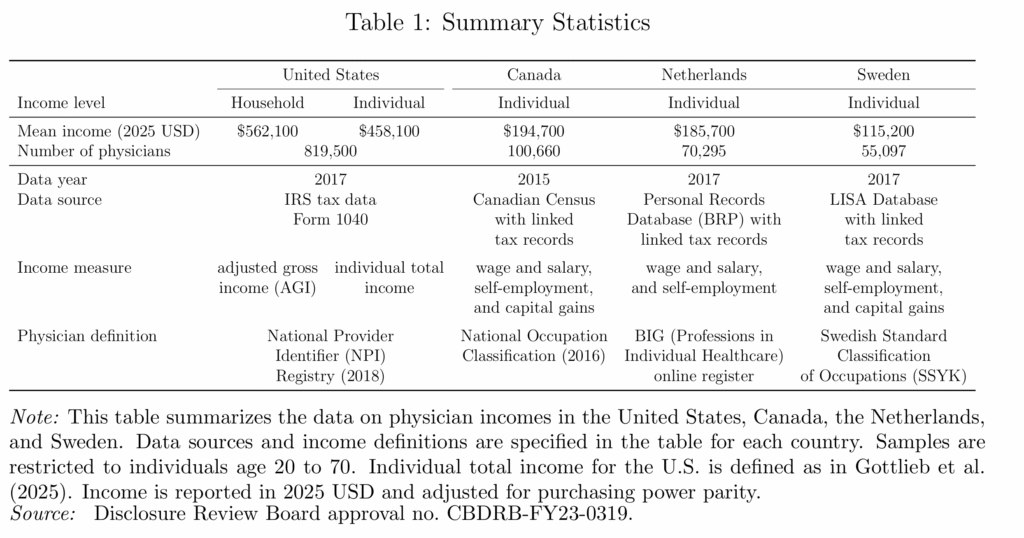
Why? Is it some feature particular to the US health care sector? Probably not. The same paper finds that physicians in the US have about the same relative income ranking as in Canada, the Netherlands, and Sweden. In other words, lots of high-skill workers in the US earn high incomes and physicians don’t look unusual relative to these other high-skill groups.
That is exactly what one would expect in an economy with an extreme shortage of high-IQ, high-skill workers. The US is a uniquely productive economy for high-skill workers which is why the US demand for foreign workers and the foreign demand to immigrate are so strong, especially at the high end.. By one estimate, “immigrants account for 32 percent of aggregate U.S. innovation.”
Immigration of high-skill workers such as with the H-1B and EB-1,2,3 programs, together with stronger U.S. education, is one way to reduce the shortage of high-skill workers. The alternative is simpler: make the economy less dynamic and less rewarding for talent. Then wages would fall and fewer ambitious people would bother coming. A solution but only if your preferred cure for scarcity is decline.
On the Giving Pledge
From my latest piece from The Free Press:
A lot of America’s most effective giving was done by the early “robber barons,” such as Carnegie, Mellon, and Rockefeller. Andrew Carnegie, for instance, helped to create what is now Carnegie-Mellon University, and Carnegie libraries to this day dot the country and encourage literacy and reading. The Mellon and Rockefeller art collections seeded some of America’s highest quality museums.
None of this was done with any kind of pledge. Those great 19th-century industrialists pursued high-quality philanthropic opportunities when they saw them, unencumbered by today’s massive foundation staffs. If a town wanted to set up a Carnegie library, they had to meet some standard criteria, and they started by sending a letter to Carnegie’s private secretary, James Bertram. The Carnegie Corporation, which in later years led much of the philanthropy, had mainly clerical staff and did not have a full-time salaried president until after Carnegie’s death. It remains to be seen whether today’s philanthropists, including the ones who signed the Giving Pledge, will do as well.
There is much more at the link.
Oil versus Ice Cream
When Tyler and I were writing Modern Principles of Economics, we wanted examples that were modern, specific, and grounded in the real world. That has been a bit of a headache, because we have to update them with every new edition. Our biggest competitor uses the ice cream market as its central example and never has to revise. Smart! But for us, the extra work has been worth it.
We chose the oil market as our central example. Oil is always in the news, and it works really well across a wide range of textbook topics: the elasticity of demand and supply; oligopoly and cartels; the shutdown condition; shocks; expectations, speculation and futures markets; and oil prices have macroeconomic implications that connect micro to macro.
Yes, keeping the examples current takes more work. But when a student sees that the price of crude has surged past $100 a barrel because Iran closed the Strait of Hormuz—choking off 20% of the world’s oil supply—they have the framework to understand what is happening. Supply shock, inelastic demand, expectations and speculation, the macroeconomic transmission to GDP—it’s all right there in the headlines. Try doing that with the ice cream market.
See the Invisible Hand. Understand Your World. It is not just our slogan. It’s our method.
Paraguay trend of the day
Lured by low taxes, entrepreneurs from across Latin America are plowing in money and taking up residence, with applications surging more than 60% in 2025. Sleek towers and luxury car dealerships now dot Asunción, a city where infrastructure is still struggling to catch up. And Wall Street investors are snapping up Paraguay’s bonds as its conservative president, Santiago Peña, aligns his government with the Trump administration.
Though roughly the size of California, Paraguay’s $47 billion economy is about 1% of the Golden State’s. But rapid growth and economic reforms in recent years helped the country win investment-grade credit status from Moody’s Ratings in 2024 and from S&P Global last year.
…Paraguay’s embrace of sound fiscal and monetary policies after its 2003 financial crisis is now paying off, with single-digit inflation and annual growth averaging around 4% over the past two decades.
Here is more from Bloomberg, growth last year was six percent. Southern Cone remains underrated.
How much more will oil prices have to go up?
[Robin] Brooks: So let me give you two ways of thinking about what’s going on, both of them are really about trying to think about what kind of risk premia need to be priced in oil, given all the massive uncertainty that we have. The first way that I’ve been thinking about this is—I spent a lot of time working on Ukraine and Russia and sanctions after the invasion four years ago. Russia produces about 10 million barrels of oil per day. It exports, of that, about 7 million barrels of oil per day. The Strait of Hormuz has transit of about 20 million barrels of oil per day. So the Strait of Hormuz is roughly 3 times what Russia could have been. And remember, in the days right after the invasion, markets were really worried about Russian oil being embargoed. There was a whole discussion about that. So the rise in Brent, which is the global benchmark oil price, is about 70% from two weeks before the outbreak of war in the Gulf to now. On a similar time horizon back in ‘22, it was 20%. So we have roughly a 3X in terms of the rise in oil prices. So when people come to me and say “$150 or $200 for oil prices” and we’re currently at $115, roughly, then I think, “why, what’s the rationale?”
The second perspective is on the supply shortfall that we have and using price elasticity of demand to think about: “how much does the price need to rise if demand has to do all the adjusting in the short term,” which it does. And “what kind of numbers do we come up with if we make reasonable assumptions?” So I put out a Substack note today—thank you so much for reading my Substack, I’m incredibly flattered and stressed as a result— if you assume that the Strait of Hormuz goes from 20 million barrels of oil per day to 10, it’s basically oil from the Gulf is running at half of its normal capacity, and you assume a price elasticity sort of in the middle of the range that the academic literature has, which is about 0.15, then you get that this would generate a rise in oil prices of between 60 and 70%. So again, if I think about what we’re pricing in markets now versus what basic back-of-the-envelope-calculations tell you, then I think we’re roughly in the right ballpark.
That is from his interview with Paul Krugman. Via Luis Garicano.
My excellent Conversation with Harvey Mansfield
Here is the audio, video, and transcript. Here is part of the episode summary:
Tyler and Harvey discuss how Machiavelli’s concept of fact was brand new, why his longest chapter is a how-to guide for conspiracy, whether America’s 20th-century wars refute the conspiratorial worldview, Trump as a Shakespearean vulgarian who is in some ways more democratic than the rest of us, why Bronze Age Pervert should not be taken as a model for Straussianism, the time he tried to introduce Nietzsche to Quine, why Rawls needed more Locke, what it was like to hear Churchill speak at Margate in 1953, whether great books are still being written, how his students have and haven’t changed over 61 years of teaching, the eclipse rather than decline of manliness, and what Aristotle got right about old age and much more.
Excerpt:
COWEN: From a Straussian perspective, where’s the role for the skills of a good analytic philosopher? How does that fit into Straussianism? I’ve never quite understood that. They seem to be very separate approaches, at least sociologically.
MANSFIELD: Analytic philosophers look for arguments and isolate them. Strauss looks for arguments and puts them in the context of a dialogue or the implicit dialogue. Instead of counting up one, two, three, four meanings of a word, as analytic philosophers do, he says, why is this argument appropriate for this audience and in this text? Why is it put where it was and not earlier or later?
Strauss treats an argument as if it were in a play, which has a plot and a background and a context, whereas analytic philosophy tries to withdraw the argument from where it was in Plato to see what would we think of it today and what other arguments can be said against it without really wanting to choose which is the truth.
COWEN: Are they complements or substitutes, the analytic approach and the Straussian approach?
MANSFIELD: I wouldn’t say complements, no. Strauss’s approach is to look at the context of an argument rather than to take it out of its context. To take it out of its context means to deprive it of the story that it represents. Analytic philosophy takes arguments out of their context and arranges them in an array. It then tries to compare those abstracted arguments.
Strauss doesn’t try to abstract, but he looks to the context. The context is always something doubtful. Every Platonic dialogue leaves something out. The Republic, for example, doesn’t tell you about what people love instead of how people defend things. Since that’s the case, every argument in such a dialogue is intentionally a bad argument. It’s meant for a particular person, and it’s set to him.
The analytic philosopher doesn’t understand that arguments, especially in a Platonic dialogue, can deliberately be inferior. It easily or too easily refutes the argument which you are supposed to take out of a Platonic dialogue and understand for yourself. Socrates always speaks down to people. He is better than his interlocutors. What you, as an observer or reader, are supposed to do is to take the argument that’s going down, that’s intended for somebody who doesn’t understand very well, and raise it to the level of the argument that Socrates would want to accept.
So to the extent that all great books have the character of this downward shift, all great books have the character of speaking down to someone and presenting truth in an inferior but still attractive way. The reader has to take that shift in view and raise it to the level that the author had. What I’m describing is irony. What distinguishes analytic philosophy from Strauss is the lack of irony in analytic philosophy. Philosophy must always take account of nonphilosophy or budding philosophers and not simply speak straight out and give a flat statement of what you think is true.
To go back to Rawls, Rawls based his philosophy on what he called public reason, which meant that the reason that convinces Rawls is no different from the reason that he gives out to the public. Whereas Strauss said reason is never public or universal in this way because it has to take account of the character of the audience, which is usually less reasonable than the author.
And yes he does tell us what Straussianism means and how to learn to be a Straussian. From his discussion you will see rather obviously that I am not one. Overall, I found this dialogue to be the most useful source I have found for figuring out how Straussianism fits into other things, such as analytics philosophy, historical reading of texts, and empirical social science.
Perhaps the exchange is a little slow to start, but otherwise fascinating throughout. I am also happy to recommend Harvey’s recent book The Rise and Fall of Rational Control: The History of Modern Political Philosophy.