Category: Current Affairs
Opening Borders
Open borders hasn’t been getting a lot of good press recently but next week Bulgaria and Romania will join the Schengen Area for air and sea travel (road travel will likely follow). No more passports or visa necessary! The Schengen Area is a remarkable achievement for a part of the world once riven by violence and rivalry. Recall:
Created in 1995 with 10 countries, the Schengen Area has since grown to cover more than 1.5 million square miles, allowing almost 420 million people to move freely between 27 countries, currently. It’s important not to confuse the Schengen Area with the European Union—the former is a travel zone where citizens can cross country borders without a passport or visa, whereas the latter is an economic and political union of countries. The Schengen Area currently includes Austria, Belgium, Croatia, the Czech Republic, Denmark, Estonia, Finland, France, Germany, Greece, Hungary, Iceland, Italy, Latvia, Liechtenstein, Lithuania, Luxembourg, Malta, the Netherlands, Norway, Poland, Portugal, Slovakia, Slovenia, Spain, Sweden, and Switzerland.
According to the Council of the European Union, “Each day around 3.5 million people cross internal borders for work or study or to visit families and friends, and almost 1.7 million people reside in one Schengen country while working in another.” Being a part of the zone saves citizens time and hassle from passport checks. It also helps travelers from 59 countries outside the EU, including the United States, as they can travel without visas for up to 90 days within the Schengen Area for tourism and business.
Unfortunately, the European Travel Information and Authorization System (ETIAS) means that US citizens will require a visa to travel to Europe next year–this is a step in the wrong direction. Nevertheless, the entry of Bulgaria and Romania to the Schengen Area is something to celebrate.
It would be great to see a Schengen Area for say the United States, Canada, Australia, the U.K and New Zealand (the US plus the CANZUK countries).
Applying to Emergent Ventures, and how to get Britain moving again
From the TxP Progress Prize:
But then Tyler asked us, twice in a row, ‘what is your signature product?’ Being honest, we realised even if our pitch was strong at a high level, we’d essentially just submitted a laundry list of ideas for what we wanted to deliver, without much focus. We knew we had to go back to the drawing board.
Then:
The blog prize was designed to advocate solutions, amplify frontier tech, and offer a clear, tractable proposal. We particularly wanted punchy takes that pulled the debate outside the norm and we encouraged people to publish online to prompt discussion. We also rewarded good writing and pointed to pieces we’d been inspired by.
That is from Andrew Bennett and Tom Westgarth. The theme was “Britain is Stuck: How Can We Get It Moving Again?” The winners (EV had no role in this selection) were:
Winner (£5000)
Rian Whitton: Firm Power can reduce Britain’s electricity prices
Runner up (£1000)
Alec Thompson: Open Source the Law
Shortlisted (£750)
Ashna Ahmad: Chilean Telexes and the Allocation Problem
Ben Hopkinson: Britain’s Second Cities are Stuck: Let’s Get Them Moving Again
Daniel Timms: The Case for a New City
At the link you will find further commendable mentions.
How credible is the Milei plan?
Here is a good Substack essay by Nicolas Cachanosky, excerpt:
Inflation expectations depend on what is expected to happen to the budget in the months to come. It is natural, then, to ask whether the observed surpluses are sustainable in the months ahead.
Answering this question requires looking at two things. First, how was the fiscal surplus achieved in January? Second, what is the expected behavior of revenues and expenditures?
The information for the first question is included in the table below, which shows its values in constant terms (February 2024). In real and accumulated terms, fiscal revenues decreased 2.5%, while expenses collapsed by 38%. Where is spending being cut the most? Numbers show that 57% of the adjustment falls on the shoulders of the private sector, while the remaining 43% falls on the government. Contrary to Milei’s repeated statements, most of the austerity is being borne by households and the private sector, whose patience limit is unknown.1 Some of these spending cuts are achieved by postponing transfers and payments to a future month…
Is this sustainable? Can Milei and Caputo continue to put this level of pressure on the already suffering households? There is no data yet for January, but just in December, real salaries in the (registered) private sector fell by -11.5% and 3.7% contraction in the monthly economic activity estimator. A report by IDESA shows that retirement income levels are as low as they were during the 2001 crisis. Worrisome, Empiria Consultores shows that the average salary is now below the poverty rate (figure below). Of course, I’m not saying all of this is Milei’s fault, who received a destroyed economy, but this is the economic and social situation upon which he is adding even more pressure.
Here is Martin Kenenguiser on Milei’s progress. Here is Ciara Nugent in the FT on Milei and state companies. Here is Mary Anastasia O’Grady in the WSJ: “A fiscal balance achieved in January isn’t sustainable, the economy is in recession, and inflation expectations by market participants at over 200% for the year are nothing to brag about. A $9 billion increase in international reserves isn’t a surge in confidence. It’s the result of printing pesos to buy the dollars and then issuing debt at high interest rates to sop up those pesos.” I do not blame Milei, but it is still far from obvious that the current plan is going to work.
R.I.P. The Scottish Enlightenment 1697-2024
The Scottish Enlightenment will die on April 1st 2024, exactly 327 years, eight months and 24 days after the incident that provoked it. For on April 1st the Hate Crime and Public Order Act (Scotland) 2021 comes into force, an Act which will criminalise speech and opinion deemed ‘hateful’ even if spoken in the privacy of your own home.
On January 8th 1697, Thomas Aikenhead, a 20 year-old student, was marched the two miles from the Old Tolbooth Prison on the High Street to a windswept sandy hillock just to the west of the causeway that crossed the marshes between Edinburgh and the port town of Leith, known as Gallow Lee. Surrounded by the pious prayers of the clergymen of the Kirk (the Church of Scotland), Thomas was hanged by the neck until he was dead.
What was Thomas – a murderer? A rapist? Was he one of Edinburgh’s notorious ‘Resurrection Men’? No. Young Thomas’s crime was that in an Edinburgh tavern on Christmas Eve 1696, he had a drink and went on a rant offending the Church and its stranglehold on Scottish culture. He was reported, arrested and tried: “The jury found Aikenhead guilty of cursing and railing against God, denying the incarnation and the Trinity and scoffing at the Scriptures.”
Thomas Aikenhead was the last person to be hanged for Blasphemy in Britain. As such he became a martyr and inspiration. The hanging of a young man for the crime of having a rant in a pub late at night became seen as an act of tyranny and oppression so heinous it was the spark that turned a barren minor nation on the north west fringe of Europe into the blazing furnace of ideas that was the Scottish Enlightenment. Ideas that would change the world forever.
… I am truly appalled that the legacy of Aikenhead and the Scottish Enlightenment…has been trashed by the Scottish Parliament and the Yousaf Government. From April 1st 2024, saying the wrong thing at your own dinner table, let alone in a drunken pub rant like young Thomas did, will once again land you in significant trouble with the law, 327 years, eight months and 24 days after Thomas died.
Mr. Yousaf, his ministers and those who drafted and will enforce this law would do well to remember how history judged those who hanged Thomas Aikenhead on that bleak winter morning on the road to Leith. In doing so they should recall that this gross act of overreach and tyranny was the high tide of the power of the Kirk, power which was swept aside by the forces unleashed when the people said ‘enough’.
An important piece from “C.J. Strachan”. Read and circulate the whole thing.
Pacific Heights: A Movie Ahead of Its Time
Pacific Heights is a 1990 movie starring Michael Keaton, Melanie Griffith, and Matthew Modine. Conventionally described as a “psychological thriller,” or a horror movie it’s actually a Kafkaesque analysis of tenancy rights and the legal system. The movie centers on a young couple, Drake and Patty, who purchase a San Francisco Victorian with dreams of fixing it up and renting several of the units to help pay the mortgage. Their dream turns into a nightmare when Carter Hayes (Michael Keaton) moves in and exploits tenant protection laws to torment and exploit them.
Hayes moves in without permission and without paying rent and he changes the locks. It doesn’t matter. When Drake (Modine) shuts off the power and heat, Hayes calls the police and the police explain to Drake:
What you did is against the law….turn the power and heat back on and apologize because according to the California civil code he has a right to sue and most likely he will win. If he’s in, he has rights, that’s how it works.
A lawyer later adds “He’s taken possession so whether he signed a lease or paid money or not he’s legally your tenant now and he is protected by laws that say you have to go to court to prove that he has to be evicted but the net effect of these laws is to…slowly drive you bankrupt and insane.”
What makes Pacific Heights a horror movie is that the tenant’s rights laws depicted are very real. Here’s just one example of thousands from NYC:
NEW: New York City homeowner gets arrested after changing the locks on *her own home* after it got taken over by squatters.
Never do business in New York.
In NYC, anyone can simply claim "squatter's rights" after 30 days of living at a home which isn't even enough time for the… pic.twitter.com/xkcfYM9l7u
— Collin Rugg (@CollinRugg) March 19, 2024
As I wrote on twitter “Decades of anti-landlord legislation has created a moocher-class of squatters who steal homes and then call the police on the owners.” Moreover, even today such laws continue to be added to the books. A bill in Congress, for example, would prevent landlords from being able to screen tenants for criminal records.
All of this has been exacerbated recently by COVID laws preventing eviction (some of which remain but which acclimatized some tenants to not paying rent and contributed to court backlogs), court backlogs and the greater ease of finding unoccupied houses using foreclosure data, death announcements, Zillow and so forth. In extreme cases it can take decades to evict a squatter who uses the law to their advantage.
Returning to Pacific Heights, what the movie gets wrong is the second half where Patty (Melanie Griffith) extracts revenge against Hayes. A less cathartic but more accurate ending would have had the couple exhausted with the complexities of tenant law and the court system and finally giving up when they realize that the law is not for them. Instead, they pay Carter Hayes a ransom to leave their own home. Of course, Drake and Patty choose never to rent to anyone ever again.
My excellent Conversation with Marilynne Robinson
Here is the audio, video, and transcript. Here is the episode summary:
Marilynne Robinson is one of America’s best and best-known novelists and essayists, whose award-winning works like Housekeeping and Gilead explore themes of faith, grace, and the intricacies of human nature. Beyond her writing, Robinson’s 25-year tenure at the famed Iowa Writers’ Workshop allowed her to shape and inspire the new generations of writers. Her latest book, Reading Genesis, displays her scholarly prowess, analyzing the biblical text not only through the lens of religious doctrine but also appreciating it as a literary masterpiece.
She joined Tyler to discuss betrayal and brotherhood in the Hebrew Bible, the relatable qualities of major biblical figures, how to contend with the Bible’s seeming contradictions, the true purpose of Levitical laws, whether we’ve transcended the need for ritual sacrifice, the role of the Antichrist, the level of biblical knowledge among students, her preferred Bible translation, whether The Winter’s Tale makes sense, the evolution of Calvin’s reputation and influence, why academics are overwhelmingly secular, the success of the Iowa Writer’s Workshop, why she wrote a book on nuclear pollution, what she’ll do next, and more.
And an excerpt:
COWEN: As a Calvinist, too, would not, in general, dismiss the Old Testament, what do you make of a book such as Leviticus? It’s highly legalistic, highly ritualistic. Some Christians read Leviticus and become a split Christian Jew almost. Other Christians more or less dismiss the book. How does it fit into your worldview?
ROBINSON: I think that when you read Herodotus, where he describes these little civilizations that are scattered over his world — he describes them in terms of what they eat or prohibit, or they paint themselves red, or they shave half their head. There are all these very arbitrary distinctions that people make in order to identify with one clan over against another.
At the point of Leviticus, which of course, is an accumulation of many texts over a very long time, no doubt, but nevertheless, to think of it as being Moses — he is trying to create a defined, distinctive human community. By making arbitrary distinctions between people so that you’re not simply replicating notions of what is available or feasible or whatever, but actually asking them to adopt prohibitions of food — that’s a very common distinguishing thing in Herodotus and in contemporary life.
So, the arbitrariness of the laws is not a fault. It is a way of establishing identification of one group as separate from other groups.
COWEN: So, you read it as a narrative of how human communities are created, but you still would take a reading of, say, Sermon on the Mount that the Mosaic law has been lifted? Or it’s still in place?
ROBINSON: Oh, it’s not still in place. We’ve been given other means by which to create identity. Moses was doing something distinctive in a certain period of the evolution of Israel as a people. He didn’t want them to be Egyptians. He didn’t want them to subscribe to the prevailing culture, which was idolatrous, and so on. He’s doing Plato in The Republic. He’s saying, “This is how we develop the idea of a community.”
Having said that, then there are certain other things like “Thou shall not kill,” or whatever, that become characterizing laws. Jesus very often says, when someone says to him, “How can I be saved?” He says, “You know the commandments.” It’s not as if God is an alien figure from the point of view of Christ, whom we take to be his son.
Interesting throughout.
China fact of the day
The growth of China’s agricultural subsidies is incredible: now at $300bn per year, according to the OECD. pic.twitter.com/hWEzB7prGf
— joseph francis (@joefrancis505) March 18, 2024
Via Andrew Batson.
The El Salvador tax reform
El Salvador’s Congress approved on Tuesday a reform to remove income taxes previously imposed on money from abroad, in a move to attract more foreign investment.
Money flows from abroad in forms such as remittances and investments in companies will now be exempt from tax, lawmakers said.
Prior to the reform, incomes equal to or greater than $150,000 had to pay a rate of 30% at the time of entry into the country.
There is no extra reason to click on this link. Here are other pieces. “Good, if you can keep it,” as they say…
Marc Andreessen and I talk AI at an a16z American Dynamism event
a16z has issued the talks from that event, and we are issuing it too, as a bonus episode of CWT. But note it is shorter than usual, and not the typical CWT format — this was done for an audience of actual DC human beings!
Excerpt:
COWEN: Why is open-source AI in particular important for national security?
ANDREESSEN: For a whole bunch of reasons. One is, it is really hard to do security without open source. There are actually two schools of thought on information security, computer security broadly, that have played out over the last 50 years. There was one school of security that says you want to basically hide the source code, and you want to hide the source code precisely. This seems intuitive because, presumably, you want to hide the source code so that bad guys can’t find the flaws in it, right? Presumably, that would be the safe way to do things.
Then over the course of the last 30 or 40 years, basically, what’s evolved is the realization in the field (and I think very broadly) that actually, that’s a mistake. In the software field, we call that “security through obscurity,” right? We hide the code. People can’t exploit it. The problem, of course, is: okay, but that means the flaws are still in there, right?
If anybody actually gets to the code, they just basically have a complete index of all the problems. There’s a whole bunch of ways for people to get the code. They hack in. It’s actually very easy to steal software code from a company. You hire the janitorial staff to stick a USB stick into a machine at 3:00 in the morning. Software companies are very easily penetrated. It turned out, security through obscurity was a very bad way to do it. The much more secure way to do it is actually open source.
Basically, put the code in public and then basically build the code in such a way that when it runs, it doesn’t matter whether somebody has access to the code. It’s still fully secure, and then you just have a lot more eyes on the code to discover the problems. In general, open source has turned out to be much more secure. I would start there. If we want secure systems, I think this is what we have to do.
Marc is always in top form.
DEI vs. the Chips Act
The Hill has a good op-ed by Matt Cole and Chris Nicholson on how labor and DEI regulations are strangling the CHIPS act. It’s somewhat over the top, failure is overdetermined, but this is an important op-ed and directionally correct.
The Biden administration recently promised it will finally loosen the purse strings on $39 billion of CHIPS Act grants to encourage semiconductor fabrication in the U.S. But less than a week later, Intel announced that it’s putting the brakes on its Columbus factory. The Taiwan Semiconductor Manufacturing Company (TSMC) has pushed back production at its second Arizona foundry. The remaining major chipmaker, Samsung, just delayed its first Texas fab.
This is not the way companies typically respond to multi-billion-dollar subsidies. So what explains chipmakers’ apparent ingratitude? In large part, frustration with DEI requirements embedded in the CHIPS Act.
…The law contains 19 sections aimed at helping minority groups, including one creating a Chief Diversity Officer at the National Science Foundation, and several prioritizing scientific cooperation with what it calls “minority-serving institutions.” A section called “Opportunity and Inclusion” instructs the Department of Commerce to work with minority-owned businesses and make sure chipmakers “increase the participation of economically disadvantaged individuals in the semiconductor workforce.”
…Handouts abound. There’s plenty for the left—requirements that chipmakers submit detailed plans to educate, employ, and train lots of women and people of color, as well as “justice-involved individuals,” more commonly known as ex-cons. There’s plenty for the right—veterans and members of rural communities find their way into the typical DEI definition of minorities. There’s even plenty for the planet: Arizona Democrats just bragged they’ve won $15 million in CHIPS funding for an ASU project fighting climate change.
…tired of delays at its first fab, [TSMC]flew in 500 employees from Taiwan. This angered local workers, since the implication was that they weren’t skilled enough. With CHIPS grants at risk, TSMC caved in December, agreeing to rely on those workers and invest more in training them. A month later, it postponed its second Arizona fab.
Now TSMC has revealed plans to build a second fab in Japan. Its first, which broke ground in 2021, is about to begin production. TSMC has learned that when the Japanese promise money, they actually give it, and they allow it to use competent workers. TSMC is also sampling Germany’s chip subsidies, as is Intel.
Intel is also building fabs in Poland and Israel, which means it would rather risk Russian aggression and Hamas rockets over dealing with America’s DEI regime. Samsung is pivoting toward making its South Korean homeland the semiconductor superpower after Taiwan falls.
…The CHIPS Act’s current identity as a jobs program for favored minorities means companies are forced to recruit heavily from every population except white and Asian men already trained in the field.
Remember that there is an Extreme Shortage of High-IQ Workers. The United States is big and rich and can afford to handicap itself in many ways but less so when it comes to high-end semiconductor manufacturing, the most difficult and complicated manufacturing process ever attempted by human beings. For that we want the Dream Team, the very best, chosen on merit alone.
Addendum: Scott Lincicome has a good overview of the problem.
The new UAPs report
You will find it here, 45 pp. of text plus lots of footnotes. Overall it is a nothing burger. You’ll find plenty of (justifiable) claims that there are no dead bodies, no alien spacecraft have been recovered, no technology is being reverse engineered, there is nothing to Roswell, and so on. Here is from the executive summary:
AARO found no evidence that any USG investigation, academic-sponsored research, or official review panel has confirmed that any sighting of a UAP represented extraterrestrial technology.
That is certainly true. What you won’t find in this report is any mention of Nimitz, Gimbal, or any of the other more puzzling cases about observed objects — on multiple sensors with independent verifications — that defy current explanation. No real discussion of the more serious pilot eyewitness reports (and no, these pilots are not saying they saw aliens, they are reporting they cannot explain what they saw). On p.26 you will find the concession: “A small percentage of cases have potentially anomalous characteristics or concerning characteristics. AARO has kept Congress fully and currently informed of its findings. AARO’s research continues on these cases.”
So overall there is no reason to revise whatever your current views might be, at least provided those views were not the crazy ones in the first place. If anything, perhaps you should do a slight Bayesian update toward believing in a real puzzle, given that in a 45 pp. report the government is not willing to directly explain or even confront the most anomalous cases.
Small countries, big firms
That is the topic of my latest Bloomberg column, here is one excerpt:
From both a biomedical and economic point of view, the success of the new class of weight-loss drugs is something to behold. Not only are they a remarkable scientific achievement, but — in the case of Ozempic and Wegovy, both made by Novo Nordisk — they are a huge boon to the Danish economy. The Danish pharmaceutical industry kept Denmark from falling into a recession last year.
The dependence of some mid-sized economies on a single commodity, often related to oil or natural gas, is a familiar story. The new twist, which may become increasingly common, is a national economy dependent on a single company — not a natural resource. This will lead to some fundamentally new economic and political dynamics.
And:
Government attempts to manage a biomedical company, or a major AI company for that matter, would probably not work. Private-sector management thus becomes ever more important for the economic growth of these small to mid-sized countries.
And while it is better for a country to have one big, successful company than not, such a company — such as Nokia in Finland — does put the domestic economy in a somewhat precarious position. Politically as well, that company will have a fair amount of leverage over domestic decisions. It is noteworthy that Novo Nordisk has a very large philanthropic fund, worth more than $100 billion by one estimate. The mere option of spending some of that money in Denmark gives the company further influence over politics and public opinion.
The net result might be more “crony capitalism” — which, to be clear, is preferable to socialism — in mid-sized countries.
Abroad, as the demand for these weight-loss drugs continues to grow, people may start identifying Denmark with pharmaceuticals — just as many people identify France with wine or cheese. The longer-run image of Denmark may shift at home as well, perhaps in a manner that encourages further successes in the biomedical sector.
Worth a ponder, there is more at the link.
We need YIMBY for the U.S. power grid
The amount of new transmission line installed in the United States has dropped sharply since 2013, when 4,000 miles were added. Now, the nation struggles to bring online even 1,000 new miles a year. The slowdown has real consequences not just for companies but for the climate. A group of scientists led by Princeton University professor Jesse Jenkins warned in a report that by 2030 the United States risks losing out on 80 percent of the potential emission reductions from President Biden’s signature climate law, the Inflation Reduction Act, if the pace of transmission construction does not pick up dramatically now.
I had not know this:
To answer the call, some states have passed laws to protect crypto mining’s access to huge amounts of power.
Or that this had come so far:
Northern Virginia needs the equivalent of several large nuclear power plants to serve all the new data centers planned and under construction. Texas, where electricity shortages are already routine on hot summer days, faces the same dilemma.
Here is the full WaPo article by Evan Halper.
My excellent Conversation with Marc Rowan
Here is the video, audio, and transcript, taped in his Apollo office in NYC. Here is the episode summary:
Marc Rowan, co-founder and CEO of Apollo Global Management, joined Tyler to discuss why rising interest rates won’t hurt Apollo’s profitability, why liabilities have traditionally been the weak spot in insurance, why the concept of liquidity needs a rethink, the meaninglessness of the term “private credit”, what role crypto will play in American finance, why Marc bought a brutalist apartment, which country has beautiful new neighborhoods, what motivated Apollo’s office redesign, what he looks for in young hires, the different kind of decision-making required in debt versus private equity, the biggest obstacle to doing business in India, how university governance can be improved, what he’s learned from running restaurants, the next thing he’ll learn, and more.
And an excerpt:
COWEN: Now, how stable is all this as a political equilibrium? If you think about the four major banks, as you well know, there are very serious stress tests applied to them, capital requirements. The Fed is a major regulator. At least for insurance, it tends to be at the state level. One can reinsure through Bermuda. Capital requirements are very different. Competence of the state regulators arguably is lower than that of the Fed. Whether or not one wants more regulation — and generally, I don’t — but is this a stable situation? How’s it going to evolve?
ROWAN: First, I would have to correct almost everything you’ve said along the way to set the table for what I’m going to talk about. First, the difference between not so much the banking system and insurance, but the banking system and the investment marketplace. Let’s start with this — there are plenty of ways for investors to lose money. Investors can buy speculative stocks. They could buy the S&P. They can speculate in almost anything.
The making or losing of money is not, in and of itself, a systemically risky activity because, for good reason, we allow speculative investing every single day. Things go up, things go down. You can lose money in credit as well as in equity.
Now we come to mutual funds. If a mutual fund, which is daily liquid, owns credit, and investors want to get their money back, you’re right, price just adjusts. Mutual funds are not price guarantors. Are they regulated? Mutual funds are regulated. Are they disclosed and transparent? Yes, they’re disclosed and transparent. The holdings of a mutual fund are completely visible and they’re de-levered. Is that a risky activity because it moved out of the banking system and into a mutual fund? I don’t think so; I actually think it has de-risked. It’s made our economy and our financial system more resilient.
Now I’ll come to your question on political equilibrium. Insurance — if you just focus on insurance — has no federal guarantee, does not borrow short and lend long, has no access to the Fed, and does not do liquidity transformation or maturity mismatch, and they are forced to hold amounts of capital.
If you look — and I’ll give you a comparison just for us, not for the whole industry — who holds more capital, Athene our insurer as a percentage of assets or the typical bank? You would think the typical bank, but you would be wrong. We hold more capital per dollar of assets than anyone else. Who holds more investment-grade assets? Ninety percent of our book is investment-grade, the typical bank is two-thirds investment-grade.
COWEN: Sure, but that’s all time-sliced—
ROWAN: Let’s keep going.
COWEN: Money market funds have been a source of systemic risk, AIG has been —
ROWAN: I can’t tell you there’s not risks in the economy. We have a choice. We can have risk dispersed among lots of institutions, or we can have it concentrated in the government-backed, borrow-short, lend-long, government-guaranteed banking system.
Every time we disperse that risk, we make the system more resilient. If you want to focus on insurance, which is your question on political equilibrium, there’s more capital, there’s no ALM mismatch, there’s more investment-grade, and there is appropriate state-based regulation for institutions that do not have government guarantees or borrow from the Fed or do anything else.
Insurance is very slow-moving. We’re talking about, on average, 10-year assets. This is a very slow-moving process. Again, most of the issues that have happened in the insurance industry have not been asset issues. They’ve been liability issues, exactly the kind of thing that insurance-specialist regulation is designed to detect.
Recommended, and of course we talk about Marc’s higher ed campaign as well.
Public Choice Outreach 2024!
Please apply and send your students to the 2024 Public Choice Outreach Conference! The conference is a crash course in public choice. It’s entirely free. Indeed scholarships are available! More details in the poster. Please pass around. Applications are here!
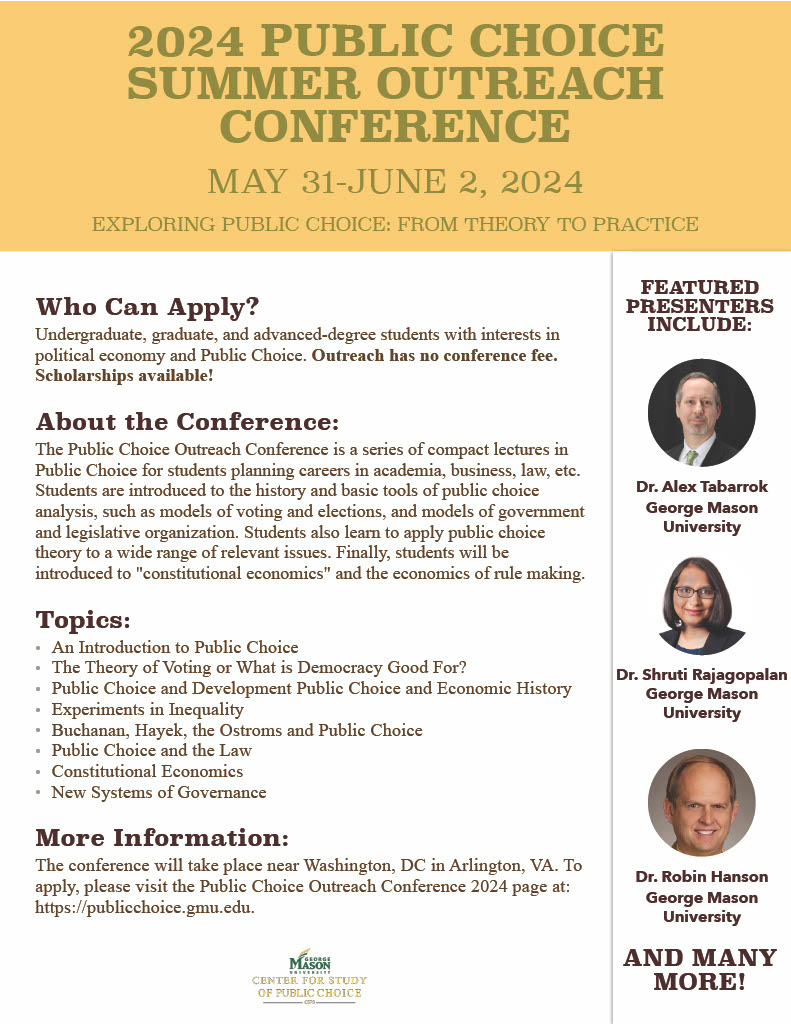
Here is a pdf of the poster, please circulate. Outreach Conference Flyer 2024 – 2