Category: Current Affairs
Public Choice Outreach 2024!
Please apply and send your students to the 2024 Public Choice Outreach Conference! The conference is a crash course in public choice. It’s entirely free. Indeed scholarships are available! More details in the poster. Please pass around. Applications are here!
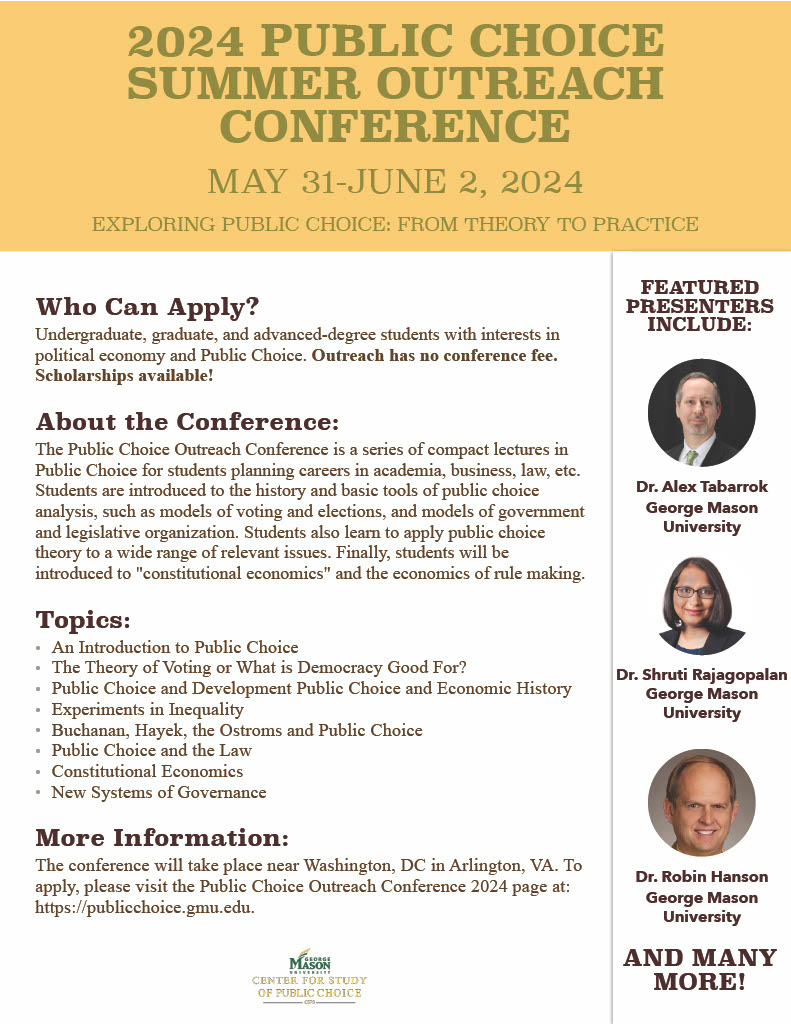
Here is a pdf of the poster, please circulate. Outreach Conference Flyer 2024 – 2
Tide turning in Washington State?
From an MR reader:
Good story here about one man in Washington state fighting the battle against the progressive tide. He single handedly got six initiatives on the ballot to repeal progressive reforms over the past few years. These include a police pursuit law that prevents police from chasing criminals in most cases, and a capital gains tax despite the Washington State constitution specifically banning income tax.
One man takes on state government and wins after passage of 3 voter initiatives (fox13seattle.com)
Big recent news is that 3 of the 6 initiatives have already passed in the State legislature, and the rest will be sent to the voters as ballot questions.
We also have a new moderate city council in Seattle that is pressing charges against protestors who disrupt city meetings, making hard drugs illegal again, and trying to re-fund the police department. Also it looks like 12 (out of hundreds) of protestors that recently shut down I-5 in the heart of the city will be prosecuted. This all would have seemed impossible under the former mayor and city council. Definitely a feeling in the air that the tide has turned to some degree.
I await further reports.
A pessimistic account of the Milei reforms
Eduardo Costantini, a billionaire property developer, supports Milei’s plans but describes his handling of Congress as an “unforced error”. “The legislative strategy he had clearly didn’t work,” he says. “He came away from this first round practically empty-handed.”
Nicolás Pino, head of agribusiness lobby La Sociedad Rural Argentina, says cutting spending without also delivering deep reforms of Argentina’s state in the legislature is “no solution”. He urges the president to “lower tensions” with Congress and try again. “He will find many people ready to help him.”
But Milei appears to think otherwise. People who deal with the government say the president is now more dependent than ever on a small inner circle of true believers and his army of social media followers, to whom he devotes more than two hours a day online. His closest advisers include his sister Karina, who used to sell specially decorated cakes on Instagram and is now the presidential chief of staff, and Santiago Caputo, a 38-year-old political consultant and social media guru whose father is a cousin of Luis Caputo, the former Wall Street trader now serving as finance minister…
Some question Milei’s economic results too. Eduardo Levy Yeyati, an economist and professor at Torcuato di Tella university in Buenos Aires, believes the much-vaunted fiscal surplus in January benefited from accounting tricks such as shuffling government payments around. “The surplus is unsustainable,” he says. “It can only be sustained if the government passes tax measures.”
I am not saying this is true, as I genuinely do not know the latest. But it is the pessimistic account, if you are looking to catch a dose of that. Here is more from Michael Stott and Ciara Nugent at the FT. You will note that the (black market) peso is up, but only modestly.
The Ability to Concentrate is Increasing?!
Distraction is everywhere. As I write this post, I pause to check twitter. Phones are omnipresent and demand our attention. Dopamine hits rule. Yet, despite the potential for greater distraction, a large study finds that on a standardized test, the ability to concentrate is up (modestly) for adults.
In the present cross-temporal meta-analysis, we investigate potential test score changes for attention as assessed by the d2 Test of attention. Based on data from 287 independent samples (N = 21,291) from 32 countries over a timespan of 31 years (1990–2021) we found evidence for moderate generational test score gains in concentration performance in adults, but not [statistically significantly, AT] children.

And while I wouldn’t put much weight on these results, since they are correlational and by country only, do note:
Internet use predicted concentration performance positively, yielding small effects for children but no meaningful effects for adults. This seems to be in contrast with findings that indicate adverse effects of digitalization in general, and video games, media multitasking, as well as overall increased screen time on attention capabilities in particular….
Of course, this is measuring attention on a test where presumably the phones have been taken away! In other words, the environment may have made deep work more difficult but we still retain the ability to concentrate in a distraction-free environment. Or, perhaps in the past, people just daydreamed more instead of checking their phones.
Is Bidenomics working?
It is too soon to say, as I express in my 2x the usual length Bloomberg column. It is amazing how many people are swallowing this one whole. Here is the simplest point:
The biggest problem is that it’s not yet clear these investments are going to pay off. They are being paid for with borrowed money, not higher taxes or lower spending elsewhere. It is always possible to boost wages and employment in the short run by funding new investments with borrowed money. The critical question is whether those investments will succeed in the long run.
And:
If they do not, today’s boom will eventually turn into a bust. Sooner or later, the federal government will have to pay for all this borrowing and spending, and that will mean some mix of (additional) tax hikes and spending cuts. That contractionary fiscal policy will hurt the economy, giving back some or all of the gains it is reaping today. The net effect of this reversal of fiscal policy could even be negative.
And is it working?
One defense of the limited global scope of Bidenomics is that the most the US can hope to do is to “take care of our own.” That may be true, but it does not alter the underlying reality. If the new investments do not bring about a significantly greener world, they will have failed. In a matter this serious, it really is about results.
Another possible outcome is more optimistic: Namely, the rest of the world will move to cheap green energy without needing support from Bidenomics. If that’s the case, however, then Bidenomics’ green-energy investments are still hard to justify. Why couldn’t the US simply borrow cheaper technologies from the rest of the world?
The most favorable scenario for Bidenomics is that US investments lead, through faster innovation and shallower learning curves, to cheaper green energy sources that otherwise would not have come about. Again, that is certainly possible. And again, it is hardly obvious that it is the most likely outcome.
We shall see. The “everything-bagel” gets discussed as well.
Kind of like the NBA All-Star game
BREAKING: Queen Camilla is taking a break from public duties for some "downtime", which means that NONE of the four most senior royals – King Charles, Queen Camilla, Prince William and Kate Middleton – are working right now.
All is not well with the Royal Family. 💁♂️ pic.twitter.com/2sgSrM0Otz
— Cillian (@CilComLFC) March 2, 2024
In the NBA All-Star game, no one is playing defense any more, and so the score was a ridiculous 211-186, something which would never happen in a regular season game. (Note that some of the league’s finer defenders were on the floor, though Joel Embiid, the reigning MVP and an intimidating defender, was sidelined due to injury.) Some part of the ethic of (defensive) service has disappeared, though the players are still happy to shoot and score. And they certainly will play defense hard when the playoffs roll around.
I’ve never seen papers on the labor supply of royal families (Cowen’s Second Law?), but I do wonder what it varies with. It is hard to use one’s royal position to influence politics, at least in the UK. And certainly you are not paid more if you work harder. The King or Queen nominally owns a lot of land and art, but in practice one cannot pull income streams from those assets. You can have a Michelangelo drawing hung in your bedroom, but that if anything is a reason not to go out in public.
You can use a royal family position to meet with lots of important people, but toward what end? Raising money for your next start-up? Alternatively, you can work harder to raise your stature and influence with the other royal family members (now we’re getting somewhere). But what if that equilibrium falls apart, if only because of one or two initial defections, or in the case of the King an illness? What external force would keep the whole struggle for royal family influence going? Is this a case of multiple competitive equilibria, and now we (they?) are stuck in the low effort corner? Can Lina Khan work on this?
What if they are all just pissed off with the lot of us? In that case, what is our next move in this von Stackelberg game? Should America reapply to the Empire with some trembling hand probability? Would it suffice to give them Newfoundland back? Take Northern Ireland off their hands? Do they want us to send more or fewer tourists to London? Should one of them marry Taylor Swift, or at least date her, to remain in the public eye?
If the NBA All-Star game is to improve, perhaps viewer censure (or mockery) for the non-cooperators is the primary way forward?
Canada fact of the day
*NEW* Canada's GDP grew by 1.1% between the 4th quarter of 2022 and 2023, while its population grew by 3.2%. That means GDP per capita is now falling at 2% annually (roughly the difference). Zero economic growth in more than 6 years. pic.twitter.com/SrGGKPZjNx
— Mikal Skuterud (@mikalskuterud) February 29, 2024
Solve for the equilibrium?
At $US15,000, BYD’s new Qin EV is already being touted as a “Corolla killer”, as the world’s second largest EV maker continues to disrupt the global auto market.
Launched earlier this week in China, the all-electric Qin Plus has five variants priced between 109,800 RMB to ($A23,300) to 139,800 RMB ($A29,700).
The Qin Plus comes with a 100 kW motor and the option of either a 48 kWh battery providing 420 km CLTC range or a 57.6 kW hour battery with 510 km range.
Mobility consultant James Carter wrote on LinkedIn the new offering is the $15,000 car that incumbent OEMs (car makers) hoped would never come.
“The new BYD Qin Plus EV Honor Edition is the car that makes EVs way cheaper than ICE vehicles and blows open the mainstream market,” he wrote.
Here is the full article. So will U.S. and EU car prices fall? Or will protectionism result? Aren’t they planning to make a bunch of these cars in northern Mexico? Will America invent some new kind of trade restriction?
What should I ask Fareed Zakaria?
Here is Fareed’s home page, here is Wikipedia:
Fareed Rafiq Zakaria…is an Indian-American journalist, political commentator, and author. He is the host of CNN‘s Fareed Zakaria GPS and writes a weekly paid column for The Washington Post. He has been a columnist for Newsweek, editor of Newsweek International, and an editor at large of Time.
He was managing editor of Foreign Affairs at age 28, briefly a wine columnist for Slate, and much more. His new book Age of Revolutions: Progress and Backlash from 1600 to the Present is very classically liberal, and in my terms “Progress Studies”-oriented.
So what should I ask him?
Claims about Iran (from the comments)
Why don’t nations buy and sell territory more?
Egypt has agreed to a $35bn deal with the United Arab Emirates to develop the town of Ras el-Hekma town on its northwestern coast, Egyptian Prime Minister Mostafa Madbouly announced on Friday after weeks of speculations.
Madbouly said at a news conference, which was attended by Egyptian and Emirati officials, that Egypt will receive an advance amount of $15bn in the coming week, and another $20bn within two months.
The deal is the largest foreign direct investment in an urban development project in the country’s modern history, the prime minister said. It is a partnership between the Egyptian government and an Emirati consortium led by ADQ, he said.
Here is the full story, Nuuk here we come…
Dwarkesh Patel with Patrick Collison
Here is my episode with @patrickc
We discuss:
– what it takes to process $1 trillion/year
– how to build multi-decade APIs, companies, and relationships
– what's next for Stripe (increasing the GDP of the internet is an open ended task, and the Collison brothers are just… pic.twitter.com/Wx52cJI9Ve— Dwarkesh Patel (@dwarkesh_sp) February 21, 2024
Israel facts of the day
GDP declined by an annualised 19.4 per cent compared with the third quarter. On a pure quarter-by-quarter basis, the economy contracted 5.2 per cent compared with the previous three months.
The sharp drop was caused in part by the call-up of 300,000 reservists, who had to leave behind their workplaces and businesses to embark on months of army service, the Central Bureau of Statistics said.
Other factors to hit the economy included the government’s sponsorship of housing for more than 120,000 Israelis evacuated from the northern and southern border areas of the country.
Following the October 7 attack, Israel also imposed tough restrictions on the movement of Palestinian workers from the West Bank into the country. The move hit the construction sector, causing labour shortages that became an additional drag on economic growth, the bureau said.
Overall, Israel still closed the year with a growing economy, with GDP up 2 per cent in 2023 from 2022. But that compared with an increase of 6.5 per cent a year earlier.
The war has triggered a steep increase in government spending, which rose 88 per cent in the three months after the outbreak of war compared with the preceding quarter. Consumers, meanwhile, were spending 27 per cent less. Imports of goods and services fell 42 per cent, the report said, while exports dropped 18 per cent.
Equatorial Guinea facts of the day
After the discovery of oil in the mid-1990s, per capita income soared and catapulted the country into the club of high income countries (it peaked at over $35,000). Meanwhile, living standards stagnated at deplorable levels — from education attainment, to infant mortality rates, to poverty rates, and more. Primary school enrollment has declined since peaking in the early 2000s. Life expectancy is 15 years lower than in countries of comparable per capita income (presently at round $7500). Poverty rates exceed 70%.
To compound matters, the country’s oil output is in decline. Current oil production (around 52k barrels per day) is a mere 13% of peak production in the mid 2000s. As a result of decades-long neglect of the non-oil sector, overall economic output is declining in tandem with declining oil production.
Here is more from Ken Opalo, the piece is instructive throughout.
Well-functioning democracy for neither me nor for thee?
I have been following only snippets of the debate over whether Biden should step down as the Democratic nominee, for instance here Josh Marshall responds to Ezra Klein (NYT). Most of all, I am struck by how little faith some of the commentators have in democratic processes. Let’s consider a few possible arguments why Biden should not step down:
1. The Democratic Party process would not produce an electable candidate against a Republican with dozens of criminal charges against him. Not even in an election that is supposed to have such enormous stakes.
2. The Democratic Party process would not produce a better candidate than a guy who, whatever the reality may be, is regarded by most of the American public as too old. Not even in an election that is supposed to have such enormous stakes.
3. An open Democratic Party convention would badly embarrass itself, if it were on the television (and internet) every evening. Remember Chicago 1968?
4. An open Democratic Party convention would be chaos, and perhaps commandeered by party extremists.
5. “Dealing” with Kamala Harris, whether that means accepting her as the nominee, or easing her out, somehow involves unacceptable consequences.
6. There are other arguments floating around too.
I am not saying these arguments are true (mostly I don’t know), I am merely reporting that I am reading and hearing them, and yes I mean from Democrats.
Most of all, I am struck by how skeptical and cynical these arguments are about democracy. It’s not even democracy in the “can we beat the Trumpers?” sense, but democratic processes internal to the Democratic Party.
Skepticism about democracy — yet never ever explicitly voiced — is a growing problem among Democratic Party thinkers (though not Ezra). On one hand, they wish to turn around and call people on the Right, or libertarians, “undemocratic,” or “anti-democratic,” or whatever. On the other hand, when it comes to actual decisions of great consequence, they are the ones terrified of the democratic processes they themselves have created. They know that, but can’t quite bring themselves to voice their doubts in those terms.
I am pleased to see that I am more positive on democracy than so many of the Democratic Party thinkers. I don’t have any particular predictions about the 2024 cycle, but I can report that I am not short the market. What I observe, however, is just how many people are shorting democratic processes and ideals. Must, sooner or later, a greater consistency between theory and practice reign? Or are professed views simply the handmaiden of political convenience, and they will, one way or another, disperse and end up blowing in the wind?
I don’t myself have a good sense of those issues, but I thought this gjk comment was interesting enough to pass along.